Metal Driveway Gates in Hitchin
Metal driveway gates made to the opening, hung on posts that can carry them, swinging or sliding to suit the ground.
A driveway gate is the heaviest single thing most people ever hang on their house, and almost every failure we are called to is the same failure: a good gate on posts that were never sized to carry it.
The first decision is not the pattern, it is swing or slide. A swing pair needs room to open and reasonably level ground. A sliding gate needs a clear run alongside the opening but almost no space in front, which is what makes it the answer on a short drive that meets the pavement.
Everything after that is measurement. The opening is surveyed, the fall across it is checked, and the leaves are made to those figures rather than trimmed from a stock pair on the morning of the fit.
What is different about Hitchin
Across North Hertfordshire District Council we fit matching gate and railing sets more often than gates alone, because on SG4 frontages a gate that does not relate to the boundary either side always looks like an afterthought.
Hitchin's conservation areas mean the planning team checks anything visible from the street, and that is a post problem before it is a gate problem. Gate posts here are sized to the finished leaf weight and concreted deep, because a leaf that heavy will find any weakness in a foundation within a season.
Most Hitchin drives we gate are shorter than the owner thinks, which is why the swing or slide question gets settled with a tape measure on the visit. Market-town centre with Tudor and Georgian buildings, Victorian terraces on the Walsworth side, and 1930s semis to the west typically leave a car length between the pavement and the house, and a swinging pair needs that space to be genuinely clear.
How it is specified
- Configurations
- Single leaf, double swing pair, or sliding on a track or cantilever
- Typical width
- Two and a half to five metres for a domestic drive, wider as a sliding leaf
- Posts
- Steel posts sized to the leaf weight and concreted deep, not bolted to a slab edge
- Ironmongery
- Galvanised heavy duty hinges, adjustable where the ground is uneven, drop bolts on a pair
- Automation
- We build gates prepared for automation and work alongside your automation installer. We do not carry out the electrical installation ourselves.
Ironmongery is where cheap gates give themselves away. Hinges, drop bolts and keeps are galvanised throughout, because a rusted hinge pin on a heavy leaf is not a cosmetic problem.
How we build it
1. Survey the opening
Width, the fall across the opening, the pavement line and where a car actually stops are all measured, because those four figures decide the configuration.
2. Posts first
Posts are sized to the finished leaf weight and concreted, and where automation is planned we set the ducting at this stage rather than digging the drive up twice.
3. Hang and adjust
Leaves hung, drop bolts and stops set, and the swing checked through its full arc with the gate loaded, not empty.
Where this is the right answer
- Drives where the frontage needs closing off and the ground is level enough to swing a pair
- Short drives that meet the pavement, where a sliding leaf avoids swinging over a public footway
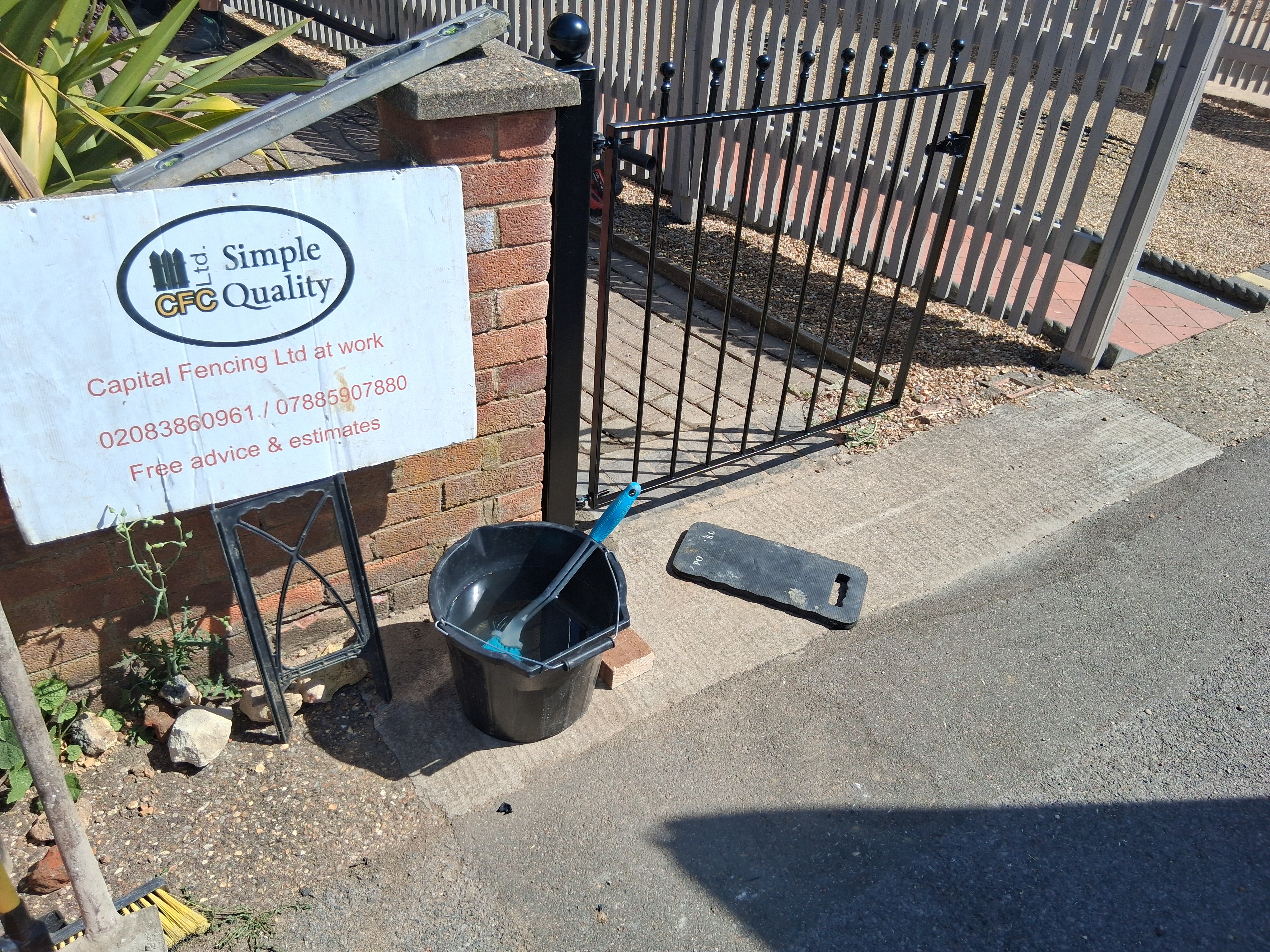
- Frontages already carrying railings, where a matching gate makes the line continuous
- Replacing a timber pair that has dropped and dragged for years
If the drive slopes up sharply from the pavement, a swinging pair will ground before it is halfway open and no hinge fixes that. Either the ground gets levelled, the gate opens outward with the visibility implications that carries, or it slides. We will tell you which on the visit rather than after installation.
Common questions
- Do I need permission for driveway gates?
- Gates next to a highway have height limits under permitted development, and a listed building or conservation area changes the picture. We flag it at quote stage so you can check with the council before anything is fabricated.
- Can you automate the gates?
- We build gates prepared for automation, including the post sizing and ducting, and we work alongside your automation installer. We do not carry out the electrical installation ourselves and we would rather say that than pretend otherwise.
- How wide should a driveway gate be?
- Two and a half metres is tight for a modern car, three metres is comfortable, and anything over four is usually a pair or a slider. We measure the actual opening and the approach angle, because a straight on entry and a tight turn in need different widths.
- Why did my old gates start dragging?
- Nearly always the posts rather than the gates. A timber post moves in the ground and a leaf that is a hundred kilos amplifies a few millimetres of lean into a gate that catches. That is why we size and concrete steel posts to the leaf.
- Can new metal gates match my existing railings?
- Yes. Where there is an existing railing run we match the bar centres, the head detail and the powder coat colour so the gate reads as part of the boundary rather than as a later addition.
- What do most Hitchin customers ask you for on this?
- Market-town centre with Tudor and Georgian buildings, Victorian terraces on the Walsworth side, and 1930s semis to the west shape most of it, so the common brief here is a run measured to an existing boundary rather than an off the shelf size. Hitchin's conservation areas mean the planning team checks anything visible from the street, and that shows up in the post work more than in the steel above it.
Driveway gates measured on site in Hitchin
We measure the opening, the fall and the approach, then quote the leaves, the posts and the ironmongery separately. Free site visit, written quote, and cards accepted once the price is agreed.
Related metal work: Railings and estate fencing, Vertical bar fencing, Galvanising and powder coating. Main hub: metal fencing and gates.
Nearby: Driveway gates in Letchworth Garden City, Driveway gates in Stevenage.
Get My Free Quote — 24h Response
No callout fee · Free site visit · Friendly local team covering London & Hertfordshire.
Pay by debit or credit card, bank transfer or cash once the work and price are agreed. No deposit taken online.