
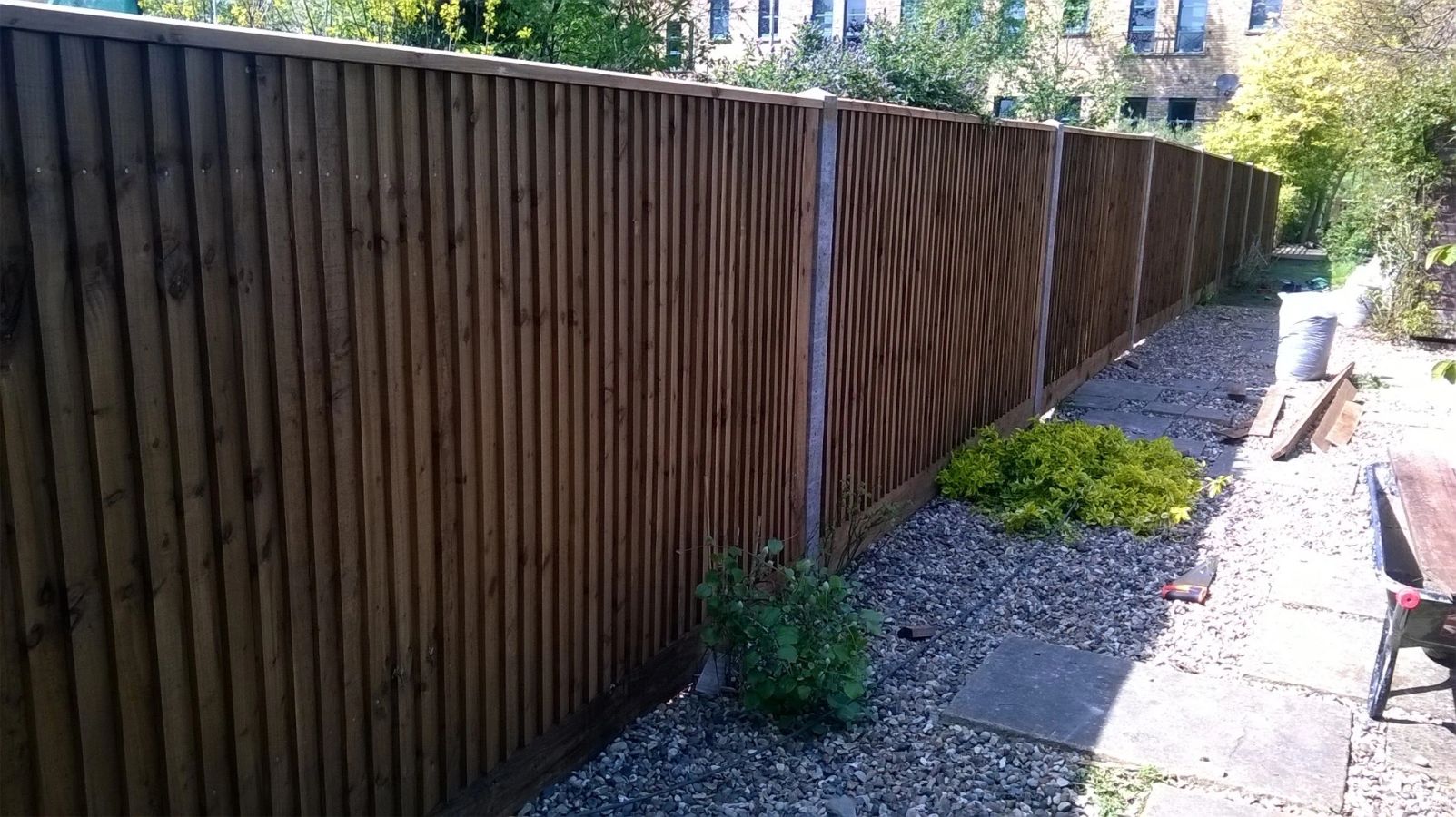
Most people start with the look of a fence. The better starting point is what the fence has to do: give privacy from a neighbour's window, stand up to wind on an exposed plot, keep a dog in, or simply mark the boundary. Once that is clear, the style and the post system follow.
This page is a guide to choosing garden fencing. Our fencing page covers the installation service itself, and our town pages cover the areas we work in.
Privacy
For full privacy, closeboard is the strongest option: vertical feather-edge boards overlapping on rails, built in place between posts. Lap panels also give good screening at a lower cost. Most rear garden fences go up to around 1.8m, and trellis can be added on top where rules and neighbours allow.
Wind
Solid fences catch the wind like a sail. On an exposed plot, closeboard on concrete posts copes better than lap panels, and slatted or hit and miss fencing lets some wind through while still screening most views. Post spacing and depth matter more than board thickness.
Pets and children
Dogs dig and push. Gravel boards along the bottom close the gap under the fence, and concrete posts will not be chewed or loosened. For small children, avoid horizontal rails on the garden side that can be climbed.
Look and style
- Closeboard: traditional, solid and strong
- Lap panel: good value, easy to replace a panel
- Slatted and hit and miss: modern, lets light through
- Picket: low and decorative, mainly front gardens
- Decorative panels: trellis-top and arched styles
- Bespoke: horizontal slats and feature screens made up to your design
Posts and gravel boards
The part you do not see decides how long a fence lasts. We normally set garden fencing on concrete posts, concreted into the ground, with concrete gravel boards so the timber sits off wet soil. Timber posts are available where you prefer them. The timber we fit is pressure treated.
Upkeep
Pressure treated timber needs little more than a stain or treatment every few years if you want to keep the colour. Composite boards need only a wash. Clearing soil and plants away from the bottom of the fence does more for its life than any treatment.
How a job runs
We visit, measure and talk through the options, then send a written quote. On the day our own team removes and takes away the old fence, sets the posts and fits the new run. Payment by card, bank transfer or cash.