Drainage fixes as part of a repair
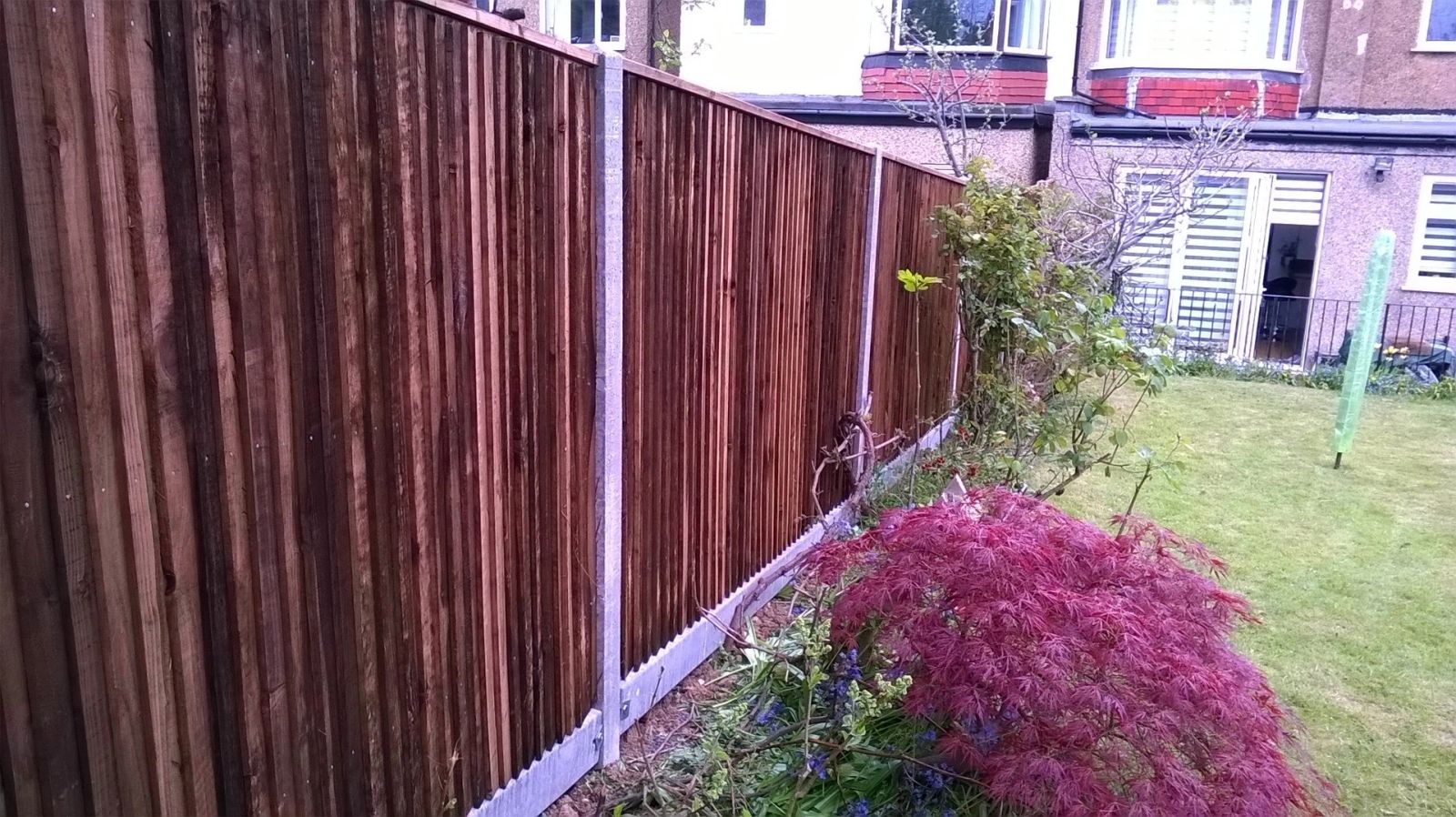
Where poor drainage caused or contributed to the original failure, a repair that doesn't also address the drainage — regrading a low spot, adding a small soakaway, or fitting a concrete gravel board — risks the same failure recurring.
Addressing drainage at repair time is usually more cost-effective than repeating the same panel or post repair every few years.
Straightening a leaning run
A run that's leaning uniformly along several bays usually points to a common cause — waterlogged ground, wind loading from one direction, or an original footing depth that was too shallow — rather than a fault with any single post.
Straightening involves resetting posts along the affected bays rather than pulling the fence back into line at the top, since forcing the panels straight without addressing the post bases just reintroduces the lean.
UV stabilisers in composite and PVC fencing
UV stabiliser additives are blended into composite and PVC fencing products during manufacture to slow the surface degradation and colour fade that ultraviolet exposure otherwise causes in polymer materials over time.
Products with a lower proportion of UV stabiliser, often reflected in a lower price point, tend to show chalking, a dusty faded surface, and colour loss earlier than better-stabilised equivalents exposed to the same sunlight.
South and west-facing runs receive substantially more cumulative UV exposure than shaded or north-facing runs, so the same product can visibly fade at different rates depending purely on orientation and surrounding shade.
Dealing with buried debris uncovered while digging out a repair footing
Old post stubs, broken glass, hardcore or builder's rubble from a previous era of the garden's use sometimes turn up when digging out a footing for repair, particularly on older plots that have been through several changes of use.
Where this happens, it's worth clearing enough of the obstruction to get a clean footing rather than working around it, and flagging anything unexpected — old drainage, buried cabling, unusually large rubble — to the client before continuing.
Timing the work seasonally
Fencing and decking can be installed year-round, but ground conditions change the practicalities: concrete cures more slowly in cold weather and shouldn't be poured in a hard frost, while waterlogged winter ground makes post holes collapse before they can be set.
Late spring and summer give the most predictable digging conditions and the fastest concrete cure times, which is also when demand is highest and lead times stretch out.
Autumn and early winter bookings, ground conditions allowing, are often the quickest to schedule and let a new timber fence weather in before the following summer.
Removing an old panel without damaging sound posts
Panels are usually fixed to posts with clips, brackets or nails through the frame, and levering a panel out with a bar without first locating and releasing those fixings risks splitting a post that would otherwise have been reusable.
Cutting through corroded nails with a reciprocating saw, rather than forcing the panel free, is often quicker and safer for the post than sustained levering.
Where only one panel in a run has failed, working carefully to free just that panel's fixings keeps the neighbouring panels and their posts undisturbed rather than loosening more of the run than necessary.
Boundary near a railway or utility corridor
A boundary next to a railway or utility corridor may be governed by the operator's own standards as well as normal planning rules, and access for their maintenance staff sometimes has to be preserved even where the land is privately owned.
Any work close to a railway boundary generally needs the operator notified in advance, and specific fence types or heights may be mandated rather than left to the landowner's choice.
Self-storage and depot perimeters
Self-storage sites and vehicle depots typically run a continuous high-security perimeter with limited access points, and any repair work has to maintain that perimeter's integrity throughout rather than leaving a gap open overnight.
Because these sites often operate extended or 24-hour access for customers or drivers, fencing work needs scheduling around live access hours, with any section requiring full closure agreed and communicated in advance.
Lighting and CCTV mounted on perimeter fencing at these sites adds a coordination step most domestic jobs don't have — services need identifying and protecting before any post is removed or reset.
Freeholder consent for a leasehold garden
Leasehold houses and flats with a garden are usually still subject to the terms of the lease, which can require the freeholder's written consent before altering boundary structures.
This applies even where the leaseholder has full day-to-day use of the garden and has paid for previous fencing work themselves.
Checking the lease, or asking the managing agent, before committing to boundary work avoids a costly rebuild if consent turns out to be required and wasn't obtained first.
Kiln-dried versus green timber movement
Green (wet, unseasoned) timber is cheaper and easier to nail without splitting, but it shrinks noticeably as it dries in situ, which opens gaps between overlapping boards and can loosen fixings within the first year.
Kiln-dried timber has already lost most of that moisture before it reaches site, so it holds its dimensions far better once fixed, at a higher material cost.
Closeboard fencing traditionally tolerates green feather-edge boards reasonably well because the overlap absorbs some shrinkage, but a tight tongue-and-groove or slatted panel is far less forgiving and benefits from kiln-dried stock.
Sheltered courtyard microclimates and reduced wear
A small enclosed courtyard garden surrounded by walls or buildings on most sides creates a sheltered microclimate with reduced wind and often reduced direct rain exposure, which can extend the practical life of a timber finish well beyond the general guideline interval.
The trade-off is often reduced airflow and higher humidity in the enclosed space, which can favour algae or mould growth even though the timber itself isn't taking direct weather.
Recommending a maintenance interval based on general exposure alone can be too cautious for a sheltered courtyard or too relaxed for a damp, poorly-ventilated one, so it's worth judging each enclosed garden on its own conditions.
Schedules of condition before nearby works
A schedule of condition is a dated record, often with photographs, of a boundary structure's state before nearby building work begins, used to settle any later dispute about damage caused during that work.
Where a neighbour is undertaking significant building work close to a shared boundary, requesting this kind of record beforehand is reasonable and protects both parties.
This is distinct from a full party wall agreement but is often produced as part of the wider party wall process where one applies.
The typical sequence for installing a fence run
A well-run fencing job generally sets out the full line first, digs and concretes every post before fixing anything else, and only starts hanging panels, rails or boards once every post has had time to cure.
Fixing panels to posts before the concrete has cured risks knocking a post out of true, which is why rushing straight from digging into panel-fitting on the same visit is usually avoided on anything beyond a very small repair.
Working this way also means any post that turns out to be misaligned is caught and corrected before panels are cut to fit it, rather than after, when correcting the post means undoing finished work.
How post hole diameter relates to load capacity
A wider post hole gives the concrete footing more surface area to resist overturning, which matters most on a taller or more exposed security run where wind and impact loading are higher than on a standard garden fence.
Increasing hole depth without also increasing diameter has a smaller effect on lateral resistance than is often assumed, since it's the concrete's bearing area against the surrounding soil that resists the post trying to rotate, not depth alone.
Using a rule of thumb for how much sound timber a repair joint needs
A splice, bracket or sistered repair generally needs a reasonable depth of genuinely sound timber on each side of the joint to hold its fixings securely, and a post probed as sound for only an inch or two below the surface usually doesn't have enough left to repair into reliably.
Where a probe test shows sound timber tapering off quickly rather than continuing solidly below the damaged section, that's usually the point where replacement becomes more sensible than trying to repair into marginal material.
Hot-dip galvanising thickness
Hot-dip galvanising coats steel in a layer of zinc by immersing it in a molten zinc bath, and the resulting coating thickness is largely governed by the steel's own thickness, since thicker sections react with the zinc for longer and build a heavier layer.
British Standard BS EN ISO 1461 sets minimum coating thickness by section thickness rather than a single blanket figure, which is why a heavy structural post gains a thicker, longer-lasting coating than thin wire mesh galvanised in the same process.
The coating protects sacrificially as well as by barrier, meaning even where it's scratched the surrounding zinc corrodes preferentially and continues to protect the exposed steel underneath, at least until that local zinc reserve is used up.
Concrete, timber and steel posts compared
Concrete posts don't rot, warp or need re-treating, which makes them the default for a long-life boundary, but they're heavier to handle, harder to cut on site, and can crack if struck hard rather than bending.
Timber posts are lighter, easier to notch and fix ironmongery to, and match a fully timber run visually, but they're the first component to fail through rot even when the boards above them are sound.
Steel posts (box section or RSJ) suit gates, very exposed runs or where a slim sightline matters, and they're galvanised or powder-coated rather than treated, but they need a compatible fixing method for timber infill panels rather than simple nailing.
Guide wheel and channel wear on sliding gates
A sliding gate runs along a bottom track or overhead guide rather than swinging on hinges, and wear in these components shows up as the gate binding, jumping the track, or leaning as it travels rather than dropping at a hinge corner.
Debris in the track is one of the most common causes of a sliding gate sticking, and clearing it is worth checking before assuming a wheel or motor fault.
Timber choice for permanently shaded gardens
A garden shaded for most of the day by tall buildings, mature trees or a north-facing aspect keeps timber damp for longer after rain, favouring naturally durable species or a higher treatment class over a standard specification that would be adequate in a sunnier plot.
Composite decking or fencing boards perform more predictably in permanent shade than timber, since they don't rely on drying out between wet spells to avoid fungal decay.
Where timber is preferred for appearance in a shaded garden, more frequent inspection and re-treatment intervals should be built into the maintenance plan from the outset rather than applied reactively once problems appear.
Tree root damage to a shared boundary structure
Where a neighbour's tree roots have visibly damaged a shared boundary wall or fence footing, resolving responsibility for repair can depend on tree ownership, the nature of any easement, and whether prior warning was given about root damage.
This is a fact-specific question rather than one with a single automatic answer, and can occasionally end up needing legal advice where the cost of repair is significant.
Documenting the damage with photographs and dates as it develops is useful evidence regardless of which direction a later conversation about responsibility takes.
Evidence photos for a repair or claim
Dated photographs of the damage taken before any clearance or repair work starts give a clearer record of the original condition than photos taken partway through the job.
Wide shots showing the whole run alongside close-ups of the specific failure point are generally more useful as a record than close-ups alone.
Raised beds built directly against a fence
A raised planting bed built with its back edge against a fence line keeps damp soil and mulch in permanent contact with the lowest boards or gravel board, which accelerates rot at exactly the point most vulnerable to moisture.
Lining the inside face of the bed against the fence with a damp-proof membrane, rather than backfilling soil directly onto the timber, reduces this contact without changing the visible design.
This detail is easy to miss at the planning stage since the bed and the fence are often specified and built by different trades without either flagging the interaction.