Practical points for boundary work in Hertford Heath
Digging in summer-baked clay ground
Clay that's dried and cracked over a hot summer can be almost as hard as digging through soft rock in the top few hundred millimetres, even though the same ground would be workable a season later once it's rehydrated.
An auger struggles on baked clay in the same way it struggles on rubble, tending to bounce and judder rather than cut cleanly, so a pilot hole broken up with a bar first can make the auger's job easier.
Watering the dig point lightly the day before, where practical, softens the very top layer enough to ease the first stage of digging without turning the hole into a mud pit.
Balustrade requirements on raised decking
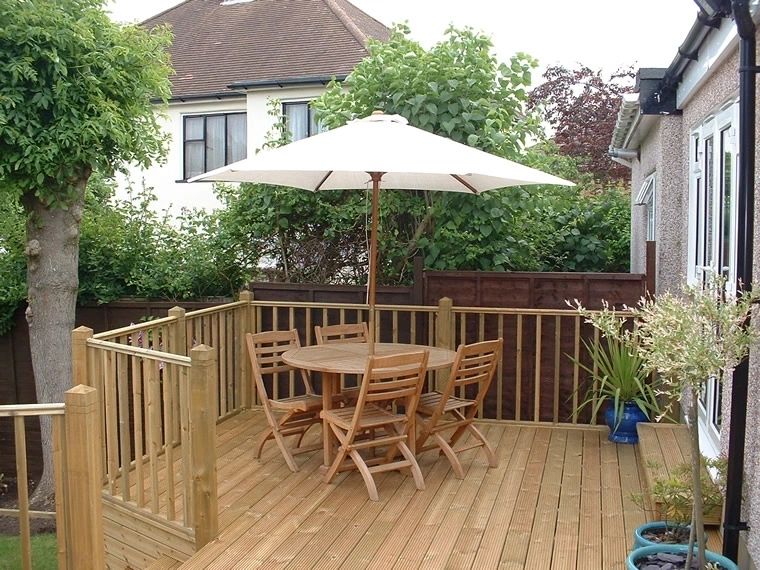
Building regulations generally expect a guarding balustrade wherever a raised deck has a drop of around 600mm or more, with a minimum height (typically around 900mm-1100mm depending on the situation) and gaps small enough that a 100mm sphere can't pass through.
That gap rule is specifically there to stop a small child getting a head or limb through the balustrade, so wide-slat contemporary balustrade designs need checking against it just as carefully as traditional close-spaced spindles.
A deck under that drop threshold doesn't need a balustrade by regulation, but a low kerb or edge trim is still worth considering as a visual cue to the edge, particularly at night.
Temporary hoarding during other building work
Where fencing or gate work runs alongside a wider building project — an extension, a loft conversion with scaffolding, or a full renovation — a temporary hoarding or site fence often needs to go up before the permanent boundary work can start.
Temporary fencing adjoining a public footpath or road has its own public safety considerations, including visibility for pedestrians and vehicles passing the site.
Sequencing matters here — installing the final boundary fence before other trades have finished moving materials through that access point often means damage that has to be repaired before the job can be signed off.
Decking substructures on clay
Timber decking built directly on shallow clay can move as the ground shrinks and swells seasonally, which shows up as a joist that's level in summer and slightly proud or dipped in winter.
Deeper post supports, or a raised deck design that isn't reliant on ground-bearing pads sitting in the active clay zone, avoid most of that seasonal movement.
Ventilation underneath the deck matters just as much as the foundation — a low, boxed-in deck with poor airflow traps moisture against the joists regardless of how well the posts are set.
End-of-terrace properties and long return boundaries
An end-of-terrace plot typically carries a much longer exposed side boundary than its mid-terrace neighbours, often running the full depth of the garden along a side street or footpath rather than backing onto another private garden.
That length changes the practical spec: more posts see wind and impact loading from the public side, and a long uninterrupted run benefits from a support post or two extra to control any bow developing over time.
Because the boundary faces a public route, it's also the fence most likely to need a more robust anti-climb consideration than an equivalent internal party fence.
HMOs and student lets
Houses in multiple occupation see heavier day-to-day wear on boundary fencing than a single-family home — more bikes, more bins, more casual leaning and climbing — and a spec that assumes normal domestic use often underperforms within a couple of years.
Licensing conditions for larger HMOs sometimes specify secure cycle storage or bin enclosures behind a lockable gate, which needs building into the boundary design rather than treated as an afterthought.
Because tenancies turn over regularly, it also helps to agree access arrangements with the managing agent rather than relying on whichever tenant happens to be in at the time of the survey.