London & Hertfordshire Free Site Visit
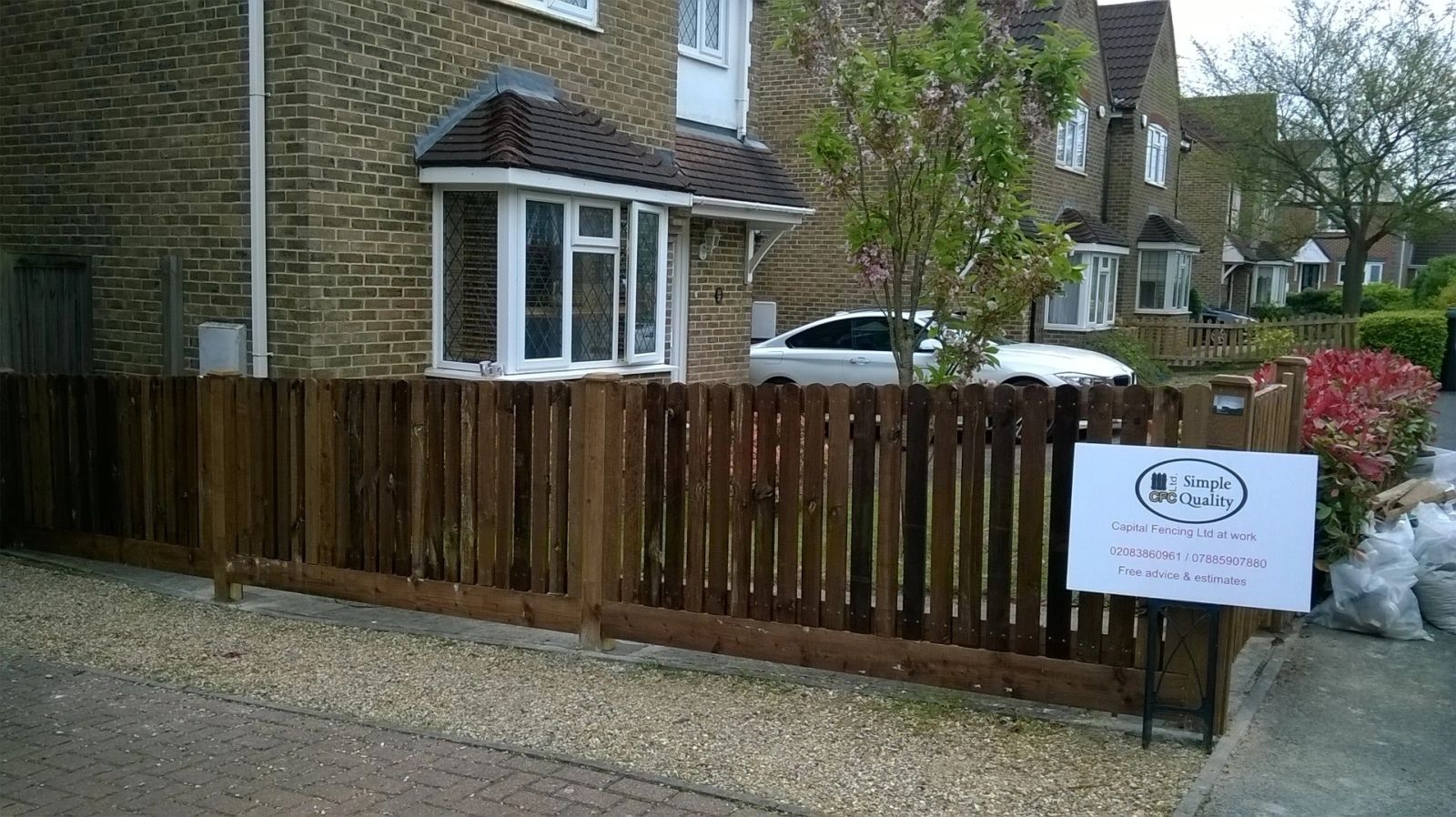
closeboard fence run installed by Capital Fencing in Hertford (SG13)
Hertford · SG13 / SG14

School fencing across Hertford — East Hertfordshire District

We approach school and nursery fencing in Hertford from the failure end backwards. Specifying decorative railings with climbable finials near a play area — trips a safeguarding audit every time — that's the single most common thing we're called back to fix, and it's the first thing our spec addresses. Roads such as Hagsdell Road and Port Vale are typical of the local layout. Hertford East station goods yard is a useful local reference point. Hertford's old town sits in a bowl where the River Lea and River Beane meet, on ground that lies close to the water table on the streets nearest Mead Lane.

We approach school and nursery fencing in Hertford from the failure end backwards. Specifying decorative railings with climbable finials near a play area — trips a safeguarding audit every time — that's the single most common thing we're called back to fix, and it's the first thing our spec addresses. Roads such as Hagsdell Road and Port Vale are typical of the local layout. Hertford East station goods yard is a useful local reference point. Hertford's old town sits in a bowl where the River Lea and River Beane meet, on ground that lies close to the water table on the streets nearest Mead Lane.

What goes wrong

Common failure modes on school and nursery fencing

  • specifying decorative railings with climbable finials near a play area — trips a safeguarding audit every time
  • under-sized gate posts on double vehicle gates — they drop within a year on daily use
Default spec

How we build school and nursery fencing in Hertford

1.2m or 1.8m bow-top or 358 weld-mesh, hot-dip galvanised then RAL powder-coated posts, self-closing gates with anti-finger-trap hinges. On Hertford jobs we adjust for conservation areas and listed buildings around the castle restrict heights and finishes.

Property mix locally: Georgian and Victorian townhouses in the centre, with newer estates on the Bengeo and Sele Farm sides. Typical gardens: long, sloping plots dropping toward the River Lea — terracing and retaining work are often part of the job. Postcodes we regularly service: SG13, SG14.

we install to BS 1722-14 for bow-top and BS 1722-10 for weld-mesh, provide safeguarding-relevant sign-off notes, and can attend outside term time only.

Why this spec, for primary schools, nurseries and early-years settings

  • no horizontal rails at climbable heights — safeguarding-first geometry
  • hot-dip galvanised then powder-coated finishes carry a 25-year service life
  • welded rather than bolted joints so nothing works loose over a school year

Typical school and nursery fencing briefs in Hertford

  • bow-top mesh replacing tired timber around a nursery outdoor area
  • matched pedestrian and vehicle gates with mag-lock and DDA-compliant pedestrian access

School & Nursery Fencing FAQs — Hertford

Do you supply RAMS and public-liability certificate ahead of works?

On school and nursery fencing jobs in Hertford (SG13), our default answer is: 1.2m or 1.8m bow-top or 358 weld-mesh, hot-dip galvanised then RAL powder-coated posts, self-closing gates with anti-finger-trap hinges. For context: hot-dip galvanised then powder-coated finishes carry a 25-year service life. Installed to BS 1722 standards, with fitter details available on request.

How do you avoid finger-trap points on self-closing gates?

Across Hertford we spec around conservation areas and listed buildings around the castle restrict heights and finishes, so on school and nursery fencing that usually means bow-top 1.2m for EYFS boundaries. We install to BS 1722-14 for bow-top and BS 1722-10 for weld-mesh, provide safeguarding-relevant sign-off notes, and can attend outside term time only.

Are your fitters DBS-checked?

East Hertfordshire District coverage means we can survey most SG13 addresses inside a week — primary schools, nurseries and early-years settings needing safeguarding-compliant boundaries. We install to BS 1722-14 for bow-top and BS 1722-10 for weld-mesh, provide safeguarding-relevant sign-off notes, and can attend outside term time only.

What height should nursery outdoor fencing be?

Practically: bow-top mesh replacing tired timber around a nursery outdoor area. That's the Hertford version of this job, not a generic one. We install to BS 1722-14 for bow-top and BS 1722-10 for weld-mesh, provide safeguarding-relevant sign-off notes, and can attend outside term time only.

Can the job be scheduled inside a half-term break?

On school and nursery fencing jobs in Hertford (SG13), our default answer is: 1.2m or 1.8m bow-top or 358 weld-mesh, hot-dip galvanised then RAL powder-coated posts, self-closing gates with anti-finger-trap hinges. The honest trade-off is specifying decorative railings with climbable finials near a play area — trips a safeguarding audit every time — which is exactly what our default spec designs out.

Recent school & nursery fencing work
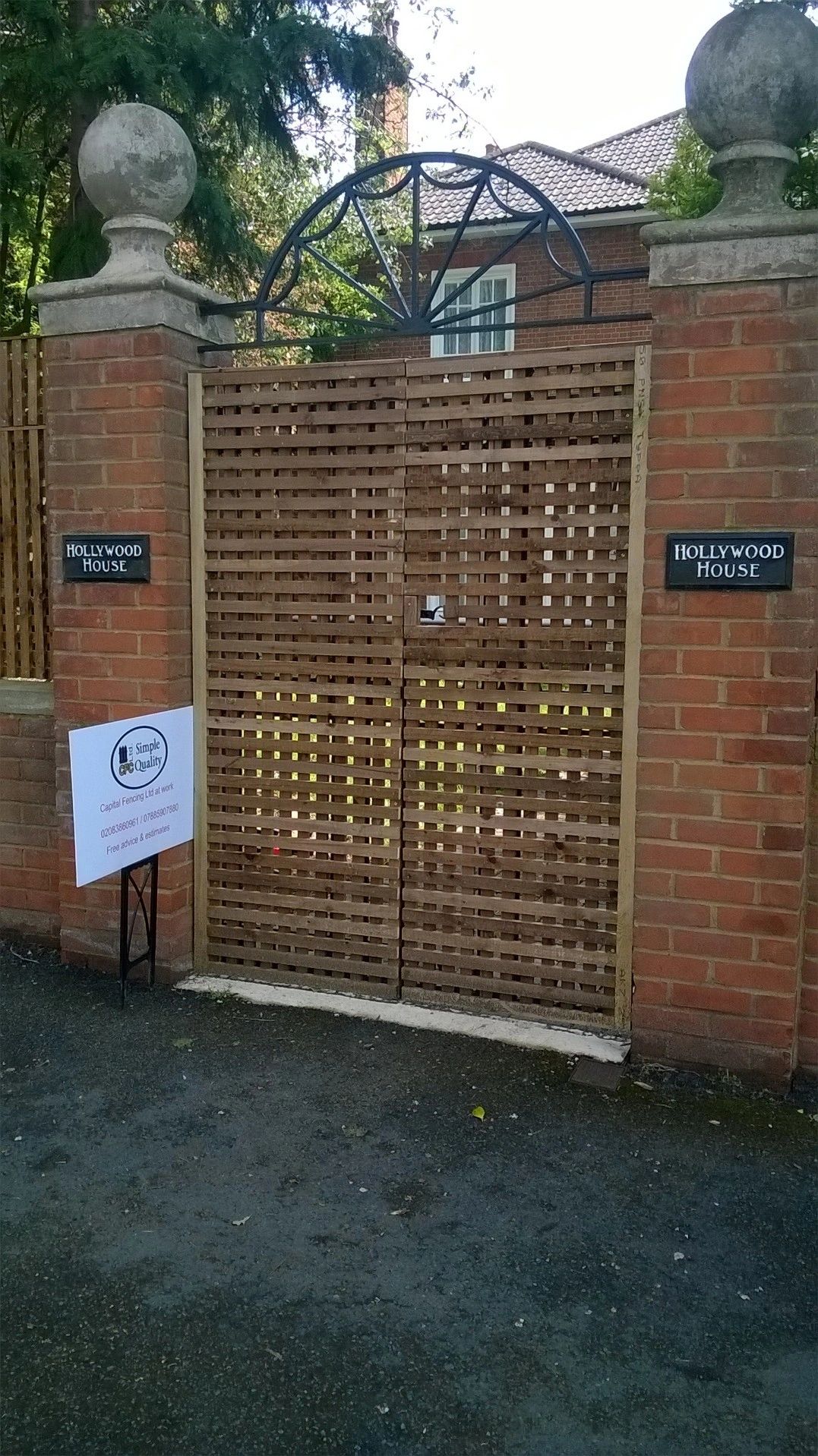
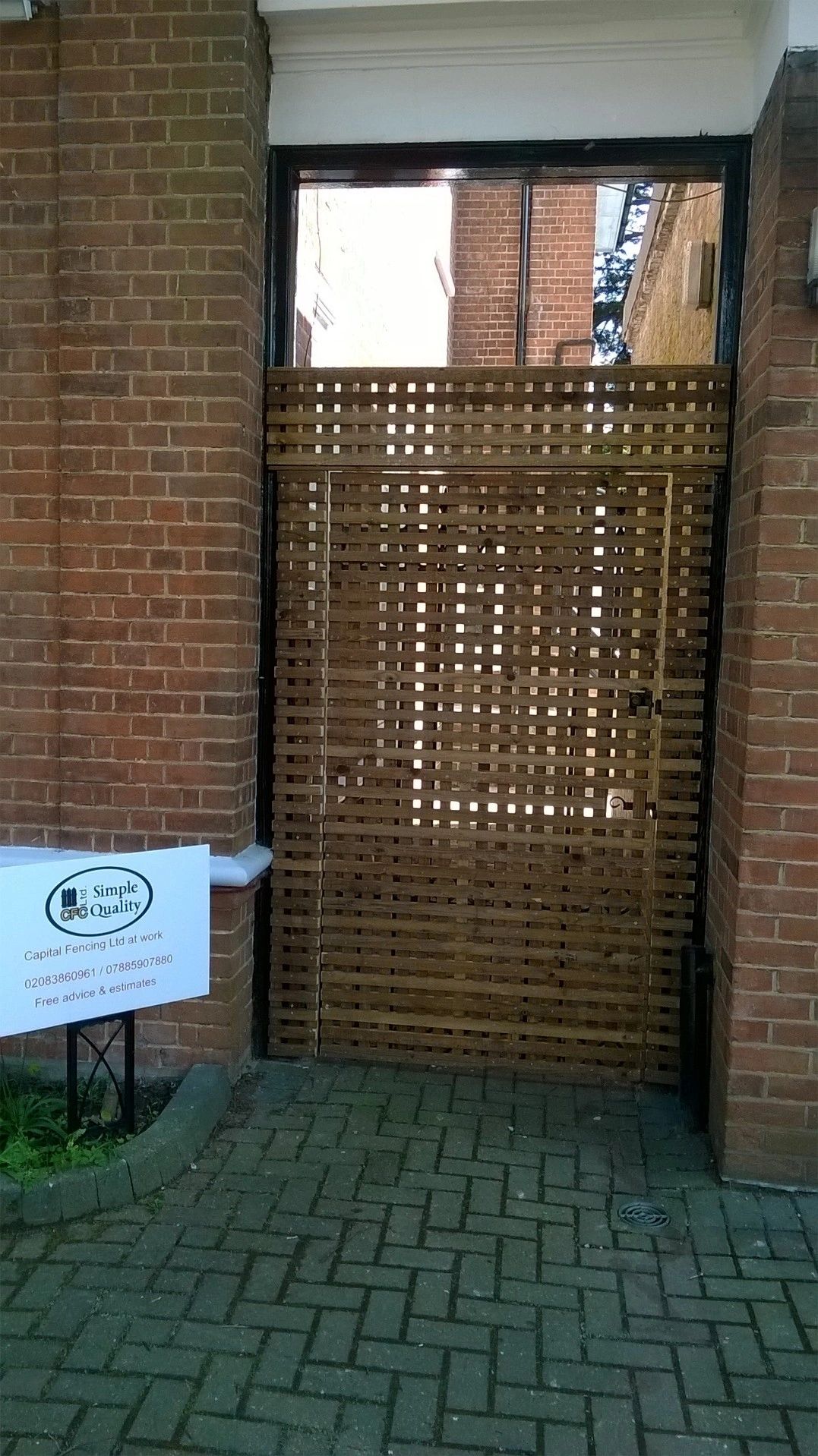
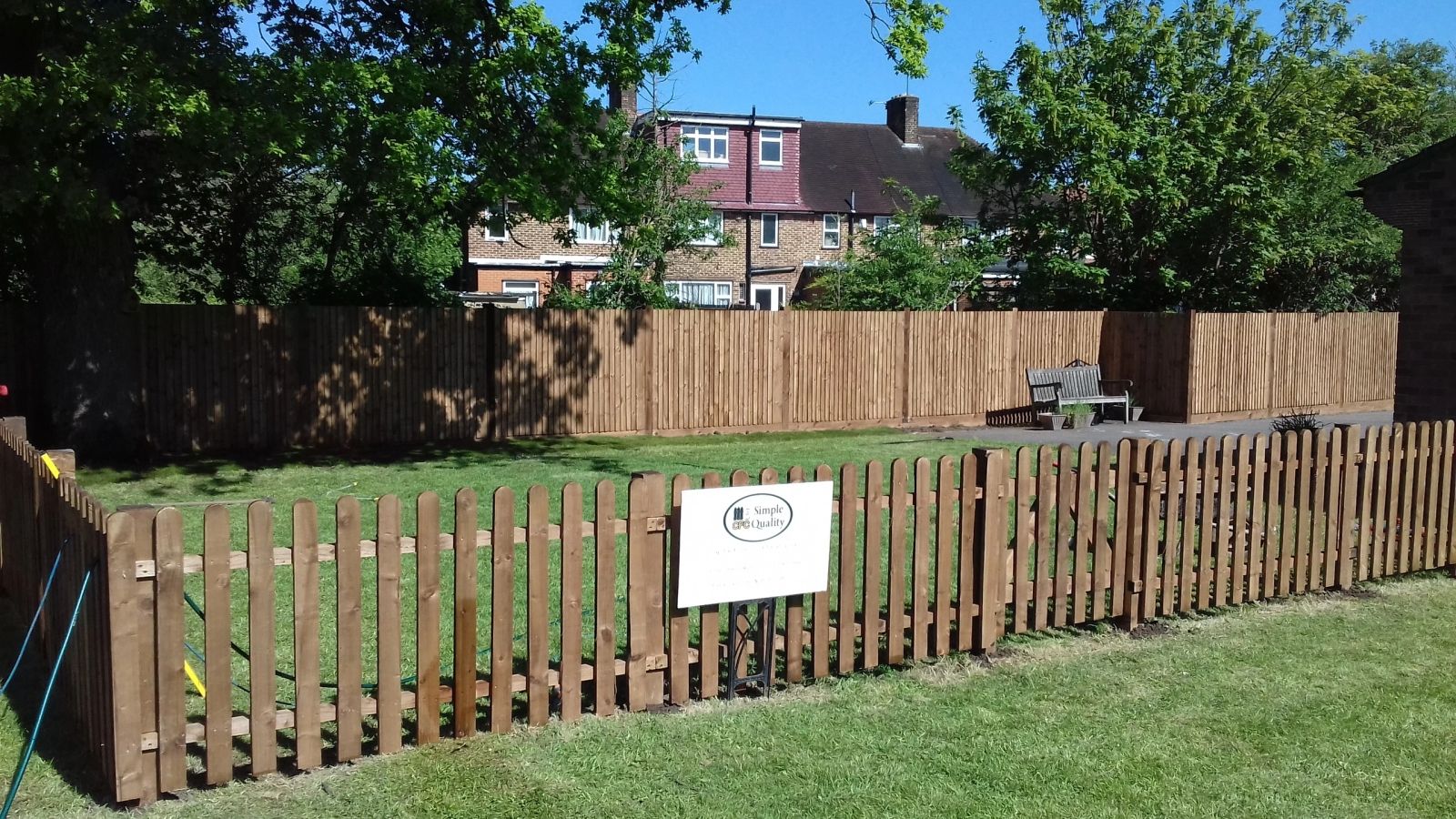
closeboard fence run installed by Capital Fencing in Hertford (SG13)panel fence install installed by Capital Fencing in Hertford (SG13)trellis-topped fence installed by Capital Fencing in Hertford (SG13)bespoke decorative fence installed by Capital Fencing in Hertford (SG13)

School & Nursery Fencing in Hertford: the practical detail

Fencing a retail service yard

A retail service yard behind a shop or unit typically holds delivery access, waste storage and sometimes gas or refrigeration plant, so its fencing needs to allow regular vehicle and trolley movement while still closing off the yard from the public shopping area.

A sliding gate is often preferred here over a swing gate because it doesn't intrude into a tight yard footprint shared with delivery vehicles manoeuvring at close quarters.

Defensive planting alongside a security fence

Dense, thorny planting such as hawthorn or berberis along the inside or outside of a lower fence adds a deterrent layer without extra height, and is sometimes used where planning limits the fence itself.

Planting needs a maintained gap from the fence line so roots don't undermine posts and growth doesn't hide someone approaching the boundary — the deterrent only works if it's kept low enough to see over and dense enough not to push through.

Tangential shrinkage and cupping

Wood shrinks more in the direction that runs tangentially to the growth rings than along the grain's length, and boards cut close to the outer edge of a log (flat-sawn) show this most, curling into a dish shape known as cupping as they dry.

A board with growth rings running roughly parallel to its face is far more prone to cupping than one cut through the centre of the log, where rings run closer to perpendicular to the face.

Fixing boards with two nails or screws per bearer rather than one resists cupping better, since a single central fixing lets the edges lift and curl relatively freely.

Certificates of lawfulness for existing boundary structures

A Certificate of Lawfulness of Existing Use or Development can formally confirm that an existing boundary structure was lawfully built, which is useful where there's uncertainty or a dispute about historic permissions.

This is different from planning permission itself — it's a factual confirmation of lawful status, often sought before a property sale to resolve a conveyancing query.

Where a long-standing boundary fence's planning history is unclear, applying for this kind of certificate can settle the question more reliably than relying on assumption.

Diagnosing which of the three usual causes applies

Almost every failing gate comes down to the hinge side, the frame or the ironmongery, and diagnosing which one it actually is before quoting avoids paying for a new gate that wasn't needed.

We check hinge fixings, frame square and latch alignment separately on site rather than assuming from how the gate looks.

Moss and damp on shaded boundaries

A boundary shaded for most of the day by a building, high hedge or overhanging trees dries far more slowly after rain than an open, sunlit run, and that prolonged dampness is what allows moss and algae to establish on timber.

Beyond the cosmetic green staining, sustained damp accelerates fungal decay in untreated or lightly treated softwood, shortening its service life compared with an identical fence in a sunnier position.

Species and treatment choice matter more on these boundaries — a naturally durable timber or a heavier preservative treatment earns its cost back in reduced maintenance on a permanently shaded run.

Repairing a fence where only hand tools will fit

A narrow side passage or a fence set hard against a building can rule out power tools with any real footprint, meaning a repair has to be done with hand saws, hand augers and manual mixing rather than the equipment that would normally speed the job up.

This mainly affects timing rather than the quality of the repair itself, since the same joints and fixings can be achieved by hand, just more slowly than with powered equipment.

UV silvering rates by aspect and species

Untreated or lightly-treated softwood exposed to full sun typically silvers to a grey patina within twelve to eighteen months, while the same timber on a shaded north face can take several years to reach the same appearance.

Hardwoods like oak silver more evenly and hold their structural integrity through the process better than softwood, which is one reason clients choosing a natural weathered look often move toward hardwood despite the higher upfront cost.

Because silvering rate varies so much by aspect, a run that turns a corner from full sun to full shade can look like two different ages of fence within its first two years even though it was installed on the same day.

Power supply and cabling for automated gates

An automated gate needs a reliable power supply run to the gate location, which on many plots means a new armoured cable run from the property rather than relying on an existing outdoor socket not rated for permanent outdoor use.

Solar-powered gate automation is an option on plots without easy mains access, though it needs a battery sized for the gate's actual cycle frequency rather than a generic system that undersizes for a busy driveway.

Any outdoor electrical work for gate automation should be certified by a qualified electrician under Part P of the Building Regulations, since it isn't the kind of job to treat as a DIY extension of the fencing work.

Bitumen paint on buried post bases

A bitumen-based coating applied to the section of a timber post that will sit below ground adds an additional moisture barrier on top of factory preservative treatment, aimed specifically at the zone in most sustained contact with damp soil.

It's a supplementary measure rather than a substitute for proper preservative treatment, since bitumen coating alone doesn't address fungal decay resistance the way a biocide-based preservative does.

The coating is usually stopped a short distance below the eventual ground line, since bitumen exposed to UV above ground degrades and can look unsightly, whereas below ground it's protected from sunlight entirely.

Concrete spur repairs to a rotten post base

A concrete spur bolted alongside a post that's rotted at the base lets the sound timber above stay in use without a full replacement, provided enough good timber remains above the rot to take the bolts.

The spur is set into its own fresh concrete footing rather than simply strapped to the old base, since the old footing has usually already failed along with the timber.

Delivery access and material drop-off

Fencing materials are heavy and awkward rather than especially bulky individually, but a full job's worth of posts, panels and gravel boards still needs a genuine drop-off point close to the work area rather than a kerbside stack carried the full plot length.

On restricted streets, agreeing a specific delivery slot with the supplier avoids a lorry blocking a road during school run or peak hours, which is often the point neighbours complain about a job rather than the noise of the work itself.

Where a driveway can take a small vehicle, checking headroom and turning space in advance saves a delivery being refused on the day and materials having to be hand-carried instead.

Matching hinge fixing type to post material

A hinge that's designed to be screwed into timber needs a different fixing approach entirely on a steel or concrete post, and retrofitting a timber-style hinge onto the wrong post material without adapting the fixing method is a common cause of early failure.

Confirming the post material before selecting hinge hardware avoids ordering fittings that then need substituting on site.

Temporary fencing while a permanent boundary is rebuilt

Removing an old boundary fence before the new one is built leaves a gap that matters for security, for keeping pets or children contained, and for site safety around an open excavation.

A simple temporary screen — netting on stakes, or hurdles wired together — bridges that gap without committing to a full second install, and is worth agreeing with the client if the job will span more than a day.

On a site backing onto a road, path or shared area, a temporary barrier around open post holes overnight is also a basic precaution against someone stepping into an unmarked hole in the dark.

Tuning an adjustable bolt-on hinge

An adjustable hinge allows small changes to a gate's height and lean after fitting via a cam or slotted fixing, without unbolting the hinge from the post, which is useful for correcting seasonal timber movement without a full repair visit.

These adjustments have a limited range, though, and a gate that's moved beyond what the hinge can correct needs the underlying cause addressed rather than the hinge wound to its limit.

Fitting post caps correctly to shed water

A post cap that doesn't fully overhang the post's top edge on all sides leaves a lip where water can track back under the cap and sit on the end grain, defeating much of its purpose.

Pyramid or weathered profile caps shed water faster than a flat cap, which matters more on an exposed post than a sheltered one, though either performs better than no cap at all on a cut post top.

Caps fixed with a single central nail can work loose and rock in wind, letting water in at the edges; a bead of exterior adhesive under the cap in addition to fixings gives a more weathertight result.

Repairing stock fencing pushed over or leaned on by animals

Fencing bordering land grazed by livestock takes a different kind of load to a garden boundary — sustained leaning and rubbing rather than occasional wind load — and posts along that kind of boundary often fail by gradually leaning outward rather than snapping.

Repair on this type of boundary is worth specifying with a stronger post spacing or additional strainer posts at intervals, since a repair matching a garden-fence specification often fails again quickly under the same ongoing pressure.

Boundary fence position relative to a neighbour's extension

A recently built extension or conservatory next door can sometimes have its own planning conditions relating to adjacent boundary treatments, particularly around overlooking or privacy screening.

Where this applies, it's the extension's planning history rather than general permitted development rules that governs what's expected at that specific boundary.

Checking a neighbour's relevant planning permission, available on the council's public register, can clarify this before assuming standard rules apply to that stretch of boundary.

Made ground from Victorian development

Much of the Victorian terraced housing across north London sits on plots that were levelled, infilled or built over earlier brickfields, clay pits and market gardens, leaving inconsistent fill rather than natural strata close to the surface.

A trial dig on these plots can turn up broken brick, ash, clinker or timber offcuts within the first spade's depth, none of which gives a post anything solid to bear on.

Where fill depth is unpredictable across a single run, post depths sometimes need to vary hole to hole rather than following one fixed spec for the whole boundary.

Non-slip decking finishes

A grooved board profile gives some grip when dry but can still become slippery once algae builds up in a shaded or north-facing spot, which is a maintenance issue rather than something a profile alone solves permanently.

Anti-slip decking strips or grit-impregnated coatings can be added to steps and high-traffic areas as a supplementary measure, and are worth specifying on steps or ramps even where the main deck area doesn't need them.

Some composite ranges are manufactured with a textured or embossed surface aimed specifically at slip resistance, which is worth checking against a wet-slip rating rather than assuming all composite boards perform the same underfoot.

Capped versus uncapped composite boards

Capped composite boards have a thin outer polymer shell bonded over the wood-polymer core, giving better resistance to moisture ingress, staining and UV fade than an uncapped board with the core material exposed directly to weather.

Uncapped composite is generally cheaper and machines more like traditional timber, since the surface can be cut, drilled or profiled without exposing a different material underneath, but it's more prone to surface fading and moisture absorption over time.

A capped board's protective shell is only on the finished faces, so a cut end on site exposes the uncapped core underneath, which some manufacturers address with an end-cap trim while others leave it exposed.

Staining versus painting: different maintenance cycles

A translucent or semi-transparent stain penetrates the timber surface and wears gradually, so re-application every two to three years is a top-up rather than a full strip-back, and overlap patches between old and new coats blend reasonably well.

Opaque exterior paint or solid-colour masonry-style coatings sit on the surface as a film, which looks crisper initially but is prone to flaking and cracking as the timber moves seasonally, and once it starts to fail it usually needs full removal rather than a top coat.

Clients choosing paint for a specific colour should budget for that more disruptive maintenance cycle rather than assuming it behaves like a stain with a different finish.

Whether the brief is bow-top mesh replacing tired timber around a nursery outdoor area or 1.8m weld-mesh on galvanised posts around a primary school MUGA, we quote it from a site visit, not a photo. Hertford is inside our core working patch and most jobs are booked in inside a fortnight. Roads such as Fanshawe Street and North Crescent are typical of the local layout. Hertford Castle grounds is a useful local reference point. The Sele Farm and Foxholes estates were built over land reclaimed from the historic brewery works, and parking on the narrow streets around SG14 is limited.

Get In Touch

Get My Free Quote — 24h Response

No callout fee · Free site visit · Friendly local team covering London & Hertfordshire.

Call us
07885907880
or 02036484746
Email
capital_fencing@yahoo.com
WhatsApp
Message us anytime
Area
London & Hertfordshire
Payment
Card payments accepted

Pay by debit or credit card, bank transfer or cash once the work and price are agreed. No deposit taken online.

Request a Free Quote

We'll get back to you within 24 hours.

Free Site Visit No Callout Fee
Call WhatsAppQuote