Weld-mesh versus expanded metal panels
Weld mesh is formed from crossed wires welded at each intersection, giving a uniform grid that's easy to cut to size and re-panel; expanded metal is slit and stretched from a single sheet, leaving no welds to fail and a diamond pattern that resists prising apart at a joint.
Expanded metal costs more per panel but suits higher-threat compounds where weld failure at a joint would be the obvious attack point; weld mesh remains the standard choice for everyday commercial and school boundaries.
Self-closing spring hinges and tension setting
A self-closing spring hinge pulls a gate shut automatically after use, which matters where a gate must not be left open — around a pool, a road-facing boundary or a play area — but the spring tension needs setting so the gate closes fully without slamming.
Tension that's too light leaves the gate ajar in a headwind; tension that's too strong accelerates wear on the latch and keep from repeated hard closing.
CDM regulations on domestic and commercial jobs
The Construction (Design and Management) Regulations 2015 apply to domestic projects as well as commercial ones, though on a domestic job the homeowner's CDM duties normally pass automatically to the contractor or principal contractor rather than sitting with the client directly.
On a commercial or public sector site, or a domestic job involving more than one contractor, formal duty-holder roles (principal designer, principal contractor) need to be identified and a construction phase plan put in place before work starts.
Even a straightforward domestic fencing job benefits from basic CDM thinking — safe access, checking for overhead cables or buried services, and clear site boundaries during the works — regardless of whether the formal paperwork threshold is met.
Construction hoarding versus the permanent boundary
Temporary site hoarding during a build is a separate specification from the permanent boundary that eventually replaces it — hoarding is chosen for site security and public safety during works, often under a party wall or highways licence, while the permanent fence is chosen for the finished property.
Where a boundary needs both, it's worth planning the sequence so the permanent fence isn't installed and then damaged by ongoing construction traffic before the build finishes.
Hoarding on a public highway usually needs its own licence from the council, separate from any planning permission covering the building work itself, and unlicensed hoarding on a footway can be removed by the authority.
Sheltered courtyard microclimates and reduced wear
A small enclosed courtyard garden surrounded by walls or buildings on most sides creates a sheltered microclimate with reduced wind and often reduced direct rain exposure, which can extend the practical life of a timber finish well beyond the general guideline interval.
The trade-off is often reduced airflow and higher humidity in the enclosed space, which can favour algae or mould growth even though the timber itself isn't taking direct weather.
Recommending a maintenance interval based on general exposure alone can be too cautious for a sheltered courtyard or too relaxed for a damp, poorly-ventilated one, so it's worth judging each enclosed garden on its own conditions.
A survey checklist for ground conditions
A useful pre-quote ground check covers a short list of practical questions: what does a trial hole show in the first 300-450mm, is there any standing or seeping water, are there visible roots or a stump near the line, and does the ground rise or fall noticeably along the run.
It's also worth asking the client directly about anything not visible on the surface — a known soakaway, an old outbuilding, a buried oil tank or a recent extension — since owners often know details that a visual survey alone won't reveal.
Recording these findings against each section of the run, rather than a single note for the whole boundary, is what allows post depth and base type to be specified accurately rather than uniformly guessed.
Hinge types found on garden gates
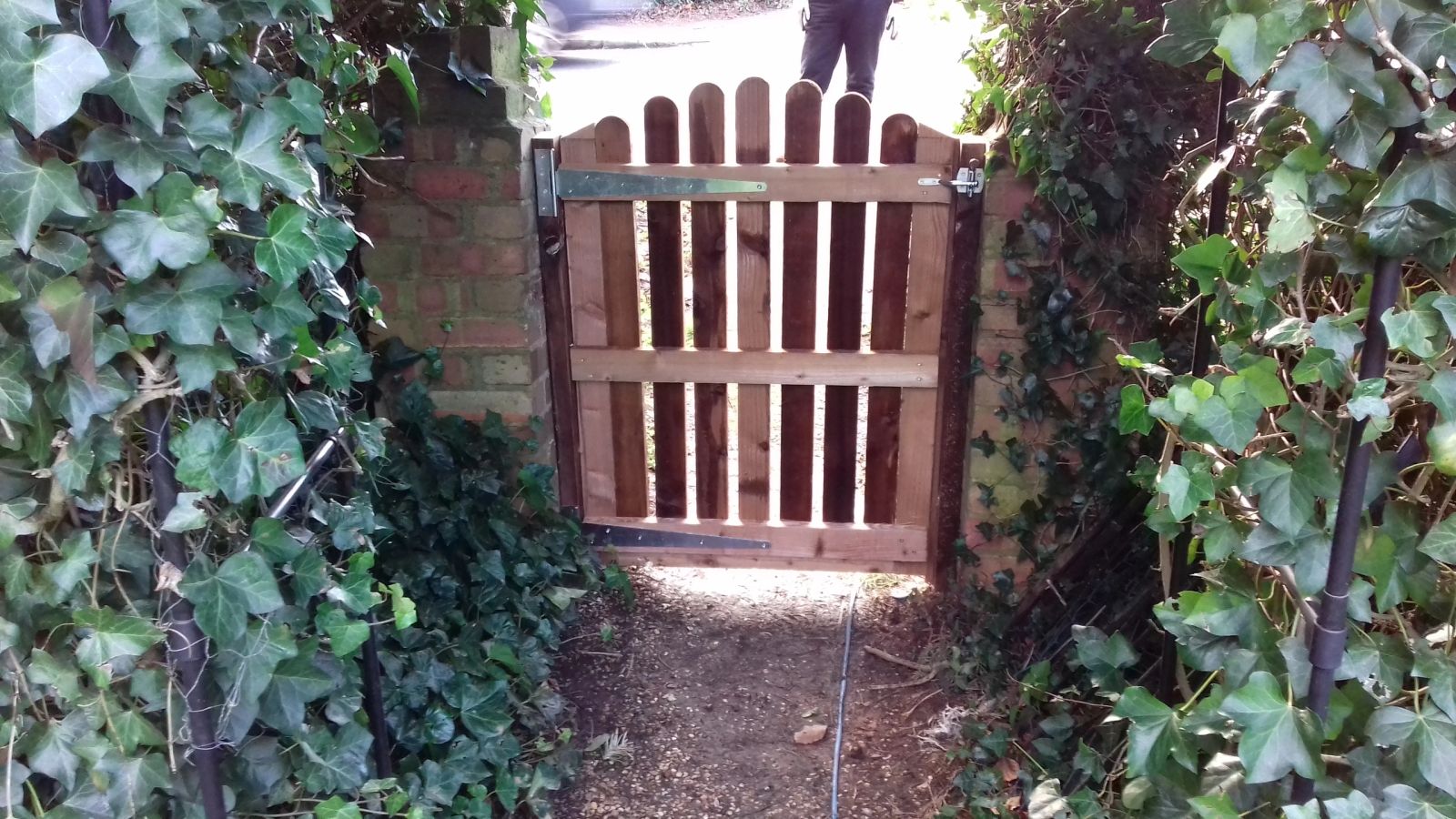
Band-and-gudgeon hinges, tee hinges, plain butt hinges and adjustable bolt-on hinges each suit a different gate weight and post material, and fitting the wrong type for the gate's weight is a common cause of early hinge failure.
A heavy timber gate needs a band-and-gudgeon or heavy-duty tee hinge rather than a light butt hinge sized for an internal door.
Perimeter fencing at an equestrian yard
An equestrian yard's outer security boundary is a separate consideration from the post-and-rail or electric fencing used to contain horses within paddocks, and tack rooms or feed stores within the yard often need their own higher-security enclosure given the value of equipment stored there.
Gate widths at an equestrian yard need to suit horsebox and trailer access, which is wider than a typical vehicle gate and worth confirming before a security gate is ordered to a standard commercial width.
Slip resistance and board grooving
Grooved decking boards are often assumed to be more slip-resistant than a smooth reeded board, but grooves can actually hold water, algae and leaf debris that make the surface more slippery if it isn't cleaned regularly, rather than less.
A smooth board kept clean and free of algae, or a textured composite surface designed specifically for grip, often performs better in practice than a grooved timber board left unmaintained.
Orientation of grooves relative to the main walking direction, and a regular cleaning routine, matter more to actual slip performance than the board profile alone.
Frost heave in shallow footings
A post base set too shallow, or poured in ground that later saturates, can be lifted slightly by frost heave as ice forms and expands beneath it, then settles unevenly once it thaws.
This is most noticeable on posts set less than the recommended depth for their height, where the concrete base itself sits within the top layer of ground most affected by winter freezing.
Once a post has heaved even a few millimetres out of true, the movement tends to repeat each winter, which is why it is worth digging to the depth appropriate for the post height rather than the minimum that will stand up in summer.
Composite thermal expansion
Wood-plastic composite boards expand and contract with temperature considerably more than solid timber, since the polymer content responds more to heat than wood fibre does on its own.
Manufacturers specify a mandatory expansion gap at both board ends and between boards laid end to end, and skipping that gap during installation is one of the most common causes of composite decking or fencing buckling in hot weather.
Dark-coloured composite absorbs more solar heat than lighter shades and expands correspondingly more, so the expansion allowance recommended for a dark board is often greater than for a pale one of the same profile.
Checking fall along the base of a fence line for drainage
Where a fence runs along the low side of a garden or parallel to a slight natural fall, water can collect and run along the fence line itself rather than away from it, sitting against gravel boards and post bases for longer than on flatter ground.
A shallow channel or a slightly raised base at the lowest points along the run helps water continue past rather than pool against the timber.
This is worth checking during a wet spell before finalising post positions, since a dry-weather site visit can miss a drainage pattern that only shows up after sustained rain.
Arris rails and rail counts by height
Arris rails are the triangular-section horizontal timbers that run between posts and carry the vertical boards in a closeboard fence, and how many are used per bay is set by the finished height rather than fixed at two everywhere.
A fence up to around 1.2m typically runs on two rails, but anything taller — particularly 1.8m closeboard — needs a third rail roughly at mid-height to stop the boards bowing outward under wind pressure.
Morticing the rail ends into the post rather than merely nailing them on gives a stiffer, longer-lived joint, which matters more as the number of rails and the height of the fence both increase.
Green belt and stock-proof boundaries
Plots backing onto green belt land, paddocks or working farmland often need a genuinely stock-proof boundary rather than a decorative garden fence, particularly where livestock graze the adjoining field.
Post-and-rail with stock netting, or a taller close-boarded run where privacy also matters, both do the job, but a standard panel fence with gaps at the base is routinely pushed through or under by sheep and larger dogs.
Any new boundary on green belt land should also be checked against local planning policy, since green belt designation adds another layer of restriction on top of the usual permitted development rules.
Manual override on an automated gate
Most automated gates include a manual release so the gate can be opened by hand during a power cut or motor fault, and checking this release still works is worth doing periodically rather than only discovering it's seized in an emergency.
We check the mechanical gate and release mechanism; motor and control-board diagnosis is referred to a specialist.
Out-of-hours security considerations for a GP surgery boundary
A GP surgery boundary needs to accommodate a high daytime footfall of patients and visitors alongside stronger overnight security around bin stores, plant rooms and any area holding clinical waste, which often means combining an open, welcoming frontage with a more solid, higher-security rear compound.
Access for ambulance and emergency vehicles is checked against gate width and turning space before a security gate is specified, since a locked or narrow rear gate can delay emergency access if not planned around actual vehicle routes.
Letting-agent instructions and access arrangements
Work instructed through a letting agent rather than directly by the owner usually needs a written authorisation confirming who can approve variations to the quote, since the agent isn't always the person paying the invoice.
Key access for an occupied rental needs proper notice to the tenant under the tenancy agreement, typically at least 24 hours, and arranging a lockbox or agent-held key avoids a wasted visit if the tenant isn't home.
Where a fence sits between a let property and an owner-occupied neighbour, it's worth the agent confirming which side is instructing and paying before quoting, to avoid a dispute over cost once the job is done.
Wire supports for climbing plants on a fence
Climbers like clematis or trained fruit need their own tensioned wire or trellis support rather than relying on the fence panel itself, since the twisting and clinging growth habit can distort thin battens over time.
Vine eyes and straining wire fixed into posts, not into panel infill, spreads the load onto the structural timber rather than the part of the fence most likely to need replacing first.
Planning wire runs at the time a fence is built, rather than drilling into finished posts later, avoids weakening a post at exactly the point that already carries the most load.
Hanging post size versus gate weight
A hanging post has to be sized to the weight and length of the gate it carries, not to match the rest of the fence line — an undersized post on a heavy double gate will lean or twist over time even with sound hinges.
We check post section and depth against the specific gate before a repair simply re-hangs the same gate onto the same undersized post.
Ring latch pull mechanisms
A ring latch uses a rotating ring handle connected to an internal bar, giving a pulling action from either side of the gate rather than the push-down action of a thumb latch, and is common on cottage-style timber gates.
The ring's fixing pin and the bar's guide staples are the usual wear points, since repeated twisting loosens the pin over time even when the bar itself is undamaged.
How ground type affects a repair
Clay ground that's shifted with the seasons is a common underlying cause of a post working loose even where storm damage gets the blame, so a repair on clay sometimes needs a deeper reset than the original installation used.
Where ground has settled unevenly across a run, we check whether that settlement is still ongoing before repairing, since fixing into ground that's still moving risks the same failure recurring.
Clarifying the '358' mesh naming convention
The '358' name commonly used for high-security welded mesh refers to its aperture dimensions of roughly 76mm by 12.5mm, formed from wire around 4mm thick, giving a mesh too small to get fingers or toes into as a climbing aid.
Different manufacturers use slightly different wire gauges and coating specifications under the same '358' description, so a spec sheet is worth checking rather than assuming all products sold under that name are identical.