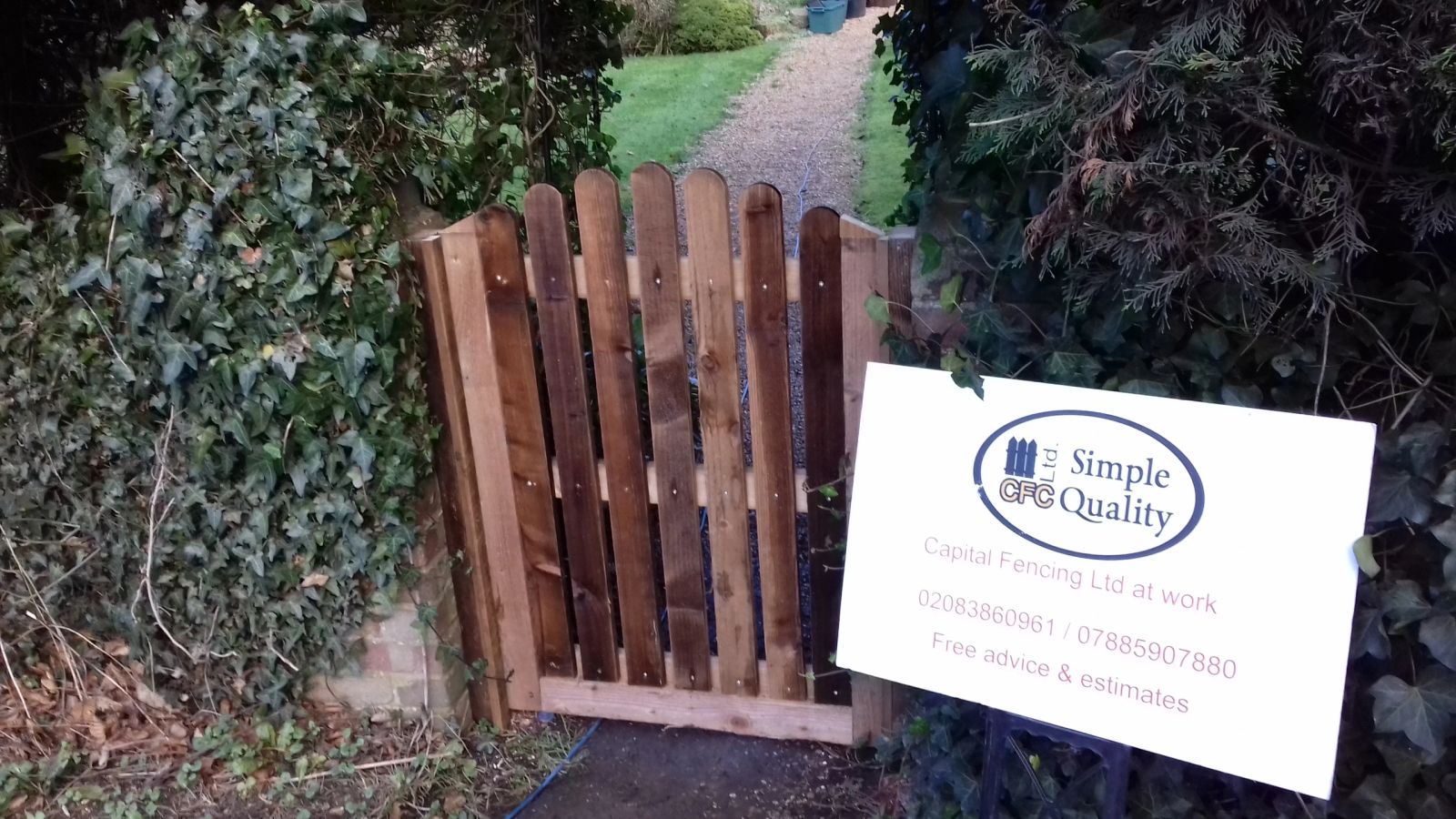
Courtyard gates and proportion
A courtyard gate typically spans a wider opening than a standard garden gate while still being a pedestrian rather than vehicle gate, which means its frame needs extra bracing to resist racking over that wider span without the benefit of a narrower opening's inherent stiffness.
Getting the proportion of stiles, rails and bracing right at this scale matters more than on a narrow gate, where the frame is naturally stiffer regardless of detailing.
Closing gaps and finger-trap risk
A gap left between a closing gate and its post or an adjacent leaf can trap fingers, particularly at a height a child would reach, and this is worth checking on any gate serving a garden used by young children.
Closing plates or adjusted hinge geometry can reduce the gap without replacing the gate itself.
Tree root heave near posts
A root growing under or beside a post footing can lift or crack the concrete over several years as the root thickens, distorting the post's alignment even though the timber itself may be sound.
Repairing a post affected by root heave sometimes means offsetting the new footing slightly rather than resetting it in exactly the same spot, particularly where the tree is protected and the root can't be cut.
Choosing gate ironmongery
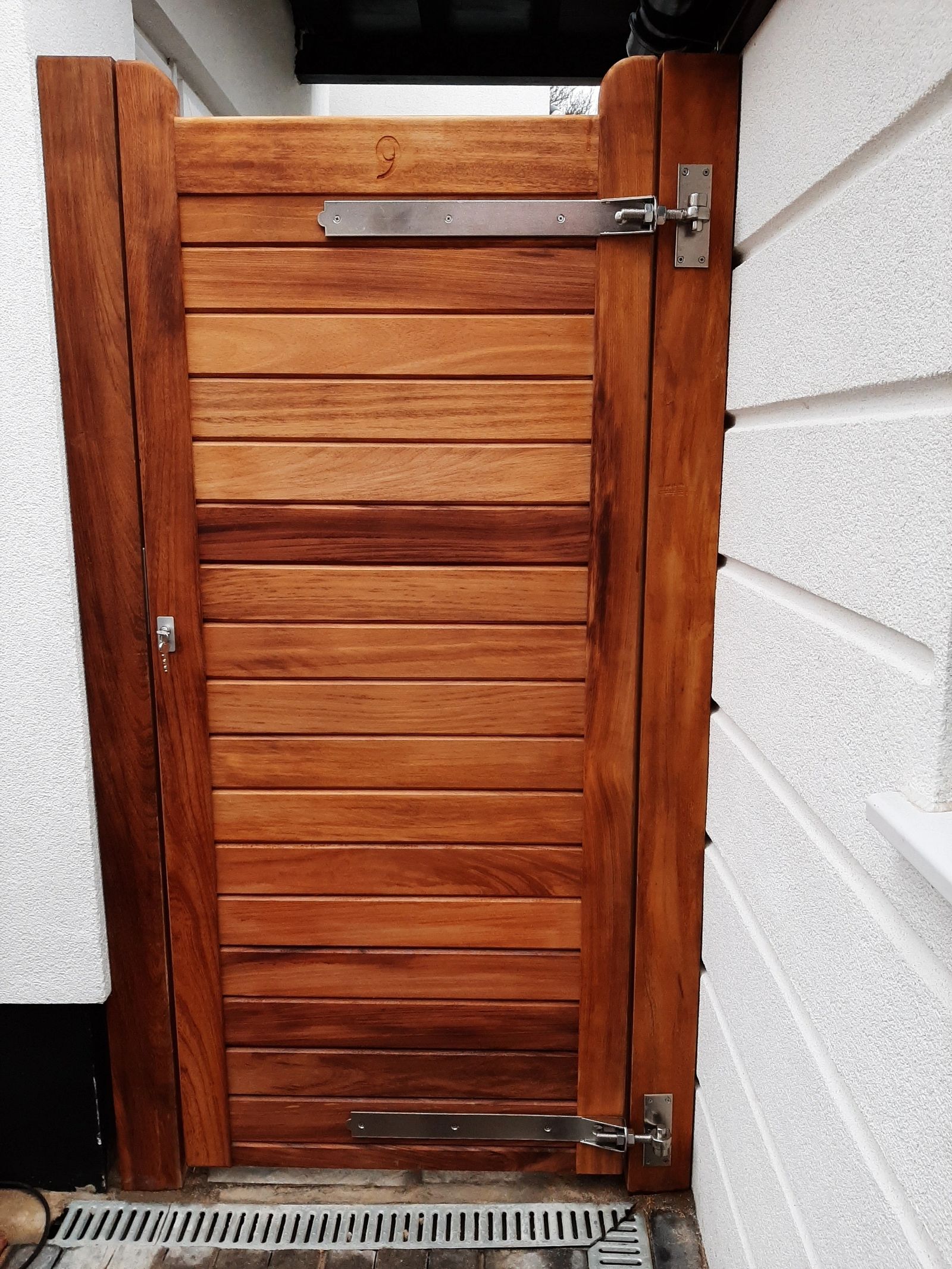
A gate is only as good as its hinges and latch — undersized hinges are the single most common reason a timber gate sags and starts dragging on the ground within a year or two.
Heavier gates, especially solid hardwood or wide driveway gates, need hinges rated for the actual weight rather than whatever came in the hardware pack, plus a diagonal bracing batten on the frame to stop it racking out of square.
Galvanised or stainless fixings are worth the small extra cost over standard zinc-plated ones anywhere exposed to weather, since a rusted hinge pin is a common and avoidable reason for an otherwise sound gate to fail.
Diagnosing which of the three usual causes applies
Almost every failing gate comes down to the hinge side, the frame or the ironmongery, and diagnosing which one it actually is before quoting avoids paying for a new gate that wasn't needed.
We check hinge fixings, frame square and latch alignment separately on site rather than assuming from how the gate looks.
Fences crossing a natural drainage swale in the garden
Some gardens have a shallow natural low line, or swale, that carries surface water across the plot during heavy rain even without any formal drainage installed, and a fence built straight across it without allowance for that flow effectively becomes a small dam.
Water backing up against a fence in these conditions accelerates rot at that specific point and, in significant storms, adds a load the fence wasn't designed to resist.
A gap under the gravel board or a permeable section at the exact point the swale crosses the boundary lets water pass through rather than building up against the structure.
Staple and clout corrosion
Wire staples and clout nails used to fix wire mesh or thin capping are among the first fixings to corrode, since their small cross-section and shallow galvanising thickness give them less protection than a heavier fixing.
A repair that replaces the mesh or board but reuses corroded staples is only a partial fix, since the corroded fixings will fail again well before the new material does.
Five-bar field gate hardware and repair
A five-bar field gate is built for spanning wide openings rather than security, with widely spaced horizontal bars and a diagonal brace, and its hardware is typically heavier gauge than a garden gate's to cope with livestock or vehicle contact.
Hanging and heel posts on this type carry more load per fixing than domestic posts, so repairs often focus on the post fixing itself rather than the gate frame.
Splitting maintenance costs on a shared access boundary
Where a title includes a shared right of way, the deeds sometimes specify how maintenance costs for that shared strip, including any bordering fence, should be split between the properties using it.
Where the deeds are silent on cost-sharing despite recording the shared right, this becomes another matter for direct agreement between the parties involved.
Checking exactly what the title says about cost responsibility, rather than assuming an even split is automatic, avoids a common source of disagreement on shared accessways.
Fencing a marina or boatyard compound
A marina or boatyard compound combines standard perimeter security with exposure to salt air and standing water, so galvanising specification and fixing hardware are upgraded from a typical inland commercial job to resist accelerated corrosion.
Gate access often needs to accommodate trailered boats and cradles passing through, which pushes toward a wide sliding gate or a removable section rather than a fixed-width pedestrian-scale opening.
Helical pile foundations for a commercial security run
A helical pile is screwed into the ground using hydraulic or mechanical torque rather than being set in an excavated and concreted hole, giving a foundation that can be installed quickly on a site where digging is disruptive or where ground conditions are variable along the run.
Load capacity is checked by torque readings taken during installation rather than assumed from a standard depth, which makes helical piling useful on a site where soil type changes noticeably across the length of the boundary.
Wheel load rating on wheeled gates
A wheel fitted to the leading edge of a heavy gate to support its weight as it swings needs a load rating matched to the gate's actual weight, since an undersized wheel flat-spots or seizes under a load it wasn't specified for.
This is separate from a sliding gate's running wheels — a support wheel on a swing gate only touches down near full opening or closing, rather than carrying the gate along its whole travel.
Protecting lawn edges along a new fence line
Digging post holes and levelling ground along a boundary inevitably disturbs a strip of lawn either side of the new line, and that strip is worth marking out and treating as a working area from the start rather than letting the disturbed area creep wider as the job progresses.
Turf lifted carefully in one piece before digging starts can sometimes be relaid afterwards rather than reseeded, which gives a faster-recovering edge than bare soil left to regrow from seed.
Where reseeding is the only realistic option, timing the final reinstatement for a season when grass seed actually establishes reliably avoids a bare strip sitting exposed for months after the fencing itself is finished.
Post spacing on a run that doesn't divide evenly
Standard panels are usually 1.83m (6ft) wide, but very few boundary runs measure out as an exact multiple of that, so the layout has to absorb the remainder somewhere rather than pretend it isn't there.
The common approach is to split the shortfall across the two end bays so both are cut slightly narrower and roughly matched, rather than leaving one full-width bay and one very narrow offcut at a single end.
Where a fixed feature — a gate opening, a manhole, an existing post that must stay — sits partway along the run, setting out works outward from that fixed point in both directions rather than from one end only.
Round post versus square-sawn post sections
A round, or half-round, post retains more of the log's original strength-giving fibre continuity around its circumference than a square-sawn post cut from the same log, since sawing removes material and can cut across some outer fibres.
Square-sawn posts are easier to fix panels and brackets to flush, since flat faces align with flat rail ends, whereas round posts often need a notched or curved bracket to seat components securely.
Round fencing stock is more common in agricultural post-and-rail and stock fencing where raw strength per log matters most, while square-sawn posts dominate garden and boundary fencing where flush fixing detail matters more.
Specifying fencing for an exposed hilltop plot
Plots on high ground with little surrounding shelter, common on the higher parts of the Chilterns and similar ridgelines, combine strong wind loading with faster-drying but also faster-weathering timber due to constant air movement.
A specification for this kind of site usually combines shorter bay spacing, part-slatted or louvred infill to reduce wind load, and a slightly heavier post section than the same height fence would need in a sheltered valley garden a few miles away.
It's a case where two gardens in the same postcode can genuinely need different specifications purely because of local topography rather than anything about the boundary itself.
Painting and re-treating repaired sections
New timber fitted into a repair should be treated before it's fixed as well as after, since end grain and cut edges exposed during fitting are the points most likely to take on moisture if left untreated.
Matching the existing stain or paint colour on a repaired section is easier once the new timber has had at least one season to weather, rather than trying to match it immediately.
Capping and end-grain protection
End grain absorbs moisture far faster than the face of a timber board, so an uncapped top rail or exposed post top takes in water long before the rest of the gate shows any sign of decay.
Fitting a capping strip or weathered top cut sheds water away from that end grain and noticeably extends the life of an otherwise sound gate.
Concealed versus visible fixings on heavier gates
A heavier timber or metal gate can be hung with either visible surface-mounted hinges or concealed fixings recessed into the frame, and the concealed option gives a cleaner appearance but is harder to inspect and adjust once installed.
Choosing between the two is partly aesthetic and partly practical, since a gate that's likely to need periodic adjustment is often better served by accessible, visible hardware.
Rotating spike toppings as a climb deterrent
A rotating spike topping uses a free-spinning tube studded with blunt spikes along the top of a wall or fence, so that a hand or foot pressing down on it spins rather than gripping, which defeats a climbing attempt without the injury risk of a fixed razor product.
It's most often fitted to a boundary wall in a residential or light-commercial setting where a coil topping would look too industrial, and it needs periodic checking that the rotating mechanism hasn't seized with paint overspray or corrosion.
Threshold and step detailing under a gate
Where a gate crosses a change in ground level, a threshold detail — a shaped cill, a small step, or a sloped paving strip — needs designing in so the gate can swing freely without a permanent gap left underneath for drafts, debris or small pets to pass through.
Retrofitting a threshold detail to an existing gate is more limited than designing it in from the start, since the gate's swing arc is already fixed by its hinges.
Alley gates on shared rear access
An alley gate closes off a shared rear passage between terraced properties and is typically installed and maintained under an agreement between several households or with local authority involvement, rather than by a single owner.
Repairs on these gates often need to account for multiple keyholders and heavier-than-domestic use, since several households pass through the same gate daily.