London & Hertfordshire Free Site Visit
bespoke wooden gate installed by Capital Fencing in Hatfield (AL9)
Hatfield · AL9 / AL10

Wooden Gates Installers Across Hatfield & welwyn garden city

Most gate problems in Hatfield are hinge and post problems. We size the post to the leaf weight, set it deep, and hang on adjustable ironmongery so the gate can be trued up later without re-hanging it. Capital Fencing installs wooden gates across Hatfield and out to welwyn garden city and st albans. Welwyn Hatfield Borough coverage plus proximity to A1(M) J3 means most quotes are on your inbox within 48 hours of a site visit. Recent work on Wellfield Road and Briars Lane. We orient jobs off University of Hertfordshire campus.

Most gate problems in Hatfield are hinge and post problems. We size the post to the leaf weight, set it deep, and hang on adjustable ironmongery so the gate can be trued up later without re-hanging it. Capital Fencing installs wooden gates across Hatfield and out to welwyn garden city and st albans. Welwyn Hatfield Borough coverage plus proximity to A1(M) J3 means most quotes are on your inbox within 48 hours of a site visit. Recent work on Wellfield Road and Briars Lane. We orient jobs off University of Hertfordshire campus.

Common Hatfield briefs

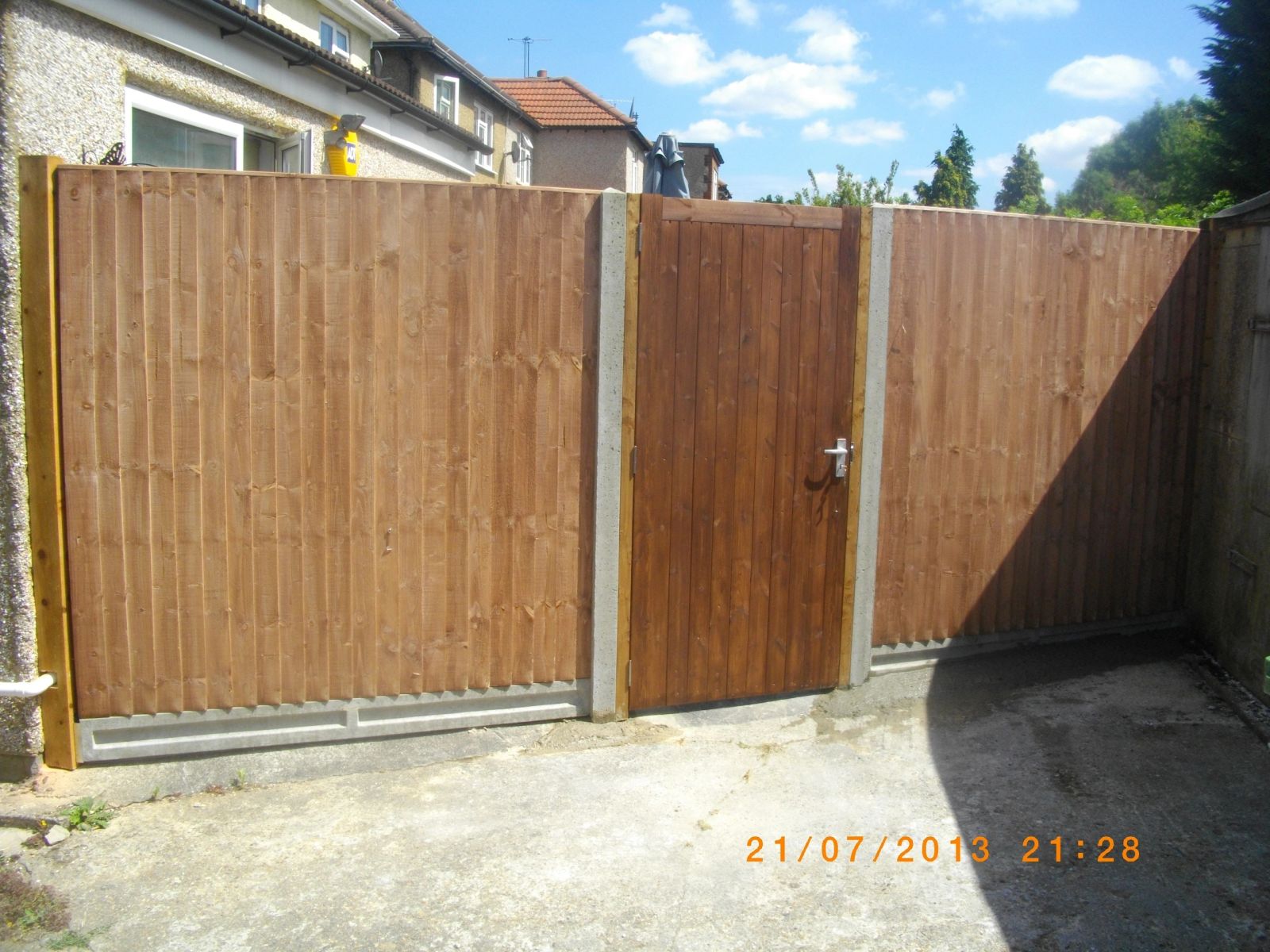
  • driveway double gates — softwood or hardwood, manual or automated
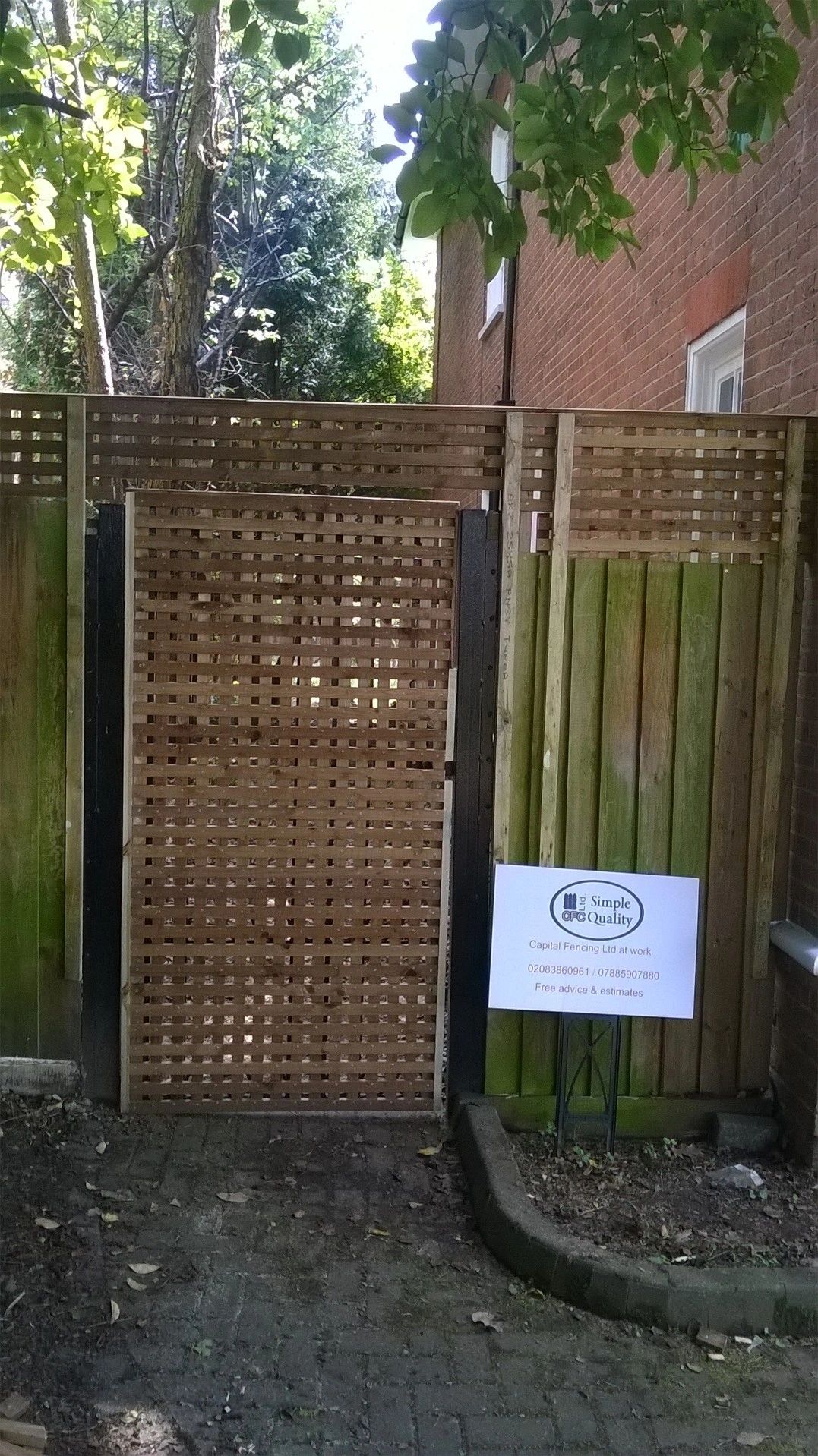
  • side gates matching a closeboard or panel boundary

Why wooden gates works here

  • warm, matches most period and modern properties without looking industrial
  • easily re-sanded and re-oiled to refresh the finish every few years
  • hardwood options like iroko regularly outlast the ironmongery
Typical spec

How we build wooden gates in Hatfield

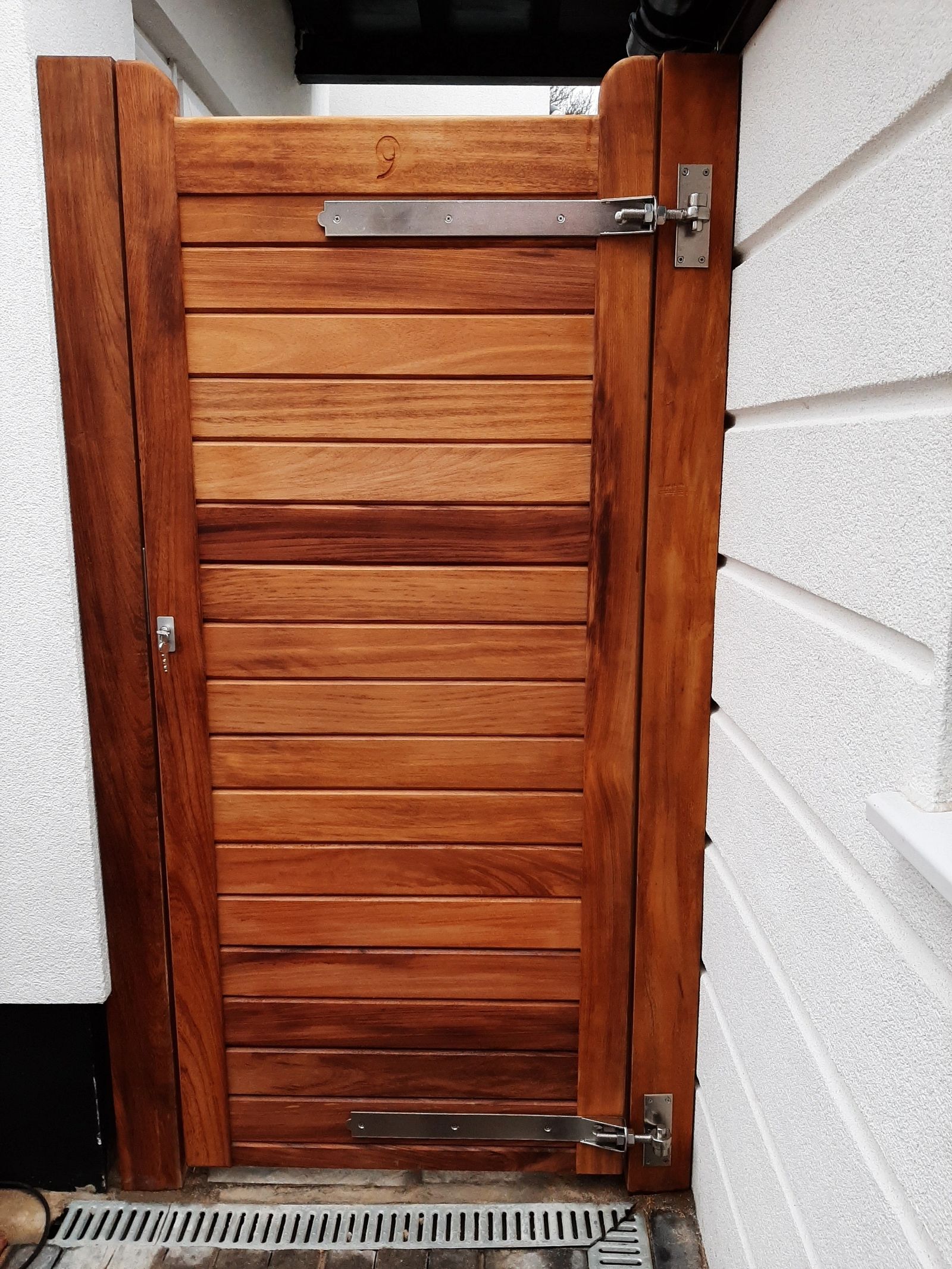
Iroko hardwood, oak or planed softwood on hot-dip galvanised ironmongery. Standard build: 44mm framed, tongue-and-groove infill, adjustable ball-race hinges, drop bolt to slabs. On Hatfield jobs we adjust for uniform new-build estates mean visual consistency across runs is important to keep frontages looking right.

Property mix locally: post-war new-town estates, university accommodation, and Old Hatfield's period cottages. Typical gardens: compact rectangular plots, mostly level, often shared with neighbour-owned fences. Postcodes we regularly service: AL9, AL10.

Wooden Gates FAQs — Hatfield

Softwood or hardwood — which lasts longer in the London weather?

End grain gets sealed before hanging, because a gate bottom rail in Hatfield sits in splash-back all winter. For post-war new-town estates in AL9, that is where the cost sits. Practically, that means easily re-sanded and re-oiled to refresh the finish every few years — and we're upfront that softwood side gates need re-treating annually to avoid black spot.

How do you finish wooden gates to resist rot?

Adjustable hinges mean the gate can be re-trued in ten minutes years later, without touching the frame. We allow for compact rectangular plots when setting out in Hatfield. In short: warm, matches most period and modern properties without looking industrial, though timber moves seasonally — expect small alignment adjustments in year one.

What ironmongery do you fit as standard?

End grain gets sealed before hanging, because a gate bottom rail in Hatfield sits in splash-back all winter. Survey slots across AL9 are usually inside a week. Worth weighing warm, matches most period and modern properties without looking industrial against timber moves seasonally — expect small alignment adjustments in year one before you commit.

Can wooden gates be automated?

Leaf weight drives the post size — an undersized post is the most common reason a Hatfield gate stops closing. We work this patch weekly, from Hatfield Business Park out toward welwyn garden city. Practically, that means easily re-sanded and re-oiled to refresh the finish every few years — and we're upfront that softwood side gates need re-treating annually to avoid black spot.

How wide can a single wooden gate span before it needs a brace or wheel?

Leaf weight drives the post size — an undersized post is the most common reason a Hatfield gate stops closing. For post-war new-town estates in AL9, that is where the cost sits. Worth weighing warm, matches most period and modern properties without looking industrial against timber moves seasonally — expect small alignment adjustments in year one before you commit.

Recent wooden gates work
bespoke wooden gate installed by Capital Fencing in Hatfield (AL9)double driveway gates installed by Capital Fencing in Hatfield (AL9)hardwood side gate installed by Capital Fencing in Hatfield (AL9)metal entrance gate installed by Capital Fencing in Hatfield (AL9)

What actually matters for wooden gates around Hatfield

Child-safe latch heights

Positioning a latch or lock out of easy reach of a young child is common general practice on a garden gate, particularly one near water, a driveway or a road, though the appropriate height depends on the specific site and use.

This is a design choice worth discussing at repair or replacement stage rather than simply refitting a latch at its original height by default.

Welded versus woven mesh

Welded mesh is formed from wires fused at each intersection, giving a rigid grid that holds its shape well and resists distortion under point loads such as someone leaning or climbing on it.

Woven mesh, including chain link, has wires interlaced rather than fused, which lets the whole panel flex and absorb impact rather than transferring load to a single joint, but it can also sag or distort more visibly over time.

Welded mesh is generally preferred where a crisp, rigid appearance matters, while woven mesh is favoured for larger open areas like sports enclosures where some give under impact is actually beneficial.

Neighbourhood plan policies on boundary treatments

Some areas have an adopted neighbourhood plan alongside the wider local plan, which can include specific policies on boundary treatments, hedging, or street character that planning officers take into account.

These policies are most relevant when a planning application is genuinely needed, rather than affecting works that fall within standard permitted development rights.

Where a proposed boundary change does need permission, checking whether a neighbourhood plan applies locally can help anticipate what the council is likely to expect.

Boundary rules in National Parks and AONBs

Properties within a National Park or an Area of Outstanding Natural Beauty can have reduced permitted development rights for boundary structures, reflecting the additional planning protection these areas carry.

Material and colour choices are often more tightly guided in these areas too, even where the height itself would otherwise be permitted.

The relevant National Park authority or council planning department is the right first point of contact for confirming what applies before ordering materials.

Keeps and hasps for padlocking

A keep holds a sliding or dropping latch bar, while a hasp is the separate hinged plate that a padlock passes through — the two are often confused but serve different jobs and aren't interchangeable on most gate designs.

Hasp screws are a common weak point since they're fitted from the accessible face; through-bolting a hasp gives more resistance to forcing than screws alone.

Cladding fixing pattern and thermal movement

Timber cladding boards are usually fixed with a single row of fixings near one edge rather than through the centre, allowing the board to expand and contract slightly around that fixed edge without the fixing itself resisting the movement.

Fixing through both edges of a wide board effectively locks it in place, which forces any subsequent expansion or shrinkage to manifest as cupping, splitting or fixing failure rather than free movement.

This detail becomes more important as board width increases, since a narrow board moves relatively little in absolute terms while a wide board can move several millimetres across its face between a dry and a humid spell.

Fences crossing a natural drainage swale in the garden

Some gardens have a shallow natural low line, or swale, that carries surface water across the plot during heavy rain even without any formal drainage installed, and a fence built straight across it without allowance for that flow effectively becomes a small dam.

Water backing up against a fence in these conditions accelerates rot at that specific point and, in significant storms, adds a load the fence wasn't designed to resist.

A gap under the gravel board or a permeable section at the exact point the swale crosses the boundary lets water pass through rather than building up against the structure.

Checking and shakes as timber dries

Checking refers to small surface splits that open along the grain as the outer face of a timber dries and shrinks faster than the still-damp core, and it's a normal, largely cosmetic feature of drying softwood rather than a structural fault.

Shakes are a related but distinct defect present in the standing tree or log itself, such as a separation between growth rings, and can run deeper into a section than surface checking.

A moderate amount of surface checking on a post or rail doesn't usually compromise strength, but a shake running the length of a load-bearing post is worth inspecting before use, since it can concentrate stress along that plane.

Thermally modified timber

Thermal modification heats timber to high temperatures in a low-oxygen environment, which alters its cell structure to reduce moisture absorption and improve decay resistance without adding any chemical preservative.

The process also darkens the timber throughout its thickness, which means a scratch or cut face shows a similar colour to the surface rather than exposing paler untreated wood underneath.

The heat treatment reduces the timber's flexural strength somewhat, so thermally modified timber is more commonly specified for cladding and decorative boarding than for load-bearing posts and rails.

Sliding versus swing gate mechanisms

A swing gate needs clear space to open into, whether that's the driveway itself or the street, while a sliding gate runs parallel to the boundary and suits plots where that swing space isn't available.

Sliding gates need a level, unobstructed track run at least as long as the gate itself, plus a foundation for the track and rollers that copes with the gate's full weight — cutting corners here is the most common cause of a sliding gate that jams.

Swing gates are generally simpler to install and service, which is worth weighing against a sliding gate's space-saving advantage on a tight or sloping driveway.

Flats and maisonettes with communal gardens

Where a garden is communal to several flats, no single leaseholder normally has authority to alter the boundary fence unilaterally — that decision usually sits with the freeholder or a resident's management company under the lease.

Ground-floor maisonettes with an exclusive-use garden are a common exception, but the lease still often restricts fence height or style to protect the amenity of upper flats overlooking the space.

Any quote for work in a communal garden should confirm who is legally instructing the job and paying for it before work starts, since informal agreement from one resident isn't the same as management company sign-off.

Gate stops and end buffers

An end stop or buffer at the fully open and fully closed positions of a sliding gate prevents the leaf running off the end of its track or slamming into a post, and a missing or worn buffer is a common cause of impact damage over time.

Checking and replacing worn buffers is a low-cost part of a sliding gate service that prevents more expensive frame damage.

Raised beds built directly against a fence

A raised planting bed built with its back edge against a fence line keeps damp soil and mulch in permanent contact with the lowest boards or gravel board, which accelerates rot at exactly the point most vulnerable to moisture.

Lining the inside face of the bed against the fence with a damp-proof membrane, rather than backfilling soil directly onto the timber, reduces this contact without changing the visible design.

This detail is easy to miss at the planning stage since the bed and the fence are often specified and built by different trades without either flagging the interaction.

Choosing a skip or a grab lorry for waste removal

A skip left on site suits a job generating waste steadily over several days and where there's a legal spot to place it, such as a driveway, but it needs a permit if it sits on the public highway.

A grab lorry collects loose spoil, rubble and old fencing directly without a skip being dropped and left, which suits a single big clearance visit and avoids occupying space on a narrow driveway or street for the whole job.

For a small domestic run, van-and-tip removal on the last day is often simpler than either option, and the right choice generally comes down to waste volume and how long the site can accommodate a static skip.

Side gates, double gates and driveway pairs all get the same treatment — hot-dip galvanised ironmongery, adjustable hinges, and a drop bolt into a slab where it is needed. Wooden Gates across AL9, AL10 is one of our regular runs. We'll quote honestly, tell you if wooden gates isn't the right answer for your garden, and book the job in within a week or two of a signed quote. Recent work on Wellfield Road and Briars Lane. We orient jobs off University of Hertfordshire campus.

Get In Touch

Get My Free Quote — 24h Response

No callout fee · Free site visit · Friendly local team covering London & Hertfordshire.

Call us
07885907880
or 02036484746
Email
capital_fencing@yahoo.com
WhatsApp
Message us anytime
Area
London & Hertfordshire
Payment
Card payments accepted

Pay by debit or credit card, bank transfer or cash once the work and price are agreed. No deposit taken online.

Request a Free Quote

We'll get back to you within 24 hours.

Free Site Visit No Callout Fee
Call WhatsAppQuote