
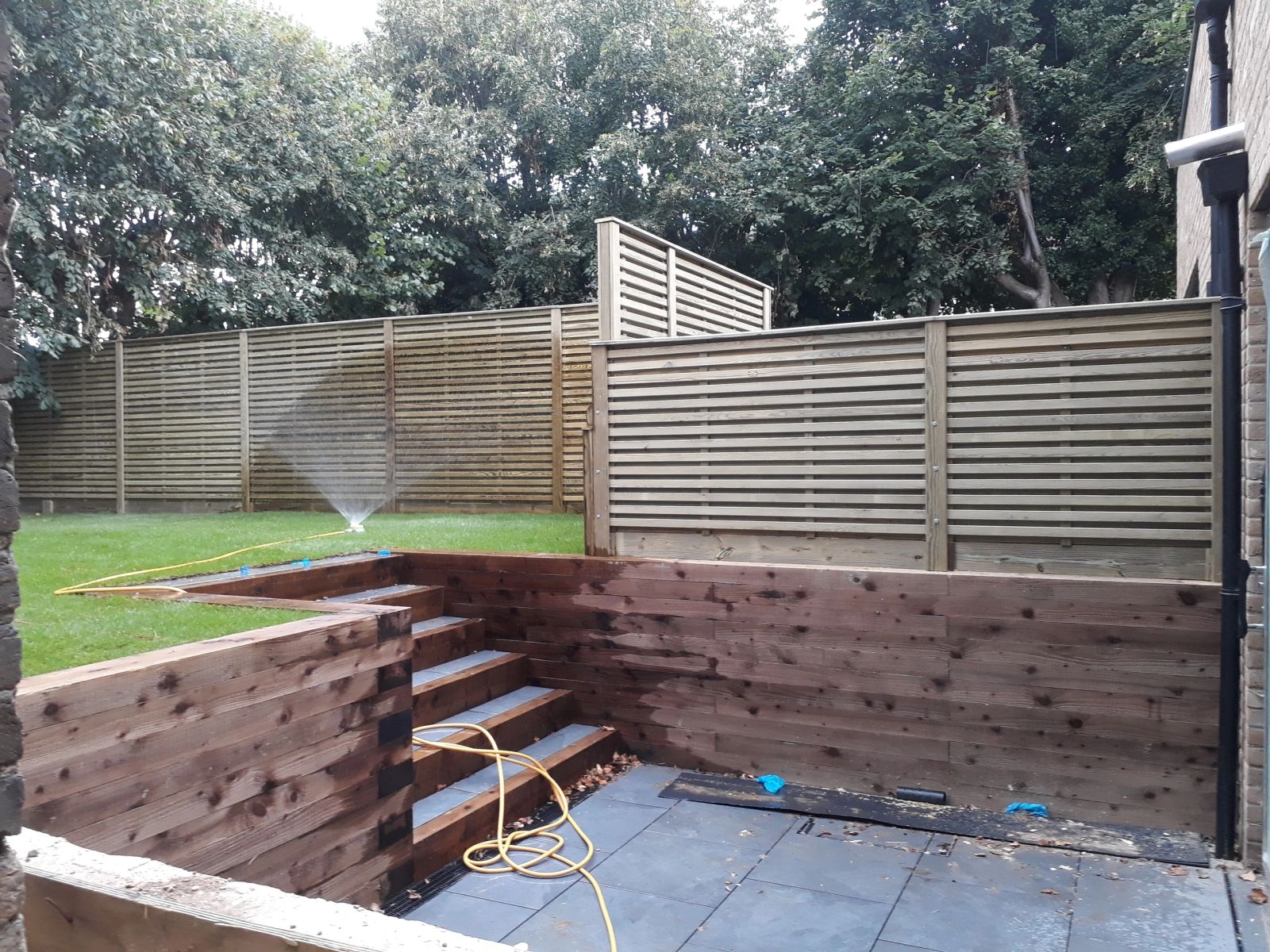
The boards on a hit-and-miss fence alternate sides of the rail, leaving small angled gaps rather than a continuous face — good for a border planted right against the boundary, less good if total privacy at close range matters most.
It's a smaller privacy trade-off than it sounds, so it's worth weighing against what a fully solid fence does to light, airflow and planting nearby.
Solid (closeboard) fencing
Best for: Sheltered gardens where total privacy matters more than wind exposure
- Complete visual privacy from any angle
- Familiar, traditional appearance
- Simple, well-understood construction
- Takes the full force of wind on an exposed boundary
- More vulnerable to storm failure on open or elevated plots
Hit-and-miss fencing
Best for: Exposed or elevated gardens, boundaries that have failed in storms before
- Roughly half the wind load of a solid fence, cutting storm damage risk
- Distinctive vertical-slat appearance, identical from both sides
- Still provides strong practical privacy at normal viewing angles
- A narrow direct sight line through the gaps at close range and low angles
- Uses more timber per metre than lap panel, so costs more than the cheapest options
Side by side
| Solid fencing | Hit-and-miss | |
|---|---|---|
| Wind load | Full | Roughly halved |
| Privacy | Complete | Strong, minor sight lines at close angles |
| Appearance | Traditional flat face | Distinctive slatted look, same both sides |
| Storm resilience | Lower on exposed plots | Notably better |
Which should you choose?
On a sheltered, walled-in garden where storms rarely reach full force, solid closeboard's total privacy usually wins out.
On an open, elevated or previously storm-damaged boundary, hit-and-miss trades a small amount of direct sight line for meaningfully better survival in high wind.
Choose based on exposure first, privacy second — hit-and-miss is the practical answer for boundaries that keep failing in wind.
Storms keep taking your fence out?
Tell us how exposed your boundary is and we'll recommend a spec that survives the next one.
Frequently asked
Does hit-and-miss let more light reach a border planted against the fence?
Yes — the gaps let dappled light and airflow through, which suits shade-loving borders better than the dead zone that sits against a fully solid fence.
Is a hit-and-miss fence noisier to stand next to on a windy day?
It's usually quieter in high wind, since air passes through the boards rather than buffeting a solid face, though it doesn't block traffic or road noise as well as a solid fence.
Do pets or wildlife squeeze through the gaps?
No — the offset boards leave no continuous gap front-to-back, only a narrow angled sightline, so it contains pets the same as a solid fence.
Does hit-and-miss suit an overlooked garden as well as a solid fence?
Almost — direct overlooking is blocked at normal standing distance; only a close, low-angle glance finds a sightline through the boards.