Perimeter security at a GP surgery or health centre
A GP surgery boundary balances public accessibility during opening hours against protecting drug storage, equipment and the building itself outside them, so a low decorative frontage often gives way to a more solid, higher fence around plant areas, bin stores and rear access at the same site.
Step-free, wide gate openings are needed anywhere patients using wheelchairs or mobility aids pass through the boundary, which can constrain gate hardware choices compared with a purely commercial yard.
Estate management schemes and shared rules
Some developments, particularly newer estates, are subject to an estate management scheme or a management company with its own rules covering boundary treatments, materials and even colours.
These schemes usually run alongside normal planning law rather than instead of it, so a fence can need to satisfy both the council and the estate's own management company.
Annual estate charges often fund maintenance of shared boundary features, so it's worth checking what's already covered before commissioning separate work on a shared line.
Gaps at ground level and cill boards
A gap under the fence at ground level lets sound through even when the rest of the face is well sealed, since low-frequency noise in particular can travel along the ground rather than only through the air above it.
A close-fitting gravel board or cill board run along the base closes this gap and also protects the lowest edge of the timber from ground moisture.
Transition detail from decking down to lawn or planting
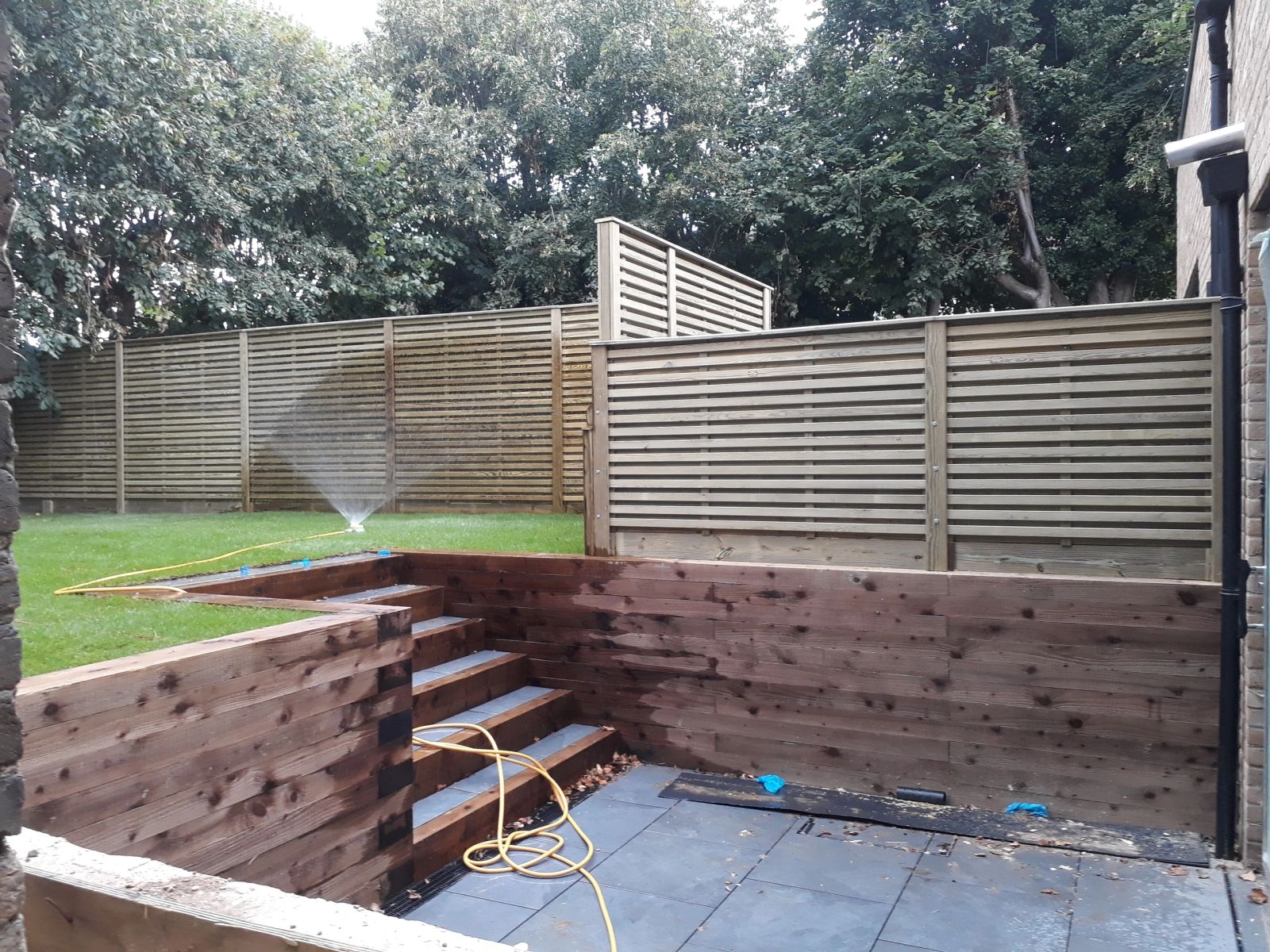
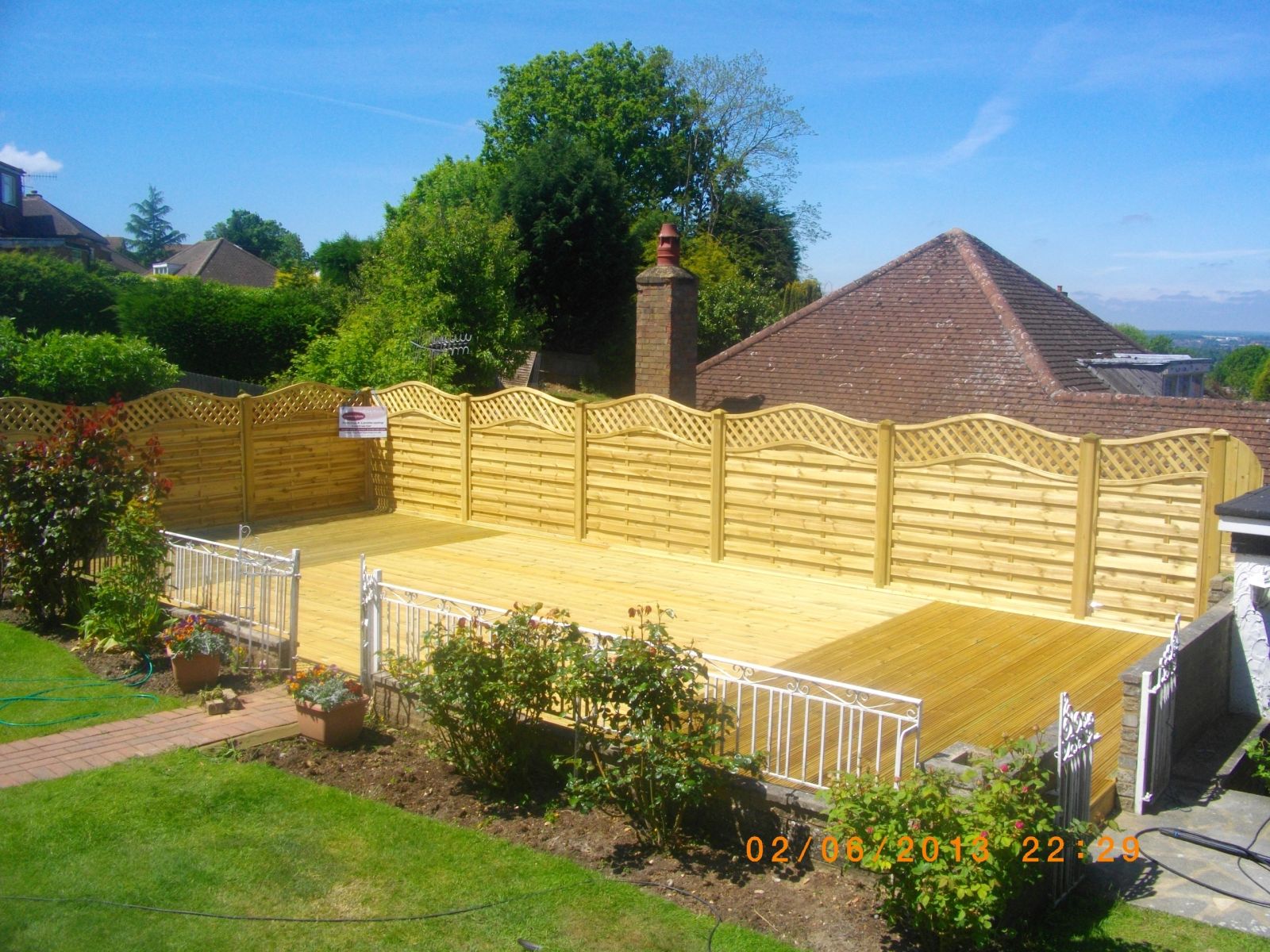
The edge where a deck meets an adjoining lawn or border needs a defined transition — a fascia board with a small step down, or a gravel or edging strip — rather than boards simply stopping at soil level, which otherwise leads to soil and organic matter migrating up against the deck edge.
That buildup against an unprotected deck edge holds moisture against the timber in exactly the way a raised bed built too close to a fence does, and is a common cause of localised rot along an otherwise sound deck perimeter.
A simple edging detail agreed at the design stage costs little compared with the deck itself but noticeably protects the vulnerable soil-contact edge.
Post section choice for heavy acoustic panels
A slender fence post sized for a standard lap panel will flex or fail under the sustained weight and wind loading of a dense acoustic panel, so post section is upsized specifically for the extra mass being carried.
A box-section steel post or a substantial concrete post gives the stiffness needed to hold a heavy panel true over years of wind loading, rather than allowing gradual lean that opens joints and lets sound through.
Panel orientation and sun exposure
A dense, dark-faced acoustic panel absorbs more solar heat through the day than an open fence, and on a south-facing run that can mean noticeably higher surface temperatures, which affects both comfort near the fence and the timber's long-term movement.
Lighter facing colours or a slight setback from a seating area reduce this effect, and it's worth considering alongside the purely acoustic decisions when planning a south-facing solid boundary.
Working off a ladder without scaffold on fencing jobs
Most domestic fencing and gate work is low enough to manage from stepladders rather than needing scaffold, but a ladder still needs a firm, level footing and, on soft ground, a board or plate under the feet to stop it sinking unevenly.
Working at the top of a tall gate post or over a wall with a ladder means keeping three points of contact and avoiding overreaching sideways, which is usually the point a ladder starts to slide rather than tip.
Where capping or a top rail needs fixing along an entire run at height, moving the ladder in short, frequent steps is safer and generally faster than overreaching from a single position to save moving it.
Colour and finish effects on a solid acoustic face
A dark-finished solid acoustic panel absorbs more heat from direct sun than a lighter finish, which can accelerate timber movement and drying out on a south-facing run.
This is a durability consideration rather than an acoustic one, but it affects how often joints need checking on an exposed, sun-facing acoustic boundary.
Post-mix density versus site-mixed concrete
Fast-setting bagged post-mix concrete is formulated to set rapidly with minimal water, but the resulting cured density and long-term strength are generally lower than a properly proportioned and compacted site-mixed concrete of the same nominal grade.
For a typical garden fence post carrying modest lateral load, post-mix's faster setting and convenience usually outweighs the modest strength difference, but for a heavily loaded gate post or long fence run, site-mixed concrete is sometimes specified for the added margin.
Both approaches depend on adequate hole diameter and depth relative to the post's exposed height, since undersized footings undermine either concrete type equally regardless of which mix is used.
Shared private water sources crossing a boundary
Some older rural properties share a private water supply, such as a well or borehole, with pipework running across one or more boundaries under a recorded easement.
Fencing work that might disturb this kind of shared supply pipe needs particular care, since interrupting it can affect a neighbour's water supply entirely, not just a garden feature.
Checking the title for any recorded private water supply arrangement is worth doing on older rural properties before any boundary groundworks proceed.
Aligning a drop bolt on double gates
A drop bolt on the leading edge of one leaf of a double gate needs a matching socket set into the ground or a fixed plate below it, and that socket has to be positioned after the gates are hung and checked closed, not marked out in advance from a plan.
Ground movement or a slight settling of the gate posts over the following months can throw the bolt out of alignment with its socket, which is why some installers set the socket in a slightly oversized recess rather than a tight-fitting hole.
Where the ground under the gate is loose gravel or soft earth, a concrete socket set flush with the surface holds alignment far better over time than a bolt simply pushed into bare ground.