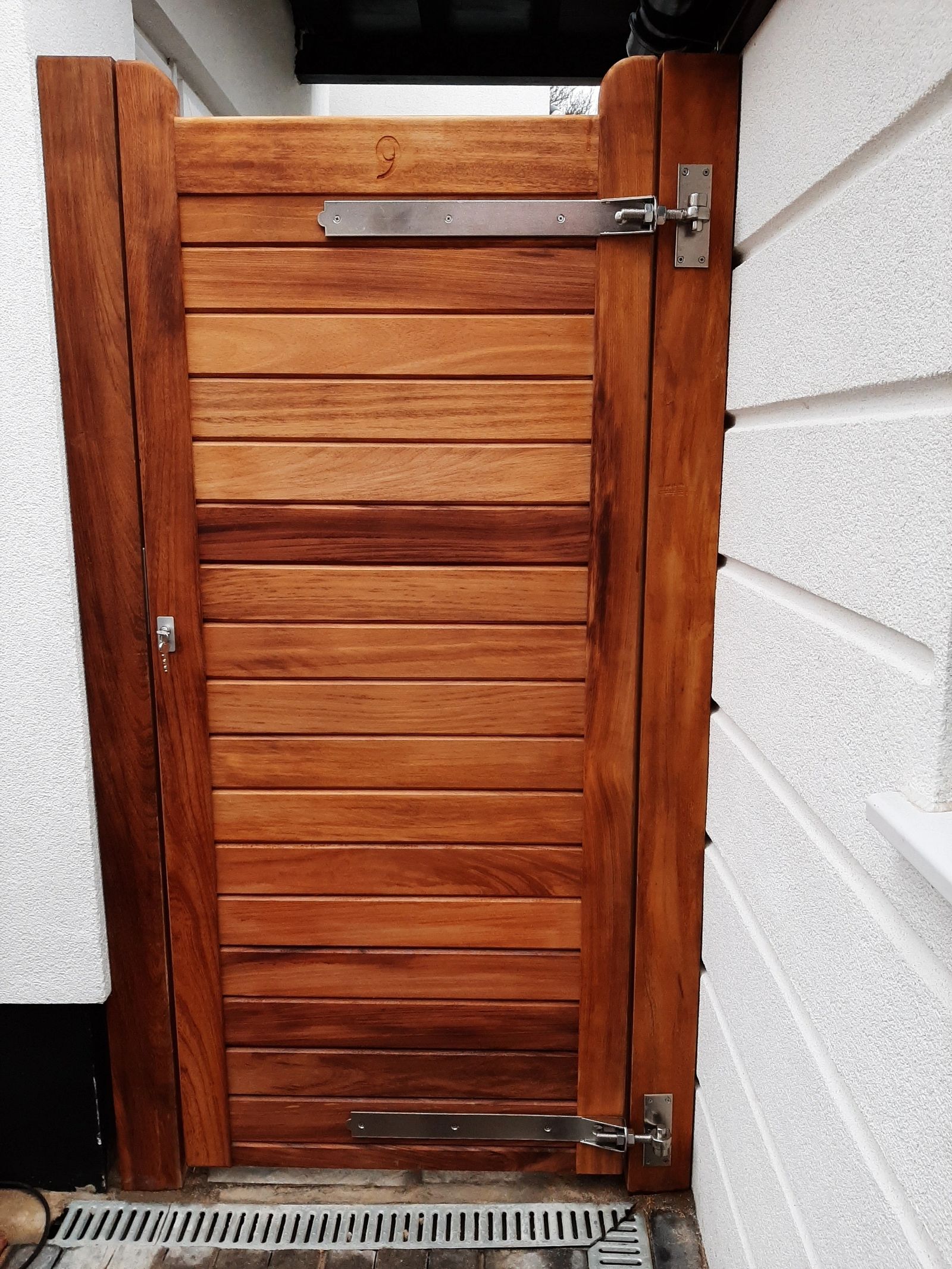
A gate that swings and closes itself on a slope
A gate hung on ground that falls away from the latch post can swing open or shut under its own weight rather than staying where it's left, which is a nuisance rather than a fault in the hardware itself.
Fitting a hydraulic closer, a gravity latch set to hold at the correct point, or re-hanging with a slight counter-lean can correct the tendency without rebuilding the gate.
Gravel terraces of the Lea and Colne valleys
The river terraces along the Lea and Colne valleys are largely sand and gravel over clay, ground that drains quickly and digs easily compared with the heavier clays further from the rivers.
Free-draining gravel is generally kinder to timber posts since water doesn't pool against the base, but loose gravel can also slump back into an open hole faster than clay, making a wider working hole necessary to get concrete properly around the post.
Where the gravel sits directly over a clay band, augers can hit a hard, sticky transition partway down that slows digging without warning.
Checking a gate opening is square before building the gate
An opening that looks square by eye can still be a few centimetres out corner to corner, which only becomes obvious once a gate built to the nominal width won't hang without binding on one side.
Measuring both diagonals of the opening and comparing them is a quick way to confirm square — equal diagonals mean a true rectangle, unequal diagonals mean the posts have drifted out of parallel or the opening has racked.
Where an opening is slightly out of square and can't easily be corrected by resetting a post, building the gate with a small taper to match the actual opening is usually more practical than forcing the posts back into an exact rectangle.
Asbestos awareness near older garage flanks
Older garages, outbuildings and some boundary walls built before the 1999 asbestos ban can incorporate asbestos-containing materials in flank panels, corrugated roofing or old fence panel infill, particularly on properties from the mid-20th century.
Disturbing suspected asbestos material isn't something to tackle as part of routine fence replacement — it needs a competent assessment and, if confirmed, removal by a licensed contractor in line with HSE guidance.
Where an older boundary structure looks like it might contain asbestos sheeting, the sensible step is to leave it undisturbed and get it checked before any adjacent groundworks begin.
Arris rail brackets and rail-end repairs
The triangular arris rail commonly rots or splits where it meets the post, since that mortise or bracket joint traps water against end grain more than any other point on the rail.
A rail-end repair usually involves cutting back to sound timber and refitting with a galvanised arris rail bracket rather than re-cutting a new mortise into an already-weakened post.
Replacing a post without dismantling the whole run
A single post can often be replaced by supporting the panels either side on temporary props, cutting the old post out at ground level, and fitting the new post into a fresh footing without lifting the neighbouring panels out.
This depends on the panel fixing type — nailed panels are harder to free without damage than panels held with clips or brackets, which come apart more cleanly.
Checking battery backup on an automated security gate
An automated gate reliant on mains power for its motor and control panel usually has a battery backup to allow a limited number of open-close cycles during a power cut, and this backup is worth testing periodically rather than trusting it will work when actually needed.
A gate left stuck open or shut during a power outage because an untested backup battery had already failed defeats the purpose of automation entirely, so a manual release mechanism is also checked as part of the same inspection.
Feather-edge board replacement
Individual feather-edge boards on a closeboard fence can be replaced one at a time without disturbing the rest of the run, since each board overlaps the next and is fixed independently to the arris rails.
Matching the taper and width of the existing boards matters more here than on a panel fence, since a mismatched board is visible immediately in a close-run overlap.
Sanding and re-treating a timber gate
A timber gate that's greying or losing its finish benefits from a light sand back to bare or sound timber before re-treating, since coating over a failed or flaking existing finish traps moisture underneath rather than sealing it out.
This is worth doing every few years depending on exposure, well before the timber itself starts to soften or split.
Fox digging and mesh skirts
Foxes commonly dig at the base of a fence line where the ground is soft, undermining a gravel board or creating a gap large enough to pass through underneath an otherwise intact fence.
A buried mesh skirt fitted along the base at repair time, angled outward below ground, is a more durable fix than repeatedly backfilling the same dug-out gap.
Timber choice for permanently shaded gardens
A garden shaded for most of the day by tall buildings, mature trees or a north-facing aspect keeps timber damp for longer after rain, favouring naturally durable species or a higher treatment class over a standard specification that would be adequate in a sunnier plot.
Composite decking or fencing boards perform more predictably in permanent shade than timber, since they don't rely on drying out between wet spells to avoid fungal decay.
Where timber is preferred for appearance in a shaded garden, more frequent inspection and re-treatment intervals should be built into the maintenance plan from the outset rather than applied reactively once problems appear.
Re-securing capping that has lifted along a run
Capping lifts where its own fixings have corroded or worked loose faster than the panel beneath, since it's the most exposed timber on the whole fence and takes the brunt of driving rain and direct sun.
A short lifted section can sometimes be re-screwed if the timber underneath is still sound, but capping that's cupped or split along its length as well as lifting is better replaced in full lengths rather than patched piece by piece.
Nesting birds in vegetation on a fence line
Dense hedging, ivy or overgrown trellis attached to a fence can hold active bird nests during the spring and summer nesting season, and disturbing a nest in use is an offence regardless of how routine the fence repair itself is.
Where a repair requires cutting back vegetation that might be nesting habitat, checking for active nests first and, if found, delaying that part of the work until the nest is no longer in use is the straightforward way to stay compliant.
Aligning hinges before final gate fixing
Hinges fixed slightly out of vertical alignment with each other make a gate bind or swing shut under its own weight rather than staying wherever it's left, even if each hinge individually looks correctly fitted.
Propping the gate at the intended finished height and checking the gap is even top and bottom before final fixing catches most alignment problems while they're still easy to adjust.
Loosely fitting the top hinge first, checking swing and clearance, and only then fully fixing both hinges is a more forgiving sequence than fully fixing both at once and finding the gate doesn't swing cleanly.
Checking and shakes as timber dries
Checking refers to small surface splits that open along the grain as the outer face of a timber dries and shrinks faster than the still-damp core, and it's a normal, largely cosmetic feature of drying softwood rather than a structural fault.
Shakes are a related but distinct defect present in the standing tree or log itself, such as a separation between growth rings, and can run deeper into a section than surface checking.
A moderate amount of surface checking on a post or rail doesn't usually compromise strength, but a shake running the length of a load-bearing post is worth inspecting before use, since it can concentrate stress along that plane.
Powder-coat pre-treatment
Powder coating is only as durable as the surface preparation beneath it, and steel that hasn't been degreased, and often chemically pre-treated with a phosphate or chromate conversion coating, will let the powder coat lift and blister within a season or two.
On galvanised steel specifically, a specialist pre-treatment is needed because standard powder coat doesn't bond reliably to a plain zinc surface without it, which is why powder-coated galvanised railings are a distinct product from simply galvanised steel painted afterwards.
Once properly applied and cured, the powder coat itself is a hard, continuous barrier finish that resists chipping better than wet paint, though any breach down to bare metal will corrode locally without a way to self-heal.
Culverted watercourses running beneath a boundary
Some older boundaries have a small watercourse culverted — enclosed in a pipe — beneath them, often unnoticed until groundworks reveal it or a drainage problem develops.
Ordinary watercourses, even culverted ones, can carry maintenance obligations and sometimes require consent from the local authority or Environment Agency before altering anything above or around them.
Where an old map or local knowledge suggests a watercourse might run beneath a boundary, checking with the council's land drainage team before digging is a sensible precaution.
Sloped gardens and retaining
A sloping plot usually rules out a single level run of panel fencing — the choice is between stepping the fence in even drops between posts, or raking the panels to follow the slope continuously.
Stepped runs look tidier on a steeper gradient and are simpler to repair panel-by-panel; raked runs suit a gentler, more even slope and avoid the small triangular gaps a stepped fence leaves underneath.
Where the drop is severe enough to need a retaining structure rather than just a stepped fence, that's a different job with its own drainage and engineering requirements, not something to bolt onto a fencing quote as an afterthought.
Storm damage triage
After a storm, triage prioritises anything posing an immediate hazard — a fence leaning over a path, a snapped post near a driveway — ahead of cosmetic damage further along the same run.
A wider survey of the whole boundary is worth doing at the same visit, since storm stress often weakens bays that haven't visibly failed yet but are more likely to fail in the next event.
Working off a ladder without scaffold on fencing jobs
Most domestic fencing and gate work is low enough to manage from stepladders rather than needing scaffold, but a ladder still needs a firm, level footing and, on soft ground, a board or plate under the feet to stop it sinking unevenly.
Working at the top of a tall gate post or over a wall with a ladder means keeping three points of contact and avoiding overreaching sideways, which is usually the point a ladder starts to slide rather than tip.
Where capping or a top rail needs fixing along an entire run at height, moving the ladder in short, frequent steps is safer and generally faster than overreaching from a single position to save moving it.
Hinge screw pull-out and through-bolting
Screws pulling out of a timber hinge post is one of the most common gate faults, usually caused by repeated leverage working the fixing loose in the grain over time rather than a single overload event.
Through-bolting the hinge with a coach bolt and washer plate on the far side of the post gives a mechanical fixing that doesn't rely on the timber's grip the way a screw does.
Non-slip decking finishes
A grooved board profile gives some grip when dry but can still become slippery once algae builds up in a shaded or north-facing spot, which is a maintenance issue rather than something a profile alone solves permanently.
Anti-slip decking strips or grit-impregnated coatings can be added to steps and high-traffic areas as a supplementary measure, and are worth specifying on steps or ramps even where the main deck area doesn't need them.
Some composite ranges are manufactured with a textured or embossed surface aimed specifically at slip resistance, which is worth checking against a wet-slip rating rather than assuming all composite boards perform the same underfoot.