London & Hertfordshire Free Site Visit
bespoke wooden gate installed by Capital Fencing in Barnet (EN5)
Barnet · EN5 / N20

Local pedestrian side gates specialist covering Barnet & new barnet

Pedestrian Side Gates in Barnet is a specific brief for us — single-leaf pedestrian gates matched into existing fencing runs. The default local answer isn't a stock catalogue drop: it's single leaf on ball-race hinges, thumb-latch and dead-locking hardware, closing stop and drop-bolt where security is a priority. On Barnet sites we also spec around shared-boundary disputes are common on the older terraced streets, so neat post lines and clear ownership marks matter, which is where a lot of pedestrian side gates jobs quietly fail two years in. Roads such as Kings Road and Calvert Road are typical of the local layout. The Spires is a useful local reference point. Chipping Barnet's medieval plot lines mean the town's boundaries are rarely square, a legacy of the original burgage plots.

Pedestrian Side Gates in Barnet is a specific brief for us — single-leaf pedestrian gates matched into existing fencing runs. The default local answer isn't a stock catalogue drop: it's single leaf on ball-race hinges, thumb-latch and dead-locking hardware, closing stop and drop-bolt where security is a priority. On Barnet sites we also spec around shared-boundary disputes are common on the older terraced streets, so neat post lines and clear ownership marks matter, which is where a lot of pedestrian side gates jobs quietly fail two years in. Roads such as Kings Road and Calvert Road are typical of the local layout. The Spires is a useful local reference point. Chipping Barnet's medieval plot lines mean the town's boundaries are rarely square, a legacy of the original burgage plots.

Typical pedestrian side gates briefs in Barnet

  • single 900mm pedestrian gate cut into an existing closeboard run
  • matched picket gate into a painted picket frontage

Why this spec, for single-leaf pedestrian gates matched into existing fencing runs

  • carried in as a like-for-like match to what's already there — no visible new post
  • hinge and latch geometry sized for daily use rather than as a one-off decorative piece
  • installed with the closing stop and latch in one visit so nothing has to be revisited
Default spec

How we build pedestrian side gates in Barnet

single leaf on ball-race hinges, thumb-latch and dead-locking hardware, closing stop and drop-bolt where security is a priority. On Barnet jobs we adjust for shared-boundary disputes are common on the older terraced streets, so neat post lines and clear ownership marks matter.

Property mix locally: Victorian terraces, post-war semis and a band of larger Edwardian villas around Hadley Green. Typical gardens: narrow rear gardens with mature trees and London clay underfoot. Postcodes we regularly service: EN5, N20.

Where pedestrian side gates isn't the right answer

  • openings needing regulated safeguarding hardware — that's the school-and-nursery spec
  • wall openings where the masonry isn't sound enough to carry the load — brick repair goes first

Pedestrian Side Gates FAQs — Barnet

Can a pedestrian gate go through a brick wall opening?

On pedestrian side gates jobs in Barnet (EN5), our default answer is: single leaf on ball-race hinges, thumb-latch and dead-locking hardware, closing stop and drop-bolt where security is a priority. For context: hinge and latch geometry sized for daily use rather than as a one-off decorative piece. Measured, quoted and installed by the same small crew.

What hinges do you use so the gate doesn't drop?

Across Barnet we spec around shared-boundary disputes are common on the older terraced streets, so neat post lines and clear ownership marks matter, so on pedestrian side gates that usually means closeboard-matched softwood for behind-the-house lines. The honest trade-off is hinging off the last post of an old fence run — the post moves and the gate stops closing within weeks — which is exactly what our default spec designs out.

Do you fit the latch and any hardware on the same visit?

Barnet coverage means we can survey most EN5 addresses inside a week — single-leaf pedestrian gates matched into existing fencing runs. The honest trade-off is hinging off the last post of an old fence run — the post moves and the gate stops closing within weeks — which is exactly what our default spec designs out.

Can the gate be sized to an unusual opening?

Practically: single 900mm pedestrian gate cut into an existing closeboard run. That's the Barnet version of this job, not a generic one. We'll walk you through carried in as a like-for-like match to what's already there — no visible new post on the site visit before you commit.

Can you match a new pedestrian gate into my existing fence?

On pedestrian side gates jobs in Barnet (EN5), our default answer is: single leaf on ball-race hinges, thumb-latch and dead-locking hardware, closing stop and drop-bolt where security is a priority. We'll walk you through carried in as a like-for-like match to what's already there — no visible new post on the site visit before you commit.

Recent pedestrian side gates work
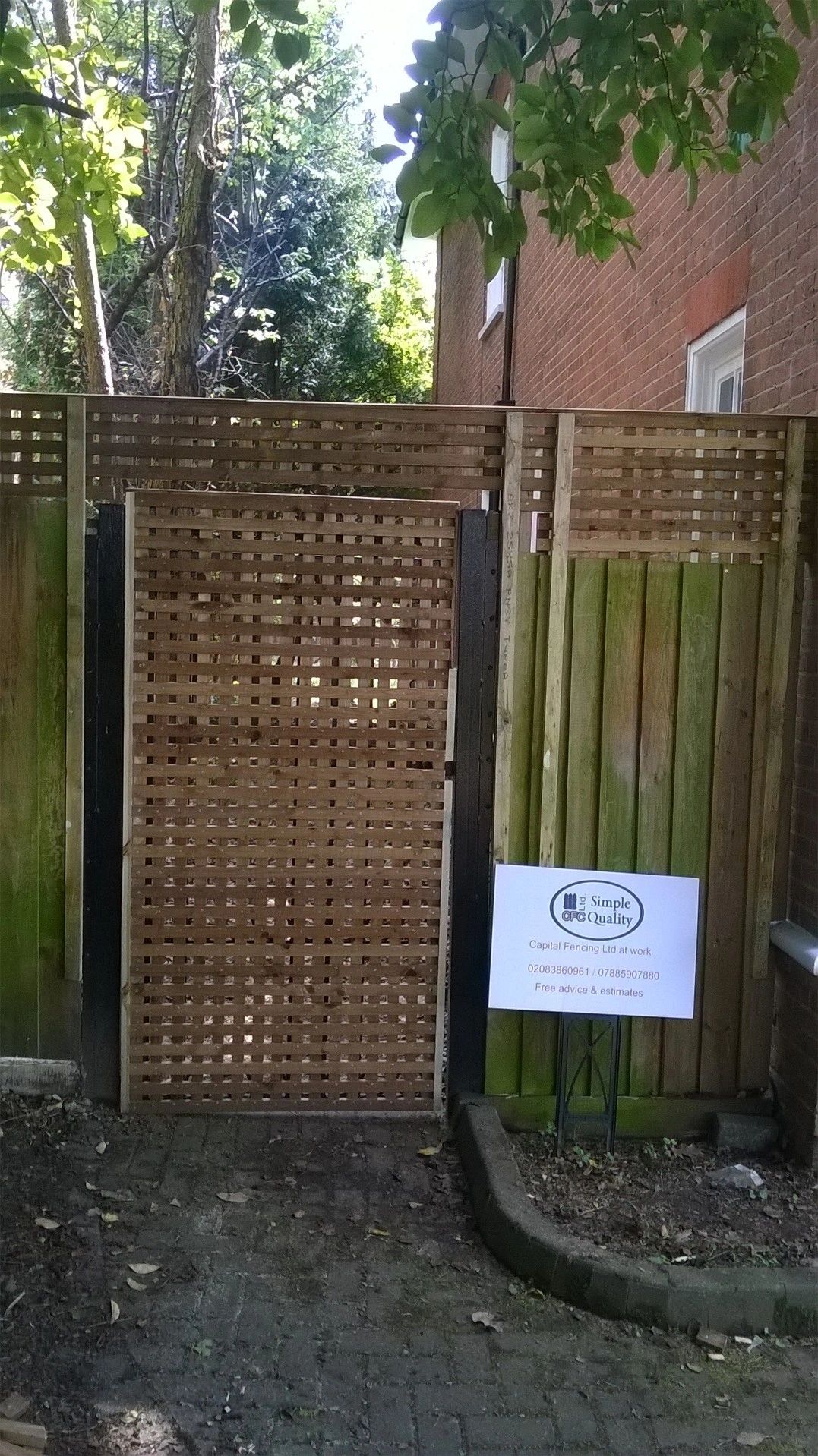
bespoke wooden gate installed by Capital Fencing in Barnet (EN5)double driveway gates installed by Capital Fencing in Barnet (EN5)hardwood side gate installed by Capital Fencing in Barnet (EN5)metal entrance gate installed by Capital Fencing in Barnet (EN5)

How we approach pedestrian side gates on Barnet properties

Perimeter fencing for a self-storage facility

A self-storage site's perimeter fence works alongside individual unit doors as a second layer of security, and is usually specified with a single controlled entry point so out-of-hours access can be logged or restricted even if some customers hold their own keys.

Height and topping on this type of perimeter tend toward the upper end of commercial practice because the contents behind any given unit door are unknown and the site is often unstaffed for long periods.

Arris rail sheared clean at the mortice joint

The morticed pocket cut into a post to take an arris rail end is a weak point in the post itself, and a rail under sustained load can shear off flush at that joint rather than splitting along its own length.

Repair options are a surface-mounted rail bracket that bypasses the damaged mortice entirely, or in more serious cases a new post section, since re-cutting a fresh mortice into an already-weakened post rarely holds long.

Splash-back staining from adjacent paving

A fence running alongside a patio, path or driveway picks up rain splash-back off the hard surface, which carries fine grit and, on older paving, residual cement dust that leaves a pale tide-mark along the lowest boards.

This band of discolouration is separate from general weathering and won't fade with the rest of the timber, since it is a surface deposit rather than UV bleaching.

A gravel strip or planting border between paving and fence line reduces the splash distance, and a periodic wash-down of just the lower boards keeps the tide-mark from building up permanently.

Fixing a post that has rotated in its concrete base

A post can twist within a slightly oversized or cracked footing without leaning, so the panels either side pull out of square even though the post still stands upright, which is easy to miss on a quick visual check.

Repair means breaking out enough concrete to free the post, resetting it square to the run, and packing and re-pouring rather than trying to twist it back while still gripped by the old footing.

Fixing a fence or gate to a neighbour's wall

Attaching a new fence panel, gate post or trellis to a wall that belongs solely to a neighbour is a trespass unless they've agreed to it, even where the fixing itself is small and reversible like a single bracket.

Where a wall is genuinely shared or in unclear ownership, written agreement before drilling avoids disputes later, particularly since removing a fixing can leave visible damage the wall owner didn't consent to.

The safer default on an unclear boundary is a free-standing post set just inside the client's own land, rather than relying on an existing structure whose ownership hasn't been confirmed.

Trellis toppers and wind load

A trellis topper adds height to an existing or new fence — commonly for climbing plants or extra privacy — and because it's open lattice rather than solid boarding it adds relatively little wind load for the height gained.

That's useful on boundaries close to the 2m permitted development limit, where a solid panel extension would push both height and wind loading up together, but it only works if the topper is genuinely open lattice rather than a solid infill dressed up as trellis.

Fixing a topper to an old or undersized post rather than the fence itself is the most common reason toppers come loose, since the extra leverage at height needs a post that was sized for it from the start.

Trellis toppers and additional wind load

Adding a trellis topper to increase privacy height also increases the wind load a fence has to carry, since even open lattice trellis catches more air than its slim appearance suggests, especially once climbing plants fill in the gaps.

Posts sized correctly for a 1.8m panel don't automatically have the reserve strength for panel-plus-trellis at 2.1m or more, particularly on an exposed run.

Where a taller finished height is wanted, it's worth specifying posts for the full combined height from the outset rather than treating the trellis as a lightweight afterthought bolted to the top.

Inspecting fixing points for early corrosion during routine maintenance

Corrosion on a galvanised security fence typically shows first at cut ends, weld points and fixing holes where the zinc coating has been broken during manufacture or installation, rather than along an untouched length of rail or mesh.

A routine inspection checks these specific points rather than relying on a general look along the fence line, since a fixing bolt corroding from the inside can look sound from the outside until it fails under load.

Boundary near a railway or utility corridor

A boundary next to a railway or utility corridor may be governed by the operator's own standards as well as normal planning rules, and access for their maintenance staff sometimes has to be preserved even where the land is privately owned.

Any work close to a railway boundary generally needs the operator notified in advance, and specific fence types or heights may be mandated rather than left to the landowner's choice.

Replacing a fence on the same line as before

Replacing a fence exactly where the old one stood is generally the lowest-risk approach from a boundary perspective, since it maintains a position both neighbours have already implicitly accepted for years.

It's still worth flagging the planned replacement to a neighbour beforehand, particularly if the new fence will be a different height, material or style to what's there now.

Where the old fence's exact line is unclear because it has leant or shifted over time, marking out the intended new line and briefly confirming it with the neighbour avoids later disagreement.

Removing old fencing and waste

Old fence panels, rotten posts and broken concrete bases don't disappear on their own, and a domestic wheelie bin won't take timber or rubble — it needs a licensed waste carrier and, for larger volumes, a registered waste transfer note.

Treated timber in particular shouldn't go on a garden bonfire, since older stock may have been treated with preservatives that produce harmful smoke when burned.

We'd always confirm whether removal and disposal of the old boundary is included in a quote, since it's one of the most common items left out of a cheaper like-for-like comparison.

Diagnosing a latch that only sticks in damp weather

A latch or gate that closes fine in dry weather but sticks or binds after rain is very often timber swelling with moisture rather than a hardware fault, and this points to a finish or ventilation issue rather than the latch mechanism itself.

Confirming the pattern is weather-related before adjusting or replacing hardware avoids fixing a symptom that will return with the next wet spell.

Concreted posts against bolted baseplates for a semi-permanent compound

A concreted post gives a stronger, more permanent fixing appropriate to a fence expected to stay in place indefinitely, but it's disruptive and costly to remove if the boundary line needs to move later, such as when a leased yard's layout changes.

A bolted baseplate fixed to an existing hardstanding trades some ultimate strength for the ability to relocate or remove the fence relatively cleanly, which suits a semi-permanent compound on a leased site better than a fully concreted installation.

Coordinating fencing work with other trades on a shared site

On a job where fencing follows landscaping, paving or groundworks by another trade, confirming final levels and boundary positions with that other trade before digging starts avoids fence posts being set to a level that then changes once the remaining groundwork is finished.

Where fencing is scheduled before paving, agreeing which side of the post line the paving will finish against prevents a post ending up embedded in what should have been a clear paving joint.

Simple sequencing conversations at the outset, rather than each trade working to its own assumptions, avoid the more expensive alternative of one trade's finished work being disturbed by the next.

Spigot connections between post and base

A spigot system lets a post be lifted clear of its ground socket for replacement without breaking out the surrounding concrete, which is useful where a vehicle strike or corrosion has damaged one post in an otherwise sound run.

The spigot itself needs to be a snug fit rather than a loose sleeve, because play at that joint under lateral load is what eventually works a socket wider and lets the post rock.

Decking substructures on clay

Timber decking built directly on shallow clay can move as the ground shrinks and swells seasonally, which shows up as a joist that's level in summer and slightly proud or dipped in winter.

Deeper post supports, or a raised deck design that isn't reliant on ground-bearing pads sitting in the active clay zone, avoid most of that seasonal movement.

Ventilation underneath the deck matters just as much as the foundation — a low, boxed-in deck with poor airflow traps moisture against the joists regardless of how well the posts are set.

Matching stain colour on a repaired section against a faded run

A freshly stained repair section will look noticeably darker or more saturated than the rest of a run that's faded over several seasons of UV exposure, even using the exact same product and shade.

Some clients prefer to accept this and let the new section weather in naturally over a season, while others ask for the whole run to be recoated at the same time for a more even finish immediately after the repair.

Repair-versus-replace based on the remaining service life of the rest of the run

A repair on a fence that's otherwise only a few years old is a straightforward like-for-like fix, but the same repair on a run that's already close to the end of its typical service life is worth weighing against bringing the replacement forward instead.

This isn't about age alone — a well-maintained older fence can still be worth repairing — but age combined with visible general wear elsewhere on the run is a reasonable prompt to discuss the wider picture rather than only the failed section.

Stain, oil and paint finishes compared

A stain sits mostly on the surface with some absorption, giving colour and some UV protection while still letting the timber's grain show through, and it typically needs reapplying every couple of years on an exposed fence.

An oil penetrates further into the timber and feeds it rather than just coating it, which suits open-grained hardwood decking and cladding, but it wears off through foot traffic and weathering faster than a stain on a vertical surface.

Paint gives the most complete colour coverage and hides the timber grain entirely, but it also traps moisture behind an intact film if the substrate isn't fully dry, and a failed paint film is harder to recover from than a faded stain, which just needs cleaning and recoating.

Keeping treated timber offcuts away from food-growing areas

Offcuts of pressure-treated fencing timber shouldn't be left lying in or used to edge a vegetable bed or fruit cage, since preservative can leach out of cut ends into adjacent soil over time.

Keeping offcuts on a hard surface or sheeting rather than directly on a border during the works avoids this becoming an issue even temporarily while the job is ongoing.

Where a client specifically wants to reuse leftover timber for raised beds, it's worth flagging that treated fencing stock isn't the right material for that purpose regardless of how convenient the offcuts seem.

Reinstating the ground surface after post installation

Concreting a post line through a lawn, gravel or paved surface leaves disturbed ground either side that needs reinstating to stop it becoming a trip hazard or a soft spot that later settles unevenly.

On a paved or block-paved surface, cut edges are made clean and matching material is used for reinstatement rather than left as a visible, poorly finished scar along the new fence line.

Tongue-and-groove privacy panels

Tongue-and-groove boards interlock edge to edge with no overlap, giving a genuinely solid, gap-free face that's the most private board profile available in timber fencing.

Because the boards key into each other rather than overlapping, the panel needs to be built with a small allowance for seasonal swelling, or the interlocking edges can bind and cup as the timber moves.

It's a heavier, stiffer panel than lap or slatted profiles, so it's usually paired with more substantial posts, and it's a common choice for pool or hot-tub screening where sightlines matter more than airflow.

Pedestrian Side Gates across EN5, N20 is a regular run for us. We'll quote honestly, tell you if pedestrian side gates isn't the right answer for your site, and book the job in within a week or two of a signed quote. measured, quoted and installed by the same small crew. Roads such as Sunset View and Hadley Green Road are typical of the local layout. Chipping Barnet churchyard is a useful local reference point. The Victorian terraces off Wood Street back onto mature street trees protected by the council.

Get In Touch

Get My Free Quote — 24h Response

No callout fee · Free site visit · Friendly local team covering London & Hertfordshire.

Call us
07885907880
or 02036484746
Email
capital_fencing@yahoo.com
WhatsApp
Message us anytime
Area
London & Hertfordshire
Payment
Card payments accepted

Pay by debit or credit card, bank transfer or cash once the work and price are agreed. No deposit taken online.

Request a Free Quote

We'll get back to you within 24 hours.

Free Site Visit No Callout Fee
Call WhatsAppQuote