London & Hertfordshire Free Site Visit
bespoke wooden gate installed by Capital Fencing in Finchley (N3)
Finchley · N3 / N12

Driveway Double Gates, Finchley: engineered-to-load spec for Edwardian terraces in Church End

Capital Fencing installs driveway double gates across Finchley and out toward barnet and mill hill. What separates a driveway double gates job from a standard boundary is the detail: 3.0m opening hardwood double gates on ball-race hinges with drop bolt and top slide bolt. That's the work, not the marketing. Roads such as East End Road and Ballards Lane are typical of the local layout. Finchley Central station is a useful local reference point. Fallow Court Avenue and Squires Lane share a back-alley layout with a pedestrian corridor running between the plots.

Capital Fencing installs driveway double gates across Finchley and out toward barnet and mill hill. What separates a driveway double gates job from a standard boundary is the detail: 3.0m opening hardwood double gates on ball-race hinges with drop bolt and top slide bolt. That's the work, not the marketing. Roads such as East End Road and Ballards Lane are typical of the local layout. Finchley Central station is a useful local reference point. Fallow Court Avenue and Squires Lane share a back-alley layout with a pedestrian corridor running between the plots.

Default spec

How we build driveway double gates in Finchley

44mm framed, tongue-and-groove or composite infill, hot-dip galvanised or stainless ironmongery, sized to the actual masonry opening not the drawing. On Finchley jobs we adjust for tree-root activity in clay soil regularly lifts old fence runs — full re-set is the typical brief.

Property mix locally: Edwardian terraces in Church End, large semis around Hampstead Garden Suburb borders, and 1930s housing in Woodside Park. Typical gardens: mid to large gardens; mature trees and London clay are the recurring constraints. Postcodes we regularly service: N3, N12.

Why this spec, for homes with off-street parking wanting matched double vehicle gates, manual or automated

  • measured on site off the actual brick piers, not a builder's plan set
  • prepared for future automation even when you're not fitting it yet — cabling ducts under the drive, hinges rated for it
  • matched pedestrian gate carried in the same visit so alignment and finish are identical

Where driveway double gates isn't the right answer

  • spans over 4m where a cantilever slider is a better answer than a two-leaf swing
  • sloping driveways where full-close geometry isn't achievable without a rising hinge system

Typical driveway double gates briefs in Finchley

  • 3.0m opening hardwood double gates on ball-race hinges with drop bolt and top slide bolt
  • 4.0m composite-faced double gates prepared for underground automation

Driveway Double Gates FAQs — Finchley

Can pedestrian and vehicle gates share the same finish and ironmongery?

On driveway double gates jobs in Finchley (N3), our default answer is: 44mm framed, tongue-and-groove or composite infill, hot-dip galvanised or stainless ironmongery, sized to the actual masonry opening not the drawing. The honest trade-off is not levelling the closing point — one leaf drags on the drive within a year — which is exactly what our default spec designs out.

How do you stop a heavy gate dropping on the closing point?

Across Finchley we spec around tree-root activity in clay soil regularly lifts old fence runs — full re-set is the typical brief, so on driveway double gates that usually means iroko hardwood on galvanised ironmongery. For context: prepared for future automation even when you're not fitting it yet — cabling ducts under the drive, hinges rated for it. Structural spans and post depths calculated, not guessed.

What's the widest span before double gates need a wheel or cantilever?

Barnet coverage means we can survey most N3 addresses inside a week — homes with off-street parking wanting matched double vehicle gates, manual or automated. We'll walk you through measured on site off the actual brick piers, not a builder's plan set on the site visit before you commit.

Can wooden driveway gates be automated later?

Practically: 3.0m opening hardwood double gates on ball-race hinges with drop bolt and top slide bolt. That's the Finchley version of this job, not a generic one. We'll walk you through measured on site off the actual brick piers, not a builder's plan set on the site visit before you commit.

How much clearance do you leave under a driveway gate?

On driveway double gates jobs in Finchley (N3), our default answer is: 44mm framed, tongue-and-groove or composite infill, hot-dip galvanised or stainless ironmongery, sized to the actual masonry opening not the drawing. For context: prepared for future automation even when you're not fitting it yet — cabling ducts under the drive, hinges rated for it. Structural spans and post depths calculated, not guessed.

Recent driveway double gates work
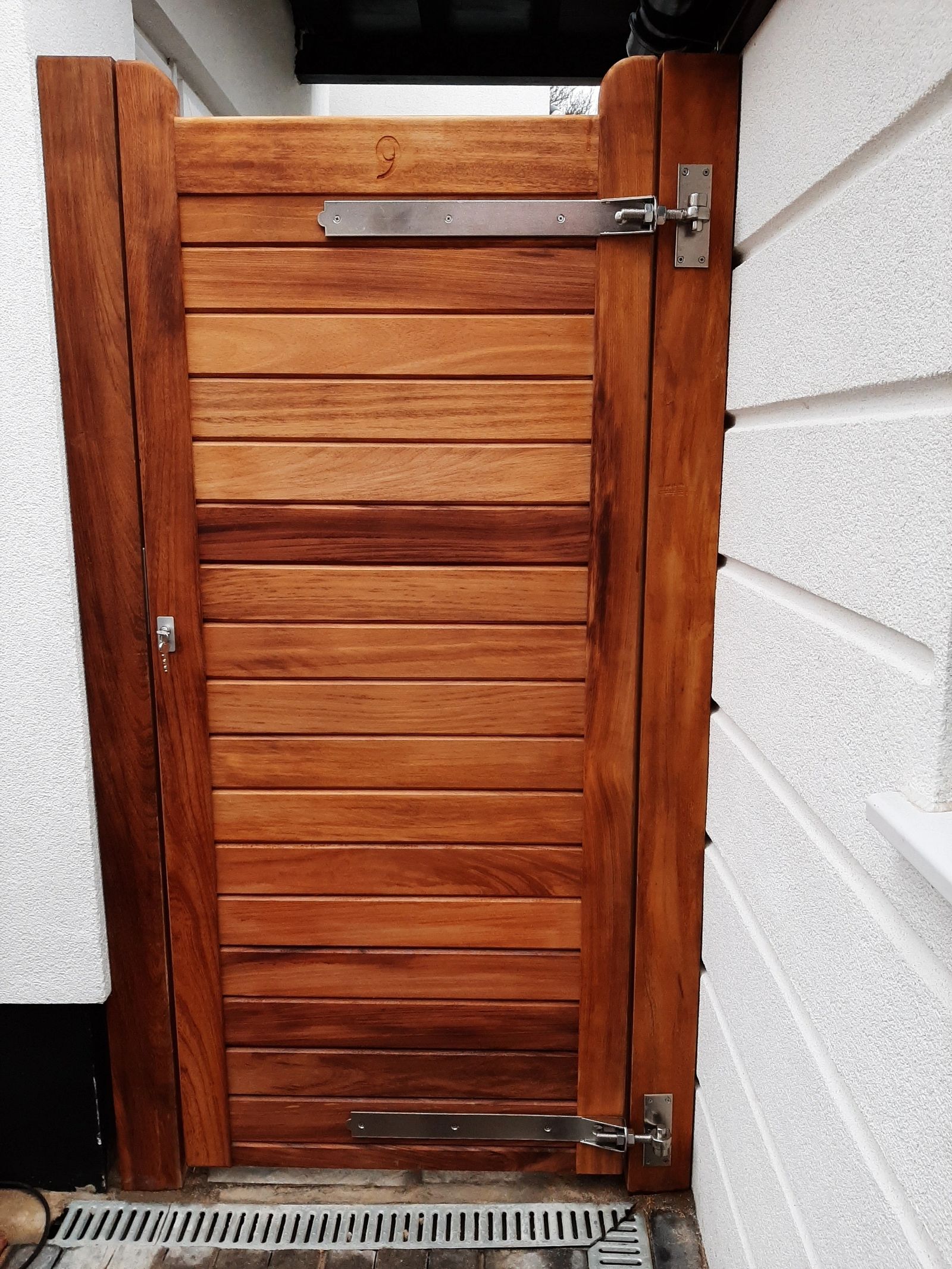
bespoke wooden gate installed by Capital Fencing in Finchley (N3)double driveway gates installed by Capital Fencing in Finchley (N3)hardwood side gate installed by Capital Fencing in Finchley (N3)metal entrance gate installed by Capital Fencing in Finchley (N3)

How we approach driveway double gates on Finchley properties

Timber, mesh and steel palisade compared

Timber gives a solid sightline and a domestic look but needs a heavier spec than a standard garden fence to hold a security brief; steel palisade and weld-mesh give a harder physical barrier with a more industrial appearance, which suits a yard better than a front garden.

Most briefs end up as a mix — a solid section where privacy matters and a mesh or railing return where an open sightline is more useful — rather than one material for the whole boundary.

Post-support metal spikes and why they loosen

A drive-in metal spike relies entirely on ground compaction around the socket for stability, so any repeated wind loading or ground softening after heavy rain gradually works the socket wider and the post starts to rock.

Once a spike has loosened it rarely re-tightens on its own; the usual fix is a larger spike bedded in fresh concrete or a switch to a concreted timber post if the ground repeatedly won't hold a spike.

Clearing debris from a sliding gate track

Leaves, gravel and windblown litter collect in a ground-level sliding gate track over time, and a build-up is one of the most common reasons a gate that used to run smoothly starts binding or stalling partway along its travel.

Regular clearing of the track, particularly after autumn leaf fall or after a period of wind, prevents debris from being repeatedly crushed into the track and becoming harder to remove.

Checking joist bearing sits level across uneven support pads

Deck support posts or pads set at even so-slightly different heights throw the whole joist run out of level, which shows on the finished deck as a barely perceptible but persistent lean across its width.

Checking each support with a long level laid across several posts at once, rather than checking each post in isolation, catches a gradual drift in height across the run that individual checks would miss.

Packing shims under a joist to correct a low support point is an acceptable fix for a small discrepancy, but it isn't a substitute for getting the support posts themselves right in the first place on a new build.

Framed, ledged and braced gate frames

A framed, ledged and braced gate combines a proper mortice-and-tenon perimeter frame with ledges and a diagonal brace behind the boarding, giving more racking resistance than a simple ledged-and-braced gate that has no frame at all.

This construction costs more to build than a basic ledged gate but holds its shape for longer, which matters on a wider or more exposed opening.

Wind load: solid panels versus slatted screens

A solid close-boarded panel presents its whole face to the wind, so on an exposed run the load transferred into the post is far higher than the same height in a slatted or louvred screen with even small gaps between boards.

Manufacturers' span tables for solid panels assume a sheltered suburban garden; on an open plot the safe bay width between posts often needs reducing rather than relying on the standard 1.8m centre.

Where the client wants privacy rather than a windbreak, a slatted design with a close-boarded section lower down still cuts load noticeably while keeping most of the screening effect.

Fixing into a rendered wall without cracking the render

Render sits as a relatively thin, brittle coat over the masonry beneath it, so drilling straight through without care can crack or blow a patch of render around the hole rather than leaving a clean fixing point.

Marking and drilling a pilot hole slowly through the render layer first, before switching to full hammer action once through into the masonry, reduces the chance of the render cracking outward from the drill's initial impact.

Where render is already loose or hollow-sounding when tapped near the intended fixing point, it's worth choosing a different spot or repairing that patch of render first rather than fixing into a surface that's already failing.

Matching stain colour on a repaired section against a faded run

A freshly stained repair section will look noticeably darker or more saturated than the rest of a run that's faded over several seasons of UV exposure, even using the exact same product and shade.

Some clients prefer to accept this and let the new section weather in naturally over a season, while others ask for the whole run to be recoated at the same time for a more even finish immediately after the repair.

Footway licences for materials on a pavement

Storing fencing materials, a small skip, or scaffolding on a public footway, even briefly, can require a licence from the council responsible for that stretch of highway.

This is separate from any parking suspension for a vehicle, and covers the physical obstruction of pedestrian space rather than the road itself.

On narrow residential pavements it's worth checking the council's footway licence requirements ahead of a delivery, since blocking a pushchair or wheelchair route without authorisation can draw a complaint.

Striker plate material and post protection

A metal striker plate let into the post protects the timber from repeated latch impact and gives the latch bolt a hard, true surface to engage with, rather than relying on the post timber itself to take that wear.

A post without a striker plate develops a worn, rounded hole around the latch opening over time, which eventually stops the latch holding securely even if realigned.

Handling heavy gate posts and large timbers safely

A large hardwood or oversized gate post can be too heavy to lift and position safely by hand, particularly into a deep hole, so a simple lifting aid such as a sack truck, roller bars or a block and tackle reduces the risk of a manual handling injury.

Lowering a heavy post into a hole under control, rather than dropping the last stretch, also protects the hole's sides from collapsing under the impact just as it's being positioned.

Where a post genuinely needs mechanical assistance to move safely, planning that equipment into the job at the outset avoids improvising with inadequate lifting methods on the day.

Questions to ask any fencing contractor

Worth asking directly: who owns the boundary being worked on, what happens if buried obstructions are found, and whether waste removal and disposal are included in the price rather than charged separately afterwards.

It's also reasonable to ask what post-setting method will be used for the specific ground conditions on site, since a contractor who hasn't looked at soil type before quoting depth and concrete volume is guessing rather than specifying.

Asking how a contractor handles a shared boundary with a neighbour who hasn't been consulted is a good test of whether they've thought through the ownership question at all, rather than just the fence itself.

Adjustable bolt-on hinges for metal gates

Adjustable bolt-on hinges, common on metal driveway gates, let the gate's height and pitch be fine-tuned after fitting via a bolt and welded bracket rather than needing the hinge repositioned entirely.

These are useful where ground level or post position isn't perfectly fixed, since small adjustments can be made without unbolting the gate from the post.

Reinforcing a hinge post weakened by gate movement

A gate hinge post takes repeated leverage every time the gate swings, which loosens its footing faster than a plain fence post nearby carrying no such load, and it's a common early failure point on a boundary that includes a gate.

Reinforcing usually means a larger post section, a deeper footing, or bracing back into the adjoining fence run, rather than simply resetting the same post size that already proved inadequate for the load.

Gravel boards and dig-under prevention

A gravel board closes the gap between ground and fence face that would otherwise let someone lift the bottom of a panel or dig a shallow scrape underneath on soft ground.

On a security-rated run, a concrete gravel board set into the ground line resists both rot and digging better than a timber board sitting on the surface, and it's the standard choice where dig-under is a realistic risk.

Listed building curtilage and garden structures

Listed building protection doesn't stop at the walls of the house — structures within its curtilage that were there at the date of listing, including some garden walls, gate piers and railings, can be treated as part of the listing itself.

That means a wall or gate that looks like an ordinary garden feature can technically need listed building consent for repair or replacement, and unauthorised work is a criminal offence rather than a simple planning breach.

Where a period boundary feature might be curtilage-listed, it's worth confirming with the council's conservation team before any demolition, since consent (or confirmation that it's not required) can usually be obtained in parallel with getting quotes.

Listed building curtilage and garden boundaries

Structures within the curtilage of a listed building — which can include garden walls, gate piers and sometimes fencing — may themselves be treated as part of the listing, even if not mentioned explicitly.

That means listed building consent can be required for work that would otherwise be unremarkable on a non-listed property, and doing work without consent where it's needed is a criminal offence.

Anyone unsure whether their boundary falls within this kind of curtilage should raise it with the council's conservation or listed buildings officer before starting.

School and nursery boundary needs

Boundaries around schools, nurseries and other settings used by children are usually specified with child safety in mind first — no horizontal rails that could be used to climb, gaps too narrow to trap a small limb, and self-closing gates with child-safe latches on any pedestrian access.

Height matters both for containment and sightlines: too high and staff lose visibility into a play area from a building; too low and it's not a meaningful boundary at all.

Any work on an occupied site with children present also has practical scheduling implications — most of this work happens outside term time or during holiday closures to avoid disruption.

Corrosion at ground line on steel posts

The point where a post meets the ground or concrete collar is where corrosion concentrates, because moisture sits there longest and any coating is most easily scuffed during installation.

A sacrificial sleeve, extra coating thickness, or a slight fall on the concrete collar to shed water all reduce this, and it's worth checking on any steel post that's been in the ground more than a few years.

Cane bolt leverage on wide leaves

The long shaft of a cane bolt gives more leverage against a wide gate leaf twisting in wind than a short bolt fixed close to the bottom rail, which is why they're specified on wider double-gate leaves rather than narrow pedestrian gates.

A cane bolt still needs a properly prepared ground socket to work, and a shaft dropped onto uneven paving without a socket wears quickly and loses its holding grip.

Digging in summer-baked clay ground

Clay that's dried and cracked over a hot summer can be almost as hard as digging through soft rock in the top few hundred millimetres, even though the same ground would be workable a season later once it's rehydrated.

An auger struggles on baked clay in the same way it struggles on rubble, tending to bounce and judder rather than cut cleanly, so a pilot hole broken up with a bar first can make the auger's job easier.

Watering the dig point lightly the day before, where practical, softens the very top layer enough to ease the first stage of digging without turning the hole into a mud pit.

Diagnosing an uneven gap between gate and post

A gap that's wider at the top than the bottom, or vice versa, between a gate and its latch post usually indicates the gate has racked out of square rather than simply dropped evenly, which is a frame issue rather than a hinge-height issue.

Measuring the gap at both top and bottom before starting a repair helps distinguish a racking fault from a straightforward drop, since the two need different corrections.

Driveway Double Gates across N3, N12 is a regular run for us. We'll quote honestly, tell you if driveway double gates isn't the right answer for your site, and book the job in within a week or two of a signed quote. structural spans and post depths calculated, not guessed. Roads such as Squires Lane and Ballards Lane are typical of the local layout. North Finchley bus garage is a useful local reference point. The Church End Conservation Area covers much of the historic centre around Avenue House.

Get In Touch

Get My Free Quote — 24h Response

No callout fee · Free site visit · Friendly local team covering London & Hertfordshire.

Call us
07885907880
or 02036484746
Email
capital_fencing@yahoo.com
WhatsApp
Message us anytime
Area
London & Hertfordshire
Payment
Card payments accepted

Pay by debit or credit card, bank transfer or cash once the work and price are agreed. No deposit taken online.

Request a Free Quote

We'll get back to you within 24 hours.

Free Site Visit No Callout Fee
Call WhatsAppQuote