London & Hertfordshire Free Site Visit
closeboard fence run installed by Capital Fencing in Edgware (HA8)
Edgware · HA8

School & Nursery Fencing in Edgware (HA8)

School and nursery fencing in Edgware is one of our regular briefs — primary schools, nurseries and early-years settings needing safeguarding-compliant boundaries. On 1930s semis built around the tube extension with rectangular suburban gardens, the failure mode we see most often is the one we design out first. Roads such as Edgwarebury Lane and Station Road are typical of the local layout. Edgware bus station is a useful local reference point. The A5, running through the town, follows the route of the Roman Watling Street.

School and nursery fencing in Edgware is one of our regular briefs — primary schools, nurseries and early-years settings needing safeguarding-compliant boundaries. On 1930s semis built around the tube extension with rectangular suburban gardens, the failure mode we see most often is the one we design out first. Roads such as Edgwarebury Lane and Station Road are typical of the local layout. Edgware bus station is a useful local reference point. The A5, running through the town, follows the route of the Roman Watling Street.

Why this spec, for primary schools, nurseries and early-years settings

  • no horizontal rails at climbable heights — safeguarding-first geometry
  • hot-dip galvanised then powder-coated finishes carry a 25-year service life
  • welded rather than bolted joints so nothing works loose over a school year

Typical school and nursery fencing briefs in Edgware

  • bow-top mesh replacing tired timber around a nursery outdoor area
  • 1.8m weld-mesh on galvanised posts around a primary school MUGA
Default spec

How we build school and nursery fencing in Edgware

1.2m or 1.8m bow-top or 358 weld-mesh, hot-dip galvanised then RAL powder-coated posts, self-closing gates with anti-finger-trap hinges. On Edgware jobs we adjust for side-return access on edgware semis is genuinely narrow — long panels often have to come up over the garage.

Property mix locally: 1930s semis built around the Tube extension, plus newer flats near the town centre. Typical gardens: rectangular suburban gardens, mostly flat, often with mature fruit trees. Postcodes we regularly service: HA8.

we install to BS 1722-14 for bow-top and BS 1722-10 for weld-mesh, provide safeguarding-relevant sign-off notes, and can attend outside term time only.

What goes wrong

Common failure modes on school and nursery fencing

  • specifying decorative railings with climbable finials near a play area — trips a safeguarding audit every time
  • under-sized gate posts on double vehicle gates — they drop within a year on daily use

School & Nursery Fencing FAQs — Edgware

Do you supply RAMS and public-liability certificate ahead of works?

On school and nursery fencing jobs in Edgware (HA8), our default answer is: 1.2m or 1.8m bow-top or 358 weld-mesh, hot-dip galvanised then RAL powder-coated posts, self-closing gates with anti-finger-trap hinges. We install to BS 1722-14 for bow-top and BS 1722-10 for weld-mesh, provide safeguarding-relevant sign-off notes, and can attend outside term time only.

How do you avoid finger-trap points on self-closing gates?

Across Edgware we spec around side-return access on edgware semis is genuinely narrow — long panels often have to come up over the garage, so on school and nursery fencing that usually means bow-top 1.2m for EYFS boundaries. For context: hot-dip galvanised then powder-coated finishes carry a 25-year service life. Installed to BS 1722 standards, with fitter details available on request.

Can the job be scheduled inside a half-term break?

Barnet coverage means we can survey most HA8 addresses inside a week — primary schools, nurseries and early-years settings needing safeguarding-compliant boundaries. We install to BS 1722-14 for bow-top and BS 1722-10 for weld-mesh, provide safeguarding-relevant sign-off notes, and can attend outside term time only.

Can pedestrian and vehicle gates share a controlled entry?

Practically: bow-top mesh replacing tired timber around a nursery outdoor area. That's the Edgware version of this job, not a generic one. For context: hot-dip galvanised then powder-coated finishes carry a 25-year service life. Installed to BS 1722 standards, with fitter details available on request.

What height should nursery outdoor fencing be?

On school and nursery fencing jobs in Edgware (HA8), our default answer is: 1.2m or 1.8m bow-top or 358 weld-mesh, hot-dip galvanised then RAL powder-coated posts, self-closing gates with anti-finger-trap hinges. We install to BS 1722-14 for bow-top and BS 1722-10 for weld-mesh, provide safeguarding-relevant sign-off notes, and can attend outside term time only.

Recent school & nursery fencing work
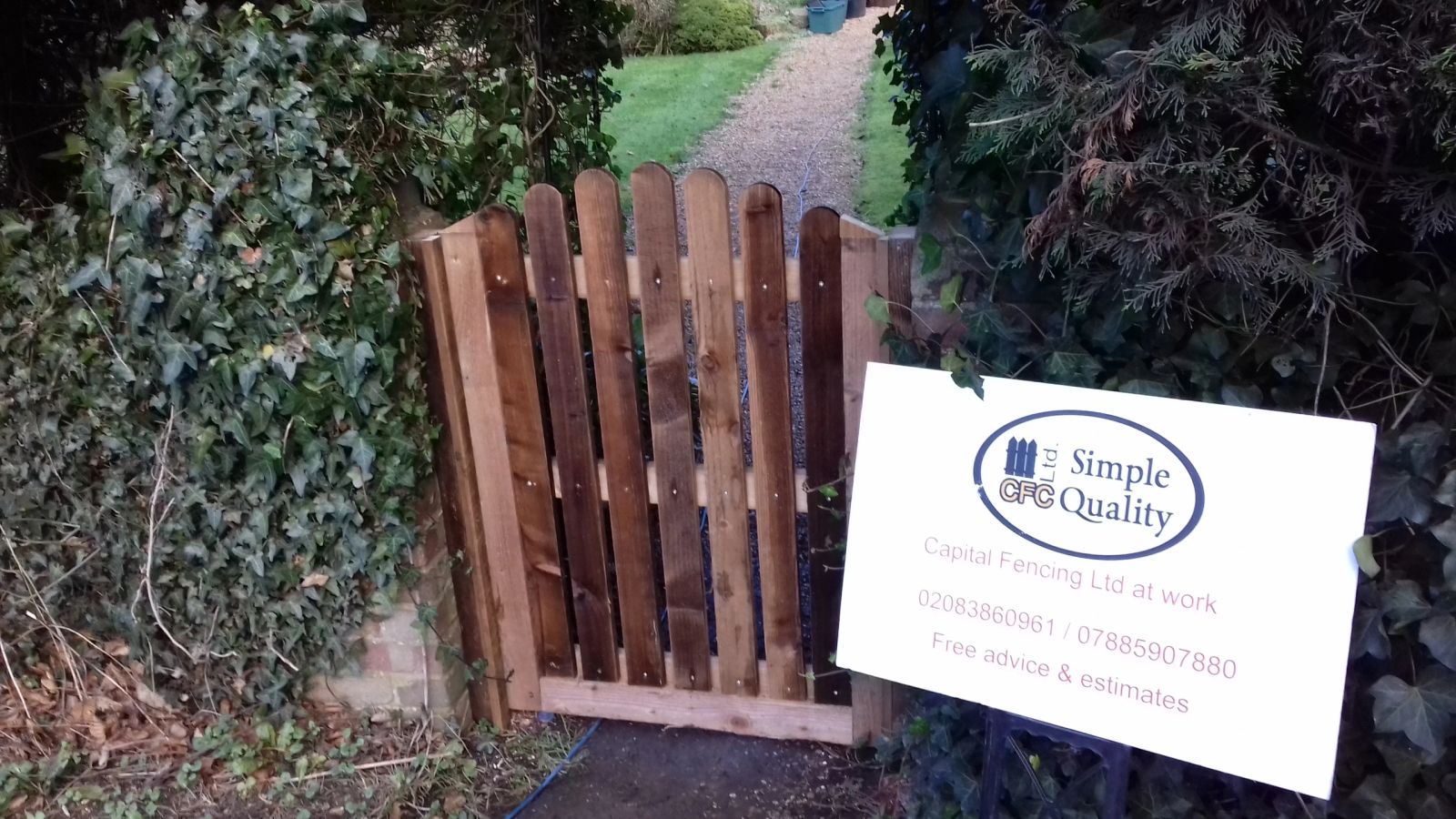
closeboard fence run installed by Capital Fencing in Edgware (HA8)panel fence install installed by Capital Fencing in Edgware (HA8)trellis-topped fence installed by Capital Fencing in Edgware (HA8)bespoke decorative fence installed by Capital Fencing in Edgware (HA8)

Local considerations across Edgware and mill hill

Permitted development height limits

Under the General Permitted Development Order, a fence, wall or gate can normally go up to 1m without planning permission where it fronts a highway used by vehicles, and up to 2m elsewhere on the plot.

That 2m figure is measured from the natural ground level, not from the base of a retaining structure, which catches people out on sloping plots where the fence ends up effectively taller on the low side.

Corner plots, listed buildings and land inside a conservation area all tighten these limits, so it's worth checking the local authority's own guidance before ordering materials rather than after.

Ironmongery checks during a fence repair

A repair visit is a natural point to check any gate ironmongery on the same boundary, since hinges and latches wear on a similar timescale to the timber around them and a worn hinge left unaddressed puts extra strain on a newly repaired gate post.

We flag any ironmongery that's due for replacement rather than only fixing the panel or post that prompted the call-out.

Handling excavated spoil on a fencing job

Digging even a modest run of post holes generates a surprising volume of spoil, and leaving it in a single heap on a lawn for the duration of a job kills the grass underneath if left more than a few days.

Spreading spoil thinly on a border, bagging it for removal, or arranging same-day disposal all avoid that dead patch, and the right choice depends on whether the client wants the spoil kept for landscaping elsewhere on the plot.

Heavy clay spoil is particularly slow to dry and awkward to barrow once it's rained on, so timing the dig to avoid leaving wet spoil sitting overnight where possible reduces both the mess and the extra effort of moving it later.

Tree Preservation Orders and a post line

A Tree Preservation Order protects specified trees from work that would damage them, and that protection extends below ground to root systems, not just the visible trunk and canopy.

Digging post holes within a protected tree's root protection area can count as damage even without touching the trunk, so it's worth checking the local TPO register before finalising a post line near a mature tree.

Where a TPO applies, the local authority can require an application before any groundworks proceed, and unauthorised damage carries meaningful penalties.

Recycled plastic fence posts

Posts made from recycled plastic, sometimes blended with additives for UV resistance and rigidity, avoid timber's rot and insect vulnerability entirely, since the material has no organic content for fungi or insects to attack.

They tend to be more flexible than an equivalent timber section of the same size, which can be an advantage in absorbing impact but a disadvantage where rigidity is needed to resist sustained wind load without visible sway.

Their thermal expansion behaviour is closer to other polymer products than to timber, meaning fixings and adjoining materials need similar allowance for movement as with composite boards rather than being treated as a timber-equivalent product.

Boundary fencing on land in a flood risk zone

Properties within a designated flood risk zone can be subject to additional requirements around solid boundary structures that might obstruct floodwater flow across the site.

A solid close-boarded fence can behave differently to a more open picket or post-and-rail design when it comes to how water moves through a garden during a flood event.

Where flood risk mapping shows a property is affected, checking with the local authority or Environment Agency for any relevant guidance is sensible before choosing a boundary style.

Converting a single gate to double

Widening a single gate opening into a double-leaf gate usually needs a new or repositioned hanging post partway across the opening as well as a slamming post on each outer side, rather than simply hanging two narrower leaves off the existing posts.

This is more involved than a straightforward repair and is worth planning against the full opening width before committing to a leaf size.

Trellis toppers failing under wind load separately from the fence

A trellis topper adds height and surface area above a solid panel, which increases the wind load the whole assembly has to resist even though the panel below might be perfectly sound, and toppers are a common point of failure in gusty conditions.

Where a topper has failed repeatedly on an exposed boundary, a lower-solidity design or additional bracing to the topper's own fixings is worth considering rather than replacing the same topper style each time it fails.

Pool and hot tub enclosure fencing logic

While UK regulations don't mandate pool fencing the way some other countries do, insurers and safety guidance still recommend a self-closing, self-latching gate and a barrier without easy footholds around any domestic pool or hot tub, particularly where young children have access to the garden.

The latch or lock should sit high enough that a small child can't reach it even standing at the gate, and the gate should swing away from the pool area rather than toward it so it can't be propped open accidentally.

A solid or closely-spaced barrier at least 1.2m high with no horizontal rails low enough to climb is the general standard worth applying even without a specific legal requirement to do so.

Alley-gating orders on rear access lanes

Some councils and police teams run formal alley-gating schemes, fitting lockable gates across shared rear alleys behind terraced housing under a specific legal order to reduce burglary and fly-tipping, with keys issued to residents whose properties back onto the lane.

Where such an order already exists, individual residents generally can't add their own separate gate or fence across the same alley without going through the same scheme, since the order regulates access for everyone on the row, not just one household.

Where no scheme exists but residents want one, the request usually starts with the council's community safety or highways team, since a privately-installed gate across a public right of way without authorisation can be ordered removed.

Checking the repair before signing off

Once a repair is finished we open and close the gate repeatedly to check it swings cleanly and latches first time, since a gate that only closes properly on the first attempt in calm conditions can still catch once it's windy or the ground has moved slightly.

We also check the diagonal brace, where fitted, is taking the load evenly rather than pulling to one side.

Checking wall coping condition before fixing into it

Coping stones or brick-on-edge capping along the top of a garden wall are often loosely bedded rather than solidly fixed, so drilling or clamping a fence post bracket into coping without checking it first can dislodge the coping itself.

A quick check by hand-pressure on each coping unit along the intended fixing line identifies any that are already loose, which is worth doing before committing to that wall as a fixing point at all.

Where coping is sound, spreading the fixing load across a bracket plate rather than a single point fixing reduces the chance of cracking the coping under wind load on the panels above.

Gravel-board clearance over uneven ground

A gravel board sitting flush with the soil on one section of a run can end up buried a couple of inches by the time the ground rises further along an uneven boundary, trapping moisture against timber that was specified to sit clear of the soil.

Stepping the board height slightly at each post, rather than running one continuous level line, keeps a consistent clearance above grade along the whole run.

Concrete gravel boards tolerate this ground contact better than timber ones, which is one reason they're specified as standard on plots with visibly uneven levels.

Checking which face of a panel should face outward

Many panel styles have a clear 'good' face with a neater finish and a reverse face showing the frame, battens or rail ends, and getting this the wrong way round means the less tidy side ends up facing the client's own garden or the neighbour's, depending on convention and agreement.

Where a boundary is shared, it's worth agreeing in advance which side the good face should present, since local convention varies and assuming it defaults toward the neighbour without discussion can cause an avoidable dispute.

Checking panel orientation before fixing, rather than after several panels are already up, saves having to unfix and turn a run of panels that all went in the wrong way round.

Panel versus closeboard repair economics

A panel fence is repaired panel by panel, so a single damaged section is a straightforward swap, whereas a closeboard fence is repaired board by board, which suits a partial repair better but takes longer per linear metre.

Where storm damage has hit a wide section, a panel system is often quicker to put right; where only a handful of boards are affected, closeboard repair wastes far less sound material.

Internal caged units within a self-storage facility

Beyond the site's outer perimeter fencing, many self-storage facilities also fit individual mesh cages or partition walls between units, giving each customer's space its own lockable boundary independent of the main building's access control.

Mesh cage partitions are usually specified with a smaller aperture than the outer perimeter mesh, since the concern at that internal scale is preventing reach-through between adjoining units rather than resisting an external climb-over attempt.

Concrete, timber and steel posts compared

Concrete posts don't rot, warp or need re-treating, which makes them the default for a long-life boundary, but they're heavier to handle, harder to cut on site, and can crack if struck hard rather than bending.

Timber posts are lighter, easier to notch and fix ironmongery to, and match a fully timber run visually, but they're the first component to fail through rot even when the boards above them are sound.

Steel posts (box section or RSJ) suit gates, very exposed runs or where a slim sightline matters, and they're galvanised or powder-coated rather than treated, but they need a compatible fixing method for timber infill panels rather than simple nailing.

Side-return gates and narrow access

A gate across a narrow side return between two properties often has very little clearance either side, which limits hinge type and swing direction and can rule out a wide double gate in favour of a single leaf.

We measure the full return width and any obstructions along the swing arc before recommending a hinge position on this kind of opening.

Dog-proofing details at ground level and gaps

Dogs test a fence at ground level far more than at height, so gaps under gravel boards, worn hollows on sloping ground, or wide overlaps between adjacent panels are the points most likely to let a determined dog through or under.

A close-fitting concrete gravel board set with minimal gap to the ground, rather than a timber board that can warp and lift, closes off the most common escape route without changing the overall fence design.

For persistent diggers, a buried mesh apron or paving strip just inside the fence line at ground level stops excavation without needing to alter the visible fence at all.

Electrified topping wire basics

An electrified topping wire adds a pulsed low-current deterrent above an existing fence line and is installed to specific clearance and signage rules rather than fitted freely, since it counts as a controlled hazard.

Specialist installers handle the energiser and wiring; the fencing contractor's role is limited to providing insulated brackets and a structurally sound top line for the wire to run along.

Play-safe detailing near a boundary

Where a fence runs alongside a play area, sharp pale tops, low horizontal rails that invite climbing, and gaps that could trap a limb are all avoided in favour of rounded caps and rail spacing that doesn't create a ladder.

This detailing sits alongside, rather than instead of, the security spec — a boundary can still be climb-resistant and impact-rated while removing the specific hazards that matter next to children.

Glue lines and re-gluing a loose frame joint

A joint that's opened up slightly but hasn't rotted can often be cleaned out, re-glued with an exterior-grade adhesive and clamped rather than remade from new timber, provided the wood itself is still sound.

Old animal-glue or PVA joints on older gates fail well before the timber does, which is why a loose but dry corner is worth checking before assuming a full rebuild is needed.

Primary schools, nurseries and early-years settings needing safeguarding-compliant boundaries — that's who this page is for. In Edgware and out to Barnet, we run the school and nursery fencing spec that survives side-return access on edgware semis is genuinely narrow — long panels often have to come up over the garage. Roads such as Hale Lane and Station Road are typical of the local layout. Canons Park is a useful local reference point. Edgware developed rapidly after the Northern line was extended to the area in the 1920s, and much of its housing dates from that period of suburban expansion.

Get In Touch

Get My Free Quote — 24h Response

No callout fee · Free site visit · Friendly local team covering London & Hertfordshire.

Call us
07885907880
or 02036484746
Email
capital_fencing@yahoo.com
WhatsApp
Message us anytime
Area
London & Hertfordshire
Payment
Card payments accepted

Pay by debit or credit card, bank transfer or cash once the work and price are agreed. No deposit taken online.

Request a Free Quote

We'll get back to you within 24 hours.

Free Site Visit No Callout Fee
Call WhatsAppQuote