Maintenance that prevents the next repair
Most repairs we're called out for could have been caught earlier with a simple seasonal check — a post that's started to lean, a gravel board showing early rot, or a hinge that's begun to sag are all cheaper to address before they fail outright.
We'll flag anything else on the boundary that looks like it's heading the same way while we're on site for an unrelated repair.
Retaining structures below a fence line
Where a retaining wall or sleeper structure holds back a level change directly under a fence, the fence and the retaining structure are doing two different jobs and shouldn't be treated as one build.
A timber fence post bolted into the top of a retaining wall relies entirely on that wall's own stability, so any doubt about the wall's condition needs resolving before new fencing is fixed to it.
Water draining from the raised bed above a retaining structure often exits at its base, which is worth accounting for when choosing post fixings and base materials at that point in the run.
Spirit level versus laser level for checking a run
A spirit level checks a single post is plumb and a single panel is level, but confirming that an entire run stays level or follows a consistent fall over 20 or 30 metres is far quicker and more reliable with a rotating laser level set at a fixed height.
On a stepped run, a laser also makes it straightforward to confirm each step drops by the same consistent amount rather than checking each post in isolation and hoping the cumulative effect looks even.
A basic spirit level remains the more practical tool for quick checks during a single post's installation, since setting up a laser for every individual post would slow the job without adding useful accuracy at that scale.
Exposed plots and wind funnelling between buildings
Wind doesn't just hit a fence head-on — gaps between buildings, especially in newer estate layouts with narrow side passages, can funnel and accelerate wind locally well beyond the general forecast for the area.
A fence positioned at the end of such a gap can see significantly higher loading than an identical run a few metres away in the lee of a building.
Recognising these funnelling positions at quote stage, and specifying heavier posts or a part-open panel design there, is more reliable than treating an entire plot as uniformly exposed or sheltered.
Corrosion inspection on buried metal fixings
Metal post anchors, brackets and shoes set at or below ground level corrode out of sight, meaning surface appearance above ground can look sound even where the buried portion has significantly deteriorated.
Rust staining bleeding up the timber post from ground level, or visible movement at the base despite an apparently solid concrete surround, are common indirect signs of corrosion happening below the visible surface.
Because the failure mode is progressive and hidden, periodic inspection of exposed fixings as a proxy, combined with checking for movement, is generally the practical approach rather than routinely excavating buried anchors.
Transition detail from decking down to lawn or planting
The edge where a deck meets an adjoining lawn or border needs a defined transition — a fascia board with a small step down, or a gravel or edging strip — rather than boards simply stopping at soil level, which otherwise leads to soil and organic matter migrating up against the deck edge.
That buildup against an unprotected deck edge holds moisture against the timber in exactly the way a raised bed built too close to a fence does, and is a common cause of localised rot along an otherwise sound deck perimeter.
A simple edging detail agreed at the design stage costs little compared with the deck itself but noticeably protects the vulnerable soil-contact edge.
Asbestos awareness near older garage flanks
Older garages, outbuildings and some boundary walls built before the 1999 asbestos ban can incorporate asbestos-containing materials in flank panels, corrugated roofing or old fence panel infill, particularly on properties from the mid-20th century.
Disturbing suspected asbestos material isn't something to tackle as part of routine fence replacement — it needs a competent assessment and, if confirmed, removal by a licensed contractor in line with HSE guidance.
Where an older boundary structure looks like it might contain asbestos sheeting, the sensible step is to leave it undisturbed and get it checked before any adjacent groundworks begin.
Freeholder consent for leasehold flats
Where a garden or yard is demised under a long lease rather than owned outright, the lease itself often requires the freeholder's written consent before any structural alteration, and a new fence, wall or gate can count as an alteration even in a small private yard.
Some leases route this through a managing agent who needs formal notice and a fee before works start, and skipping that step can technically breach the lease even where the work itself is uncontroversial.
It's worth reading the relevant clause of the lease, or asking the managing agent directly, rather than assuming that owning the flat gives unrestricted rights over its garden boundary.
Tongue-and-groove privacy panels
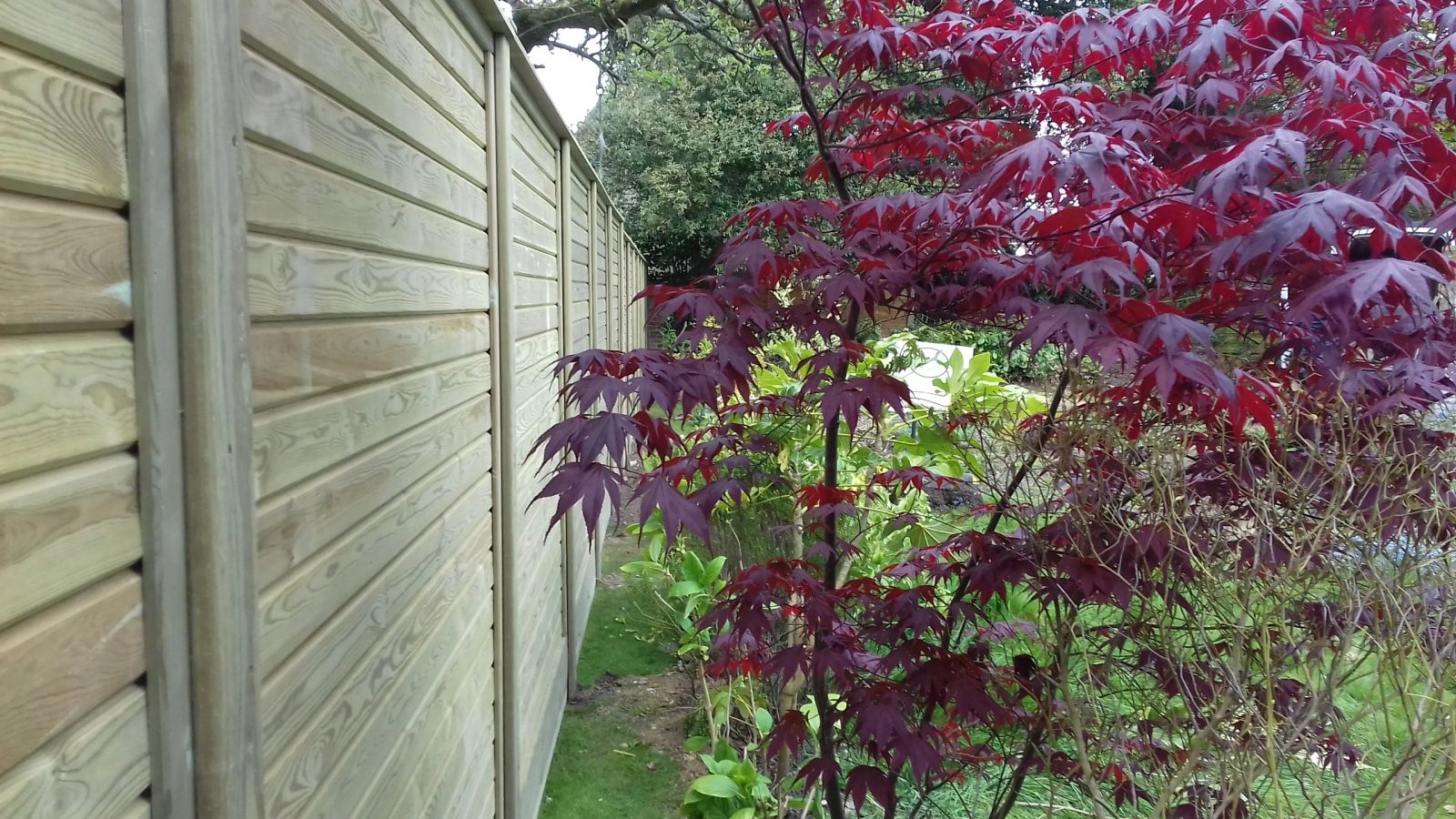
Tongue-and-groove boards interlock edge to edge with no overlap, giving a genuinely solid, gap-free face that's the most private board profile available in timber fencing.
Because the boards key into each other rather than overlapping, the panel needs to be built with a small allowance for seasonal swelling, or the interlocking edges can bind and cup as the timber moves.
It's a heavier, stiffer panel than lap or slatted profiles, so it's usually paired with more substantial posts, and it's a common choice for pool or hot-tub screening where sightlines matter more than airflow.
Why a night-time visual check adds value to a security survey
A daytime survey shows the fence's physical condition but not how it actually performs after dark, when most intrusion attempts happen, so a short evening visit to check lighting coverage, shadow lines and visibility from the street can reveal gaps a daytime walk-round misses entirely.
This isn't always practical for every job, but it's worth offering on a higher-value commercial site where lighting and fencing are both being reviewed together.
Choosing rail section size for a security run
Rails on a palisade or railing run are sized in cross-section to the span between posts, not to the pale height alone, because a rail that's too slender for its span will visibly deflect under a leaning or pushing load.
A heavier box-section or channel rail is specified on wider bays or taller runs, and increasing bay width to save on posts only works if the rail section is upsized to match the extra span.
Weed and damp membrane beneath a ground-level deck
A permeable membrane laid over the ground beneath a low-level deck suppresses weed growth and reduces the amount of moisture rising from bare soil into the enclosed void under the boards.
It needs to be permeable rather than a solid impermeable sheet, since trapping ground moisture entirely beneath an impermeable membrane can create a worse damp environment than leaving the soil exposed to some airflow.
Combined with adequate ventilation gaps at the deck's edges, a permeable membrane is a low-cost addition that measurably reduces the humidity the joists sit in throughout the year.
Gate detailing on sites prone to flooding
A gate on a boundary that's prone to periodic flooding benefits from open rather than solid infill low down, allowing floodwater to pass through rather than build up against a solid face and load the frame or undermine the posts.
Post fixings on flood-prone ground also need to account for the ground becoming waterlogged and softer than normal during a flood event, not just its condition in dry weather.
Public liability considerations on a shared boundary
Work that takes place on or near a shared boundary inherently affects two properties, which is one reason contractors carry public liability insurance covering damage or injury arising from the works, generally quite separate from any specific job guarantee.
Clients are entitled to ask to see a contractor's current public liability certificate before work starts, and for jobs involving excavation near a neighbour's structure or a shared wall it's reasonable practice to confirm cover explicitly rather than assume it.
This is a generic industry consideration rather than a claim about any particular policy, and the details of cover, exclusions and limits vary between insurers and should be checked directly with the provider.
Setting posts in clay
London clay and the heavier Hertfordshire boulder clays shrink and swell noticeably between a dry summer and a wet winter, which is exactly the movement that works a badly-set post loose over a few seasons.
The fix is depth and drainage rather than just more concrete: posts need to go below the zone that dries out and cracks seasonally, typically deeper than the standard 600mm used on free-draining ground, with a stone or gravel key at the base so water isn't trapped against the timber.
Postcrete alone on shallow clay bases is one of the most common reasons we're called out to replace a fence that's only a few years old.
Wildlife gaps for hedgehog movement
A small gap of around 130mm square cut into the base of a solid fence panel, sometimes called a hedgehog highway, lets hedgehogs move between connected gardens without needing to dig under or go around a continuous boundary.
This is increasingly requested by clients aware of declining hedgehog populations and is straightforward to incorporate into a new close-boarded panel, ideally agreed with the neighbouring property so the gaps line up on both sides of the boundary.
The gap doesn't compromise the fence's structural performance if it's cut cleanly within a single board rather than across a post or rail.
Fox digging and mesh skirts
Foxes commonly dig at the base of a fence line where the ground is soft, undermining a gravel board or creating a gap large enough to pass through underneath an otherwise intact fence.
A buried mesh skirt fitted along the base at repair time, angled outward below ground, is a more durable fix than repeatedly backfilling the same dug-out gap.
Keeps and hasps for padlocking
A keep holds a sliding or dropping latch bar, while a hasp is the separate hinged plate that a padlock passes through — the two are often confused but serve different jobs and aren't interchangeable on most gate designs.
Hasp screws are a common weak point since they're fitted from the accessible face; through-bolting a hasp gives more resistance to forcing than screws alone.
Applying for a Land Registry boundary determination
Where a boundary's exact position is genuinely disputed, it's possible to apply to HM Land Registry for a 'determined boundary', which involves a formal survey and legally fixes the line rather than leaving it as a general indication.
This process is comparatively rare for domestic disputes because of the cost and evidence involved, and is normally a last resort after direct discussion has failed.
Most everyday fence replacement work never needs this, but it exists as a formal route for the minority of cases where agreement genuinely can't be reached.
Keeping treated timber offcuts away from food-growing areas
Offcuts of pressure-treated fencing timber shouldn't be left lying in or used to edge a vegetable bed or fruit cage, since preservative can leach out of cut ends into adjacent soil over time.
Keeping offcuts on a hard surface or sheeting rather than directly on a border during the works avoids this becoming an issue even temporarily while the job is ongoing.
Where a client specifically wants to reuse leftover timber for raised beds, it's worth flagging that treated fencing stock isn't the right material for that purpose regardless of how convenient the offcuts seem.
How garden slope affects water shedding along a fence base
On a sloped garden, water naturally runs along the base of a fence line toward the lowest point, which means the downhill end of a run often sits in wetter ground than the uphill end even though both were built to the same specification.
This uneven exposure is a common reason why one end of an otherwise uniform fence needs gravel board replacement years before the rest.
A shallow cross-fall drainage channel or a slightly raised gravel board at the low point can intercept some of this flow before it pools against the timber.
Repairing trellis toppers
A trellis topper is a lighter structure than the fence panel beneath it and is usually the first part of a run to fail in wind, since its open lattice catches gusts differently to a solid panel face.
Where the topper has failed but the panel below is sound, only the topper needs replacing, refitted to the same post caps or brackets as the original.