
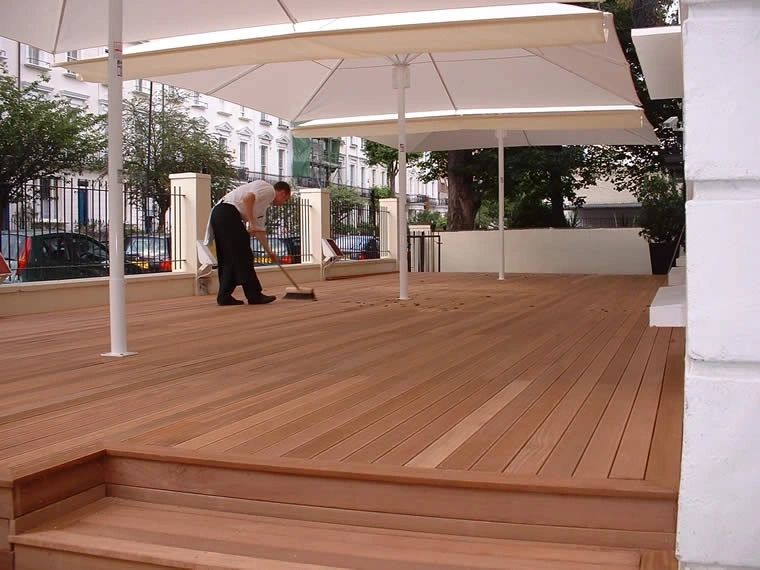
Decking steps join the deck to the garden, and they get more use than any other part of it. Good steps feel natural: every step is the same height, each tread is deep enough for a whole foot, and nothing moves when you stand on it. Poor steps catch people out, especially in the dark or when the boards are wet.
This guide explains how decking steps are planned: the rise and going, how many steps you need, width, how they are built, and how to keep them safe.
Rise and going
The rise is the height of each step; the going is the depth of each tread from front to back. Comfortable outdoor steps have a modest rise and a generous going, because people walk outdoors with longer strides and often carry things. The most important rule is that every rise is the same. Even a small difference between steps is enough to trip someone.
How many steps you need
Measure the height from the top of the deck to the ground where the bottom step will land, then divide it into equal rises. If the ground slopes, measure at the landing point, not at the deck edge. A low deck might need one step; a raised deck might need several, and at that point a handrail and possibly a landing come into it.
- Measure deck height at the landing point
- Divide into equal rises
- Check the total going fits the space in front
- Plan a firm landing at the bottom
Width and position
Steps can be a narrow flight to one side or a wide run across the whole front of the deck. Wider steps feel more relaxed and double as seating; narrower steps take less room from the garden. Think about where people actually walk: steps that line up with the path or the lawn get used, while steps in the wrong place end with a worn track beside them.
Stringers, treads and landings
Steps are built on stringers, the angled timbers that carry the treads, or as stacked boxes for low, wide steps. The stringers are fixed to the deck frame at the top and rest on a firm, level base at the bottom, never straight on soil. Treads are boarded in the same material as the deck, with a nosing board on the front edge so the step is easy to see.
Slip resistance and lighting
Steps get wet and shaded, and that is where green growth starts. Grooved or anti-slip boards, keeping steps clear of leaves and cleaning off algae all help; our slippery decking page explains the causes and fixes. If you want lights in the risers or treads, it is worth planning the positions while the steps are built, so an electrician can wire them in afterwards. Even a single light at the top and bottom of a flight makes a real difference after dark.
Handrails
A single step or two rarely needs a rail. A longer flight, steps off a raised deck, or steps used by older people or children are much safer with a handrail on at least one side. Building Regulations guidance covers when handrails and guarding are needed. Our decking balustrades page explains how rails are fixed, and our raised terrace decking page covers higher decks. For the deck and steps themselves, see our decking page.
Send us photos and rough measurements, we send a written estimate, then we visit to confirm before work starts. We cover London and Hertfordshire.