
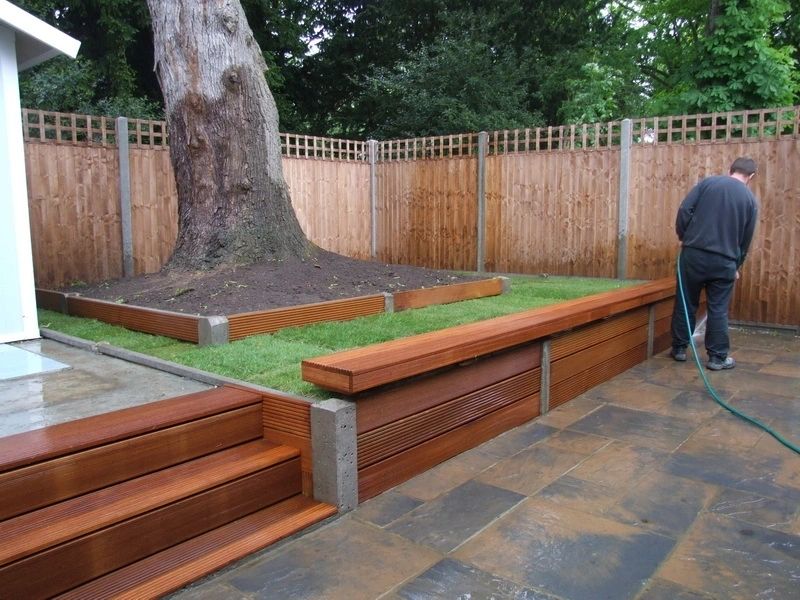
A decking balustrade is the rail, posts and infill around the edge of a raised deck or alongside its steps. It stops people stepping off the edge, gives you something to hold on the steps, and frames the deck. We fit balustrades and handrails to new decks and add them to existing ones, in timber spindles, composite or metal infill.
The look is a choice; the strength is not. A balustrade that wobbles when you lean on it is worse than none, so most of this page is about how it is fixed.
Does your deck need a balustrade?
As general guidance, a raised deck with a drop of about 600mm or more usually needs guarding along its open edges, and steps with several risers benefit from a handrail. Building Regulations guidance sets out when guarding is needed and how high it should be, so check it for your deck, particularly where children use the garden or the deck sits beside a steep drop.
Lower decks may not need a balustrade at all, but many people still add one on one side, or a short handrail on the steps, for comfort.
Heights and gaps
The guarding height and the size of gaps in the infill are both set out in Building Regulations guidance for domestic stairs and landings. The key points are that the rail is high enough to stop someone toppling over, and the gaps are small enough that a small child cannot get through. We set heights and spacings to that guidance when we build.
Fixing to the frame
Balustrade posts are fixed into the deck frame, not just screwed onto the top of the boards. They are bolted to the outer joists, with extra blocking where needed, so they resist being pushed outwards. On an existing deck we check the outer joists first; if they are soft or undersized, they are strengthened before the posts go on.
- Posts bolted through the outer joists
- Blocking behind posts so they cannot twist
- Top rails jointed and fixed at every post
- Handrails on steps fixed to the stringers or posts
Timber, composite or metal infill
Timber spindles are the traditional choice and suit a timber deck; a hardwood rail feels good in the hand. Composite balustrade systems match composite decking and need little upkeep. Metal infill, such as bars between timber or composite posts, gives a lighter, more open look. Whichever you choose, the rail on top is the part you touch, so it is worth getting one that is comfortable to hold.
Adding a balustrade to an existing deck
Most decks can take a balustrade added later, as long as the frame is sound. Raised terrace decks and hot tub decks are the most common candidates, because they sit higher and get used in the evening. Our raised terrace decking and hot tub decking pages cover those builds, and our decking steps guide explains handrails on steps.
Send us photos and rough measurements, we send a written estimate, then we visit to confirm before work starts. We cover London and Hertfordshire.