
How it's done
Should You Repair or Replace Your Decking?
Last updated
The short answer
Repair decking when the frame underneath is sound and the problems are local, such as a few split boards, loose screws or one weak joist. Replace it when many joists or posts are rotten, the frame was built too lightly, or you want a different deck. A full reboard on a checked frame is often the sensible middle option.
At a glance
- Deciding factor
- The condition of posts, bearers and joists
- Repair suits
- Local board, fixing or single joist problems
- Replace suits
- Widespread rot or a frame built too lightly
- Middle path
- New boards on a checked, strengthened frame
The boards are what you see, but the frame is what decides. A deck with a sound frame can nearly always be repaired; one with a rotten frame rarely should be.
When a deck starts to look tired, owners tend to ask whether a few new boards will do or whether the whole thing should come up. The honest answer depends far more on what is underneath than on the surface, and it often sits somewhere between the two.
We repair and rebuild timber and composite decks for homes across London and Hertfordshire. This guide sets out how we judge each part of a deck, so you can look at your own with the same questions in mind before you send us photos.
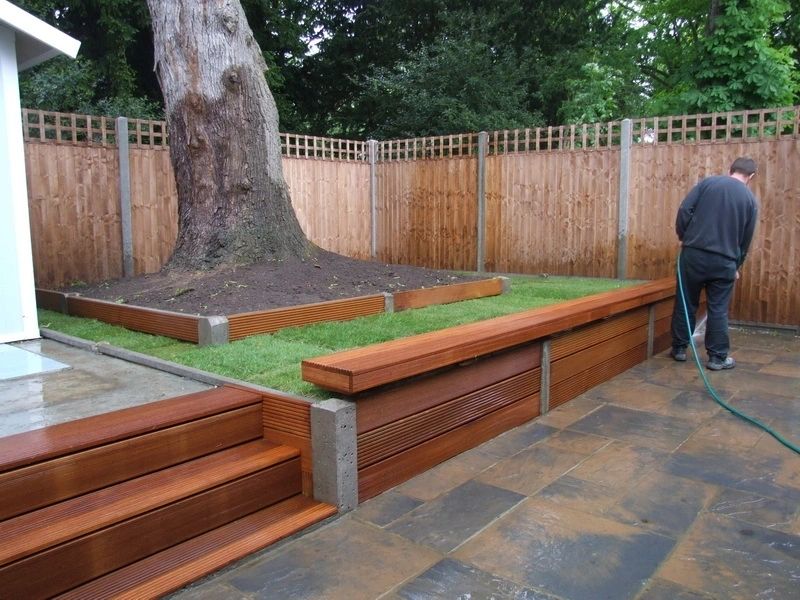
Start underneath: posts, bearers and joists
Everything on a deck sits on its substructure. Posts or pads carry the bearers, bearers carry the joists and joists carry the boards. If you can see under the deck, push a screwdriver into a few joists, especially near the posts, where boards meet the house wall and anywhere water drips off the edge.
Firm timber that resists the screwdriver is a good sign. Wood that crumbles, smells musty or lets the blade sink in easily is rot. One or two soft joists can often be replaced or doubled up with new timber alongside. Widespread softness, or rotten posts at ground level, usually means the frame has reached the end of its life.
When repair makes sense
A repair is usually the better choice when the frame is sound and the problems are local. The common cases we see are listed below.
- A handful of split, cupped or soft boards
- Boards lifting because screws or nails have worked loose
- Creaks caused by boards rubbing or loose fixings
- A single weak joist or a bouncy section between joists
- Loose handrails, balustrade posts or step treads
- A worn finish on otherwise healthy timber
When replacement is the better money
Replacement starts to make sense when patching would mean renewing most of the parts anyway. If many boards are failing at once, several joists are soft and the posts are rotting at the base, each repair just exposes the next weak piece. Paying for that one visit at a time usually costs more than starting again.
Other reasons to rebuild are a frame that was built too lightly in the first place, with joists too far apart for the boards on top, or a deck that no longer suits the garden. Changing the shape, height or materials is far simpler as a new build than as a repair.
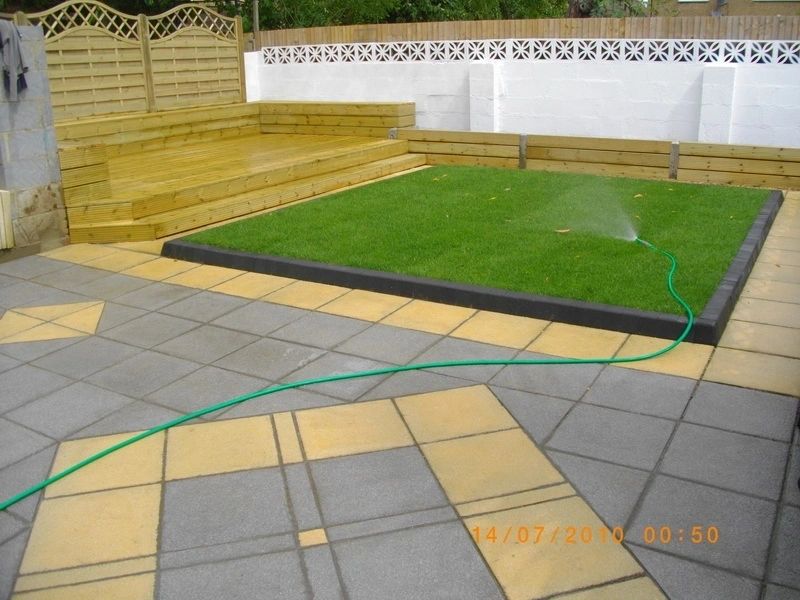
The middle path: new boards on a sound frame
A common outcome is a reboard. The frame is checked, any weak joists are replaced or strengthened, and a full new set of boards goes on top. This gives an even, new looking surface without the cost and disruption of rebuilding the structure. It is also the point where some owners switch to composite or hardwood boards, provided the joist spacing suits the new boards.
Matching old and new boards
New timber boards will not match weathered ones straight away. Softwood tones down over time and an oil or stain can help blend the colours. Composite ranges change over the years, so an exact match for an older composite deck is not always possible. Where it matters, we may suggest replacing a whole area or a full run of boards rather than dotting new ones among old.
Composite decks are judged differently
Composite boards do not rot, but the timber or metal frame below them can still fail, and boards can crack, fade or lose their surface cap after hard knocks. A composite deck with a sound frame and a few damaged boards is a straightforward repair, provided matching boards can still be found.
What to send us
Photos of the whole deck, close ups of the worst boards, and anything you can see underneath are the most useful starting point, along with rough measurements and your postcode. We send a written estimate from those and visit to confirm before the work is agreed. If a repair will do, we will say so.
Frequently asked
Can you replace just a few deck boards?
Yes, if the frame underneath is sound. We remove the failed boards, check the joists they sat on and fit new boards to match as closely as the material allows.
How do I know if my decking joists are rotten?
Push a screwdriver into the joists, especially near posts and the house wall. If it sinks in easily or the timber crumbles, that part is rotten.
Can I put composite boards on my old timber frame?
Sometimes. The frame must be sound and the joists close enough together for the composite board maker's requirements. We check both before recommending it.
Is a bouncy deck always a frame problem?
Usually it points to joists set too far apart, a weak or rotten joist, or a loose fixing at a bearer. Each has a different fix, so it is worth having it looked at.
Want this priced properly for your garden?
Photos first, then a written estimate across London and Hertfordshire, a written specification, and a fixed price. No obligation.