
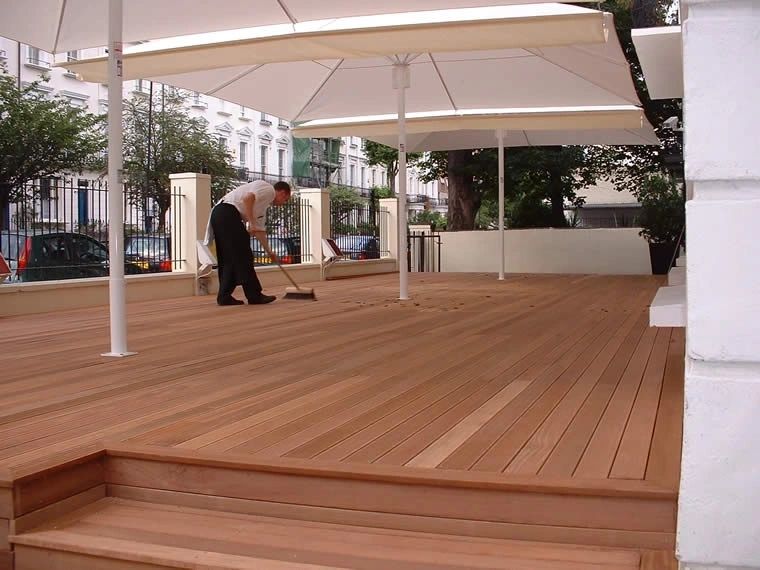
Composite decking is chosen by people who want a deck they can use rather than maintain. The boards are made from wood fibre and recycled plastic, come in modern colours and need no sanding and no oiling, only a wash now and then. We supply and fit composite decks across London and Hertfordshire with our own team, and every deck starts with a free site visit and a written quote.
This page covers what a composite deck involves, why the frame matters more than the board, what affects the cost and how a job runs from the first visit to the finished deck.
Why people choose composite
The main reason is upkeep. A softwood deck looks its best when it is treated every couple of years; a composite deck keeps its colour with a clean. Composite boards do not splinter, which matters to families with young children and pets, and they come in greys, browns and darker tones that suit modern houses and garden rooms.
Composite is not the right answer for everyone. It usually costs more than softwood to buy, it can feel warmer in direct sun in darker colours, and some people simply prefer the look and feel of real timber, in which case hardwood such as Balau or Ipe is worth a look.
The frame underneath
Composite boards are less stiff than timber and move with temperature, so they rely on the frame. Most manufacturers ask for closer joist spacing than a softwood deck and set out gaps between boards and at the ends. We build on concrete set or post anchored joists, properly spaced and ventilated, so air moves under the boards and water drains away.
A composite deck laid straight onto an old timber frame, or with joists too far apart, is the usual cause of boards that bounce, bow or open up at the joints. The frame is priced as part of the job, not as an afterthought.
- Concrete set posts or post anchors to carry the frame
- Joists spaced to the board manufacturer's guidance
- Ventilation and drainage under the boards
- Weed membrane and a gravel margin where a deck meets a fence
Finishing touches
Matching fascia boards hide the frame and give a clean edge. Hand built steps link a raised deck to the lawn or patio, and balustrades can be fitted on higher decks. Built in bench backs and picture frame borders are options that make a deck look designed rather than just laid. Our recent composite decks include a raised deck with a built in bench back and matching fascias beside a closeboard fence, and a deck with a gravel drainage margin along the fence line.
What affects the cost
We do not publish prices, because two decks of the same size can be very different jobs. These are the things that move the price, and each is set out in the written quote.
- Area and shape: straight runs are simpler than angles and borders
- Height: raised decks need more supports, steps and balustrades
- Ground: slopes, soft ground or old paving to clear
- Board range and colour chosen
- Access: side access or everything carried through the house
- Extras such as fascias, benches, steps and lighting cut outs
How a composite decking job runs
We visit, measure, look at the ground, the height and the access, and talk through board colours and finishes. You get a written quote. On the job the ground is cleared and prepared, supports are set, the frame is built and levelled, the boards are laid with the right gaps and fixings, and the edges and steps are finished. Waste is taken away before we leave.
If you want to understand the timing, our guide on how long a deck takes to build explains what makes a job quicker or slower.
Looking after composite decking
A wash with warm soapy water and a soft brush a couple of times a year keeps most composite decks looking right. Keep leaves from sitting in piles, keep the gaps clear so water drains, and avoid dragging heavy metal furniture across the surface. No oiling, staining or sanding is needed.