
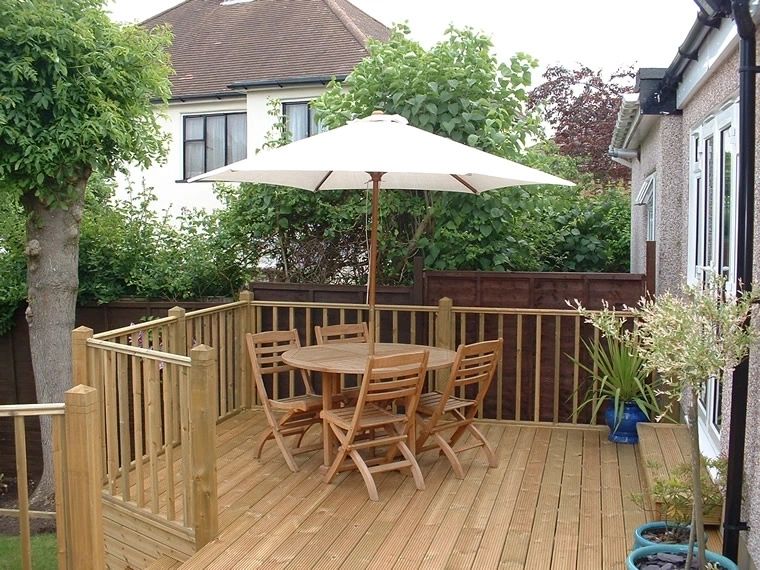
Hardwood decking is the natural timber choice for a deck that should last. Dense hardwoods such as yellow balau and ipe are naturally durable, feel solid underfoot and have a richer colour than softwood. We supply and fit hardwood decks, from the frame underneath to the last board and fixing.
This page explains what makes hardwood different, how it is fixed, what upkeep to expect, and how it compares with softwood and composite.
Why choose hardwood
Hardwood is denser than softwood, so it wears better, resists rot naturally and does not need the regular treatment softwood does. It is also heavier and harder, which gives a deck that feels solid rather than springy. The trade-off is cost and fitting time: hardwood costs more than softwood and takes longer to fit.
Frame and fixing
A hardwood deck is only as good as the frame under it. Joists are spaced to suit the boards, kept off the ground and given ventilation so moisture can escape. Because dense hardwoods are hard to cut, boards are usually pre-drilled before screwing, which takes longer but stops splitting and gives a neat, even fixing line.
- Treated joists, spaced to suit the boards
- Ventilation under the deck to keep it dry
- Pre-drilled, screwed boards for a clean finish
- Steps and edging in the same timber
Oiling and upkeep
Left alone, hardwood weathers to a silver-grey. Many people like that look. If you want to keep the original warm colour, the deck needs oiling from time to time with a decking oil made for hardwood. A sweep and wash keeps the surface clear and stops it getting slippery.
Hardwood, softwood or composite
Softwood is the lower-cost option and suits many gardens, but needs treating more often. Composite needs the least upkeep and keeps its colour, but it is a manufactured board rather than real timber. Hardwood sits between them: real timber, naturally durable, with some upkeep if you want to hold the colour. Our comparisons of softwood vs hardwood and composite vs hardwood go into more detail, and our decking cost guide explains how the choice affects the price.
Where a hardwood deck suits
Hardwood suits a deck that gets heavy use, a garden where you want real timber rather than a manufactured board, and spaces close to the house where a richer colour sets off the brickwork. Because the boards are dense and stable, hardwood also works well for steps and edging that take a lot of foot traffic. We also replace tired softwood decks with hardwood, often reusing a sound frame where it can carry the new boards.
How a hardwood decking job runs
Send us photos and rough measurements, we send a written estimate, then we visit to confirm before work starts. We cover London and Hertfordshire. The estimate sets out the timber, the frame, the fixing and any steps or edging.