
Quick checklist
- Confirm corner joints are mortice-and-tenon, not surface-screwed
- Check a diagonal brace is included in the quote
- Ask for adjustable ball-race hinges, hot-dip galvanised as a minimum
- Confirm latching post depth matches or exceeds the hinge post
- Discuss re-oiling interval before you sign off the finish
Hardwood gates are the item most likely to be under-specified on a fencing job, because a gate takes far more mechanical stress than a static fence panel — every opening and closing cycle loads the hinges, frame joints and latching post. This page sets out what actually stops a gate dropping, binding or racking within the first year.
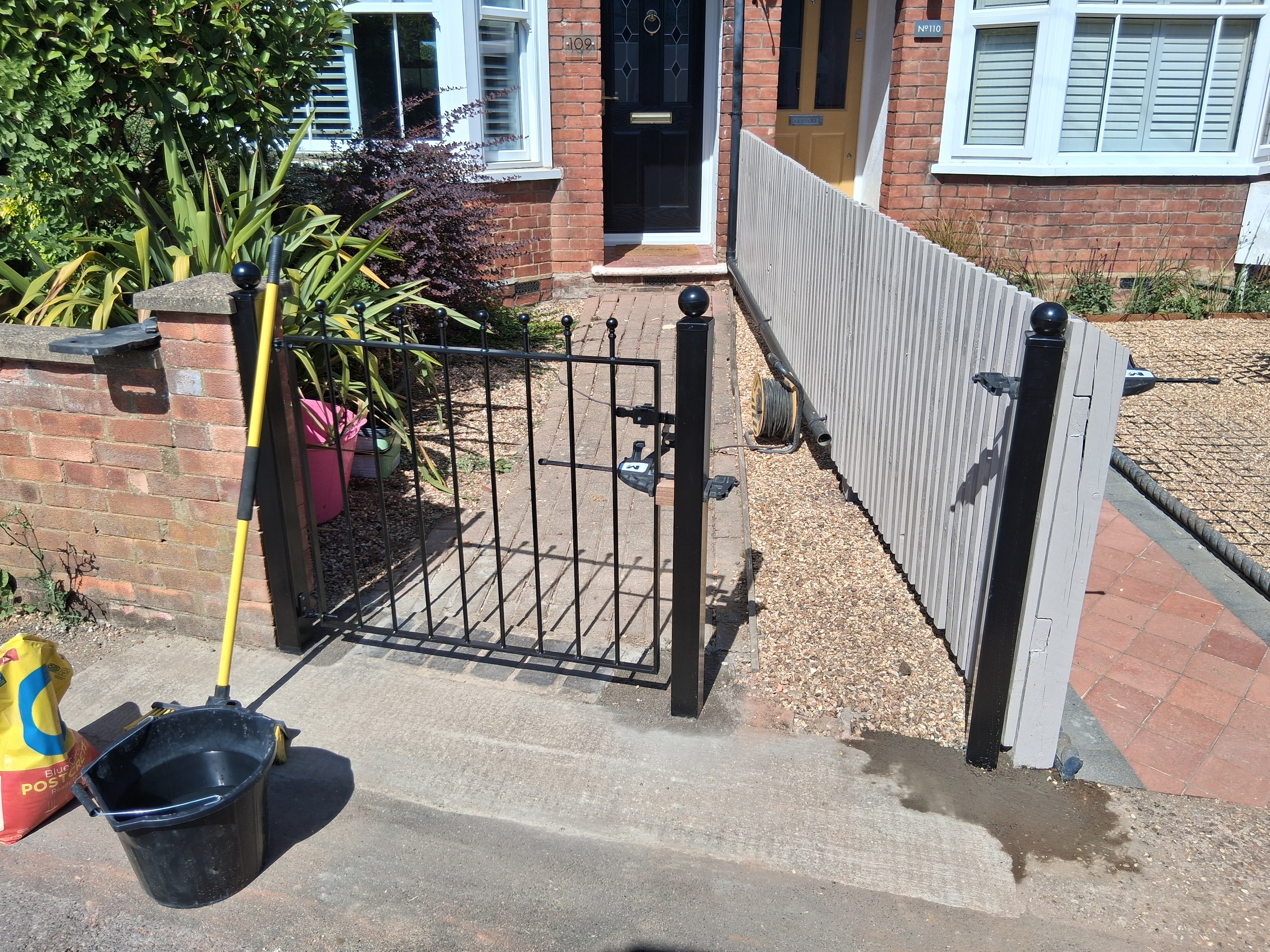
Timber species and grade
Iroko and oak are the two hardwoods we use most for gates: iroko is more dimensionally stable and doesn't need staining to weather well, oak is stronger in the joint but moves more seasonally and stains where damp iron fixings sit against it, so stainless or galvanised fixings matter more with oak.
Softwood gates (pressure-treated redwood) are a legitimate lower-cost option matched to a painted timber fence, provided the frame is properly braced and re-treated annually.
Frame construction and bracing
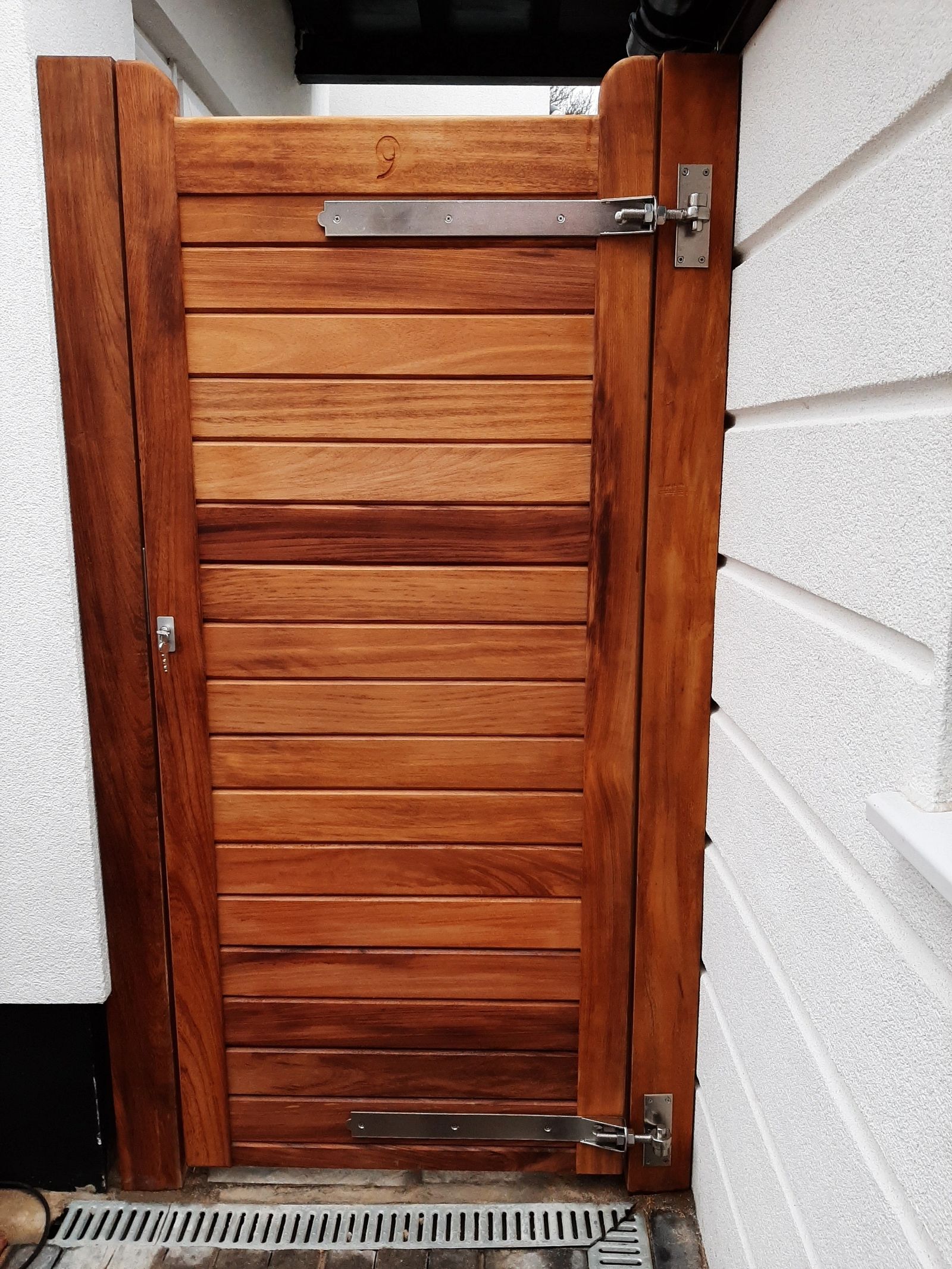
A gate is a frame first and infill second. Mortice-and-tenon or bridle joints at the corners resist racking far better than surface-screwed butt joints, and a diagonal brace running from the bottom hinge corner to the top latch corner is what actually stops a gate sagging over time — this is the detail most commonly missing on budget gates.
- Mortice-and-tenon or bridle joints at all four corners
- Diagonal brace, hinge-side-bottom to latch-side-top
- Minimum 44mm frame thickness for anything wider than a single pedestrian gate
- Wider double gates need a drop bolt or ground socket to take the load off the hinges
Ironmongery and honest maintenance
Hot-dip galvanised, adjustable ball-race hinges let you correct drop over time rather than replacing the gate; budget bright-zinc hinges corrode and seize within a few winters. Latching posts need to be set as solidly as gate posts, since a gate stresses its latching point almost as much as its hinge point.
Even a well-built hardwood gate needs occasional adjustment as the frame settles in year one, and periodic re-oiling to keep the timber's finish — this isn't a fault, it's normal for a moving timber structure exposed to weather.
Want a gate that still closes properly in five years?
We'll spec the frame joints, bracing and ironmongery to match how the gate will actually be used, not just how it looks on day one.
Frequently asked
Iroko or oak — which is better for a hardwood gate?
Iroko is more dimensionally stable and needs less fuss; oak is very strong but moves more and needs galvanised or stainless fixings to avoid staining. Both outlast pressure-treated softwood significantly.
How wide can a single hardwood gate be before it needs a wheel?
Beyond roughly 1.2–1.5m a single gate benefits from a support wheel or cantilever detail to stop hinge-side sag; wider openings are usually better as a pair of gates.
Why does my new gate need adjusting after a few months?
Timber settles and moves seasonally in its first year; adjustable ball-race hinges let this be corrected with a simple tweak rather than needing a rebuild.
Do hardwood gates need painting or oiling every year?
Iroko can be left to weather to silver-grey with minimal care; if you want to keep the honey colour, annual oiling is needed on any hardwood.
Can a hardwood gate be automated?
Yes, provided the frame, hinges and posts are specified to take the extra load and cycling frequency an automated system adds.