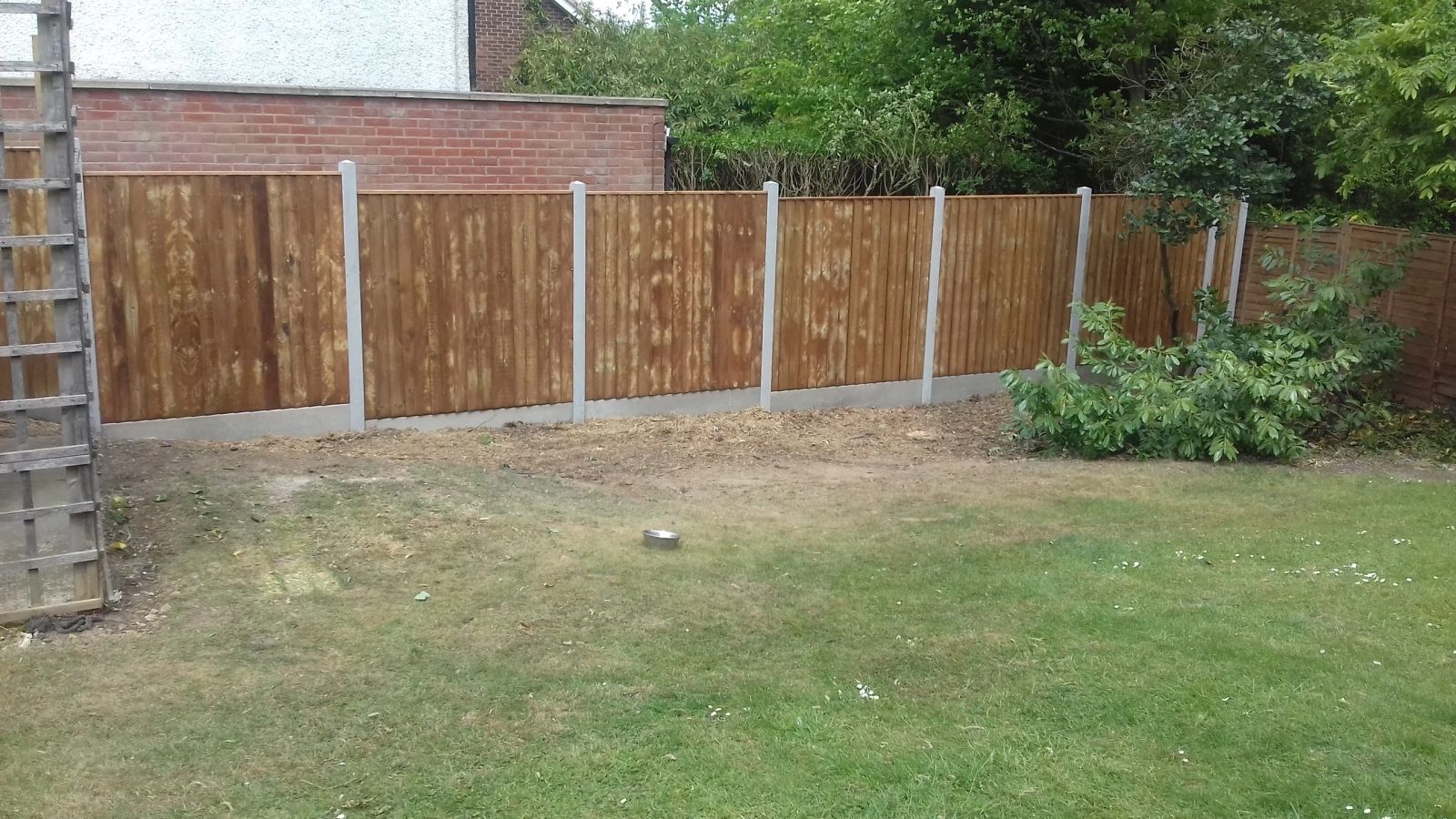
Barnet Council is the local authority for Mill Hill (NW7); the housing stock leans toward large detached homes on the ridgeway, 1930s semis around the broadway, and modern infill near mill hill east, and gardens tend to be spacious plots — many of the ridgeway properties have gardens deep enough for full landscaping schemes. What tends to drive the spec on a Mill Hill job is the mill hill conservation area on the ridgeway has strict rules on materials and finishes. Insurance paperwork after storm damage: Most household policies distinguish between storm damage to a fence, which is often covered subject to policy wording and excess, and general wear or rot, which typically isn't, so insurers commonly ask for photographs of the damage and sometimes of the fence's prior condition. A dated photo of the boundary from before the storm, even an incidental one, can materially help a claim where the insurer disputes whether failure was storm-related or simply due to age. Gravel terraces of the Lea and Colne valleys: The river terraces along the Lea and Colne valleys are largely sand and gravel over clay, ground that drains quickly and digs easily compared with the heavier clays further from the rivers.
Property: large detached homes on the Ridgeway, 1930s semis around the Broadway, and modern infill near Mill Hill East
Gardens: spacious plots — many of the Ridgeway properties have gardens deep enough for full landscaping schemes
the Mill Hill Conservation Area on the Ridgeway has strict rules on materials and finishes
Under Barnet Council, covering NW7. Nearest arterial: A1 / A41, M1 J2 / A41. Served from Mill Hill Broadway (Thameslink) / Mill Hill East (Northern line). Local commercial anchors: Mill Hill Industrial Estate, The Broadway.
Streets we regularly work on: Milespit Hill, Uphill Road, Nan Clark's Lane, The Ridgeway. Local anchors: Totteridge Valley footpath, Mill Hill Park, Mill Hill East station.
Mill Hill sits on a plateau above the Totteridge Valley, and the higher ground around The Ridgeway is more exposed to wind than the sheltered streets below. The newer estates around Mill Hill East were built over shallower topsoil above clay, typical of the area's underlying geology. Nan Clark's Lane borders the Totteridge Valley green belt, where development and boundary changes are restricted by planning policy. The former Mill Hill Barracks site off Milespit Hill was redeveloped for housing, and the area's military history is well documented.
Practical points for boundary work in Mill Hill
Insurance paperwork after storm damage
Most household policies distinguish between storm damage to a fence, which is often covered subject to policy wording and excess, and general wear or rot, which typically isn't, so insurers commonly ask for photographs of the damage and sometimes of the fence's prior condition.
A dated photo of the boundary from before the storm, even an incidental one, can materially help a claim where the insurer disputes whether failure was storm-related or simply due to age.
This is a general description of how these claims are typically assessed rather than a statement about any specific insurer's policy, and terms, excesses and definitions of 'storm' vary between providers and should be checked in the policy document.
Gravel terraces of the Lea and Colne valleys
The river terraces along the Lea and Colne valleys are largely sand and gravel over clay, ground that drains quickly and digs easily compared with the heavier clays further from the rivers.
Free-draining gravel is generally kinder to timber posts since water doesn't pool against the base, but loose gravel can also slump back into an open hole faster than clay, making a wider working hole necessary to get concrete properly around the post.
Where the gravel sits directly over a clay band, augers can hit a hard, sticky transition partway down that slows digging without warning.
Checking a gate opening is square before building the gate
An opening that looks square by eye can still be a few centimetres out corner to corner, which only becomes obvious once a gate built to the nominal width won't hang without binding on one side.
Measuring both diagonals of the opening and comparing them is a quick way to confirm square — equal diagonals mean a true rectangle, unequal diagonals mean the posts have drifted out of parallel or the opening has racked.
Where an opening is slightly out of square and can't easily be corrected by resetting a post, building the gate with a small taper to match the actual opening is usually more practical than forcing the posts back into an exact rectangle.
Applying to modify or discharge an old covenant
Where an old restrictive covenant genuinely no longer serves a useful purpose, it's possible to apply to the Upper Tribunal (Lands Chamber) to have it modified or discharged, though this is a formal legal process rather than a quick fix.
This route is generally used where a covenant is preventing otherwise sensible work and informal agreement with whoever benefits from it can't be reached.
Given the legal complexity involved, this is very much a solicitor-led process rather than something to attempt without professional advice.
Trellis toppers and wind load
A trellis topper adds height to an existing or new fence — commonly for climbing plants or extra privacy — and because it's open lattice rather than solid boarding it adds relatively little wind load for the height gained.
That's useful on boundaries close to the 2m permitted development limit, where a solid panel extension would push both height and wind loading up together, but it only works if the topper is genuinely open lattice rather than a solid infill dressed up as trellis.
Fixing a topper to an old or undersized post rather than the fence itself is the most common reason toppers come loose, since the extra leverage at height needs a post that was sized for it from the start.
Trellis toppers and additional wind load
Adding a trellis topper to increase privacy height also increases the wind load a fence has to carry, since even open lattice trellis catches more air than its slim appearance suggests, especially once climbing plants fill in the gaps.
Posts sized correctly for a 1.8m panel don't automatically have the reserve strength for panel-plus-trellis at 2.1m or more, particularly on an exposed run.
Where a taller finished height is wanted, it's worth specifying posts for the full combined height from the outset rather than treating the trellis as a lightweight afterthought bolted to the top.
Spacious plots — many of the Ridgeway properties have gardens deep enough for full landscaping schemes is typical, alongside large detached homes on the ridgeway, 1930s semis around the broadway, and modern infill near mill hill east.
Does applying to modify or discharge an old covenant come up much on jobs around Mill Hill?
Given the legal complexity involved, this is very much a solicitor-led process rather than something to attempt without professional advice. Where an old restrictive covenant genuinely no longer serves a useful purpose, it's possible to apply to the Upper Tribunal (Lands Chamber) to have it modified or discharged, though this is a formal legal process rather than a quick fix. This route is generally used where a covenant is preventing otherwise sensible work and informal agreement with whoever benefits from it can't be reached.
What should I know about trellis toppers and wind load in Mill Hill?
Fixing a topper to an old or undersized post rather than the fence itself is the most common reason toppers come loose, since the extra leverage at height needs a post that was sized for it from the start. A trellis topper adds height to an existing or new fence — commonly for climbing plants or extra privacy — and because it's open lattice rather than solid boarding it adds relatively little wind load for the height gained. That's useful on boundaries close to the 2m permitted development limit, where a solid panel extension would push both height and wind loading up together, but it only works if the topper is genuinely open lattice rather than a solid infill dressed up as trellis.
What should I know about trellis toppers and additional wind load in Mill Hill?
Where a taller finished height is wanted, it's worth specifying posts for the full combined height from the outset rather than treating the trellis as a lightweight afterthought bolted to the top. Adding a trellis topper to increase privacy height also increases the wind load a fence has to carry, since even open lattice trellis catches more air than its slim appearance suggests, especially once climbing plants fill in the gaps. Posts sized correctly for a 1.8m panel don't automatically have the reserve strength for panel-plus-trellis at 2.1m or more, particularly on an exposed run.
Does checking a gate opening is square before building the gate come up much on jobs around Mill Hill?
An opening that looks square by eye can still be a few centimetres out corner to corner, which only becomes obvious once a gate built to the nominal width won't hang without binding on one side. Measuring both diagonals of the opening and comparing them is a quick way to confirm square — equal diagonals mean a true rectangle, unequal diagonals mean the posts have drifted out of parallel or the opening has racked. Where an opening is slightly out of square and can't easily be corrected by resetting a post, building the gate with a small taper to match the actual opening is usually more practical than forcing the posts back into an exact rectangle.
Is Mill Hill within your standard travel area?
Yes — Mill Hill is served from Mill Hill Broadway (Thameslink) / Mill Hill East (Northern line), off A1 / A41, and is inside our regular working patch.
Some of our projects
Getting a crew here is straightforward: A1 / A41 links through, M1 J2 / A41 isn't far, and Mill Hill Broadway (Thameslink) / Mill Hill East (Northern line) serves the area. Checking a gate opening is square before building the gate: An opening that looks square by eye can still be a few centimetres out corner to corner, which only becomes obvious once a gate built to the nominal width won't hang without binding on one side. Measuring both diagonals of the opening and comparing them is a quick way to confirm square — equal diagonals mean a true rectangle, unequal diagonals mean the posts have drifted out of parallel or the opening has racked. Applying to modify or discharge an old covenant: Where an old restrictive covenant genuinely no longer serves a useful purpose, it's possible to apply to the Upper Tribunal (Lands Chamber) to have it modified or discharged, though this is a formal legal process rather than a quick fix.
Get In Touch
Get My Free Quote — 24h Response
No callout fee · Free site visit · Friendly local team covering London & Hertfordshire.