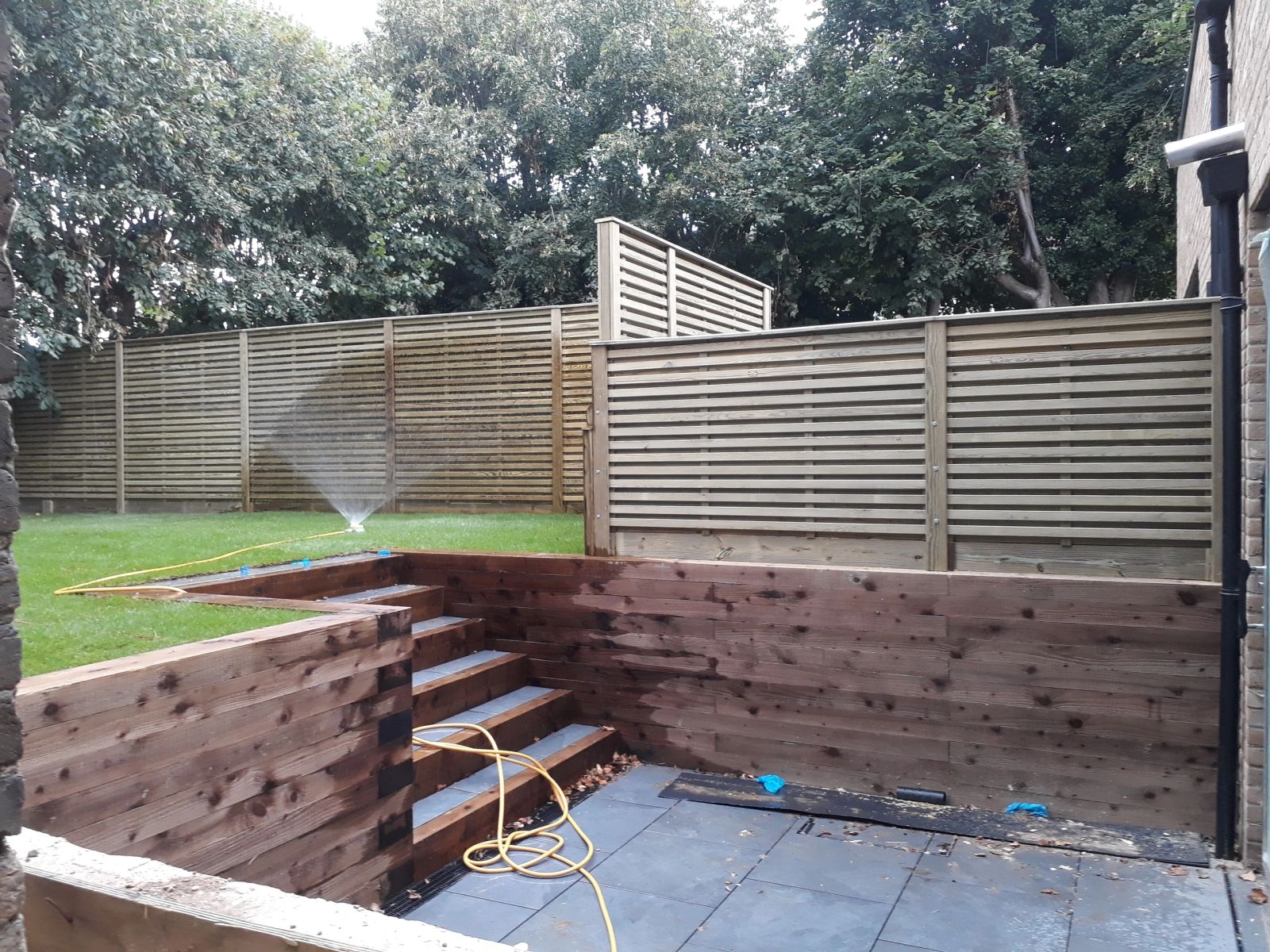
Barnet Council is the local authority for Finchley (N3, N12); the housing stock leans toward edwardian terraces in church end, large semis around hampstead garden suburb borders, and 1930s housing in woodside park, and gardens tend to be mid to large gardens; mature trees and london clay are the recurring constraints. What tends to drive the spec on a Finchley job is tree-root activity in clay soil regularly lifts old fence runs — full re-set is the typical brief. Land registered as a town or village green: Land formally registered as a town or village green carries strong legal protection against enclosure or obstruction, including from fencing, under the Commons Act 2006. This status can sometimes apply to open spaces that don't look obviously like a traditional village green, following a successful community application to register them. Hit-and-miss fencing for windy plots: Hit-and-miss fencing alternates boards on either side of the rails so each gap on one face is covered by a board on the other, giving privacy from both sides while leaving narrow gaps through the panel itself.
Property: Edwardian terraces in Church End, large semis around Hampstead Garden Suburb borders, and 1930s housing in Woodside Park
Gardens: mid to large gardens; mature trees and London clay are the recurring constraints
tree-root activity in clay soil regularly lifts old fence runs — full re-set is the typical brief
Under Barnet Council, covering N3, N12. Nearest arterial: A1000 / A406 North Circular, M1 J2 (10 min) / North Circular A406. Served from Finchley Central, West Finchley, Woodside Park (Northern line). Local commercial anchors: Ballards Lane, Tally Ho Corner.
Streets we regularly work on: Squires Lane, Nether Street, Fallow Court Avenue, Ballards Lane. Local anchors: Church End library, North Finchley bus garage, Victoria Park (Finchley).
Finchley spans the N3, N12 and N2 postcode areas, each with a different housing character — tighter Victorian terraces with rear-alley access toward East Finchley, and more spacious post-war semis around Woodside Park. The Church End Conservation Area covers much of the historic centre around Avenue House. Fallow Court Avenue and Squires Lane share a back-alley layout with a pedestrian corridor running between the plots. Nether Street runs close to the historic course of the Mutton Brook, a watercourse partly culverted as the area was developed.
Practical points for boundary work in Finchley
Land registered as a town or village green
Land formally registered as a town or village green carries strong legal protection against enclosure or obstruction, including from fencing, under the Commons Act 2006.
This status can sometimes apply to open spaces that don't look obviously like a traditional village green, following a successful community application to register them.
Checking the relevant register before fencing land bordering an open green space avoids inadvertently obstructing protected land.
Hit-and-miss fencing for windy plots
Hit-and-miss fencing alternates boards on either side of the rails so each gap on one face is covered by a board on the other, giving privacy from both sides while leaving narrow gaps through the panel itself.
Those gaps let a proportion of wind pass through rather than loading the whole panel face, which is why it's a common recommendation on exposed boundaries where a solid closeboard run would need heavier posts and shorter bays.
It uses more timber than a single-skin boarded fence for the same run length, so it's priced accordingly, but the reduced wind load can offset that in post and repair costs over time.
Choosing hand tools over power tools on sensitive sites
A petrol auger or breaker finishes a dig far faster than hand tools but brings noise, vibration and exhaust that matter more on a site with close neighbours, a nervous pet next door, or restricted working hours.
Hand tools also give more control in tight spots — close to a wall, a root, or a service — where a powered tool's speed becomes a liability rather than an advantage.
The practical approach on most jobs is powered tools for the bulk of straightforward digging and hand tools kept ready for the awkward sections, rather than committing to one method for an entire run.
Obstruction offences under the Highways Act
The Highways Act 1980 makes it an offence to obstruct a public highway, including the footway, without lawful authority, which is the underlying reason fencing, skips or materials on a pavement need proper authorisation.
This applies regardless of whether the obstruction is temporary for a delivery or intended as a permanent boundary feature encroaching onto highway land.
Where any part of planned boundary work might extend onto or over a public footway or verge, checking with the highway authority first avoids a straightforward enforcement issue later.
Small claims court as a route for fencing disputes
Straightforward disputes over the cost or condition of a shared boundary fence can, in principle, be pursued through the small claims track of the county court, which is designed to be accessible without needing a solicitor.
This route is generally reserved for lower-value, relatively clear-cut disagreements rather than complex boundary line disputes, which usually need more specialist legal input.
It's worth exhausting direct discussion and mediation options first, since even a successful small claim can be a slower and more stressful route than reaching agreement directly.
Landlord and void-period turnarounds
Boundary repairs between tenancies are usually driven by a tight void period, where the priority is a straightforward, durable, easy-to-maintain spec rather than a bespoke design, since the landlord isn't the one living behind it.
Standard panel heights and widely-available materials also matter here, because a future repair after another tenant needs to match without a special order or long lead time.
Where several rental properties share the same landlord or managing agent, batching repairs across more than one property in the same visit is often the most efficient way to keep void periods short.
Is small claims court as a route for fencing disputes something you plan for in Finchley?
This route is generally reserved for lower-value, relatively clear-cut disagreements rather than complex boundary line disputes, which usually need more specialist legal input. It's worth exhausting direct discussion and mediation options first, since even a successful small claim can be a slower and more stressful route than reaching agreement directly. Straightforward disputes over the cost or condition of a shared boundary fence can, in principle, be pursued through the small claims track of the county court, which is designed to be accessible without needing a solicitor.
How does "obstruction offences under the highways act" affect fencing or decking work in Finchley?
The Highways Act 1980 makes it an offence to obstruct a public highway, including the footway, without lawful authority, which is the underlying reason fencing, skips or materials on a pavement need proper authorisation. This applies regardless of whether the obstruction is temporary for a delivery or intended as a permanent boundary feature encroaching onto highway land. Where any part of planned boundary work might extend onto or over a public footway or verge, checking with the highway authority first avoids a straightforward enforcement issue later.
Is choosing hand tools over power tools on sensitive sites something you plan for in Finchley?
Hand tools also give more control in tight spots — close to a wall, a root, or a service — where a powered tool's speed becomes a liability rather than an advantage. The practical approach on most jobs is powered tools for the bulk of straightforward digging and hand tools kept ready for the awkward sections, rather than committing to one method for an entire run. A petrol auger or breaker finishes a dig far faster than hand tools but brings noise, vibration and exhaust that matter more on a site with close neighbours, a nervous pet next door, or restricted working hours.
Is Finchley within your standard travel area?
Yes — Finchley is served from Finchley Central, West Finchley, Woodside Park (Northern line), off A1000 / A406 North Circular, and is inside our regular working patch.
Do you cover neighbourhoods near Finchley?
Yes — see our full coverage map for neighbourhoods near Finchley.
Does landlord and void-period turnarounds come up much on jobs around Finchley?
Where several rental properties share the same landlord or managing agent, batching repairs across more than one property in the same visit is often the most efficient way to keep void periods short. Boundary repairs between tenancies are usually driven by a tight void period, where the priority is a straightforward, durable, easy-to-maintain spec rather than a bespoke design, since the landlord isn't the one living behind it. Standard panel heights and widely-available materials also matter here, because a future repair after another tenant needs to match without a special order or long lead time.
Some of our projects
Coverage runs off A1000 / A406 North Circular, near M1 J2 (10 min) / North Circular A406, served from Finchley Central, West Finchley, Woodside Park (Northern line). Choosing hand tools over power tools on sensitive sites: A petrol auger or breaker finishes a dig far faster than hand tools but brings noise, vibration and exhaust that matter more on a site with close neighbours, a nervous pet next door, or restricted working hours. Hand tools also give more control in tight spots — close to a wall, a root, or a service — where a powered tool's speed becomes a liability rather than an advantage. Obstruction offences under the Highways Act: The Highways Act 1980 makes it an offence to obstruct a public highway, including the footway, without lawful authority, which is the underlying reason fencing, skips or materials on a pavement need proper authorisation.
Get In Touch
Get My Free Quote — 24h Response
No callout fee · Free site visit · Friendly local team covering London & Hertfordshire.