Practical points for boundary work in Marshalswick
Hedgerow removal and nesting-bird season
Removing or cutting back a hedge to install a new boundary fence is generally best avoided between March and August, the main bird nesting season, since disturbing an active nest is an offence under the Wildlife and Countryside Act regardless of intent.
Some countryside and agricultural hedgerows are also protected under the Hedgerow Regulations, which can require notifying the local authority before removal even outside a garden setting.
A pre-work check of the hedge for active nests, and scheduling removal for autumn or winter where the timeline allows, avoids both the legal risk and the delay of having to stop mid-job.
Restaurants and pub gardens
Boundary fencing around a pub garden or restaurant terrace often does double duty as noise and light screening for neighbouring residential properties, and its height and permeability can be a condition attached to the premises licence rather than a free choice.
Trading hours mean access for fencing work is usually easiest early morning before service starts, since a garden in active use for covers can't have posts being dug mid-lunch.
Where outdoor seating sits close to the boundary, fixings and post positions need checking against any licensed seating plan so the finished fence doesn't reduce covers below what the licence allows.
New build plots and pre-agreed boundary specifications
New build properties are often sold with a specific boundary treatment already agreed as part of the planning permission for the wider development, sometimes written into individual plot transfers.
Replacing a developer-installed fence with something different can, in some cases, breach these plot-specific terms even after the development has been fully sold and the developer has moved on.
Checking the original plot transfer documents, or the wider planning permission for the estate, is worth doing before assuming a new build boundary can simply be swapped for something else.
Tongue-and-groove privacy panels
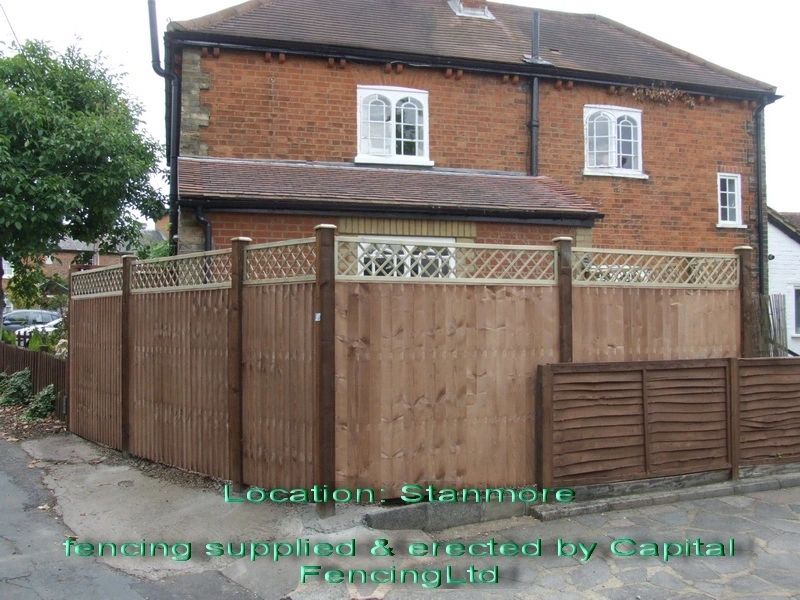
Tongue-and-groove boards interlock edge to edge with no overlap, giving a genuinely solid, gap-free face that's the most private board profile available in timber fencing.
Because the boards key into each other rather than overlapping, the panel needs to be built with a small allowance for seasonal swelling, or the interlocking edges can bind and cup as the timber moves.
It's a heavier, stiffer panel than lap or slatted profiles, so it's usually paired with more substantial posts, and it's a common choice for pool or hot-tub screening where sightlines matter more than airflow.
Timber post taper and strength distribution
A sawn timber post is typically a constant cross-section along its length, whereas the bending moment from wind load on the attached panel is greatest at ground level and reduces toward the top, meaning the post's strength margin isn't evenly used along its height.
This is why increasing embedment depth or post section size, rather than simply extending post height, is generally the more effective way to improve resistance to wind-induced snapping at ground level.
A post that fails from wind load almost always fails at or just below ground level rather than partway up its exposed length, reflecting where the bending stress genuinely concentrates.
London Clay shrink-swell behaviour
London Clay is one of the most shrinkable soils in the country, expanding when saturated over winter and pulling away from anything set in it during a dry summer, sometimes opening a visible gap around a post base.
That cycle is what loosens posts that were adequately firm when first concreted in, rather than any fault in the original installation.
Depth and a granular key at the base do more to resist this movement long-term than simply increasing the volume of concrete around a shallow post.