Trellis wind load as a failure cause
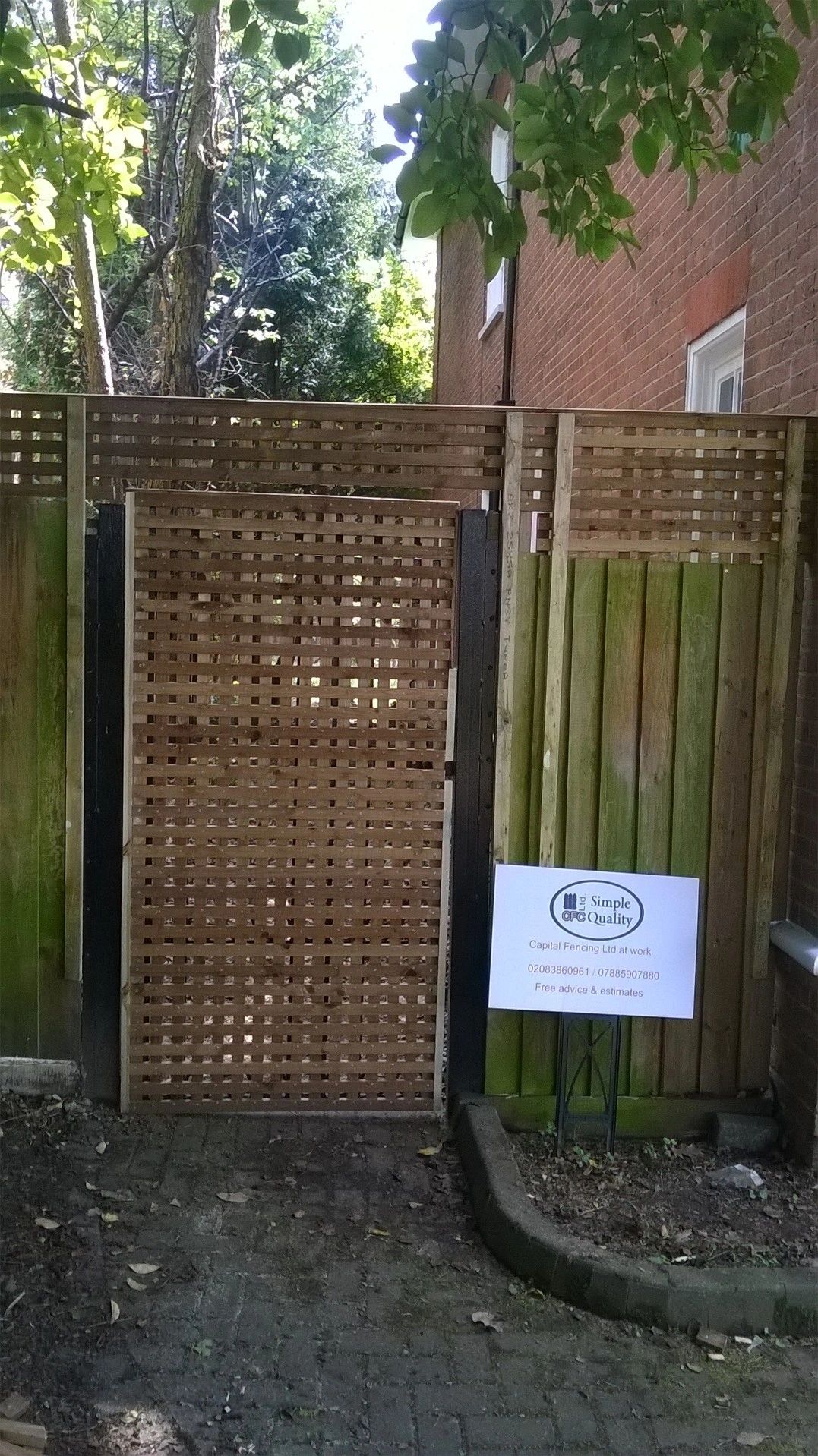
A solid-backed trellis, sometimes fitted with climbers trained across it, catches significantly more wind than an open lattice design, and that extra load is transferred straight into the post below it.
Where a trellis topper keeps failing on an exposed run, switching to a more open lattice pattern reduces the load rather than simply refitting the same design each time.
Repairing a fence where only hand tools will fit
A narrow side passage or a fence set hard against a building can rule out power tools with any real footprint, meaning a repair has to be done with hand saws, hand augers and manual mixing rather than the equipment that would normally speed the job up.
This mainly affects timing rather than the quality of the repair itself, since the same joints and fixings can be achieved by hand, just more slowly than with powered equipment.
Correcting mismatched post spacing discovered during a repair
Occasionally an older run turns out to have inconsistent post spacing from the original build, which only becomes apparent when a panel being fitted during a repair doesn't sit at the expected width against the next post.
Rather than forcing a standard panel into a non-standard gap, options include a site-cut infill panel or slightly repositioning the post if it hasn't already been set, since forcing a fit usually strains the panel's frame and shortens its life.
Night latches on garden and side doors
A night latch, more commonly seen on house front doors, is sometimes fitted to a solid garden door or side gate door for self-latching convenience, engaging automatically on closing while still allowing free egress from inside.
It needs a solid, well-fitted frame to work reliably outdoors, since timber movement that would be barely noticeable indoors can be enough to throw an exterior-mounted night latch out of alignment.
Deadlocks fitted to timber gate doors
A deadlock fitted to a solid timber gate door needs a keep let into a post or frame that's substantial enough to resist forcing, since a deadlock is only as strong as the timber and keep it engages with.
Outdoor use also means the lock case and keep need weather protection or a corrosion-resistant finish that an equivalent internal door lock wouldn't require.
Helical pile foundations for a commercial security run
A helical pile is screwed into the ground using hydraulic or mechanical torque rather than being set in an excavated and concreted hole, giving a foundation that can be installed quickly on a site where digging is disruptive or where ground conditions are variable along the run.
Load capacity is checked by torque readings taken during installation rather than assumed from a standard depth, which makes helical piling useful on a site where soil type changes noticeably across the length of the boundary.
Snagging and sign-off walk-round
A finished fence should be walked end to end with the client before sign-off, checking posts are plumb, panels are level and gates open and close cleanly through their full swing without binding on the ground.
Gaps under gravel boards, exposed fixings, and any concrete splashed onto adjoining paving or planting during the install are the kind of small snags worth catching at walk-round rather than left for the client to notice weeks later.
Where any item is flagged, agreeing a specific date for it to be resolved — rather than a vague 'we'll come back' — is what actually gets snagging closed out.
Matching a new gate to the existing boundary
A replacement gate is sized and detailed to match the piers or posts either side of the opening rather than fitted as a stock size, since a gate that doesn't sit flush against its opening looks obviously replaced even when well built.
Where the surrounding fence has a specific profile or capping detail, the gate frame is matched to it.
Scrap value theft targeting fence fittings
Cast aluminium or brass post caps and decorative finials have occasionally been targeted for scrap value on isolated boundaries, in the same way capping rails have, so lower-value steel or composite alternatives are sometimes specified deliberately on an exposed run for that reason alone.
Where a decorative metal fitting is wanted for appearance, fixing it with concealed or one-way screws reduces how quickly it can be removed compared with an exposed standard fixing.
Arris rail brackets and rail-end repairs
The triangular arris rail commonly rots or splits where it meets the post, since that mortise or bracket joint traps water against end grain more than any other point on the rail.
A rail-end repair usually involves cutting back to sound timber and refitting with a galvanised arris rail bracket rather than re-cutting a new mortise into an already-weakened post.
Aligning a drop bolt on double gates
A drop bolt on the leading edge of one leaf of a double gate needs a matching socket set into the ground or a fixed plate below it, and that socket has to be positioned after the gates are hung and checked closed, not marked out in advance from a plan.
Ground movement or a slight settling of the gate posts over the following months can throw the bolt out of alignment with its socket, which is why some installers set the socket in a slightly oversized recess rather than a tight-fitting hole.
Where the ground under the gate is loose gravel or soft earth, a concrete socket set flush with the surface holds alignment far better over time than a bolt simply pushed into bare ground.
Capping and end-grain protection
End grain absorbs moisture far faster than the face of a timber board, so an uncapped top rail or exposed post top takes in water long before the rest of the gate shows any sign of decay.
Fitting a capping strip or weathered top cut sheds water away from that end grain and noticeably extends the life of an otherwise sound gate.
Protecting galvanised coatings on fixings during a repair
Cutting, drilling or hammering a galvanised bracket or bolt during a repair can chip through the zinc coating and expose bare steel underneath, which then corrodes faster at exactly that damaged point than the surrounding coated surface.
Touching up any damaged area with a cold galvanising compound at the time of repair is a small step that meaningfully extends the life of the fixing, rather than leaving bare steel to start rusting immediately.
Assessing whether a removed panel's fixings are reusable
When a panel is lifted out to replace a post behind it, the panel's own clips, brackets or nails are sometimes still serviceable and can be reused, but corroded or bent fixings are worth replacing at the same time rather than refitting a panel with worn hardware.
This is a small extra check that avoids a repair looking complete on the day but failing again within a year because the original fixings, not just the post, were already close to the end of their life.
Hand-digging near suspected buried services
Once a cable avoidance tool or utility plan indicates a service is likely nearby, digging switches from auger or mechanical methods to hand tools only, working down in shallow spits rather than one deep thrust.
A spade can still shear a shallow, poorly-buried cable, so the safer tool close to a marked service is a fork or trowel used to expose it by feel and sight before any spade work resumes.
If a cable or pipe is exposed, it's left supported and undamaged in the open trench rather than backfilled over, and the post position is adjusted if the service sits exactly where the hole needs to go.
Party wall notices and communication
The Party Wall etc. Act 1996 covers work to a shared wall or excavation near a neighbour's foundations, and while an ordinary timber fence on a boundary line usually falls outside it, a new masonry boundary wall built astride the line, or deep post holes close to a neighbour's foundations, can bring it into play.
Where the Act applies, formal written notice is required before work starts, giving the neighbour a defined period to consent or dissent, and proceeding without notice risks an injunction even on otherwise straightforward work.
Even where the Act doesn't strictly apply, a simple letter or conversation confirming line, height and access before work starts avoids most of the disputes that end up needing formal resolution.
High water table and drainage
Gardens near a river, floodplain or low-lying valley bottom can have a water table close enough to the surface that a normal post hole fills with water before the concrete goes in.
The practical answer is a free-draining aggregate base rather than a solid concrete plug, so ground water can move past the post instead of sitting against it and accelerating rot in untreated timber.
On repeat-flood plots we'd also flag gravel boards set slightly proud of ground level, so the panel itself sits above the usual high-water mark even if the boards need replacing more often.
Sanding and re-treating a timber gate
A timber gate that's greying or losing its finish benefits from a light sand back to bare or sound timber before re-treating, since coating over a failed or flaking existing finish traps moisture underneath rather than sealing it out.
This is worth doing every few years depending on exposure, well before the timber itself starts to soften or split.
Council neighbour consultation schemes for permitted development
Certain categories of permitted development, mainly larger extensions rather than fencing itself, fall under a formal neighbour consultation scheme requiring the council to notify adjoining owners even without a full planning application.
Boundary fencing itself is rarely covered by this specific scheme, but it's sometimes confused with the ordinary neighbour notification that happens during a full planning application for other works.
Where in doubt about which process applies to a specific project, the council's planning department can clarify which consultation route, if any, is relevant.
Managing noise during a security fence installation
Post-hole augering, breaking out old concrete footings and cutting steel palisade to length all generate noise that's worth flagging to neighbours or site occupants in advance, particularly on a compound or commercial job with fixed working hours nearby.
Where a site has noise-sensitive neighbours, sequencing louder tasks earlier in the working day and confining cutting to one area reduces the disruption without slowing the job significantly.
Composite fencing construction and expansion gaps
Composite fencing boards are a wood-fibre and polymer blend, usually clipped or screwed onto an aluminium or timber sub-frame rather than nailed directly, which avoids splitting the board and allows for its different movement characteristics.
Composite expands and contracts with temperature more than timber does, so boards are fitted with a small expansion gap at each end and between courses rather than butted tight, and a run installed without those gaps can bow or buckle in hot weather.
The sub-frame itself is usually still timber or aluminium posts rather than composite throughout, since composite isn't generally used as a structural post material.
CDM Regulations and domestic clients
The Construction (Design and Management) Regulations 2015 apply even to domestic projects like fencing and decking, though in a domestic setting the client's specific duties are normally treated as passed to the contractor unless otherwise agreed.
In practice this means the appointed contractor typically takes on responsibility for managing health and safety on the project, rather than the homeowner personally.
It's still reasonable for a homeowner to ask how a contractor manages site safety, particularly on larger multi-trade projects involving several contractors on the same domestic site.