Welded versus woven mesh
Welded mesh is formed from wires fused at each intersection, giving a rigid grid that holds its shape well and resists distortion under point loads such as someone leaning or climbing on it.
Woven mesh, including chain link, has wires interlaced rather than fused, which lets the whole panel flex and absorb impact rather than transferring load to a single joint, but it can also sag or distort more visibly over time.
Welded mesh is generally preferred where a crisp, rigid appearance matters, while woven mesh is favoured for larger open areas like sports enclosures where some give under impact is actually beneficial.
Acoustic and noise-reducing boundaries
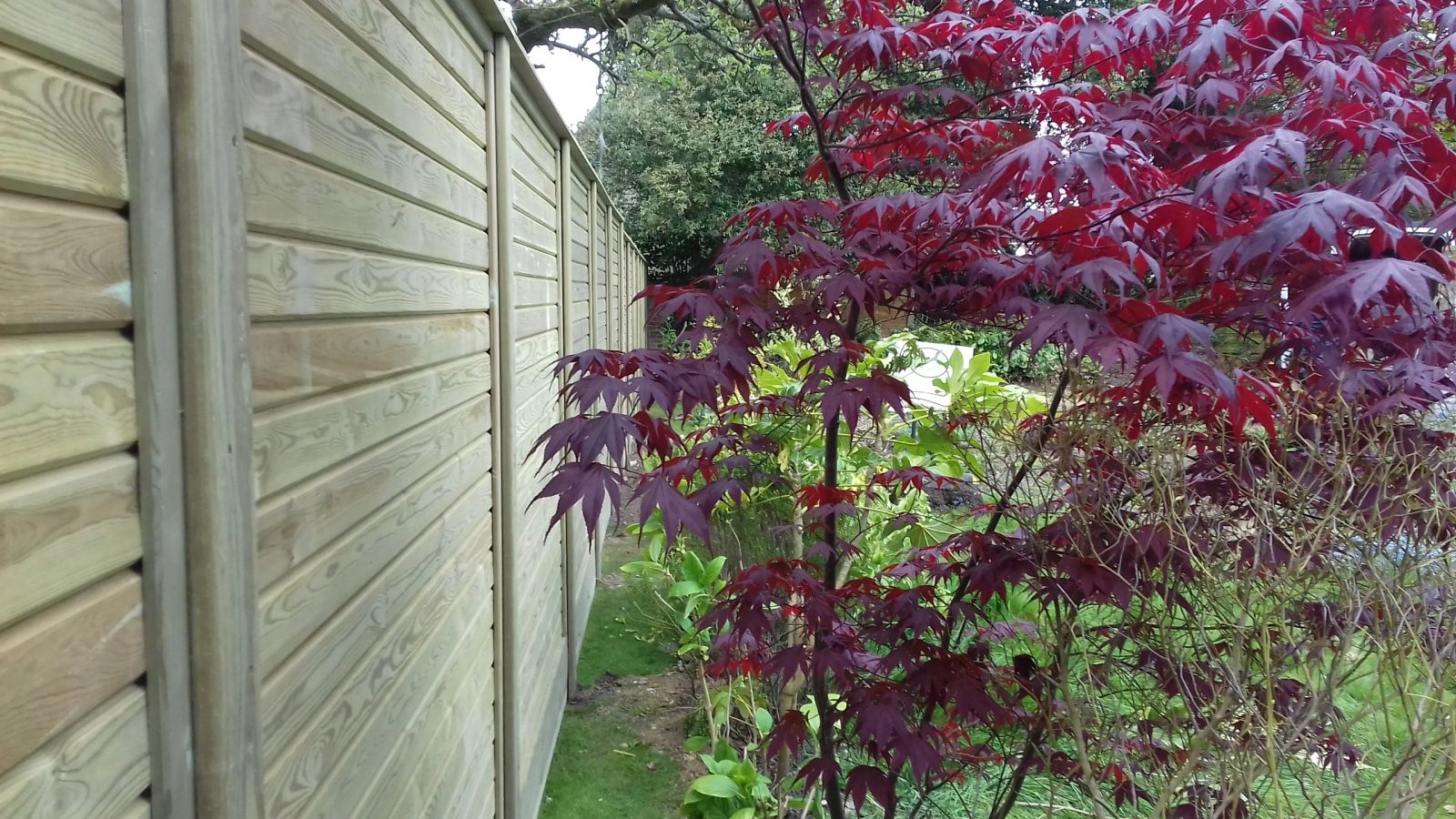
A garden backing onto a busy road, railway line or commercial yard can benefit from a boundary built with sound reduction in mind, though a garden fence will never fully block road noise the way a proper acoustic barrier does.
Solid, gap-free construction matters more than material choice — close-boarded overlap timber with no sightlines through it performs noticeably better than a picket or slatted style, and any gaps at the base undo much of the benefit.
Denser materials and added mass, such as a composite core or an additional inner skin, do help further, but the single biggest factor is simply eliminating gaps and sightlines through the run.
Concrete spurs as a lifetime-extension repair
Where a timber post has rotted at ground level but the panels and the rest of the run remain sound, bolting a concrete spur alongside the rotten section rather than replacing the whole post is a common and effective partial repair.
The spur takes over the structural role at ground level while the timber above the rot line, which is usually still sound, continues to carry the panel fixings.
This repair only works while enough sound timber remains above the rotten section to bolt through; once rot has progressed too far up the post, spurring no longer gives a reliable fix and full post replacement is the honest answer.
Aluminium and steel railings
Aluminium railings are lighter, don't rust, and hold a powder-coated finish well without the ongoing maintenance steel needs, which makes them common for low-boundary and pool-safety railings where upkeep is meant to be minimal.
Steel railings are heavier and stiffer for the same section size, which suits taller or higher-security applications, but the finish has to be maintained — a scratch through galvanising or powder coating exposes bare steel to rust from that point.
Both are usually supplied as welded panels between posts rather than built up rail-by-rail on site, so panel width and post spacing need to be agreed before ordering rather than adjusted afterward.
Badger and wildlife legal considerations
Badgers and their setts are protected under wildlife legislation, so a repair near an active sett or badger path needs the presence of the animal considered before any digging or fixing work near that spot.
Where wildlife activity is suspected near a repair site, we recommend checking for protected status before altering ground close to the affected boundary.
Fall direction and drainage across a deck
A deck built dead level holds standing water after rain, which speeds up algae growth and softens the timber surface faster than a deck with a slight fall built in to shed water away from the house.
The fall is normally built into the joist or bearer heights during construction, angled away from any adjoining wall or door threshold, rather than relying on the boards themselves to slope.
Getting the fall direction right at the design stage also avoids water pooling against a house wall, which risks damp ingress at the threshold over time.
Disposing of broken-out concrete footings
Broken-out concrete from an old post footing is inert waste and can generally go to a construction and demolition waste facility, but it still needs removing from site rather than left buried or piled at the back of a garden.
On a job with several posts being reset, the volume of broken concrete adds up quickly, and planning where it's going before the repair starts avoids it sitting as a hazard or an eyesore on site for longer than necessary.
Realistic panel replacement frequency on an exposed plot
A standard timber panel on a sheltered suburban plot might reasonably be expected to last a decade or more before replacement; the same panel on a genuinely exposed, wind-loaded boundary can fail in structural terms — cracked rails, a bowed or blown-out panel — well inside that timeframe regardless of treatment quality.
Setting client expectations around this at quote stage, rather than after an early failure, avoids the impression that a product or installation was faulty when the real cause is unmanaged exposure.
Where budget allows, specifying for the exposure from the outset is cheaper over the fence's life than replacing a standard panel repeatedly on the same exposed run.
Padlock and hasp standards
Padlocks are commonly rated to a recognised standard covering resistance to cutting, drilling and picking, and a high-security hasp is only as good as the padlock fitted to it — pairing a budget padlock with a heavy-duty hasp undermines the whole fitting.
A closed-shackle or shrouded hasp design protects the padlock body from bolt-croppers, which is the more common attack on an exposed gate than picking.
Anti-lift hinge pins on a security gate
A standard hinge pin can be lifted out from outside a gate if the pin isn't captive, effectively removing the gate from its frame without touching the lock at all, which is a well-known weakness on older gates fitted with basic hinges.
An anti-lift hinge design, or a simple dowel welded to prevent the pin lifting clear, closes this gap cheaply and is worth checking for on any existing gate being assessed as part of a security upgrade.
Clearing debris from a sliding gate track
Leaves, gravel and windblown litter collect in a ground-level sliding gate track over time, and a build-up is one of the most common reasons a gate that used to run smoothly starts binding or stalling partway along its travel.
Regular clearing of the track, particularly after autumn leaf fall or after a period of wind, prevents debris from being repeatedly crushed into the track and becoming harder to remove.
Through-fixing a hasp for padlock security
A hasp fixed only with screws from the accessible face can be forced or unscrewed relatively easily, whereas through-bolting it with fixings passing right through the gate frame to a backing plate resists that kind of attack far better.
This is a straightforward upgrade on an existing gate that already has a hasp fitted, without needing to replace the hasp itself.
Welded mesh panels compared with twin-wire double-mesh panels
A single-skin welded mesh panel is cost-effective and widely used, but a twin-wire double-mesh panel sandwiches two offset mesh layers so that the apertures never align, making the panel far harder to get a foothold or cutting tool through cleanly.
Double-mesh panels are generally specified for a higher-security compound or a site with a known history of attempted intrusion, while single-skin panels remain the standard choice for a general commercial boundary.
Timber strength grading classes
Structural timber is graded into strength classes such as C16 or C24 based on visual inspection of defects like knots and slope of grain, or by machine stress grading that measures stiffness directly.
C24 timber has been graded to a higher strength and stiffness threshold than C16, and is specified where a structural calculation demands it, such as a longer unsupported gate post span, rather than chosen purely by appearance.
Fencing timber is rarely strength-graded in the same formal way as construction timber, which is one reason gate posts subject to real structural calculation sometimes specify a graded section rather than standard fencing stock.
Boundary fencing between garden and agricultural land
Where a residential garden backs onto agricultural land, stock-proof fencing standards relevant to livestock containment may be a factor the adjoining farmer expects, separate from purely decorative garden fencing considerations.
Responsibility for maintaining this kind of boundary can be split differently to a typical suburban arrangement, sometimes reflecting historic agricultural tenancy agreements rather than standard residential conveyancing norms.
Checking with the adjoining landowner and the title documents together gives a fuller picture than assuming the same rules apply as between two ordinary garden neighbours.
Low bottom rails as a trip hazard
A gate's bottom rail set slightly proud of the finished ground or paving level can become a trip hazard, particularly at a frequently used pedestrian entrance, and this is worth checking as part of a repair rather than only assessing the gate's swing and hardware.
Adjusting the ground level either side or resetting the gate's hung height can resolve this without altering the gate's construction.
Who maintains a grass verge next to a boundary
A grass verge between a garden boundary and the road is often owned and maintained by the local council as part of the adopted highway, rather than by the adjoining property owner.
This affects where a fence can legally be positioned, since building onto highway land, even a seemingly unused verge, generally needs authorisation.
Where the extent of a verge and its ownership isn't obvious, the local highway authority can usually confirm it against their adopted highway records.
Digging near land drains
Older gardens, especially those on heavier clay, sometimes have unrecorded clay pipe or perforated plastic land drains laid to relieve waterlogging, and these rarely appear on any plan.
Hitting one with an auger usually shows up as a sudden drop in resistance followed by water pooling in the hole from a direction that doesn't match the water table generally on site.
A damaged land drain should be reconnected or rerouted rather than just backfilled over, since a broken run can redirect water against a post base for years afterwards.
Narrow access and carrying materials by hand
Where there's no side access wide enough for a barrow, materials have to be hand-carried through the house or over a boundary, which changes both the time a job takes and the choice of components — shorter, lighter sections are far easier to move this way than long concrete gravel boards.
Protecting internal flooring and doorways during a through-house carry is worth agreeing before the first delivery arrives, since a scuffed hallway wall is one of the most common complaints on this kind of access.
On some terraces the only alternative is craning or lifting material over a roof or side wall, which needs its own access and safety plan rather than being treated as a simple manual carry.
Marker tape and underground cable protection during fencing works
Even where a cable route has been avoided by shifting post positions, a warning marker tape laid above the cable at a shallower depth than the cable itself gives a visual and physical warning to anyone digging near the line in future.
This is a low-cost addition worth doing whenever a post line runs close to a known service, since a fence contractor working carefully today doesn't guarantee the same care from whoever digs near that boundary years later.
Checking fall along the base of a fence line for drainage
Where a fence runs along the low side of a garden or parallel to a slight natural fall, water can collect and run along the fence line itself rather than away from it, sitting against gravel boards and post bases for longer than on flatter ground.
A shallow channel or a slightly raised base at the lowest points along the run helps water continue past rather than pool against the timber.
This is worth checking during a wet spell before finalising post positions, since a dry-weather site visit can miss a drainage pattern that only shows up after sustained rain.
Protecting a driveway surface during on-site concrete mixing
Mixing concrete directly on a resin-bound, block-paved or stamped concrete driveway risks permanent staining if spilt mix isn't cleared immediately, since cement staining bonds into a porous surface far more readily than it wipes off.
A mixing board or tray, and a bucket of clean water kept nearby to rinse tools and any spillage straight away, are simple precautions that cost little time compared with the alternative of professionally cleaning a stained driveway afterwards.
Where a mixer is used rather than hand-mixing, positioning it so any spill or overflow lands on a protected area rather than the finished surface is worth doing before the first batch rather than after the first mess.