Height rules when replacing a damaged section
A repair that keeps the fence at its existing height rarely needs a fresh planning check, but if a client wants to increase height while replacing a damaged section, the same permitted development limits apply as a new boundary.
This comes up most often on a front boundary, where the allowed height is lower than at the side or rear.
Boundary fencing on an allotment site
An allotment site boundary is often lower-spec than a commercial compound but still needs to deter casual theft of tools, produce and sheds, so a stock fence or low chain-link topped with a single strand of barbed wire is a common, proportionate choice.
Individual plot gates within the site are usually simpler again, since the main perimeter is doing the primary security work and plot-level fencing is more about defining boundaries between tenants.
Height and visibility rules for gates
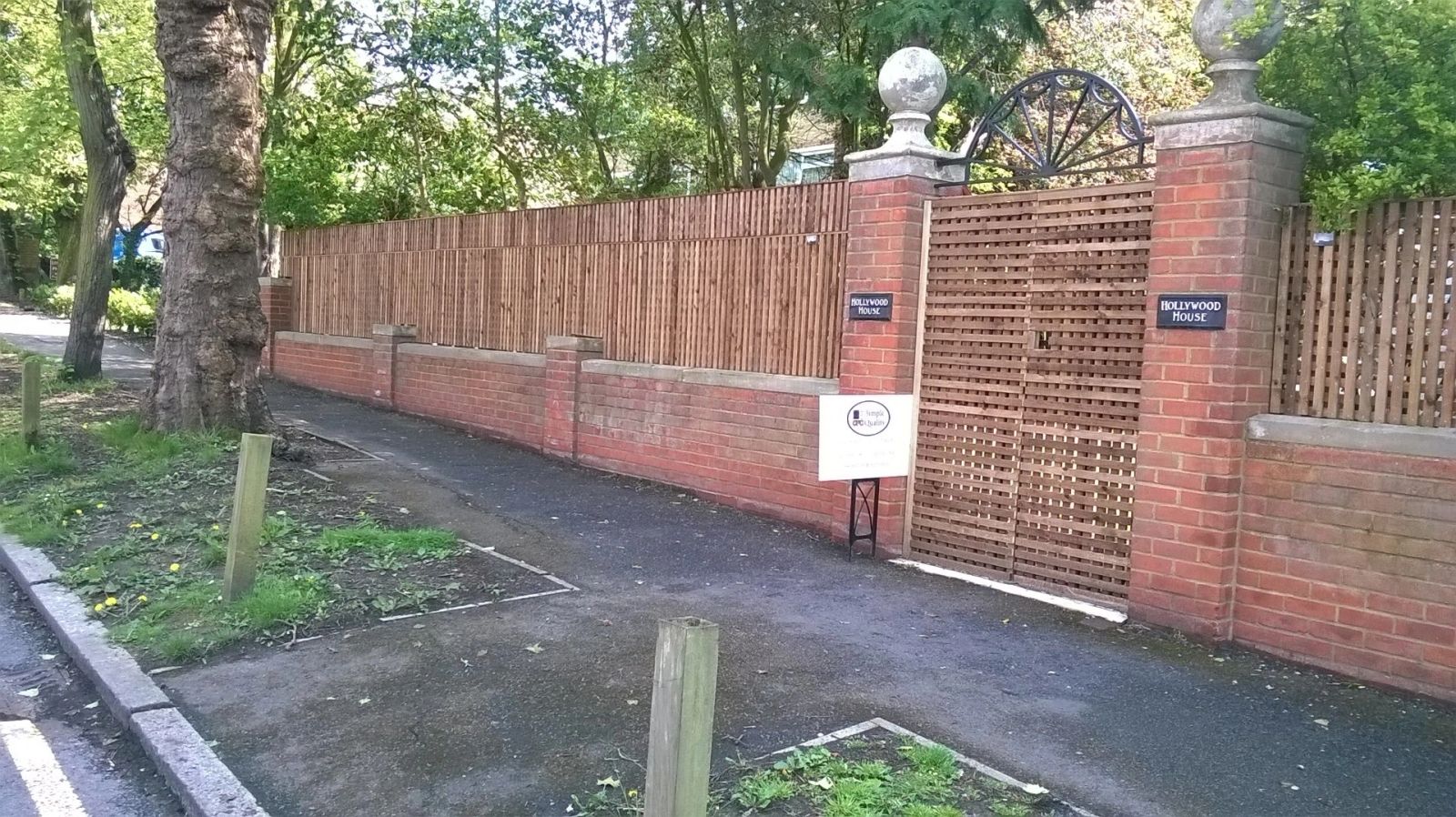
A driveway or front gate is subject to the same permitted development height limits as a boundary fence, and a gate near a junction or a shared driveway has additional visibility requirements to keep sightlines clear for road users.
We check these before recommending a taller or more solid replacement gate, not just when repairing an existing one.
Handling a boundary on a level change
Where a security line has to follow a slope or a step in level between neighbouring plots, panels are stepped bay-by-bay rather than raked, keeping the cap rail level and avoiding a gap opening up under a raked panel where the ground falls away.
A retaining detail is sometimes needed below the fence line itself where the level change is severe enough that the fence alone can't take the load.
UV silvering rates by aspect and species
Untreated or lightly-treated softwood exposed to full sun typically silvers to a grey patina within twelve to eighteen months, while the same timber on a shaded north face can take several years to reach the same appearance.
Hardwoods like oak silver more evenly and hold their structural integrity through the process better than softwood, which is one reason clients choosing a natural weathered look often move toward hardwood despite the higher upfront cost.
Because silvering rate varies so much by aspect, a run that turns a corner from full sun to full shade can look like two different ages of fence within its first two years even though it was installed on the same day.
Arched top gates and curved rail jointing
An arched top gate needs a curved top rail jointed into straight stiles, and that curved rail is usually built up from several shaped sections rather than cut from a single curved timber, since a single piece cut across the grain to follow the curve would be structurally weak.
Repairs to a cracked arched rail need to identify which built-up section has failed rather than treating the whole curve as one component.
Re-securing capping that has lifted along a run
Capping lifts where its own fixings have corroded or worked loose faster than the panel beneath, since it's the most exposed timber on the whole fence and takes the brunt of driving rain and direct sun.
A short lifted section can sometimes be re-screwed if the timber underneath is still sound, but capping that's cupped or split along its length as well as lifting is better replaced in full lengths rather than patched piece by piece.
Party fence wall versus an ordinary boundary fence
A 'party fence wall' has a specific meaning under the Party Wall etc. Act 1996 — a structure that stands astride the boundary line, jointly used by both properties, which is distinct from a garden fence panel that simply happens to mark a boundary.
Most timber panel fencing sits on one owner's land and isn't a party structure in that legal sense, even where it visually marks the boundary line.
Genuine party wall situations are more likely with masonry garden walls straddling the line, and those can bring the Act's notice procedures into play, which is worth checking before work starts.
Capping rail replacement
A capping rail along the top of a panel run sheds rainwater off the panel faces and its own fixings are exposed to the most weathering on the whole fence, so it often needs replacing before the panels beneath show any damage.
Refitting capping with a slight overhang and a drip groove reduces water tracking back onto the panel face compared with a flush-fitted replacement.
Power supply and cabling for automated gates
An automated gate needs a reliable power supply run to the gate location, which on many plots means a new armoured cable run from the property rather than relying on an existing outdoor socket not rated for permanent outdoor use.
Solar-powered gate automation is an option on plots without easy mains access, though it needs a battery sized for the gate's actual cycle frequency rather than a generic system that undersizes for a busy driveway.
Any outdoor electrical work for gate automation should be certified by a qualified electrician under Part P of the Building Regulations, since it isn't the kind of job to treat as a DIY extension of the fencing work.
Historic boundary stones and markers
Older rural and some urban boundaries occasionally retain historic boundary stones, iron markers or other physical features predating modern title plans, sometimes referenced directly in old deeds.
These features can carry real evidential weight in establishing a long-accepted boundary line, particularly where later documents are vague or contradictory.
Where such a marker exists, it's worth photographing and noting its position before any fencing work potentially disturbs or removes it.
Cladding fixing pattern and thermal movement
Timber cladding boards are usually fixed with a single row of fixings near one edge rather than through the centre, allowing the board to expand and contract slightly around that fixed edge without the fixing itself resisting the movement.
Fixing through both edges of a wide board effectively locks it in place, which forces any subsequent expansion or shrinkage to manifest as cupping, splitting or fixing failure rather than free movement.
This detail becomes more important as board width increases, since a narrow board moves relatively little in absolute terms while a wide board can move several millimetres across its face between a dry and a humid spell.
Why corner posts fail more often and need stronger repair specification
A corner post carries the combined load of two fence runs meeting at an angle rather than a single run passing through, so it's under more sustained stress than an intermediate post and often fails first on an ageing boundary.
Repairing a corner post is worth specifying to a slightly higher standard than a mid-run post — larger section, deeper footing, sometimes additional bracing — given the extra load it carries permanently rather than only occasionally.
Combining a windbreak hedge with a lighter fence
Planting a windbreak hedge or shrub line on the exposed side of a fence reduces the wind load the fence structure has to carry directly, since the vegetation absorbs and diffuses much of the force before it reaches the panels.
This takes several years to become effective as the planting matures, so it's usually specified alongside a fence built to cope with full exposure initially, with the expectation that loads reduce over time rather than the reverse.
It's a useful option where a client wants a lighter, less heavily-specified fence than pure exposure would otherwise demand, provided they accept the interim years before the hedge does its share of the work.
What a site survey covers
A proper site survey checks the boundary line against the deed plan where available, probes ground conditions at a few points along the run, and confirms access for both delivery vehicles and hand-carried materials.
It should also flag anything that changes cost before it becomes a surprise later — buried services, a shared boundary needing neighbour agreement, overhead cables limiting how tall equipment can be used, or a slope needing a stepped rather than level run.
A survey that skips any of these and goes straight to a headline price is the most common reason a quote changes significantly once work actually starts.
Weld-mesh versus expanded metal panels
Weld mesh is formed from crossed wires welded at each intersection, giving a uniform grid that's easy to cut to size and re-panel; expanded metal is slit and stretched from a single sheet, leaving no welds to fail and a diamond pattern that resists prising apart at a joint.
Expanded metal costs more per panel but suits higher-threat compounds where weld failure at a joint would be the obvious attack point; weld mesh remains the standard choice for everyday commercial and school boundaries.
Corrosion at ground line on steel posts
The point where a post meets the ground or concrete collar is where corrosion concentrates, because moisture sits there longest and any coating is most easily scuffed during installation.
A sacrificial sleeve, extra coating thickness, or a slight fall on the concrete collar to shed water all reduce this, and it's worth checking on any steel post that's been in the ground more than a few years.
The 1m limit next to a highway
Where a boundary fronts a highway used by vehicles — which includes most residential roads, not just main routes — permitted development height drops to 1 metre rather than 2 metres.
This lower limit exists mainly for visibility and road safety reasons, so it applies even where the fence itself is set back slightly from the actual carriageway edge.
Corner plots can be caught by this rule on more than one side, which is easy to miss when only the main frontage is considered.
Boundary ownership evidence and T-marks
A 'T' mark on a title plan, pointing inward from the boundary line towards a particular plot, is the traditional (though not universal) convention indicating that plot owns and is responsible for that boundary structure.
Where both sides of a boundary carry a T, or neither does, the deeds are silent and ownership defaults to whatever can be evidenced by other means — old photographs, the position of fence posts, or long-standing maintenance history.
T-marks aren't a legal guarantee and can be missing or wrong on older plans, so where a boundary is disputed it's worth treating the mark as a starting point for discussion rather than conclusive proof.
Drainage easements running under a fence line
Some boundaries have a formal drainage easement recorded against the title, protecting a buried pipe or watercourse that a neighbouring property has the right to maintain access to.
Fence posts set directly over or immediately alongside a protected drainage run can technically breach the terms of the easement even if the pipe itself isn't damaged during installation.
Checking the title register, and asking the water company to confirm any known drainage records, is sensible before digging post holes on an older plot with an unclear drainage history.
Aligning a drop bolt on double gates
A drop bolt on the leading edge of one leaf of a double gate needs a matching socket set into the ground or a fixed plate below it, and that socket has to be positioned after the gates are hung and checked closed, not marked out in advance from a plan.
Ground movement or a slight settling of the gate posts over the following months can throw the bolt out of alignment with its socket, which is why some installers set the socket in a slightly oversized recess rather than a tight-fitting hole.
Where the ground under the gate is loose gravel or soft earth, a concrete socket set flush with the surface holds alignment far better over time than a bolt simply pushed into bare ground.
Capping rails and finials
A capping rail along the top of a fence run does more than tidy the appearance — it sheds rainwater off the end grain of vertical boards, which is otherwise the fastest point for water to soak in and start rot.
Decorative finials on posts are largely an aesthetic choice, but a domed or sloped post cap still serves the same water-shedding purpose as a capping rail along a panel top.
Skipping a capping rail to save cost on a budget job is one of the more common reasons a fence's boards fail from the top down within a few years, even when the rest of the construction is sound.