Fence height and boundary lighting interaction
A taller solid fence can throw a shadow line that defeats existing security lighting, creating a dark strip right where an intruder would approach the boundary.
Lighting angles are worth reviewing alongside any height change, and a fence contractor should flag an obvious shadow problem even though relocating the light itself is usually a separate trade.
Phasing a perimeter security upgrade
Replacing an entire perimeter in one go isn't always practical on an occupied commercial site, so work is often phased section by section, with each completed run left secure before the next section is opened up.
Phasing needs a sequence that never leaves the whole boundary compromised at once — usually working round from the least to most vulnerable elevation rather than a simple left-to-right order.
Concreted posts against bolted baseplates for a semi-permanent compound
A concreted post gives a stronger, more permanent fixing appropriate to a fence expected to stay in place indefinitely, but it's disruptive and costly to remove if the boundary line needs to move later, such as when a leased yard's layout changes.
A bolted baseplate fixed to an existing hardstanding trades some ultimate strength for the ability to relocate or remove the fence relatively cleanly, which suits a semi-permanent compound on a leased site better than a fully concreted installation.
Acoustic fencing compared with planting-based screening
Dense planting alone reduces perceived noise mostly by psychological and visual screening rather than genuine sound-blocking, since a hedge thin enough to see through offers little real acoustic mass.
A solid acoustic fence combined with planting in front of it gets the best of both — genuine sound reduction from the solid barrier, softened by greenery that also helps with dust and visual softening.
Where space is tight, prioritising the solid barrier over depth of planting usually gives a better acoustic result than a wide but thin screen of shrubs.
Preservative penetration envelope thickness
Pressure treatment doesn't necessarily saturate a timber section all the way through, and the depth of genuine preservative penetration, sometimes called the treatment envelope, can be shallower in dense or resistant species than the treated colour suggests.
Cutting a treated post in half reveals this directly, often showing a pale, untreated core surrounded by a darker treated outer band a few millimetres to a couple of centimetres deep depending on species and process.
This is the practical reason cut ends need separate end-grain treatment, since a fresh cut through the envelope exposes untreated core timber that the original pressure treatment never reached.
Dealing with a feather-edge board that has cupped
A board cups when one face dries and shrinks faster than the other, usually where the weathered outer face has taken more sun and rain cycling than the sheltered inner face, and it's most common on wide boards cut from flatter-sawn stock.
A cupped board rarely flattens back out once set, so repair is a straight swap rather than an attempt to refix it flatter, and choosing narrower or more vertically grained replacement stock reduces the chance of the same board cupping again.
Frost effects on curing concrete
Concrete that freezes before it has gained enough initial strength can suffer permanent damage — the water within it expands as ice, disrupting the matrix before it sets properly, leaving a weaker base than the mix should give.
Fast-setting post-fix concretes generate some heat as they cure and are more frost-tolerant than a standard wet mix, which is one reason they're the practical choice for winter installations.
Where a hard frost is forecast within the first 24 hours of a pour, delaying the job or insulating the base overnight is usually cheaper than replacing a post that's failed at the concrete collar the following year.
HMO licensing and boundary obligations
A licensed House in Multiple Occupation can carry specific conditions relating to the external areas of the property, including secure and well-maintained boundary fencing, safe means of escape through a rear garden, and bin storage screened from the street.
Licensing officers inspecting the property will check the condition of boundary structures as part of the wider fire safety and amenity standards, and a broken or unsafe fence can be flagged as a licence condition breach requiring remedy within a set period.
Landlords of licensed HMOs should treat boundary repair requests from the council's licensing team as time-limited compliance matters rather than routine maintenance to schedule at leisure.
Meeting stiles on double gates
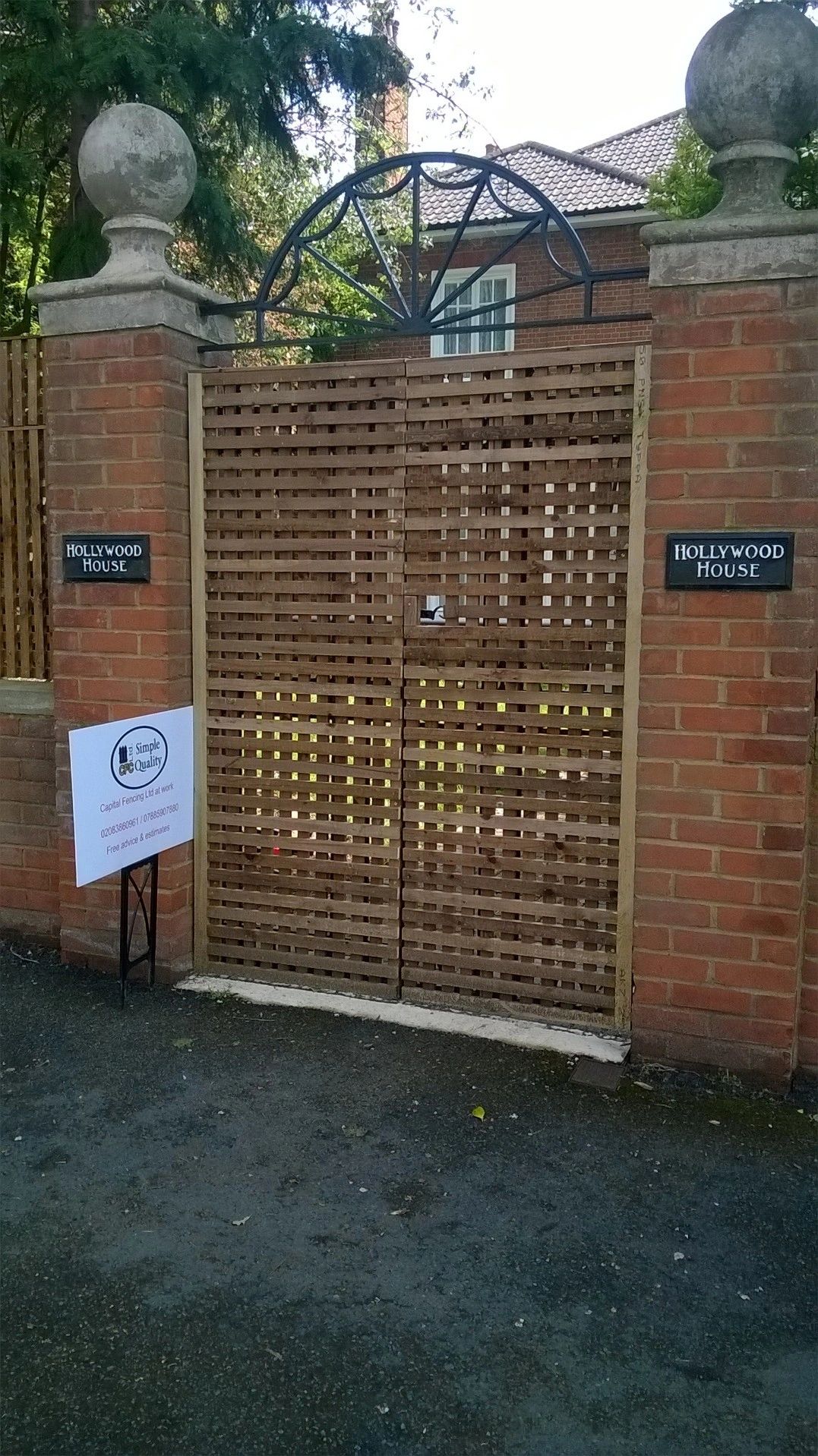
Where two leaves of a double gate meet in the middle, the meeting stiles need to stay flush and aligned with each other for the latch or bolt arrangement to work, and seasonal movement or a dropped hinge on either leaf throws this alignment off first.
We check both leaves together rather than adjusting one side in isolation, since a fix on one leaf alone can leave the meeting point mismatched.
Sliding versus swing gate mechanisms
A swing gate needs clear space to open into, whether that's the driveway itself or the street, while a sliding gate runs parallel to the boundary and suits plots where that swing space isn't available.
Sliding gates need a level, unobstructed track run at least as long as the gate itself, plus a foundation for the track and rollers that copes with the gate's full weight — cutting corners here is the most common cause of a sliding gate that jams.
Swing gates are generally simpler to install and service, which is worth weighing against a sliding gate's space-saving advantage on a tight or sloping driveway.
Gate stop positioning for correct swing angle
A gate stop set into the ground or fixed to the post limits how far a gate can swing open, protecting the hinges from being forced past their working range by wind or an over-enthusiastic push.
Positioning the stop correctly against the gate's actual swing arc, rather than a generic distance from the post, avoids the stop being struck at an angle that damages the gate's bottom rail.
Cantilever gate counterbalance rollers
A cantilever sliding gate has no ground track and instead relies on internal rollers running along a supporting beam set into the ground either side of the opening, with a counterbalanced section extending behind the gate to carry its weight.
Because there's no track to keep clear, faults on this type are more often traced to the internal rollers or the foundation beam settling than to surface debris.
Planning enforcement notices on unauthorised boundaries
Councils have enforcement powers to require unauthorised boundary structures to be altered or removed, usually triggered by a neighbour's complaint or a routine site visit for unrelated work.
There are time limits on enforcement action for most breaches, though these vary by the type of breach and don't apply to work within a conservation area or affecting a listed building in the same way.
Responding promptly and cooperatively to any enforcement contact from a council generally leads to a better outcome than ignoring it.
Automation compatibility checks and specialist referral
Before a gate is automated, its weight, swing clearance and frame rigidity need to suit the motor type being considered, and a gate that's sound for manual use isn't automatically suitable for automation without checking.
We check the gate itself is fit for automation and refer the motor, control-board and sensor installation to a specialist automation engineer.
LOLER-adjacent inspection duties on powered gates
Automated or powered gates fall under machinery safety regulations rather than lifting equipment rules directly, but the same discipline of scheduled inspection applies — force limiting, safety edges and photocell alignment on a powered gate need periodic checking, not a one-off commissioning test.
Where a fencing contractor supplies the mechanical gate leaf but not the automation, responsibility for these checks is usually split contractually, and it's worth confirming who's covering what before the gate goes live.
Diagonal bracing struts on gate posts
A diagonal timber or metal strut run from partway up a gate post back to a buried anchor or second post resists the twisting and leaning force a heavy gate exerts on its hinge post over time, particularly on wide or heavy gates.
Without bracing, that twisting load is carried entirely by the post's own embedment in the ground, which can gradually work the post out of true even where the concrete footing itself remains intact.
Bracing is generally specified based on gate weight and width rather than applied universally, since a light pedestrian gate rarely generates enough leverage to need it while a wide vehicle gate almost always does.
Aligning hinges before final gate fixing
Hinges fixed slightly out of vertical alignment with each other make a gate bind or swing shut under its own weight rather than staying wherever it's left, even if each hinge individually looks correctly fitted.
Propping the gate at the intended finished height and checking the gap is even top and bottom before final fixing catches most alignment problems while they're still easy to adjust.
Loosely fitting the top hinge first, checking swing and clearance, and only then fully fixing both hinges is a more forgiving sequence than fully fixing both at once and finding the gate doesn't swing cleanly.
Wildlife gaps for hedgehog movement
A small gap of around 130mm square cut into the base of a solid fence panel, sometimes called a hedgehog highway, lets hedgehogs move between connected gardens without needing to dig under or go around a continuous boundary.
This is increasingly requested by clients aware of declining hedgehog populations and is straightforward to incorporate into a new close-boarded panel, ideally agreed with the neighbouring property so the gaps line up on both sides of the boundary.
The gap doesn't compromise the fence's structural performance if it's cut cleanly within a single board rather than across a post or rail.
Picket fence styles and spacing
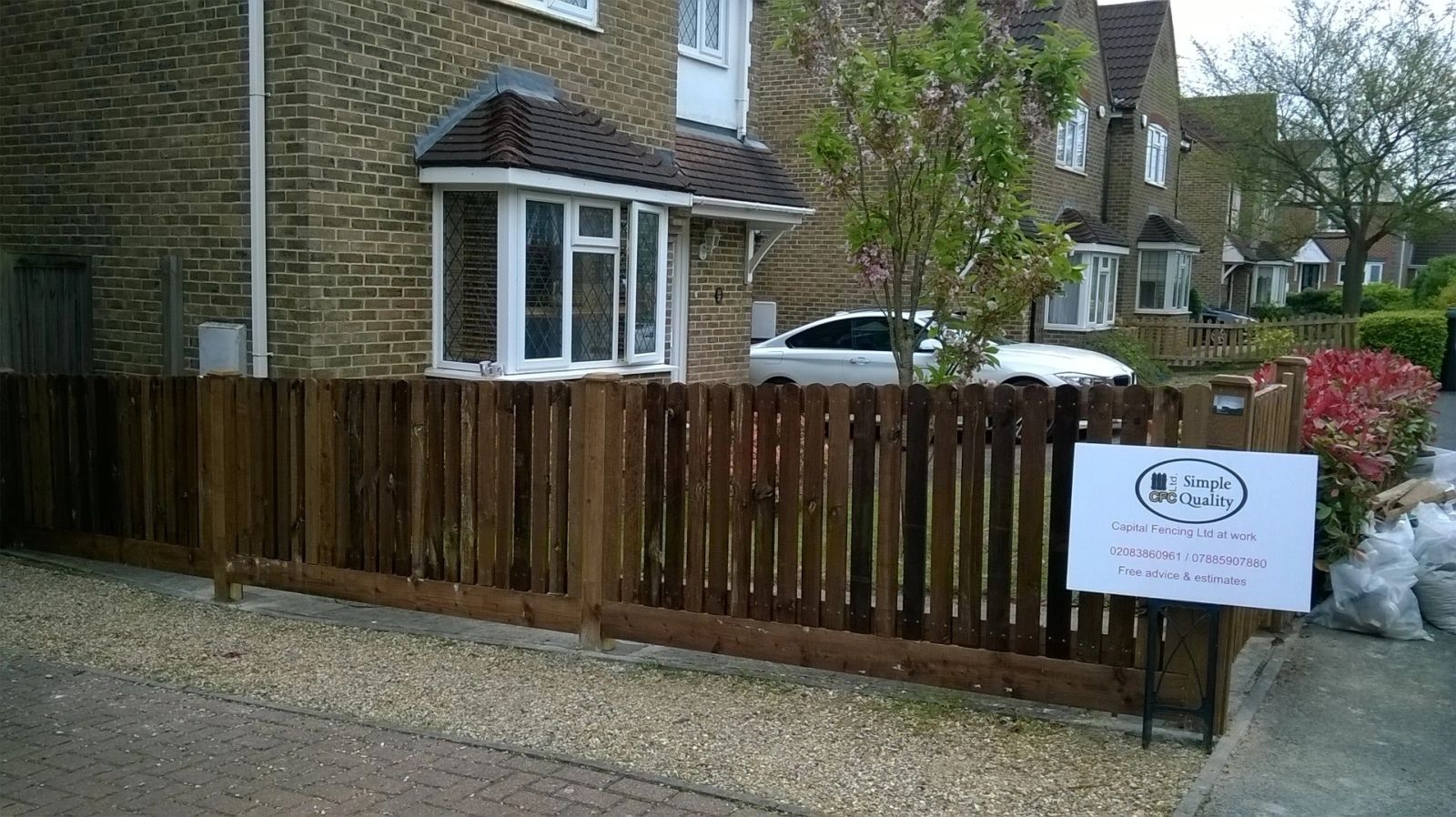
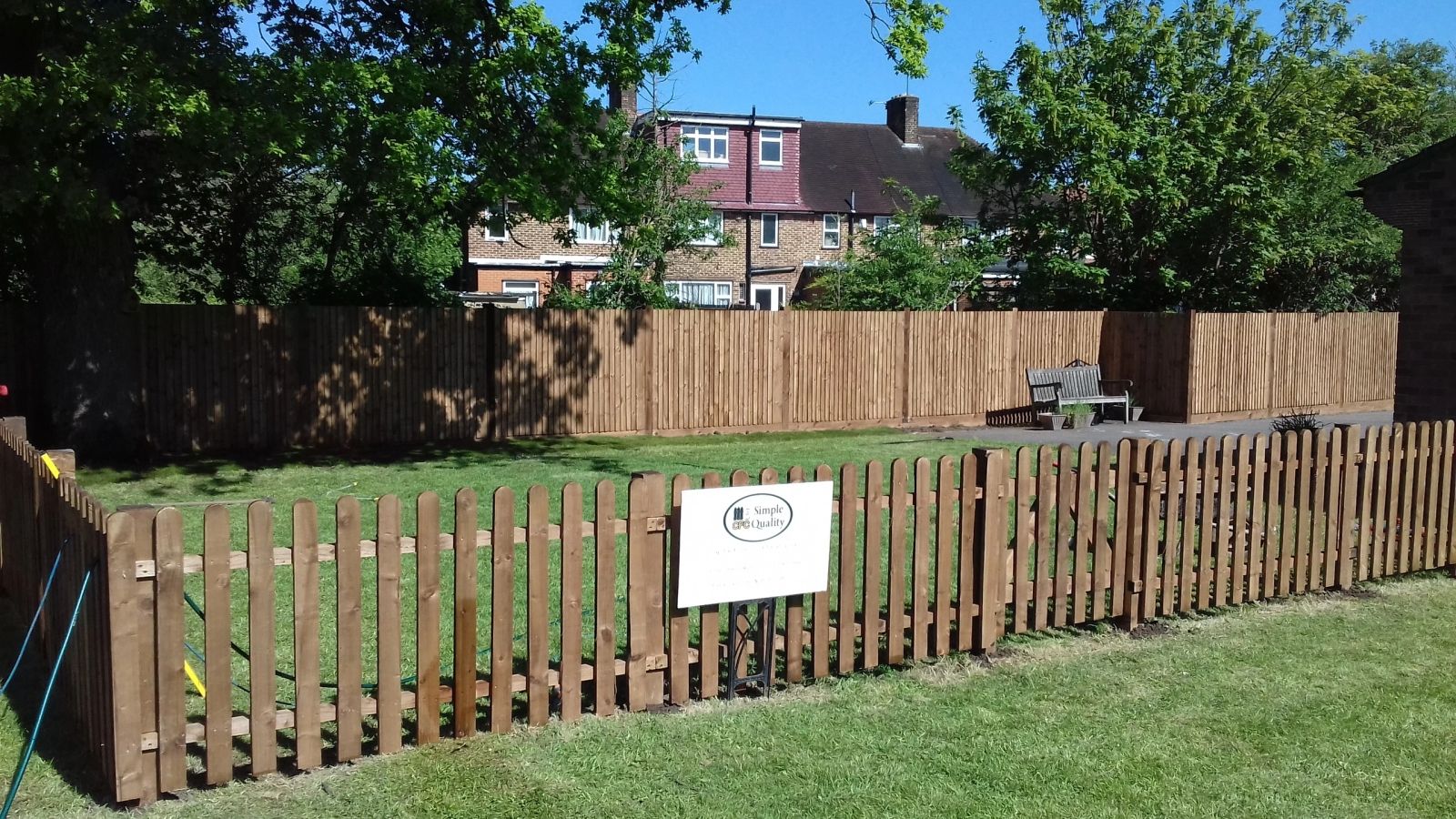
Picket fencing trades privacy for a lower, more open boundary, which suits front gardens where sightlines to the street and a welcoming appearance matter more than screening.
Picket spacing is a genuine design choice — narrower gaps look more traditional and offer a bit more containment for small pets, while wider spacing uses less timber and lets more light and air through a planted border behind it.
Because picket fencing is low, it rarely needs the same post depth as a taller closeboard run, though corner and gate posts still need proper concrete footings regardless of the fence's height.
Wet rot versus dry rot fungi in fence timber
Wet rot fungi need sustained high moisture content to establish and spread, and are the more common cause of decay in buried or ground-contact fence posts that stay consistently damp.
Dry rot, despite the name, also needs moisture to establish initially but can then spread through drier surrounding material via root-like strands, making it more of a concern in enclosed, poorly ventilated timber structures than open-air fencing.
In practice, most fence post decay encountered on typical garden and boundary fencing is wet rot rather than dry rot, given the open, ventilated conditions most fencing timber sits in.
Checking for secondary damage after a fence has fallen flat
Once a section of fence has actually fallen rather than just leaning, it's worth checking what it fell onto or against — a shed, a parked car, planting — since secondary damage from the fall is sometimes the more significant repair cost.
The fallen section itself also needs assessing for whether any timber is still reusable, since a fall can snap fixings without necessarily destroying the panel or boards, which affects how much of the repair is replacement versus refitting.
Salt-laden air and coastal-adjacent exposure
Gardens within a few miles of open coast, or on a plot regularly exposed to salt spray carried on strong onshore winds, see accelerated corrosion of standard fixings and hinges compared with an inland site.
Stainless steel or heavily galvanised fixings are worth the extra cost in these conditions, since standard zinc-plated screws and hinges can show surface rust within a single season.
Timber itself isn't usually damaged by salt exposure directly, but a finish applied over salt residue left on the surface after a storm won't bond as well as one applied to a clean, rinsed surface.