London & Hertfordshire Free Site Visit
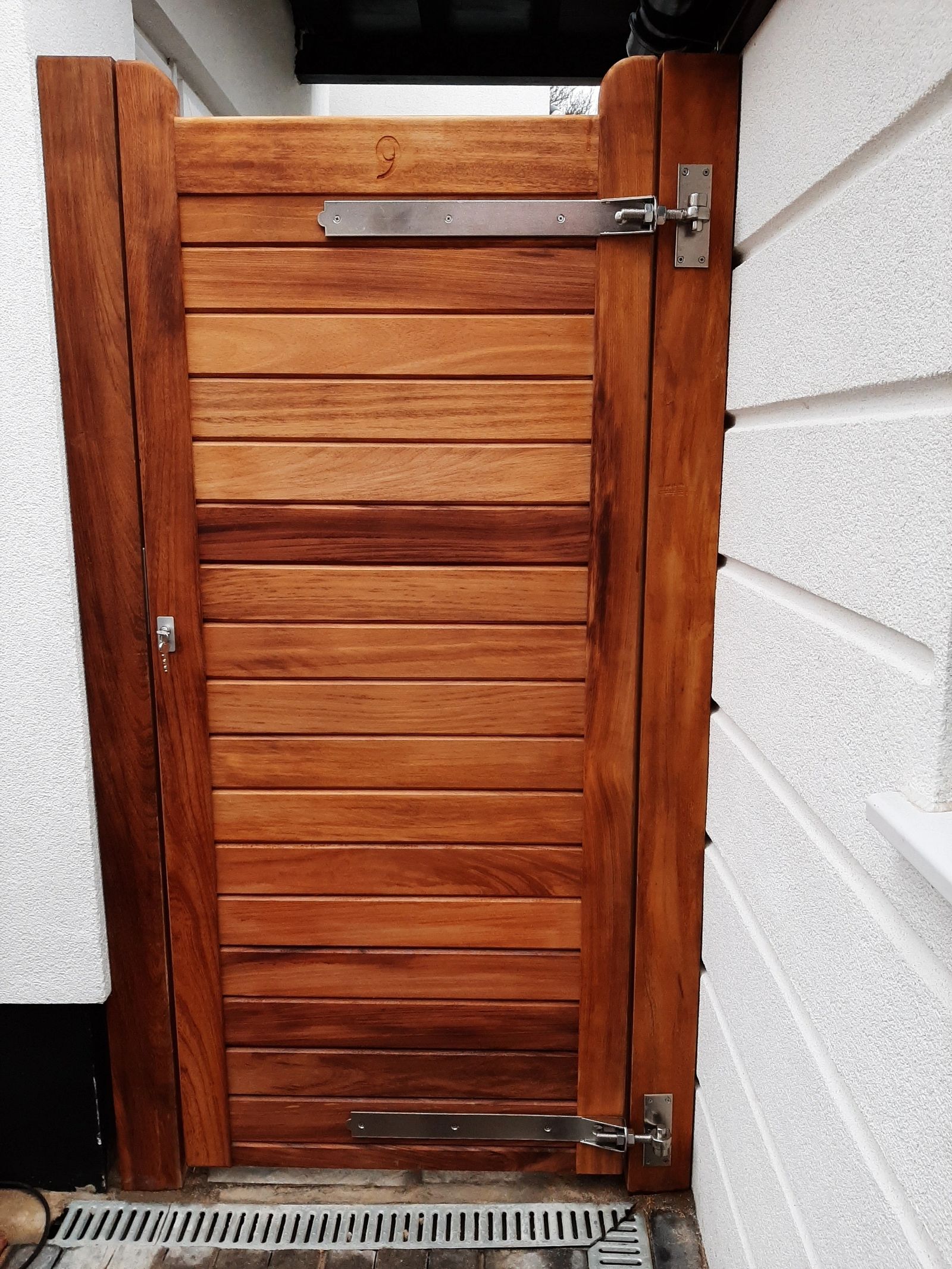
bespoke wooden gate installed by Capital Fencing in Potters Bar (EN6)
Potters Bar · EN6

Pedestrian Side Gates in Potters Bar (EN6)

We approach pedestrian side gates in Potters Bar from the failure end backwards. Hinging off the last post of an old fence run — the post moves and the gate stops closing within weeks — that's the single most common thing we're called back to fix, and it's the first thing our spec addresses. Roads such as Hatfield Road and Darkes Lane are typical of the local layout. Oakmere Park is a useful local reference point. The town's housing is predominantly inter-war semi-detached, built as the area developed following the arrival of the railway.

We approach pedestrian side gates in Potters Bar from the failure end backwards. Hinging off the last post of an old fence run — the post moves and the gate stops closing within weeks — that's the single most common thing we're called back to fix, and it's the first thing our spec addresses. Roads such as Hatfield Road and Darkes Lane are typical of the local layout. Oakmere Park is a useful local reference point. The town's housing is predominantly inter-war semi-detached, built as the area developed following the arrival of the railway.

Why this spec, for single-leaf pedestrian gates matched into existing fencing runs

  • carried in as a like-for-like match to what's already there — no visible new post
  • hinge and latch geometry sized for daily use rather than as a one-off decorative piece
  • installed with the closing stop and latch in one visit so nothing has to be revisited

Typical pedestrian side gates briefs in Potters Bar

  • hardwood pedestrian gate through a brick garden wall opening
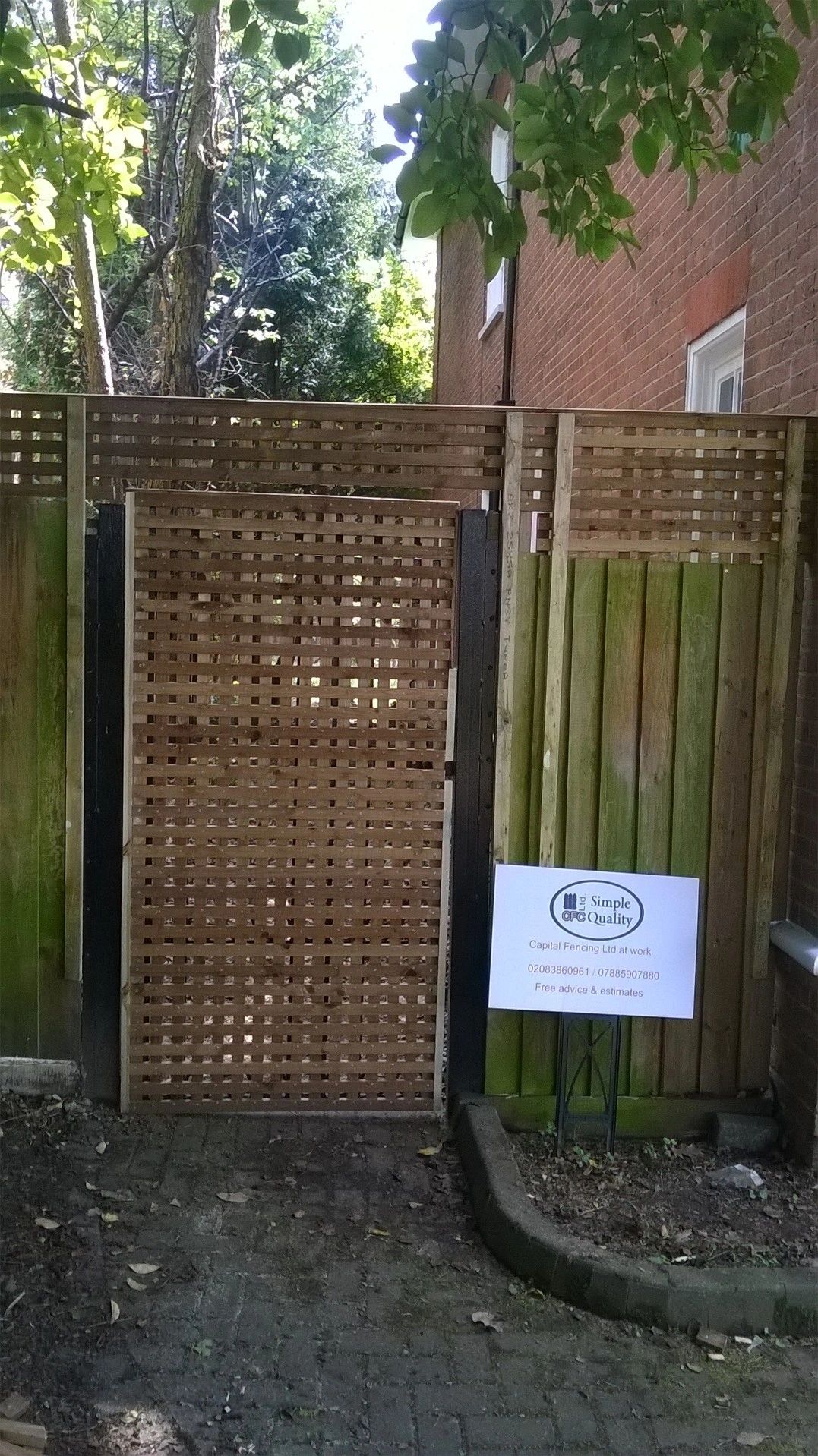
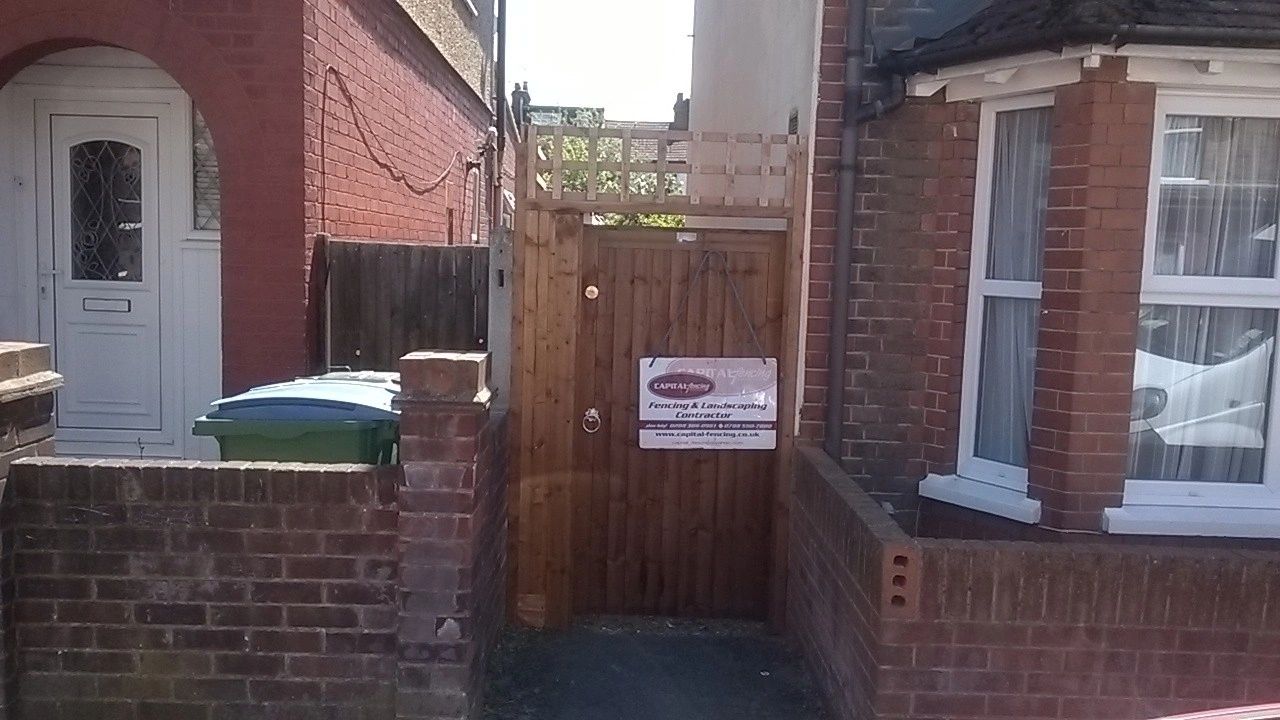
  • single 900mm pedestrian gate cut into an existing closeboard run
Default spec

How we build pedestrian side gates in Potters Bar

single leaf on ball-race hinges, thumb-latch and dead-locking hardware, closing stop and drop-bolt where security is a priority. On Potters Bar jobs we adjust for many gardens border the green belt — the brief usually needs sturdy stock-proof boundary work.

Property mix locally: 1930s semis, post-war detached homes around Cranborne Road, and infill developments near Little Heath. Typical gardens: generous rear gardens — often deep enough for decking plus a separate utility area. Postcodes we regularly service: EN6.

What goes wrong

Common failure modes on pedestrian side gates

  • hinging off the last post of an old fence run — the post moves and the gate stops closing within weeks
  • specifying a decorative latch not rated for daily use — hardware fatigue inside a year

Pedestrian Side Gates FAQs — Potters Bar

Can you match a new pedestrian gate into my existing fence?

On pedestrian side gates jobs in Potters Bar (EN6), our default answer is: single leaf on ball-race hinges, thumb-latch and dead-locking hardware, closing stop and drop-bolt where security is a priority. For context: hinge and latch geometry sized for daily use rather than as a one-off decorative piece. Measured, quoted and installed by the same small crew.

How do I keep the gate closed without a spring hinge?

Across Potters Bar we spec around many gardens border the green belt — the brief usually needs sturdy stock-proof boundary work, so on pedestrian side gates that usually means closeboard-matched softwood for behind-the-house lines. The honest trade-off is hinging off the last post of an old fence run — the post moves and the gate stops closing within weeks — which is exactly what our default spec designs out.

What hinges do you use so the gate doesn't drop?

Hertsmere Borough coverage means we can survey most EN6 addresses inside a week — single-leaf pedestrian gates matched into existing fencing runs. We'll walk you through carried in as a like-for-like match to what's already there — no visible new post on the site visit before you commit.

Softwood or hardwood for a matched pedestrian gate?

Practically: single 900mm pedestrian gate cut into an existing closeboard run. That's the Potters Bar version of this job, not a generic one. We'll walk you through carried in as a like-for-like match to what's already there — no visible new post on the site visit before you commit.

Do you fit the latch and any hardware on the same visit?

On pedestrian side gates jobs in Potters Bar (EN6), our default answer is: single leaf on ball-race hinges, thumb-latch and dead-locking hardware, closing stop and drop-bolt where security is a priority. The honest trade-off is hinging off the last post of an old fence run — the post moves and the gate stops closing within weeks — which is exactly what our default spec designs out.

Recent pedestrian side gates work
bespoke wooden gate installed by Capital Fencing in Potters Bar (EN6)double driveway gates installed by Capital Fencing in Potters Bar (EN6)hardwood side gate installed by Capital Fencing in Potters Bar (EN6)metal entrance gate installed by Capital Fencing in Potters Bar (EN6)

Local considerations across Potters Bar and barnet

Bollards and hostile-vehicle basics

Bollards protect a pedestrian area or building frontage from vehicle incursion and are specified separately from the fence line itself, usually to a recognised impact rating for the vehicle speed and mass expected.

Fixed, removable and retractable bollards each suit different access patterns — removable bollards are common where delivery vehicles need occasional access through an otherwise protected frontage.

Timber stain versus paint breathability

A translucent or semi-transparent stain generally remains vapour-permeable, allowing moisture that gets into the timber to escape back out again as the wood dries, which reduces the risk of trapped moisture driving rot.

Solid, opaque paint films are often less permeable, and a paint film that cracks or is breached can trap moisture behind it against the timber, sometimes accelerating localised decay compared with an unpainted equivalent.

Modern microporous exterior paints aim to combine paint's fuller colour coverage with a degree of vapour permeability, narrowing but not eliminating this trade-off between appearance and moisture management.

Pressure-washer damage on soft timber

A pressure washer used too close, or at too high a setting, strips the softer spring-growth wood fibres from softwood faster than the harder summer-growth bands, leaving a rippled, furry surface texture that no longer takes stain evenly.

This damage is largely irreversible on a panel face and usually shortens the remaining life of the timber by exposing more surface area to moisture uptake.

A wide fan nozzle held well back, or a lower-pressure setting reserved for decking rather than fence panels, cleans without cutting into the timber surface.

Salt-laden air and coastal-adjacent exposure

Gardens within a few miles of open coast, or on a plot regularly exposed to salt spray carried on strong onshore winds, see accelerated corrosion of standard fixings and hinges compared with an inland site.

Stainless steel or heavily galvanised fixings are worth the extra cost in these conditions, since standard zinc-plated screws and hinges can show surface rust within a single season.

Timber itself isn't usually damaged by salt exposure directly, but a finish applied over salt residue left on the surface after a storm won't bond as well as one applied to a clean, rinsed surface.

Which side a fence's face and posts should sit on

There's a long-standing but informal convention that the 'good side' — the smooth face without visible posts and rails — should face the neighbouring property, though this is a courtesy rather than a legal requirement.

Some title deeds do specify a required orientation as part of an ownership condition, which takes precedence over the general convention where it applies.

Where no such condition exists, agreeing the facing direction with a neighbour before building avoids a common and easily-avoided source of minor friction.

Vegetation growing through or over a shared fence

Plants growing from one garden through, over or against a shared fence — a spreading shrub, an overhanging branch, a self-seeded sapling in the fence line itself — sit in a grey area between garden maintenance and boundary structure that isn't always covered by a simple 'good neighbour' agreement.

A sapling that germinates directly against a post and is left to grow can eventually distort or crack the post as its trunk thickens, which is a slow-motion structural problem rather than a purely cosmetic one.

Flagging seedlings growing in or immediately against a fence line at an early stage, before root or trunk growth causes structural distortion, avoids a much larger repair later.

Keeping mortice depth consistent across a run of timber posts

Hand-cut mortices in timber posts can vary slightly in depth from post to post if they're cut freehand rather than to a fixed jig or depth stop, which then shows up as a rail sitting at a slightly different height at each junction.

A simple depth stop clamped to the chisel or drill bit, checked against the first mortice cut, keeps every subsequent one consistent without needing to measure each one individually from scratch.

Checking a sample rail against several mortices before committing to cutting the whole run confirms the depth is right before the error, if there is one, has been repeated across every post.

Use classes for ground-contact timber

Treated timber is graded into use classes according to how much moisture and ground contact it's expected to face, and specifying the wrong class for the job is a common cause of premature rot that isn't obvious until years later.

Use Class 3 covers above-ground timber exposed to the weather, such as boards and rails; Use Class 4 covers timber in direct or near-permanent ground contact, which is what posts and gravel boards should be specified to, not Use Class 3 stock used because it's cheaper or more available.

A supplier's treatment certificate should state the use class achieved, and it's worth asking for it on any job where posts are the expensive, hard-to-replace component of the run.

Parking and material handling on site

Fencing, gates and decking all involve moving bulky, heavy material — concrete posts, gravel boards, decking joists — from a van to the working area, and how far that has to be carried has a real effect on labour time.

On streets with permit parking, no off-street loading bay, or restricted delivery hours, we plan the drop-off around those restrictions rather than assuming a van can sit outside all day.

Where a plot has a driveway or side gate wide enough for a barrow run, that alone can shave a meaningful amount of time off a job compared with hand-carrying everything round the front.

Vertical picket infill on top of a mesh security panel

Adding a row of vertical steel pickets above a mesh panel gives extra height without the wind loading of a full-height solid mesh extension, and the picket spacing is kept tight enough that it doesn't create a new set of usable footholds.

This detail is common where a boundary needs to reach a taller overall height for a later phase of a site's security review without replacing the mesh panels already installed at the lower level.

Clearing old gate hardware and frames

Old hinges, latches and, where a frame is beyond repair, the timber itself are removed and taken off site as part of the job, rather than left for the client to dispose of separately.

Where original ironmongery is salvageable and still serviceable, we reuse it rather than replacing parts that don't need it.

Post splitting from over-driven fixings

Driving a nail or coach screw too close to a timber post's edge, particularly near the end grain, concentrates stress in a narrow section of fibres and can split the post along the grain rather than simply seating the fixing.

Pre-drilling a pilot hole for larger fixings, especially near board or post ends, relieves that concentrated stress by giving the fixing a path that doesn't have to force the surrounding fibres apart.

Species with straighter, more even grain generally resist this kind of splitting better than timber with interlocked or knotty grain near the fixing point, where existing weaknesses in the fibre structure make a split more likely to propagate.

Handling older timber treated with preservatives no longer in use

Timber treated with older preservative formulations that have since been withdrawn or restricted can still be present in fences installed some years ago, and cutting or sanding that timber during a repair can release different residues than modern treated timber would.

Where a fence is old enough that its original treatment is uncertain, working with good ventilation, gloves and dust control, and disposing of offcuts as general waste rather than burning them, is the sensible default.

Matching joist centres to the deck board chosen

Choosing the decking board before finalising joist centres avoids a common sequencing mistake, since a thinner or more flexible board specified after the substructure is already built may need joists closer together than what's already in the ground.

Board thickness, species and orientation (laid along or across the joists) all interact, so a change to any one of them partway through a project can mean revisiting the joist layout rather than just swapping the board.

Getting board specification confirmed before ordering joist timber is a small step that avoids costly rework on a part-built substructure.

Tongue-and-groove board joints

Tongue-and-groove boards have a projecting tongue on one edge and a matching groove on the other, which locks adjacent boards together and stops the panel racking or gapping as timber moves.

This gives a fully solid-looking panel face with no gaps even as the boards season, unlike an overlapping feather-edge panel where gaps can open as the wood shrinks.

The tight interlocking fit does mean less room for movement overall, so tongue-and-groove panels are more prone to visible buckling if fitted without a small expansion allowance at each end.

Feather-edge versus overlap panel construction

Feather-edge fencing uses individual tapered boards nailed vertically to horizontal arris rails, built up on site board by board, which makes it easier to repair a single damaged board without disturbing the rest of the run.

Pre-made overlap or lap panels are faster to install since they arrive as a complete unit, but a single split board usually means replacing the whole panel rather than one board.

Feather-edge also tends to be the sturdier choice on an exposed or long run, since the individual boards and rail structure resist wind loading better than a thinner factory panel.

Cill board water-shedding function

A cill or capping rail fitted along the top of a panel fence sheds rainwater clear of the panel's top edge, in the same way a window cill sheds water clear of a wall, reducing the time the top edge of boards stays saturated.

Without a cill, the end grain along the top of vertical boards absorbs water directly and repeatedly, which is a common cause of premature rot starting specifically at the top of a panel rather than the base.

A cill with a slight forward overhang and a drip groove on its underside sheds water further clear of the face below it than a flush-fitted cill, reducing streak staining on the boards beneath.

Dog-proofing details at ground level and gaps

Dogs test a fence at ground level far more than at height, so gaps under gravel boards, worn hollows on sloping ground, or wide overlaps between adjacent panels are the points most likely to let a determined dog through or under.

A close-fitting concrete gravel board set with minimal gap to the ground, rather than a timber board that can warp and lift, closes off the most common escape route without changing the overall fence design.

For persistent diggers, a buried mesh apron or paving strip just inside the fence line at ground level stops excavation without needing to alter the visible fence at all.

Siberian larch as a fencing timber

Siberian larch grows slowly in a cold climate, which produces a dense, tight-grained timber with better natural durability than most fast-grown European softwoods, without needing pressure treatment in many applications.

It's noticeably harder to nail and screw without pre-drilling than typical treated pine, and a nail driven in at the wrong angle is more likely to split the board than sink cleanly.

Left unfinished it weathers to a silvery grey similar to cedar, though its higher density means it holds up somewhat better to knocks and general handling on site.

Historic boundary stones and markers

Older rural and some urban boundaries occasionally retain historic boundary stones, iron markers or other physical features predating modern title plans, sometimes referenced directly in old deeds.

These features can carry real evidential weight in establishing a long-accepted boundary line, particularly where later documents are vague or contradictory.

Where such a marker exists, it's worth photographing and noting its position before any fencing work potentially disturbs or removes it.

Lap panels versus closeboard durability

Overlap (lap) panels are factory-assembled from thin horizontal slats stapled to a light timber frame, which makes them cheap and quick to fit but noticeably shorter-lived than boarded fencing.

The thin slats and lightweight frame flex in wind and the staples pull through over a handful of seasons, especially on an exposed run, whereas closeboard's thicker feather-edge boards and nailed arris rails tolerate the same movement without failing.

Lap panels suit a budget-driven job with modest exposure; anywhere wind-loaded or expected to last well past a decade is better specified as closeboard from the outset.

Repairing a fence on a sloped or stepped boundary

A boundary on a slope often fails first at the lowest point of each step, where water naturally collects, so a repair there sometimes needs a revised drainage detail rather than simply replacing the failed section like-for-like.

We check the fall of the whole run before repairing one section, since a step that's settled unevenly can be the real cause of a failure further along.

On pedestrian side gates in Potters Bar you get the same crew from first site visit to hand-over. That's the whole model — small team, match-what-you-have spec, written quote before we start. Roads such as Mimms Hall Road and The Avenue are typical of the local layout. Potters Bar station is a useful local reference point. Potters Bar sits just inside the M25 at Junction 24, on the boundary between Hertfordshire and Greater London.

Get In Touch

Get My Free Quote — 24h Response

No callout fee · Free site visit · Friendly local team covering London & Hertfordshire.

Call us
07885907880
or 02036484746
Email
capital_fencing@yahoo.com
WhatsApp
Message us anytime
Area
London & Hertfordshire
Payment
Card payments accepted

Pay by debit or credit card, bank transfer or cash once the work and price are agreed. No deposit taken online.

Request a Free Quote

We'll get back to you within 24 hours.

Free Site Visit No Callout Fee
Call WhatsAppQuote