Boundary fencing around church grounds
Church grounds often combine a public-facing boundary that needs to stay welcoming during opening hours with a requirement to secure the building and any lead roof or metalwork against theft outside those hours, which can mean a lower decorative railing at the frontage and a more solid, higher-security line around the building itself.
Listed building status is common on older churches, so railing style and any new fixing into existing stone or brick boundary walls usually needs consent before work starts.
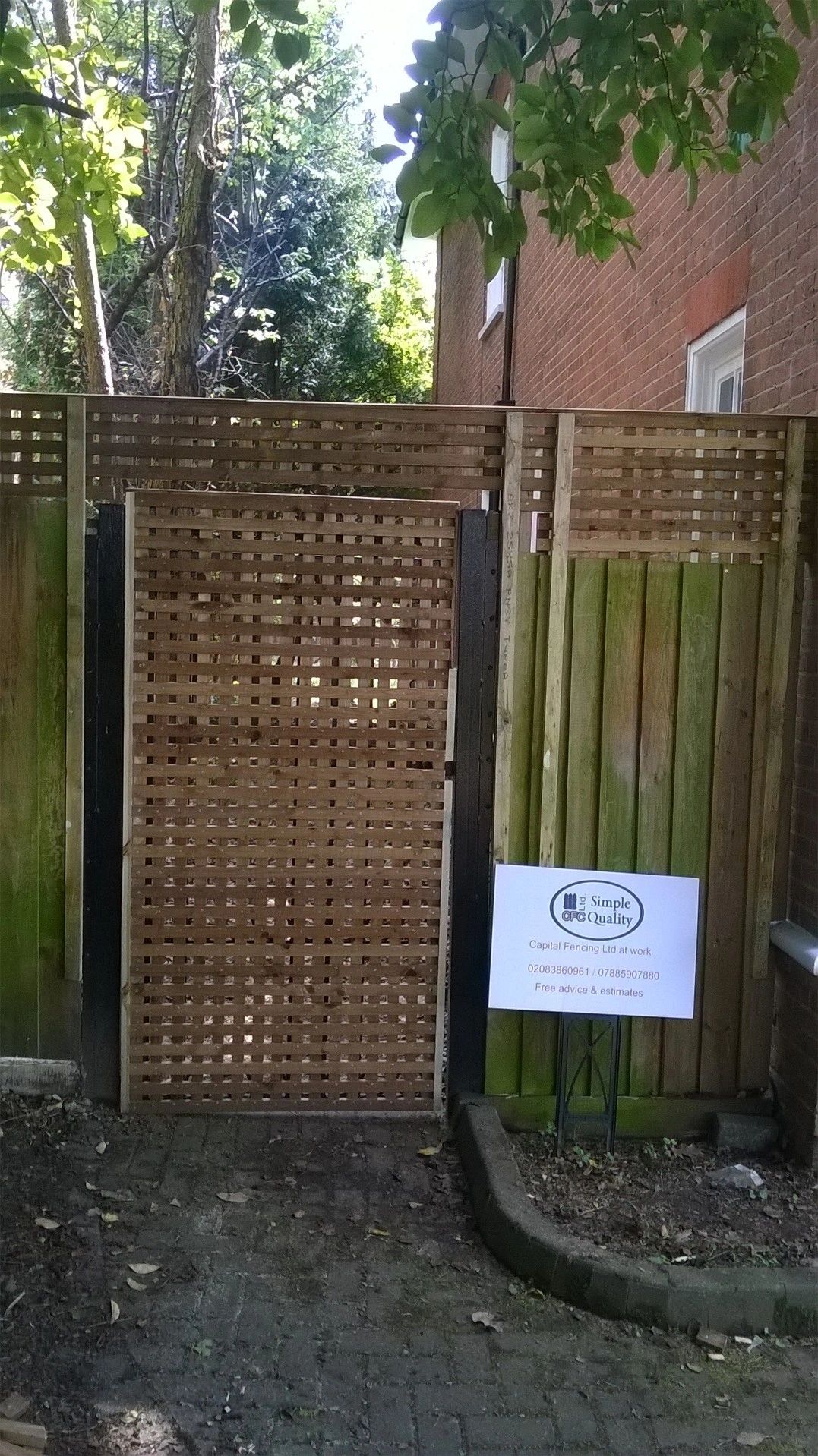
Matching a gate to an existing fence style
A replacement gate looks obviously mismatched if its board profile, height or capping detail doesn't follow the fence either side of it, even when the gate itself is well built.
We match board spacing, rail positions and capping profile to the existing run rather than fitting a stock gate design into a bespoke boundary.
End-grain sealing on cut timber
Any cut made on site — trimming a post to length or cutting a rail to fit — exposes end grain that draws in moisture far faster than the treated face of the timber, making it a common starting point for rot if left unsealed.
Sealing cut ends with an end-grain preservative at the time of cutting, not afterward, closes off that entry point before the timber is fixed in place.
Seasonal ground conditions affecting installation
Clay ground shrinks and cracks in a dry summer and swells again over winter, which can loosen a post fixed during one season and tightened again by movement in another — installation timing is factored into how deep and how set a post needs to be.
A frozen or waterlogged base isn't workable for concreting, so winter installations sometimes need a delayed pour or a temporary prop until ground conditions allow the footing to cure properly.
Digging in summer-baked clay ground
Clay that's dried and cracked over a hot summer can be almost as hard as digging through soft rock in the top few hundred millimetres, even though the same ground would be workable a season later once it's rehydrated.
An auger struggles on baked clay in the same way it struggles on rubble, tending to bounce and judder rather than cut cleanly, so a pilot hole broken up with a bar first can make the auger's job easier.
Watering the dig point lightly the day before, where practical, softens the very top layer enough to ease the first stage of digging without turning the hole into a mud pit.
Widening an existing gate opening
Widening a driveway opening to take a larger vehicle usually means moving or replacing both hanging and slamming posts, not just fitting a wider gate to the existing gap, since the posts themselves define the usable width.
Ground and drainage either side of the widened opening are checked at the same time, since regrading the entrance often follows a widening job.
Construction hoarding versus the permanent boundary
Temporary site hoarding during a build is a separate specification from the permanent boundary that eventually replaces it — hoarding is chosen for site security and public safety during works, often under a party wall or highways licence, while the permanent fence is chosen for the finished property.
Where a boundary needs both, it's worth planning the sequence so the permanent fence isn't installed and then damaged by ongoing construction traffic before the build finishes.
Hoarding on a public highway usually needs its own licence from the council, separate from any planning permission covering the building work itself, and unlicensed hoarding on a footway can be removed by the authority.
Deciding between stepping and raking a panel run
Stepped panels stay level themselves and drop in increments post to post, leaving a small triangular gap under each panel that grows towards the low end of a run; raked panels are cut at an angle so the top edge follows the slope continuously with no gap.
Stock panels can be stepped without alteration, but raking almost always means cutting a panel's top rail and infill to an angle on site, which only works with materials that can be cut and re-fixed cleanly, such as featheredge or slatted boards.
A steep, uneven slope generally favours stepping for speed and future repairability; a long, gentle and even gradient often looks better raked, since the steps would otherwise be very shallow and visually fussy.
Drainage as a repeat cause of failure
Where a post has failed at the base, poor drainage around that specific spot is often the underlying reason rather than simple age — a low point that collects rainwater rots a post from the ground up years before the timber above shows any sign of it.
A repair that resets the post without addressing the drainage at that point risks the same failure recurring within a few seasons.
Moisture at the base of a gate frame
The bottom rail of a gate frame traps moisture longer than any other part of the gate, which is why frame rot almost always starts there first — a gate hung close to ground level with poor drainage underneath will rot faster than one with a clear run-off gap.
Where a repair addresses bottom-rail rot, improving drainage at that point is usually worth doing at the same time.
Latch types: Suffolk, ring, auto-latch, gravity
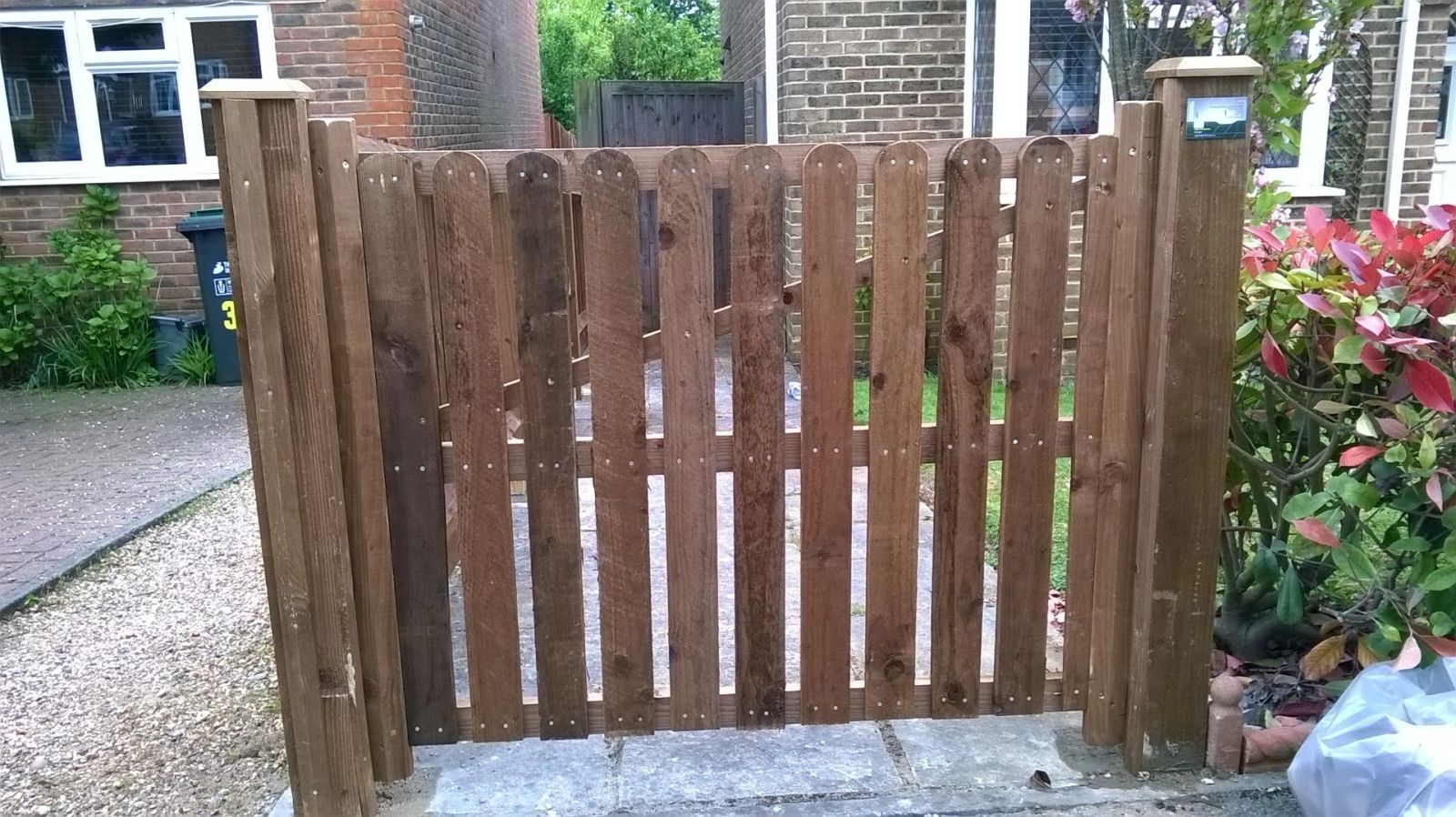
A Suffolk latch and a ring latch both use a thumb-operated lever to lift a bar out of a keep, while an auto-latch closes itself on contact and a gravity latch relies on weighted design to drop into place — each needs different striker alignment to work reliably.
Replacing a worn latch with a like-for-like type is usually simpler than switching types, since the keep and striker positions are often already cut for that specific mechanism.
Reinforcing a hinge post weakened by gate movement
A gate hinge post takes repeated leverage every time the gate swings, which loosens its footing faster than a plain fence post nearby carrying no such load, and it's a common early failure point on a boundary that includes a gate.
Reinforcing usually means a larger post section, a deeper footing, or bracing back into the adjoining fence run, rather than simply resetting the same post size that already proved inadequate for the load.
Carrying 2.4m panels through a domestic hallway
A standard 2.4m fence panel is longer than most internal hallways are wide, so it has to be carried end-on through doorways and pivoted at corners rather than moved flat, which takes two people to control safely.
Door frames, light switches and stair newels are the most common casualties of moving long panels through a house, so a dry run to identify pinch points before committing to carrying a stack of panels through saves repeated near-misses.
Where a hallway genuinely can't take a full panel around a tight corner, the practical fallback is building the run from shorter featheredge boards fixed in place rather than trying to force a pre-built panel through.
Why frost affects the timing of a post repair
Concrete poured around a post footing in freezing conditions can suffer frost damage before it's cured enough to resist it, leaving a weaker footing than the same mix poured in mild weather, so hard frosts are a reason to delay rather than push a repair through.
Ground that's frozen solid is also harder to dig cleanly, and posts reset into ground that later thaws unevenly can move again within the same season, so timing a repair around a settled mild spell reduces the risk of redoing it.
Overhanging roofline drip lines onto a boundary
A fence running close to a house or outbuilding without gutters, or with a gutter that overshoots during heavy rain, can sit directly under a concentrated drip line that soaks one section of the run far more than the rest.
Over time this shows up as a localised patch of accelerated rot or algae growth that doesn't match the general weathering pattern of the rest of the boundary.
Where this can't be resolved by fixing the guttering itself, a slightly increased offset from the wall or a more resistant board section at that specific point avoids repeat localised failure.
North-facing boundaries and slower drying
A north-facing boundary receives little or no direct sun through autumn and winter, so rainfall sits on the timber and in the surrounding ground noticeably longer than on a south-facing equivalent.
This affects concrete curing time as well as timber drying — a post base poured on a north-facing run in cold weather takes longer to reach working strength and shouldn't be loaded or backfilled early just because a south-facing base nearby has already set.
Over the life of the fence, the practical effect is usually a shorter repaint or restain interval on the shaded side than the rest of the same boundary.
Part-run replacement and matching heights
Replacing part of a run while leaving the rest standing means matching not just the panel style but the exact height, since even a small step in height between old and new sections is visually obvious along a straight boundary.
Where the original height isn't available in current stock, adjusting the post height or capping detail can sometimes close the gap without replacing the whole run.
Listed building curtilage and garden structures
Listed building protection doesn't stop at the walls of the house — structures within its curtilage that were there at the date of listing, including some garden walls, gate piers and railings, can be treated as part of the listing itself.
That means a wall or gate that looks like an ordinary garden feature can technically need listed building consent for repair or replacement, and unauthorised work is a criminal offence rather than a simple planning breach.
Where a period boundary feature might be curtilage-listed, it's worth confirming with the council's conservation team before any demolition, since consent (or confirmation that it's not required) can usually be obtained in parallel with getting quotes.
Listed building curtilage and garden boundaries
Structures within the curtilage of a listed building — which can include garden walls, gate piers and sometimes fencing — may themselves be treated as part of the listing, even if not mentioned explicitly.
That means listed building consent can be required for work that would otherwise be unremarkable on a non-listed property, and doing work without consent where it's needed is a criminal offence.
Anyone unsure whether their boundary falls within this kind of curtilage should raise it with the council's conservation or listed buildings officer before starting.
Handling heavy gate posts and large timbers safely
A large hardwood or oversized gate post can be too heavy to lift and position safely by hand, particularly into a deep hole, so a simple lifting aid such as a sack truck, roller bars or a block and tackle reduces the risk of a manual handling injury.
Lowering a heavy post into a hole under control, rather than dropping the last stretch, also protects the hole's sides from collapsing under the impact just as it's being positioned.
Where a post genuinely needs mechanical assistance to move safely, planning that equipment into the job at the outset avoids improvising with inadequate lifting methods on the day.
Planning material handling for single-access rear gardens
A rear garden with no side access at all means every post, panel and bag of aggregate has to go through the house, so protecting flooring and doorways along that route is as much a part of the job planning as the fencing itself.
Breaking deliveries into smaller loads that fit through internal doorways and turns avoids the alternative of discovering a full-length panel won't clear a hallway corner on the day.
Where the volume of material makes carrying through the house impractical, a temporary lift or chute over a side wall, arranged and agreed with the client in advance, is sometimes the more efficient option despite the extra setup time.
Security fencing directly alongside a public footpath
A fence running hard against a public footpath needs anti-climb toppings avoided or set back for pedestrian safety, and any gate opening onto the footpath must not swing out into it, since an outward-opening gate on a shared path is both a trip hazard and often a rights-of-way issue.
Where the footpath is well used, sightlines along the path are kept open at any pinch point rather than allowed to be blocked entirely by a solid fence, partly for personal safety of path users after dark.