Fencing a boundary alongside a watercourse
A boundary running alongside a stream, ditch or river usually needs consent from the relevant authority before fencing work close to the watercourse, since works within a defined distance of the bank can affect flood flow or maintenance access.
Posts are kept clear of the bank edge itself where erosion risk is present, and a fence design that could trap floating debris during high flow is generally avoided in favour of an open rail or wire design on that specific stretch.
Trellis toppers and wind load
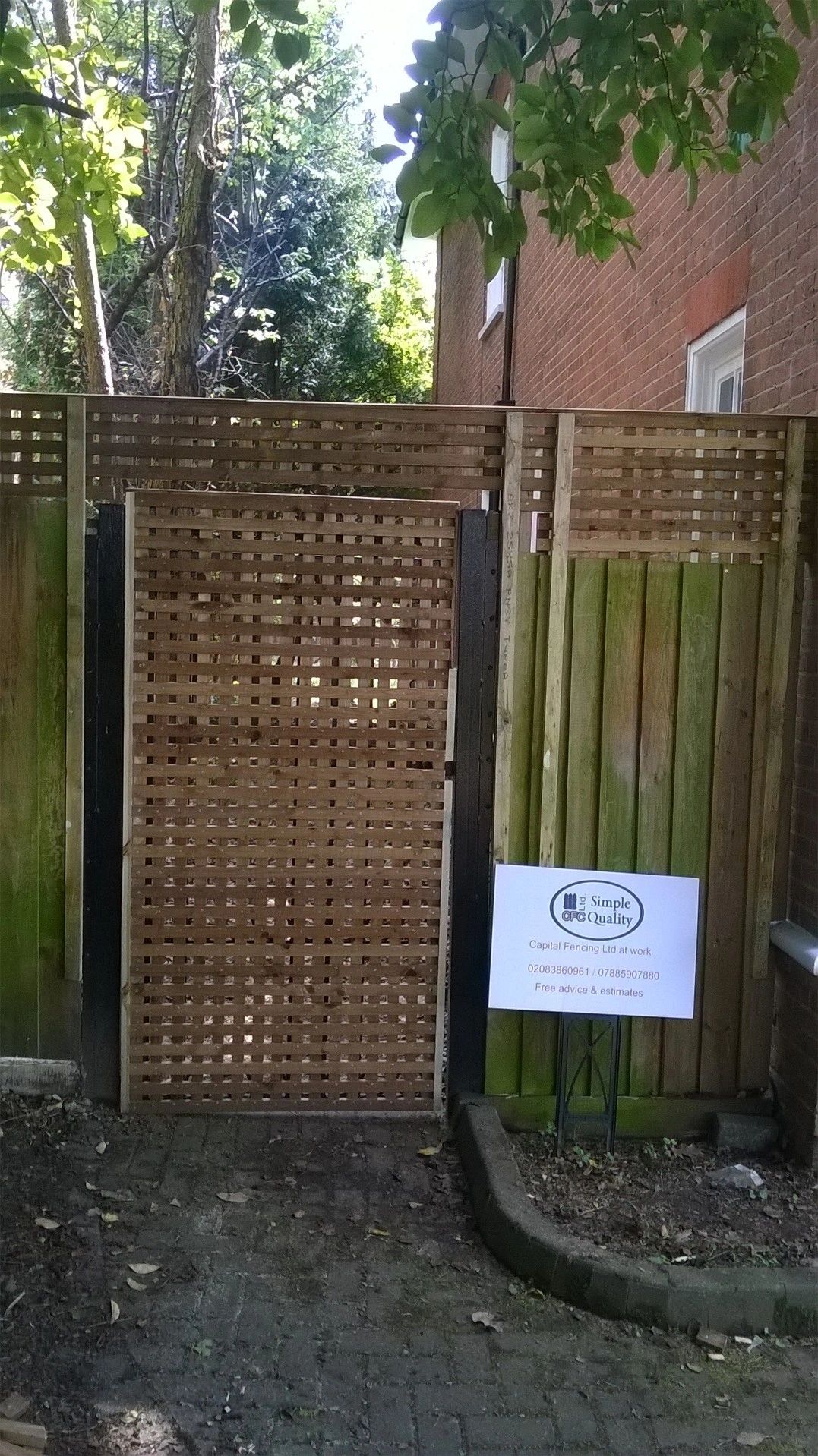
A trellis topper adds height to an existing or new fence — commonly for climbing plants or extra privacy — and because it's open lattice rather than solid boarding it adds relatively little wind load for the height gained.
That's useful on boundaries close to the 2m permitted development limit, where a solid panel extension would push both height and wind loading up together, but it only works if the topper is genuinely open lattice rather than a solid infill dressed up as trellis.
Fixing a topper to an old or undersized post rather than the fence itself is the most common reason toppers come loose, since the extra leverage at height needs a post that was sized for it from the start.
Trellis toppers and additional wind load
Adding a trellis topper to increase privacy height also increases the wind load a fence has to carry, since even open lattice trellis catches more air than its slim appearance suggests, especially once climbing plants fill in the gaps.
Posts sized correctly for a 1.8m panel don't automatically have the reserve strength for panel-plus-trellis at 2.1m or more, particularly on an exposed run.
Where a taller finished height is wanted, it's worth specifying posts for the full combined height from the outset rather than treating the trellis as a lightweight afterthought bolted to the top.
Specification driven by an insurer's boundary requirements
Some commercial and high-value premises have boundary security requirements set by an insurance policy — a minimum fence height, mesh type or lock standard — that the fencing spec has to meet regardless of what would otherwise be chosen.
Where a specific requirement applies, it's worth getting it in writing from the policy documents before quoting, since fitting to a general standard when a stricter one is required can leave a gap the client didn't expect.
Protecting known cable and pipe runs during digging
Where a service run is known — marked by the utility company, visible from a meter or duct cover, or noted on a site plan — a physical marker or hand-dug trial pit at that point before general digging starts confirms its exact depth and route.
Once a service is located, leaving a visible marker such as a cane or spray line on the surface stops it being forgotten by whoever digs the next hole along the run, particularly on a multi-day job with different people digging on different days.
Ducted services are generally easier to work around than direct-buried cables since the duct itself gives some protection, but the duct can still be damaged by an auger or breaker if its depth isn't confirmed first.
Concrete cure time before a post can be loaded
A post set in fast-setting postcrete can usually take light loading within an hour or two, but a full concrete footing needs several days of cure before it should be relied on for the lateral loading a security fence or gate applies.
Fitting a heavy gate leaf to a post before its footing has properly cured can rock the post out of plumb before the concrete has reached working strength, which is a common avoidable cause of an early lean on a new installation.
Fencing shared or communal garden spaces
Communal gardens shared by several properties usually need any new fencing agreed by the group or managing body rather than one resident acting unilaterally, since a partition can change how the whole space is used.
Where a communal garden includes mature planting or trees under a collective management plan, new fence lines need checking against that plan rather than just against the ground itself.
Access routes for maintenance vehicles or refuse collection through a communal garden also need to stay clear when planning new subdivisions with fencing.
Fascia boards and picture-framing a deck
A fascia board fixed around the visible edges of a deck hides the joist ends and cut board edges, giving a tidier finished look and protecting the end grain of the joists from direct weather exposure.
Picture-framing takes this further by running a border board around the perimeter with the main boards mitred into it, which reads as a more considered finish but needs accurate setting-out since any error in the mitred corners is highly visible.
Both details add material and labour without changing the deck's structural performance, so they're a specification choice driven by appearance and edge protection rather than necessity.
Protecting lawn edges along a new fence line
Digging post holes and levelling ground along a boundary inevitably disturbs a strip of lawn either side of the new line, and that strip is worth marking out and treating as a working area from the start rather than letting the disturbed area creep wider as the job progresses.
Turf lifted carefully in one piece before digging starts can sometimes be relaid afterwards rather than reseeded, which gives a faster-recovering edge than bare soil left to regrow from seed.
Where reseeding is the only realistic option, timing the final reinstatement for a season when grass seed actually establishes reliably avoids a bare strip sitting exposed for months after the fencing itself is finished.
Terraced gardens and stepped runs
A garden cut into level terraces, common on steeper plots across the Chilterns fringe, usually means the fence has to step down at each change of level rather than run as one continuous raked line.
Each stepped section needs its own post pair set level within that section, with the horizontal joint between sections finished cleanly rather than leaving an open triangular gap under the lower panel.
Where the terraces are formed by retaining walls rather than simple grading, the fence posts typically sit on top of the wall structure and need fixings suited to masonry rather than a standard earth-set post.
Parking and material handling on site
Fencing, gates and decking all involve moving bulky, heavy material — concrete posts, gravel boards, decking joists — from a van to the working area, and how far that has to be carried has a real effect on labour time.
On streets with permit parking, no off-street loading bay, or restricted delivery hours, we plan the drop-off around those restrictions rather than assuming a van can sit outside all day.
Where a plot has a driveway or side gate wide enough for a barrow run, that alone can shave a meaningful amount of time off a job compared with hand-carrying everything round the front.
Leylandii hedges and root competition near posts
A mature leylandii hedge planted close to a boundary develops a dense, shallow root mat that competes directly with a post base for space and moisture, often making standard post-hole digging difficult without cutting through live roots.
Leylandii also draws a large amount of water from the surrounding soil in summer, which can locally dry and shrink clay soil right along the fence line even where the wider garden isn't especially exposed.
Where a hedge is being kept, offsetting posts slightly from the direct root zone, or hand-digging around larger roots rather than augering through them, extends post life without needing to remove established planting.
Helical pile foundations for a commercial security run
A helical pile is screwed into the ground using hydraulic or mechanical torque rather than being set in an excavated and concreted hole, giving a foundation that can be installed quickly on a site where digging is disruptive or where ground conditions are variable along the run.
Load capacity is checked by torque readings taken during installation rather than assumed from a standard depth, which makes helical piling useful on a site where soil type changes noticeably across the length of the boundary.
Composite wood-polymer ratios
Wood-plastic composite fencing boards are made from a blend of wood fibre and polymer, and the ratio between the two materially affects the finished product's stiffness, weight and how closely it resembles real timber grain.
A higher wood-fibre content generally gives a more timber-like appearance and feel but can also make the board more absorbent and slightly more prone to swelling at cut edges than a polymer-dominant mix.
Composite boards from different manufacturers aren't interchangeable even when nominally similar in size, since differing ratios change how the board expands with temperature and how it should be fixed and spaced.
Data protection basics for boundary CCTV
Domestic CCTV covering only a homeowner's own property is generally exempt from full UK GDPR obligations, but that exemption narrows considerably once cameras capture a neighbour's garden, shared paths, or public areas.
Where wider coverage is genuinely needed, clear signage and being able to explain why footage is captured helps if a neighbour raises a concern with the Information Commissioner's Office.
Positioning cameras to focus tightly on a homeowner's own boundary and property, rather than sweeping across a neighbour's space, is the simplest way to avoid this becoming an issue.
Key-alike systems across a site
Where a site has several gates, a key-alike or master-key system lets one key open every lock while still allowing individual keys to be issued separately, cutting down on the number of keys staff have to carry.
This is arranged through the locksmith supplying the cylinders rather than the fencing installer, but gate hardware needs to be compatible with the chosen cylinder type before it's fitted.
Party Wall Act considerations for boundary fencing works
Fencing work itself rarely triggers the Party Wall Act, but where a security upgrade involves excavating close to a shared wall's foundation or building a new wall astride the boundary line, notice to the neighbouring owner may be required before work starts.
Checking whether proposed post positions or a new plinth wall fall within the Act's notice distance from a party structure is worth doing at design stage, since retrospective notice after work has begun causes more delay than checking first.
Applying for a Land Registry boundary determination
Where a boundary's exact position is genuinely disputed, it's possible to apply to HM Land Registry for a 'determined boundary', which involves a formal survey and legally fixes the line rather than leaving it as a general indication.
This process is comparatively rare for domestic disputes because of the cost and evidence involved, and is normally a last resort after direct discussion has failed.
Most everyday fence replacement work never needs this, but it exists as a formal route for the minority of cases where agreement genuinely can't be reached.
Seasonal timing for fence repairs
Repairs undertaken in late autumn or winter often coincide with wetter ground and slower-curing concrete, which can extend how long a post takes to reach full strength before it should be loaded.
Where a repair isn't urgent, timing it for a drier period gives both the timber treatment and any concrete footing a better chance to cure properly before winter weather returns.
Inspecting welded joints on mesh panel frames
A welded mesh panel's frame corners are a common early failure point under repeated wind loading or impact, since a poor weld can crack internally while still looking intact from the outside until the joint finally gives way.
A visual check for hairline cracking, rust bleeding from a joint, or slight movement when the frame corner is pushed by hand can catch a failing weld before the panel actually comes loose from its post.
Salt-laden air and coastal-adjacent exposure
Gardens within a few miles of open coast, or on a plot regularly exposed to salt spray carried on strong onshore winds, see accelerated corrosion of standard fixings and hinges compared with an inland site.
Stainless steel or heavily galvanised fixings are worth the extra cost in these conditions, since standard zinc-plated screws and hinges can show surface rust within a single season.
Timber itself isn't usually damaged by salt exposure directly, but a finish applied over salt residue left on the surface after a storm won't bond as well as one applied to a clean, rinsed surface.
Lifetime comparison of hedging and fencing as a boundary
A well-established hedge can outlast several generations of timber fencing with no post replacement or re-treatment cycle, but it needs regular cutting to stay within bounds and takes several years to reach an effective screening height from new planting.
A fence gives an immediate, defined boundary and predictable height but carries an ongoing maintenance and eventual replacement cost that a mature hedge doesn't.
Many gardens end up with a mixed solution — a fence for the immediate boundary definition with hedging planted alongside it to soften the appearance and eventually take over some of the screening role.