Fallen branch impact damage
A falling branch typically damages a localised section — one or two panels and sometimes the post beneath the point of impact — rather than the whole run, so repair can usually be confined to the affected bay.
The bays either side are still worth checking, since the same impact can rack a neighbouring post even where the panel there shows no visible damage.
Hanging post size versus gate weight
A hanging post has to be sized to the weight and length of the gate it carries, not to match the rest of the fence line — an undersized post on a heavy double gate will lean or twist over time even with sound hinges.
We check post section and depth against the specific gate before a repair simply re-hangs the same gate onto the same undersized post.
Gate swing on a sloped driveway approach
A driveway gate installed at the top or bottom of a sloped approach needs its swing arc checked against the actual gradient, since a gate that clears the ground when closed can still catch the rising slope partway through its opening arc.
Sliding gates are sometimes preferred over swinging gates on a sloped approach for exactly this reason, since they don't need to clear a changing ground level along their travel.
Skip versus grab-away waste removal
A skip needs road or driveway space for its full duration and, on a public highway, a council permit, whereas a grab lorry can load and leave within an hour without occupying the site overnight.
For a single fence-replacement job the volume of old timber and rubble is often small enough that a grab-away collection is more practical than a full skip hire, particularly where there's nowhere suitable to site one.
Mixed loads containing both timber and concrete sometimes need separating for the waste carrier to dispose of correctly, so it's worth checking what a specific collection will and won't take before old material is piled up ready to go.
Shared ownership properties and boundary consent
Shared ownership homeowners typically still need the housing association or landlord's consent for structural boundary alterations, in line with the terms of the lease, even though they own a share of the property.
This mirrors the position for full leaseholders in many respects, and skipping the consent step can create complications later, particularly when it comes to staircasing to full ownership or reselling.
Checking the specific lease terms, or asking the shared ownership provider directly, avoids doing boundary work that technically breaches the agreement.
Hardstanding and uneven levels
Where a fence line crosses from a garden onto a patio, driveway or other hardstanding, post bases usually need core-drilling into the existing slab rather than a dug hole, which is a different technique and a different price than fencing over soil.
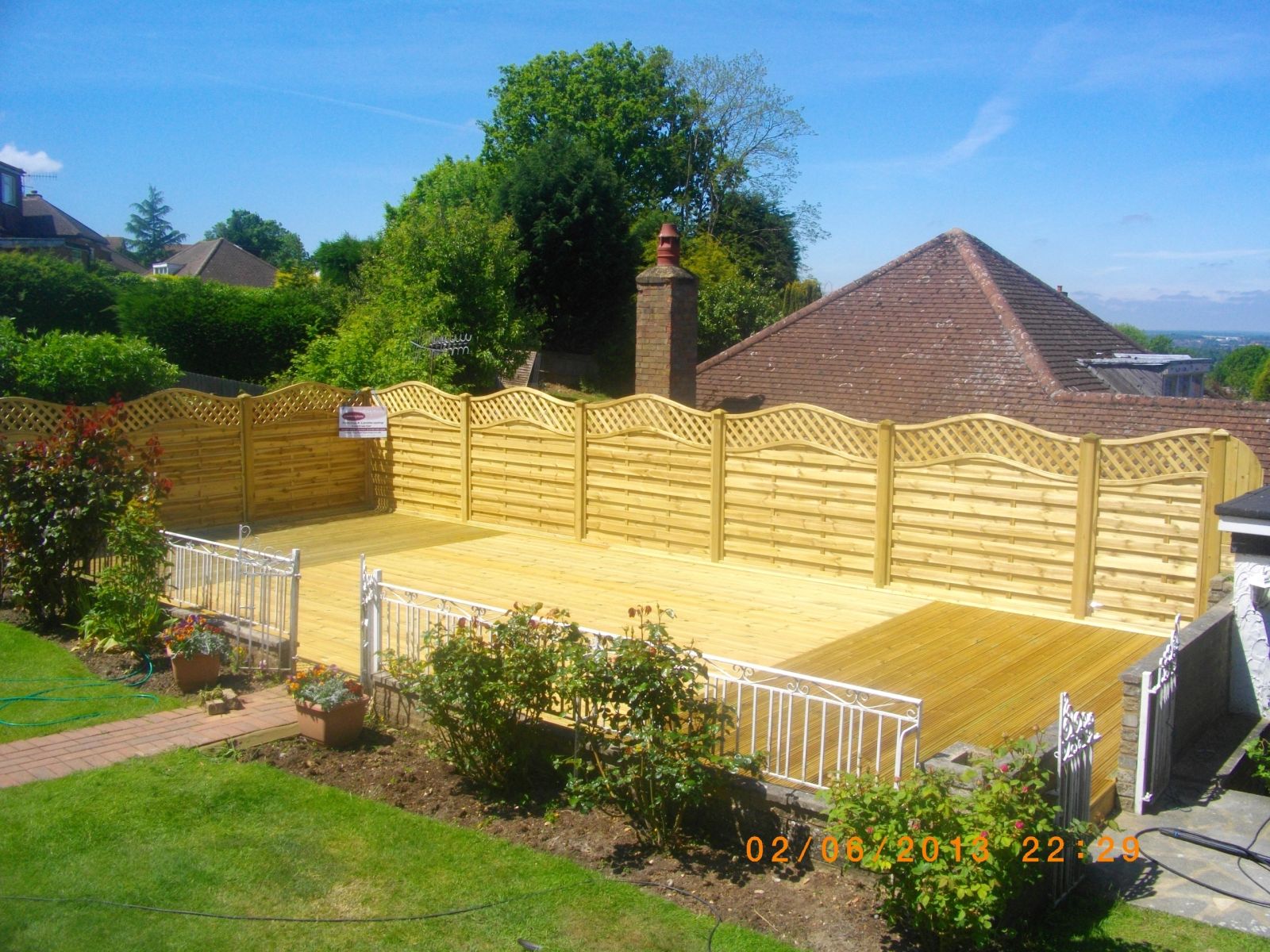
A change in level along a run — a step up to a raised patio, or a drop to a lower side passage — needs the fence height measured consistently from the ground it's actually protecting, not from an average across the whole run.
Getting this detail wrong is one of the more common reasons a finished fence ends up looking uneven even though every panel was fitted correctly on its own section.
Meeting stiles on double gates
Where two leaves of a double gate meet in the middle, the meeting stiles need to stay flush and aligned with each other for the latch or bolt arrangement to work, and seasonal movement or a dropped hinge on either leaf throws this alignment off first.
We check both leaves together rather than adjusting one side in isolation, since a fix on one leaf alone can leave the meeting point mismatched.
Ironmongery grades for gates
Gate hinges, latches and drop bolts are graded broadly by size and load rating rather than sold as one universal fitting, and undersized ironmongery on a heavy hardwood gate is a common cause of early sagging even when the frame itself is well built.
Externally, ironmongery needs a corrosion-resistant finish suited to constant weather exposure — galvanised, stainless or a specifically outdoor-rated coated finish — rather than internal-grade fittings that will rust and seize within a season or two.
A self-closing hinge or a matching pair of hinges rated for the gate's actual weight is worth specifying explicitly on a quote, since 'a pair of hinges' without a load rating leaves the actual spec to whatever's in stock.
Cutting a panel down for a short bay
A lap or closeboard panel can usually be cut down in width by removing boards from one edge and refixing the cut edge to the panel's own frame, provided there's still a batten or rail to fix into once the cut is made.
Concrete panels generally can't be cut at all, which is one of the practical reasons timber is chosen over concrete gravel-board-and-panel systems on an irregular boundary with several odd-width bays.
Whatever is cut, the new edge needs its own vertical support — either an extra batten screwed to the frame or, for a wider cut-down section, a slip post — so the panel doesn't flex or drop at the trimmed end.
Keeping post positions clear of drainage gulleys and channels
A surface drainage channel or gulley running near the boundary needs to stay clear and functioning, so a post landing directly over or immediately beside one can block flow or make future clearing of the channel awkward.
Where the fence line has to cross a channel, spanning it with a slightly wider gap under the gravel board, rather than boxing the channel in completely, keeps it accessible for clearing leaves and debris.
It's worth running water through the channel before finishing the job, where practical, to confirm the new fence hasn't inadvertently altered how it drains.
Quick-set post mix versus mixed concrete
A quick-set post concrete cures within a few hours and is convenient for a single-post repair where the fence needs to take load again quickly, but a standard mixed concrete generally gives a denser, longer-lasting footing for a larger job.
For a repair affecting several posts along a run, mixed concrete is usually the more durable choice even though it takes longer to reach working strength.
Fire escape routes and non-lockable egress
A secure gate on a fire escape route or final exit path must allow people to get out without a key, even if it stays locked against entry from outside — a simple push-bar or thumb-turn release satisfies this on the inside face.
This is checked against the building's fire strategy before a lockable gate is fitted on any route marked as an escape path, because a fully keyed gate on both faces is a genuine life-safety fault.
Nail versus screw fixing on repairs
Nailed fixings are faster to install and are the standard on new panel builds, but a screwed fixing holds better in timber that's already slightly softened by weathering, which makes screws the more reliable choice on a repair into older stock.
Screws also allow a board or rail to be removed cleanly if it needs replacing again later, whereas a nailed fixing usually damages the surrounding timber on removal.
Steel post for a heavy timber gate
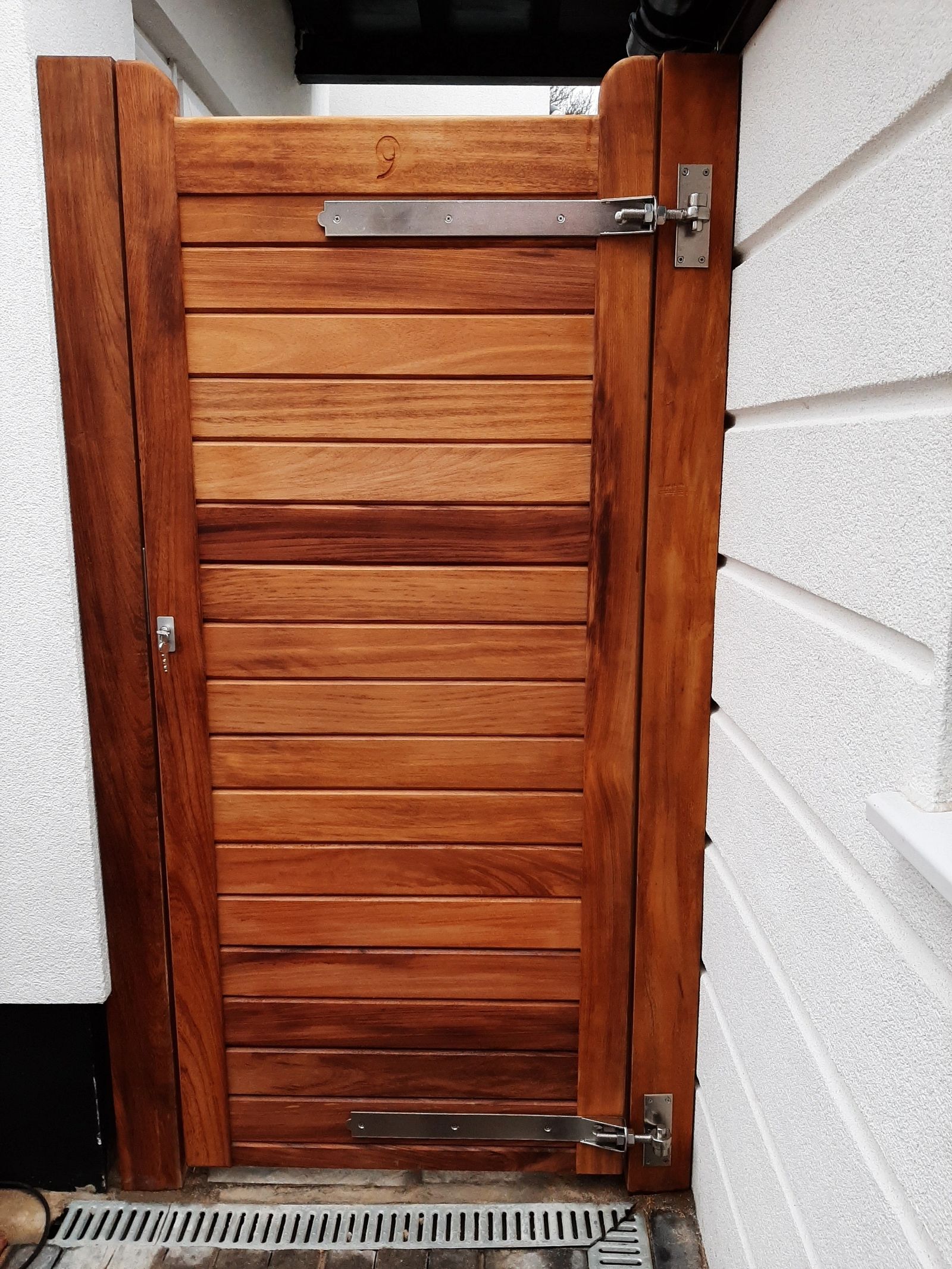
A wide or solid-faced timber gate can be heavy enough that a timber hanging post, even oversized, isn't stiff enough to resist long-term leverage, in which case a concreted steel post with a welded or bolted hinge plate gives a stiffer fixing.
This is more common on wide driveway gates than standard pedestrian gates, where the extra cost of a steel post is offset by significantly less long-term sag.
Restrictive covenants on newer estates
Many post-war and modern estates carry restrictive covenants in the original transfer deeds that go beyond planning law, commonly limiting fence height, requiring a specific style, or banning solid boundary treatments on front gardens entirely to preserve open-plan sightlines.
These covenants are a private legal matter between landowner and the estate's management company or original developer, so full planning permission being unnecessary doesn't mean the fence is automatically allowed.
Breach of covenant is usually enforced by a neighbour, resident's association or management company rather than the council, and can result in a requirement to remove the work at the owner's cost, so checking the title register for covenants before ordering is worthwhile on any estate build.
Visibility splays on corner plots and driveways
Corner plots and driveways onto a road often have a highway visibility splay — a triangular zone near the junction — where boundary height is restricted so drivers and pedestrians can see each other clearly.
These restrictions are usually lower than the standard 1m front-boundary limit and are enforced by the highway authority rather than just general planning policy, so it's worth checking with the council for any plot near a junction or driveway crossing a footway.
Open railings or low planting within a visibility splay are common solutions where some boundary definition is still wanted without blocking sightlines.
Long-run line setting with laser and string
A straight security run over a long distance is set out with a string line or laser level between end posts before any intermediate post is positioned, since a small error compounded over many bays leaves a visibly crooked line.
On an undulating site, a laser also confirms consistent post height above ground even where the ground itself rises and falls, keeping the top line level rather than following every dip.
A boundary at the bottom of a slope
A fence line at the foot of a slope collects both surface run-off and, on clay, a slower seepage of water moving through the ground itself, so the ground here is often wetter and softer than the rest of the plot.
Post bases in this position benefit from a raised free-draining collar rather than concrete flush with the surrounding grade, keeping standing water away from the timber-to-concrete joint.
It's also worth checking whether the fence itself is inadvertently damming water that would otherwise continue draining downhill off the plot entirely.
Anti-twist shoulder details on post fixings
Some post shoe and anchor systems include a shaped shoulder or collar that grips the post's cross-section rather than relying purely on friction from clamping bolts, resisting the post twisting in the fitting under sustained wind load.
Without that shoulder detail, a smooth-sided post held only by bolted clamp plates can gradually rotate within the fitting as repeated gusts work it slightly each time, loosening the bolts further with each cycle.
This detail matters more on taller, more exposed posts carrying larger panel or gate areas, where the leverage from wind load is greatest, than on short, low-level fencing where twisting force is comparatively small.
Post spacing on a run that doesn't divide evenly
Standard panels are usually 1.83m (6ft) wide, but very few boundary runs measure out as an exact multiple of that, so the layout has to absorb the remainder somewhere rather than pretend it isn't there.
The common approach is to split the shortfall across the two end bays so both are cut slightly narrower and roughly matched, rather than leaving one full-width bay and one very narrow offcut at a single end.
Where a fixed feature — a gate opening, a manhole, an existing post that must stay — sits partway along the run, setting out works outward from that fixed point in both directions rather than from one end only.
Cat-proofing retrofit limits
Adding an inward-curved topper or roller bar to deter cats from climbing over an existing fence works reliably on a fence in good condition, but the fixings for that addition still rely on the post and rail beneath being sound.
Retrofitting cat-proofing to a run that also needs repair is best sequenced after the repair, since fitting new hardware to a post that's about to be reset is wasted effort.
Inspecting fixing points for early corrosion during routine maintenance
Corrosion on a galvanised security fence typically shows first at cut ends, weld points and fixing holes where the zinc coating has been broken during manufacture or installation, rather than along an untouched length of rail or mesh.
A routine inspection checks these specific points rather than relying on a general look along the fence line, since a fixing bolt corroding from the inside can look sound from the outside until it fails under load.