Height rules when replacing a damaged section
A repair that keeps the fence at its existing height rarely needs a fresh planning check, but if a client wants to increase height while replacing a damaged section, the same permitted development limits apply as a new boundary.
This comes up most often on a front boundary, where the allowed height is lower than at the side or rear.
Child-safe latch heights
Positioning a latch or lock out of easy reach of a young child is common general practice on a garden gate, particularly one near water, a driveway or a road, though the appropriate height depends on the specific site and use.
This is a design choice worth discussing at repair or replacement stage rather than simply refitting a latch at its original height by default.
Hedgehog gaps and protected species awareness
A small gap at the base of a fence panel, often around 13cm square, lets hedgehogs and other small wildlife move between gardens, which is increasingly encouraged as gardens become more enclosed.
Separately, some sites may have protected species such as bats, nesting birds or great crested newts present, and disturbing them during certain works can be a legal matter regardless of boundary ownership.
Where there's any reason to suspect protected species on a site, checking with an ecologist or the local authority before groundworks is the sensible route rather than assuming it won't apply.
End-of-terrace properties and long return boundaries
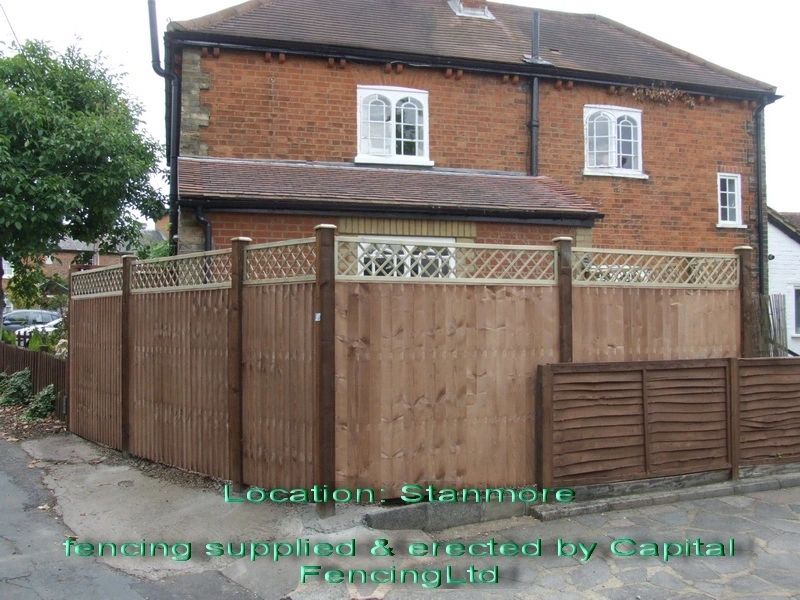
An end-of-terrace plot typically carries a much longer exposed side boundary than its mid-terrace neighbours, often running the full depth of the garden along a side street or footpath rather than backing onto another private garden.
That length changes the practical spec: more posts see wind and impact loading from the public side, and a long uninterrupted run benefits from a support post or two extra to control any bow developing over time.
Because the boundary faces a public route, it's also the fence most likely to need a more robust anti-climb consideration than an equivalent internal party fence.
Thumb latch lever and bar wear
A thumb latch lifts an internal bar via a lever operated from one or both faces of the gate, and wear typically shows up as play at the pivot pin or a lever that no longer lifts the bar high enough to clear the keep.
Because the mechanism is simple, most thumb latch faults can be corrected by re-fixing the pivot or reshaping the bar's resting angle rather than replacing the whole latch.
Manual override on an automated gate
Most automated gates include a manual release so the gate can be opened by hand during a power cut or motor fault, and checking this release still works is worth doing periodically rather than only discovering it's seized in an emergency.
We check the mechanical gate and release mechanism; motor and control-board diagnosis is referred to a specialist.
Opening size tolerance for a new gate
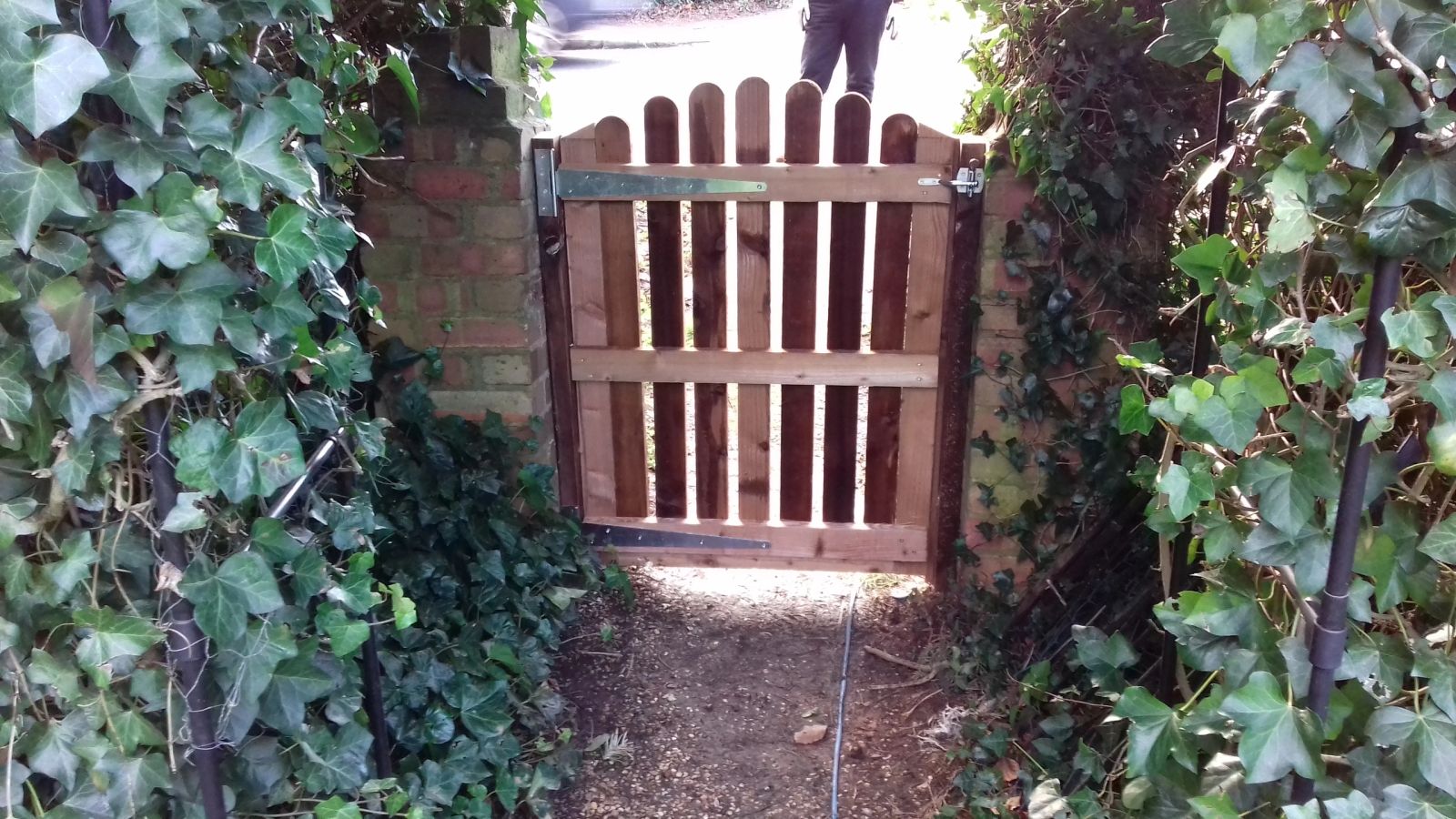
A new gate needs to be built slightly narrower than the measured opening to allow clearance for hinges, swing and seasonal timber movement, and getting this tolerance wrong either leaves a gate that binds in wet weather or one with an unacceptably large gap either side.
The right tolerance also depends on the hinge type specified, since a hinge that sits proud of the post face takes up more of that clearance than a flush-fitting type.
Dry-mix versus wet-mix concrete for post bases
A dry mix — post-fixing concrete poured dry into the hole around a braced post and left to draw moisture from the surrounding ground — sets over a day or two and suits smaller domestic posts in reasonably moist soil.
A wet mix, gauged and mixed with water before placing, gives more control over strength and is generally preferred for larger posts, gate posts under lateral load, or very dry, free-draining ground where a dry mix may not draw enough moisture to cure properly.
Wet mix also allows proper tamping to remove air pockets around the post, which a dry mix poured in stages can't achieve to the same degree.
Asbestos awareness near older garage flanks
Older garages, outbuildings and some boundary walls built before the 1999 asbestos ban can incorporate asbestos-containing materials in flank panels, corrugated roofing or old fence panel infill, particularly on properties from the mid-20th century.
Disturbing suspected asbestos material isn't something to tackle as part of routine fence replacement — it needs a competent assessment and, if confirmed, removal by a licensed contractor in line with HSE guidance.
Where an older boundary structure looks like it might contain asbestos sheeting, the sensible step is to leave it undisturbed and get it checked before any adjacent groundworks begin.
Disposing of rotten timber and green waste from a repair
Rotten fence timber is general waste rather than green waste, and larger quantities from a full-run repair usually need a licensed waste carrier or a permitted tip run rather than a domestic green bin, which only takes garden material.
Treated timber in particular shouldn't be burned on site, since older treatments can contain preservatives that produce harmful smoke, so timber waste from a repair should be taken away rather than disposed of on the plot.
Resin anchoring a post base into an existing footing
Resin anchoring sets a threaded stud or spike into a drilled hole in sound existing concrete using a chemical resin, which can let a new post base be fixed onto an old footing that's otherwise still structurally usable.
It only works where the existing concrete itself is sound; resin anchored into cracked or spalled concrete has nothing solid to bond to and the fixing will fail alongside the concrete rather than because of the resin.
Selvedge detailing on chain-link mesh
The selvedge is the twisted or knuckled edge finish at the top and bottom of a chain-link roll, and a twisted (barbed) selvedge gives a rougher, harder-to-grip edge than a knuckled one, which is a small but relevant detail on a security-rated chain-link run.
A knuckled selvedge is safer where the fence is near public access because it removes the sharp twisted ends, so the choice between the two trades off deterrent value against injury risk in the same way as toppings do.
Working around pets and children on site
An open trench, a stack of loose posts or a partially removed fence panel is an obvious hazard for a young child or an excitable dog, and on an occupied family garden it's worth agreeing at survey stage how pets will be kept away from the working area each day.
A garden with no boundary at all for part of a working day — because the old fence has come down and the new one isn't up yet — needs a temporary barrier or a clear arrangement for keeping animals indoors until the run is complete.
Leaving tools, concrete mix or offcuts accessible overnight on a site with children present is worth avoiding even where the work itself is finished for the day.
Decking joist spacing and spans
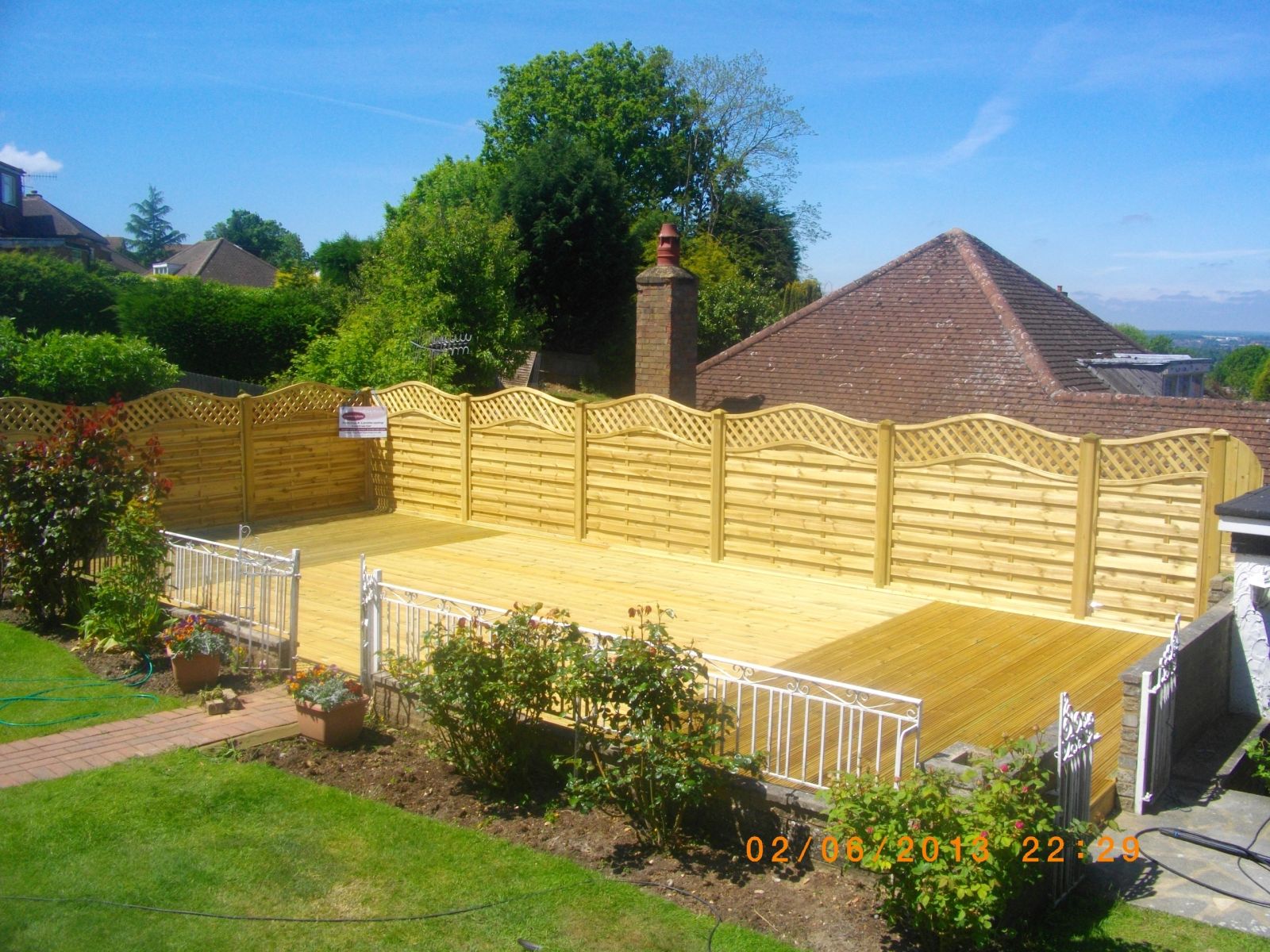
Joist spacing under a deck is set by the board being used and the load expected, not fixed universally — timber boards typically need joists at closer centres than the equivalent composite board, because composite is generally less stiff across a span.
Manufacturers publish maximum joist spacing for their composite boards, and it's shorter still where boards run diagonally rather than square to the joists, since a diagonal run effectively increases the unsupported span between fixings.
Undersized joist spacing shows up as bounce or long-term sag between joists well before it becomes a safety issue, so it's worth checking spacing against the actual board spec rather than a generic rule of thumb.
Restaurants and pub gardens
Boundary fencing around a pub garden or restaurant terrace often does double duty as noise and light screening for neighbouring residential properties, and its height and permeability can be a condition attached to the premises licence rather than a free choice.
Trading hours mean access for fencing work is usually easiest early morning before service starts, since a garden in active use for covers can't have posts being dug mid-lunch.
Where outdoor seating sits close to the boundary, fixings and post positions need checking against any licensed seating plan so the finished fence doesn't reduce covers below what the licence allows.
High water table and post-base concrete
On a plot where the water table sits close to the surface, a post hole can start filling with groundwater before the post is even positioned, which stops a wet concrete mix from curing properly around the base.
The usual fix is a free-draining pea shingle or hardcore base rather than solid concrete, letting water pass the post instead of holding it in permanent damp.
Pumping a hole dry immediately before setting the post is only a short-term measure if the water simply returns within minutes, and that's usually the signal to change the base specification rather than repeat the attempt.
Recommended inspection intervals for gate hardware
Checking hinge fixings, latch alignment and post plumb roughly twice a year, typically before and after the worst of winter weather, catches most developing faults while they're still a simple adjustment rather than a full repair.
A gate in heavy daily use, such as a bin store or communal alley gate, benefits from more frequent checks than a garden gate opened only occasionally.
What happens if a boundary structure needs planning permission
Where a proposed fence, wall or gate exceeds permitted development limits, a standard planning application goes to the local authority, who assess it against the same character and amenity considerations as any other householder application.
A refusal can be appealed to the Planning Inspectorate, though that process takes months rather than weeks, which is worth factoring into any timeline for a boundary structure that's likely to need consent.
It's almost always faster and cheaper to design within permitted development limits from the outset than to plan around needing consent, unless there's a strong reason the extra height or coverage is necessary.
Timber grades and treatment
Pressure-treated softwood is graded by the treatment's intended service life — timber rated for ground contact (Use Class 4) should always be used for posts, while a lighter Use Class 3 treatment is normally sufficient for panels and boards that don't touch soil.
Tanalised or vacuum-pressure-treated stock takes preservative deeper into the timber than a surface-dipped batch, which matters most at cut ends, where the untreated core is exposed and should always be re-treated on site.
Hardwoods like oak or iroko don't need chemical preservative to the same degree but cost more upfront and behave differently as they season, so the choice is really about budget and maintenance appetite rather than one being simply 'better'.
Movement joints in timber cladding
Timber cladding boards fixed edge to edge without any allowance for seasonal expansion can buckle or split as the boards swell in wet weather and have nowhere to expand into.
A small gap left between board ends, or a slightly loose fixing pattern that allows a board to expand slightly within its fixing slots, accommodates this movement without transferring stress into the board itself.
The required gap varies by species and board width, since wider boards and more moisture-reactive species move more in absolute terms than narrow boards of a stable species for the same change in humidity.
Detached plots with a paddock or field edge
Detached properties backing onto a paddock, field or grazing land need a boundary that does two jobs at once — keeping the garden private and, if livestock use the adjoining land, keeping animals off the garden side.
A standard close-boarded fence isn't stock-proof on its own; where horses or cattle are present on the other side, a stock fence or post-and-rail set slightly inside the garden fence is the usual belt-and-braces approach.
Field boundaries also see more vegetation growth and root pressure from hedgerows than a typical suburban fence line, so posts often need resetting or straightening more often than an equivalent garden boundary.
Aftercare guidance for the first season
Newly set posts need their first winter to fully settle, and a slight tightening of gate hinges or latch alignment after the first few months of seasonal movement is normal rather than a sign of poor work.
Untreated or lightly treated timber benefits from an owner-applied preservative or stain within the first year, particularly on end grain and cut edges exposed during installation, since factory treatment doesn't reach every surface once a panel's been cut to fit.
Clearing leaves and debris from the base of gravel boards each autumn, where they trap moisture against the timber, is a simple habit that measurably extends the life of a fence beyond what the initial installation alone determines.