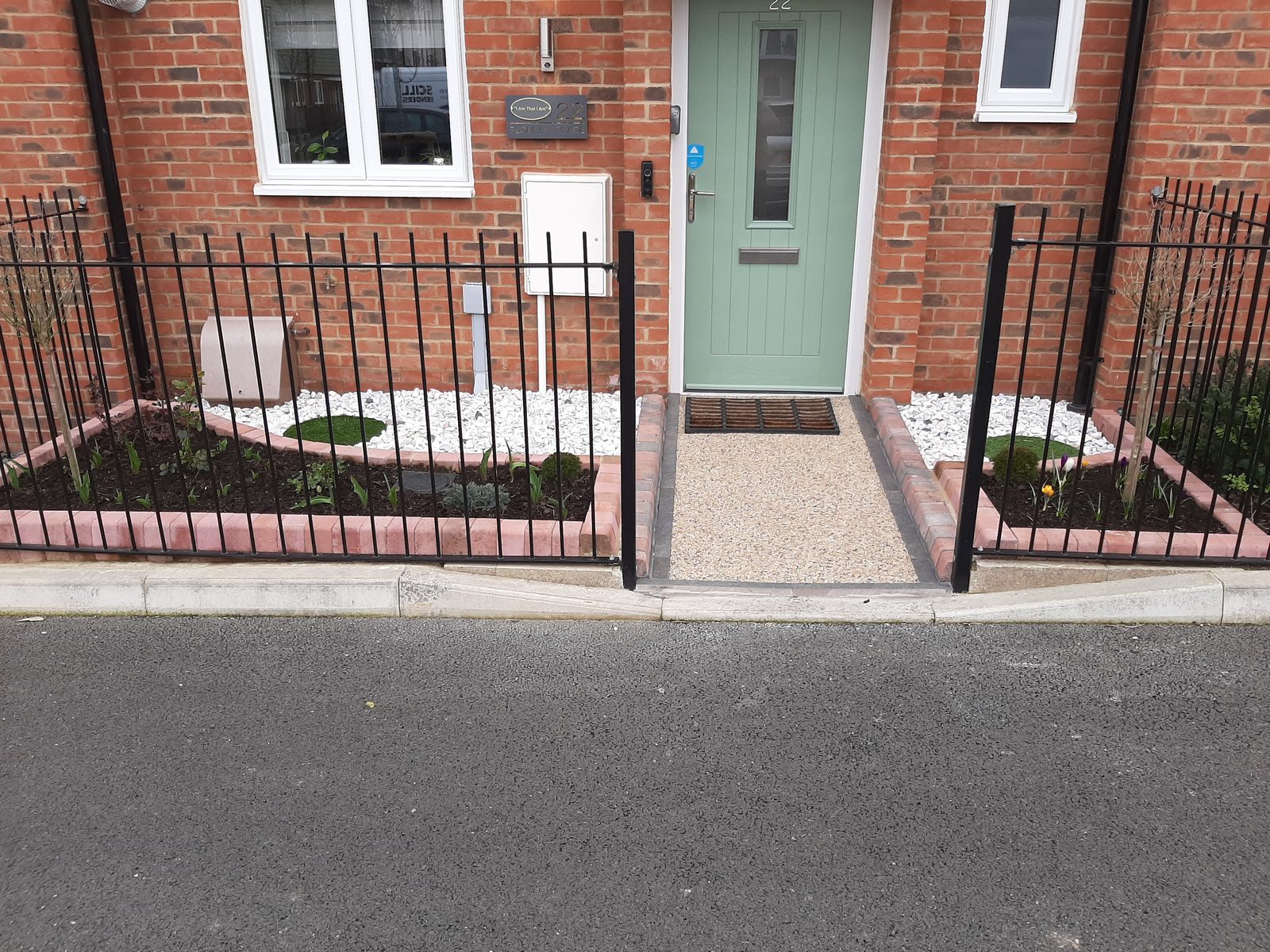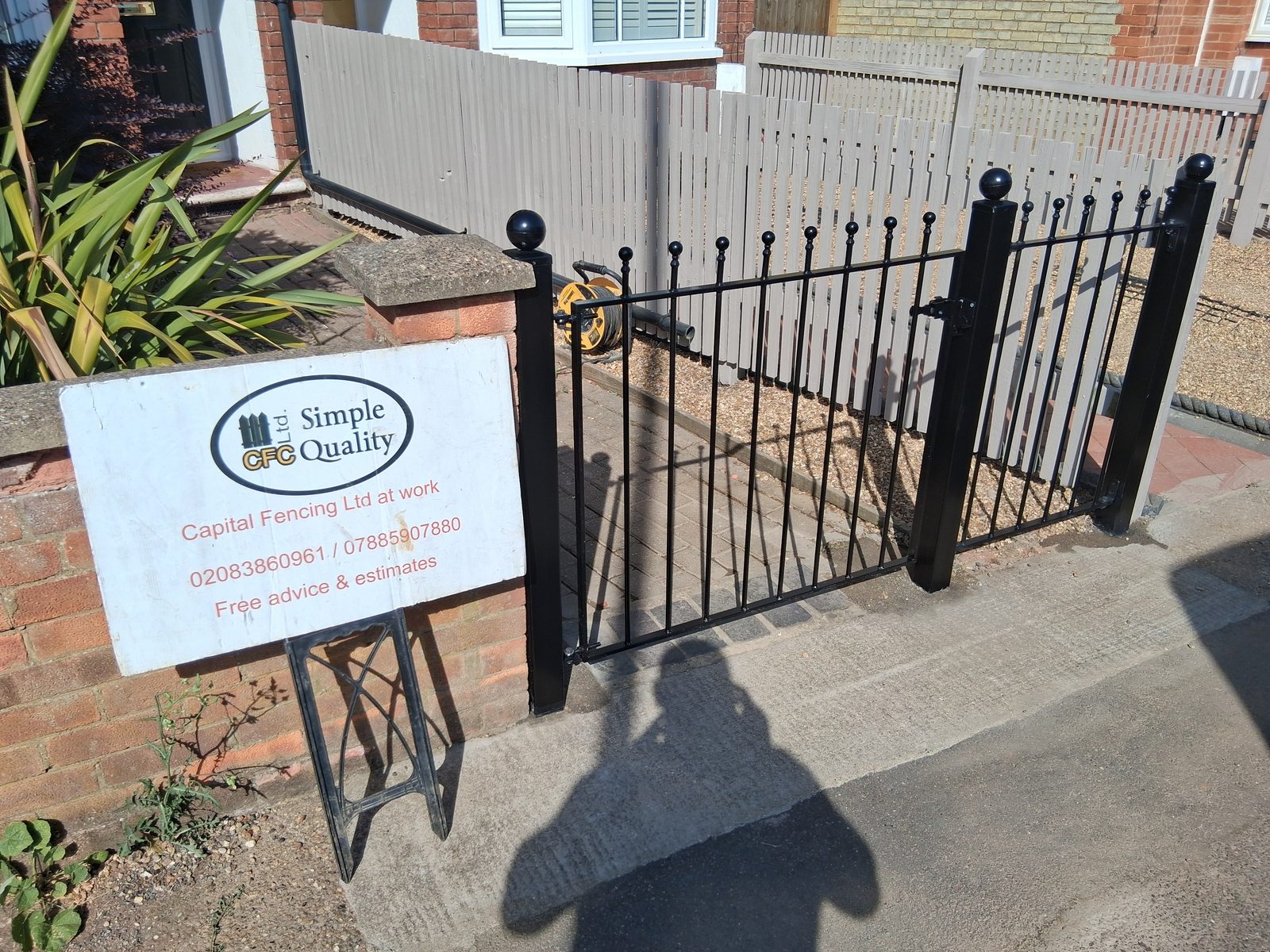
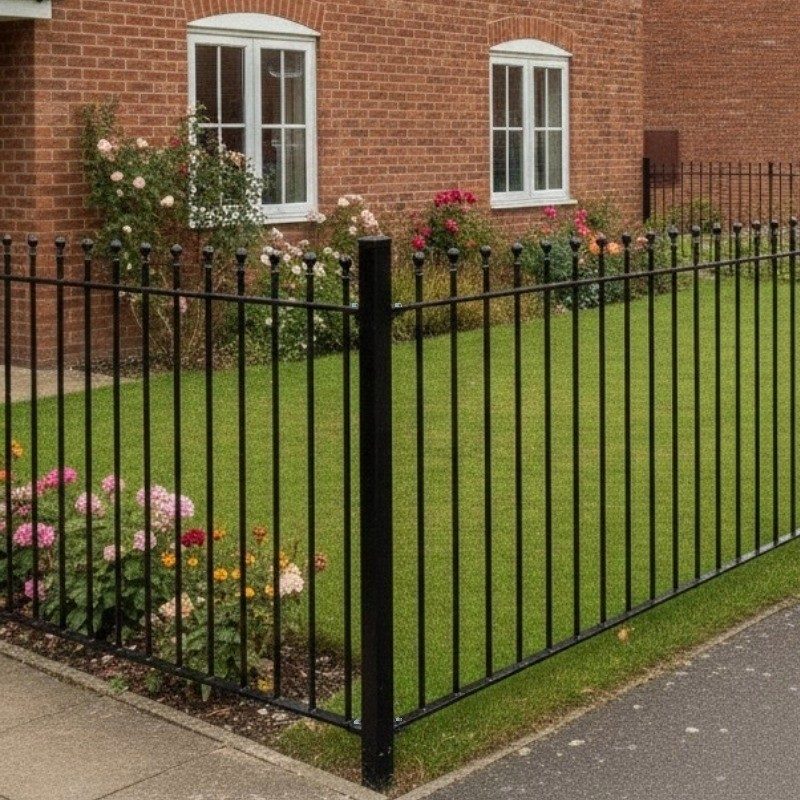
Garden railings mark the front boundary without hiding the house. They keep a low, open line along the pavement, stop people cutting across the garden, and give a front gate something to close against. We fit metal railings on top of existing dwarf walls, on new posts set in the ground, and alongside a matching pedestrian gate so the whole front reads as one piece.
This page covers domestic front garden railings and smaller garden runs. Longer estate, communal and made to measure railing runs are covered on our railings and estate fencing page.
Where garden railings work best
Most of the railings we are asked about sit along the front of a terrace or semi, where the old boundary has gone or the wall has lost its original ironwork. Railings suit a low front boundary because they define the line without blocking light or the view of the house.
- Railings fixed on top of an existing dwarf or garden wall
- Free-standing railings on posts where there is no wall
- A matching pedestrian gate between railing panels
- Short handrails beside front steps and paths
Mild steel with a wrought-iron style
Modern metal railings are made from mild steel rather than true wrought iron, which is rarely produced now. The look can still be traditional: vertical bars with flat, ball or spear tops, or plainer square bars for a modern house. We describe this as wrought-iron style, because that is honestly what it is.
The steel is hot dip galvanised and then powder coated. Galvanising is what stops rust; the powder coat gives the colour and protects the galvanising underneath. That combination is why a properly finished railing does not need repainting every few years, and it is explained in more detail on our galvanising and powder coating page.
Railings on top of a wall
If the wall is sound, railings can be fixed into the top of it. We check the coping and brickwork first, because the fixings are only as good as what they go into. Loose copings, cracked bricks or a wall that is already leaning need dealing with before any railing goes on top, otherwise the railing simply moves with the wall.
Where the wall is too low or too damaged, a free-standing railing on its own posts set in concrete is often the better choice.
Adding a matching gate
A front path gate looks best when it uses the same bar pattern, top detail and colour as the railings either side. The gate needs a post or pier strong enough to carry it and a latch that works from both sides. The railings and gate project in Hitchin, shown in our projects section, is a good example of a matched front.
How a railings job runs
Send us photos and rough measurements, we send a written estimate, then we visit to confirm before work starts. We cover London and Hertfordshire. On the visit we confirm the run length, the height, how the railings will be fixed and where any gate sits, then the work goes ahead as set out in writing.
If you already have railings that are flaking or rusting, read our guide to rusting railings and metal gates first: some can be treated rather than replaced.