London & Hertfordshire Free Site Visit
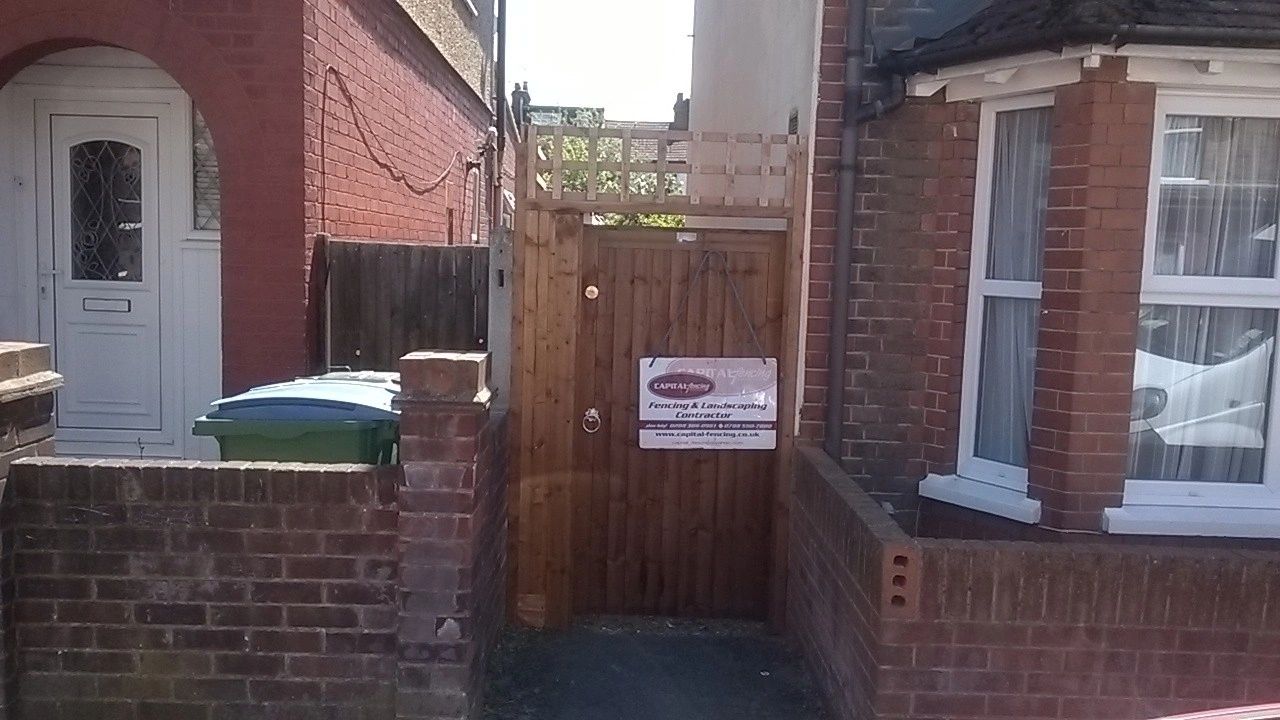
bespoke wooden gate installed by Capital Fencing in Letchworth Garden City (SG6)
Letchworth Garden City · SG6

Looking for Wooden Gates in Letchworth Garden City? Local Specialist Serving North Hertfordshire District

A wooden gate is joinery, not fencing. Frame it properly in iroko, oak or planed softwood, hang it on adjustable ball-race hinges, and it swings the same in February as in July — which is more than can be said for most Letchworth Garden City gates we are called out to replace. Every wooden gates job we run in Letchworth Garden City starts from what fails locally: letchworth heritage foundation design rules dictate fence styles, heights and finishes on most streets. Our default spec — 44mm framed, tongue-and-groove infill, adjustable ball-race hinges, drop bolt to slabs — is built around that, not around a generic price sheet. Recent work on Hillshott and Nevells Road. We orient jobs off Broadway Cinema.

A wooden gate is joinery, not fencing. Frame it properly in iroko, oak or planed softwood, hang it on adjustable ball-race hinges, and it swings the same in February as in July — which is more than can be said for most Letchworth Garden City gates we are called out to replace. Every wooden gates job we run in Letchworth Garden City starts from what fails locally: letchworth heritage foundation design rules dictate fence styles, heights and finishes on most streets. Our default spec — 44mm framed, tongue-and-groove infill, adjustable ball-race hinges, drop bolt to slabs — is built around that, not around a generic price sheet. Recent work on Hillshott and Nevells Road. We orient jobs off Broadway Cinema.

Why wooden gates works here

  • warm, matches most period and modern properties without looking industrial
  • easily re-sanded and re-oiled to refresh the finish every few years
  • hardwood options like iroko regularly outlast the ironmongery
Honest trade-offs

Where wooden gates isn't the right answer

  • hardwood costs significantly more up-front than treated softwood
  • timber moves seasonally — expect small alignment adjustments in year one

We'll say so on the site visit — a wasted quote helps nobody.

Typical spec

How we build wooden gates in Letchworth Garden City

Iroko hardwood, oak or planed softwood on hot-dip galvanised ironmongery. Standard build: 44mm framed, tongue-and-groove infill, adjustable ball-race hinges, drop bolt to slabs. On Letchworth Garden City jobs we adjust for letchworth heritage foundation design rules dictate fence styles, heights and finishes on most streets.

Property mix locally: the world's first garden city — Arts and Crafts cottages, planned terraces and consistent street trees. Typical gardens: generous, leafy plots — many gardens contain protected trees with TPOs. Postcodes we regularly service: SG6.

Common Letchworth Garden City briefs

  • driveway double gates — softwood or hardwood, manual or automated
  • pedestrian gates set into a brick pier or existing wall opening

Wooden Gates FAQs — Letchworth Garden City

How do you finish wooden gates to resist rot?

Adjustable hinges mean the gate can be re-trued in ten minutes years later, without touching the frame. For the world's first garden city — arts and crafts cottages in SG6, that is where the cost sits. In short: warm, matches most period and modern properties without looking industrial, though timber moves seasonally — expect small alignment adjustments in year one.

What ironmongery do you fit as standard?

Leaf weight drives the post size — an undersized post is the most common reason a Letchworth Garden City gate stops closing. We allow for generous when setting out in Letchworth Garden City. Practically, that means easily re-sanded and re-oiled to refresh the finish every few years — and we're upfront that softwood side gates need re-treating annually to avoid black spot.

Softwood or hardwood — which lasts longer in the London weather?

Adjustable hinges mean the gate can be re-trued in ten minutes years later, without touching the frame. Survey slots across SG6 are usually inside a week. Worth weighing warm, matches most period and modern properties without looking industrial against timber moves seasonally — expect small alignment adjustments in year one before you commit.

How do you stop a wooden gate dropping over time?

Adjustable hinges mean the gate can be re-trued in ten minutes years later, without touching the frame. We work this patch weekly, from Pixmore Industrial Estate out toward hitchin. In short: warm, matches most period and modern properties without looking industrial, though timber moves seasonally — expect small alignment adjustments in year one.

How wide can a single wooden gate span before it needs a brace or wheel?

Adjustable hinges mean the gate can be re-trued in ten minutes years later, without touching the frame. For the world's first garden city — arts and crafts cottages in SG6, that is where the cost sits. Practically, that means easily re-sanded and re-oiled to refresh the finish every few years — and we're upfront that softwood side gates need re-treating annually to avoid black spot.

Recent wooden gates work
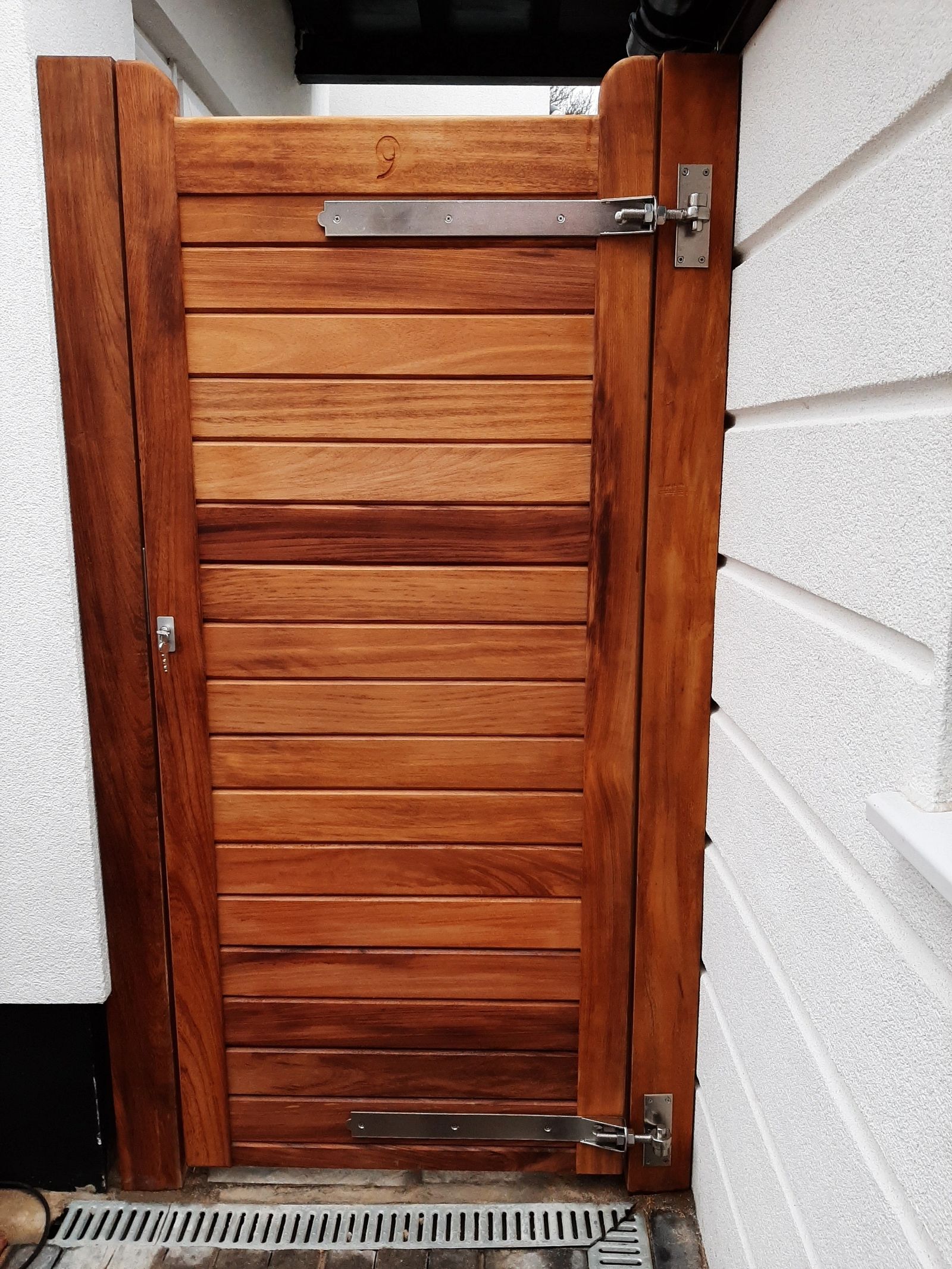
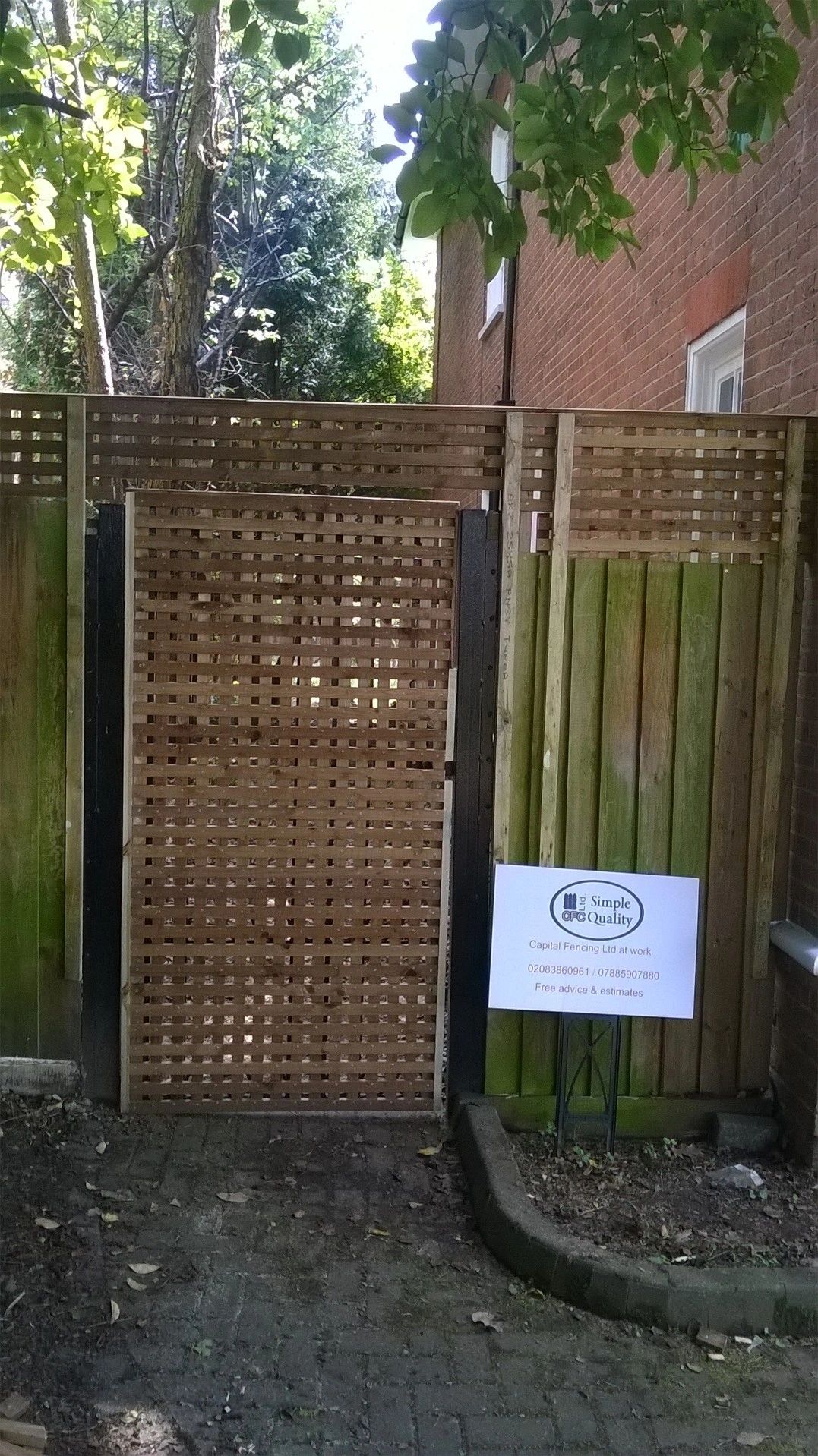
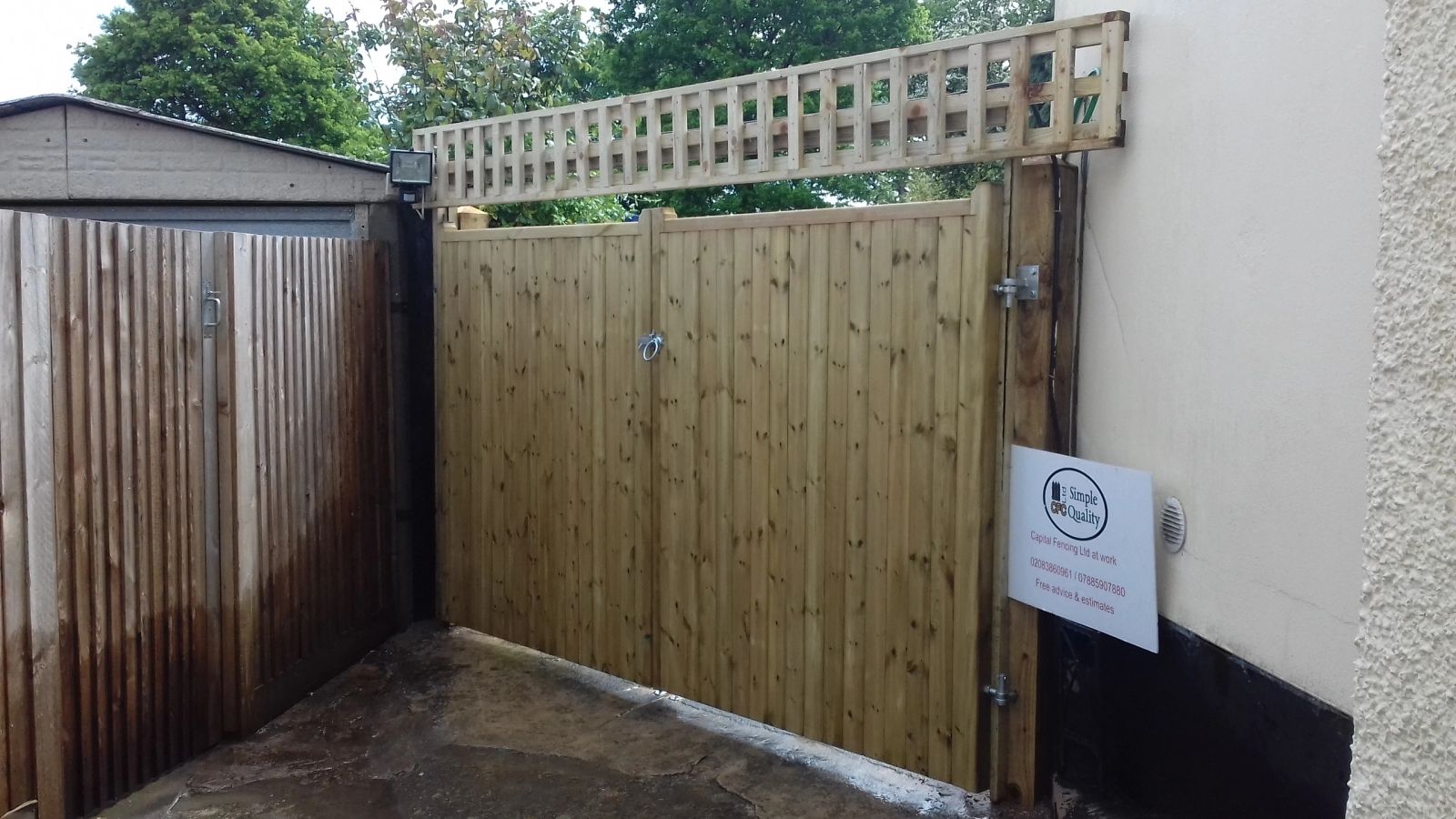
bespoke wooden gate installed by Capital Fencing in Letchworth Garden City (SG6)double driveway gates installed by Capital Fencing in Letchworth Garden City (SG6)hardwood side gate installed by Capital Fencing in Letchworth Garden City (SG6)metal entrance gate installed by Capital Fencing in Letchworth Garden City (SG6)

Site notes: wooden gates in SG6

Gate detailing on sites prone to flooding

A gate on a boundary that's prone to periodic flooding benefits from open rather than solid infill low down, allowing floodwater to pass through rather than build up against a solid face and load the frame or undermine the posts.

Post fixings on flood-prone ground also need to account for the ground becoming waterlogged and softer than normal during a flood event, not just its condition in dry weather.

Shiplap board profiles

Shiplap boards are machined with a rebated lap joint along each long edge, so adjoining boards interlock rather than simply overlapping flat, which sheds water more effectively than a plain overlap.

The rebate also means shiplap panels sit with a smaller visible overlap than feather-edge for the same weather resistance, giving a flatter, more even panel face.

Because the interlocking edges rely on a consistent machined profile, shiplap doesn't tolerate the same board-to-board variation as waney-edge, and a warped board can be harder to seat correctly in the joint.

Sheeting plants and borders during fencing works

Established shrubs and borders close to a fence line are easily damaged by dropped tools, spoil heaps or simply being walked over repeatedly during a multi-day job, so temporary boards or breathable sheeting laid over beds reduces incidental damage.

Concrete dust and cement splash can scorch foliage if it settles on leaves and isn't rinsed off promptly, which is worth flagging before mixing starts next to a prized border.

Where a plant genuinely sits in the way of a post position, agreeing with the client in advance whether it's moved, worked around, or the post offset avoids an awkward decision made on the spot mid-dig.

Permitted development height limits

Under the General Permitted Development Order, a fence, wall or gate can normally go up to 1m without planning permission where it fronts a highway used by vehicles, and up to 2m elsewhere on the plot.

That 2m figure is measured from the natural ground level, not from the base of a retaining structure, which catches people out on sloping plots where the fence ends up effectively taller on the low side.

Corner plots, listed buildings and land inside a conservation area all tighten these limits, so it's worth checking the local authority's own guidance before ordering materials rather than after.

Bitumen paint on buried post bases

A bitumen-based coating applied to the section of a timber post that will sit below ground adds an additional moisture barrier on top of factory preservative treatment, aimed specifically at the zone in most sustained contact with damp soil.

It's a supplementary measure rather than a substitute for proper preservative treatment, since bitumen coating alone doesn't address fungal decay resistance the way a biocide-based preservative does.

The coating is usually stopped a short distance below the eventual ground line, since bitumen exposed to UV above ground degrades and can look unsightly, whereas below ground it's protected from sunlight entirely.

Slatted panels and gap sizing

Contemporary slatted panels use horizontal or vertical timber or composite boards with a deliberate gap between them, typically anywhere from a few millimetres up to 20mm or more depending on the level of privacy wanted.

A narrow gap reads as near-solid from a normal viewing distance while still admitting light and airflow; a wider gap gives more of a screening effect than true privacy and lets more wind through, which matters on exposed plots.

Gap sizing is set at design stage rather than adjusted on site, since it affects how many boards and how much fixing timber the run needs, and inconsistent gaps are one of the most visible signs of a poorly set-out job.

Ongoing access rights reserved under a utility wayleave

A recorded wayleave or easement for utility apparatus usually reserves an ongoing right for the utility company to access and maintain their equipment, which can mean a fence built across the strip needs a lockable gate or removable section.

Building an entirely fixed fence over an area subject to this kind of reserved access can lead to the utility company needing to remove part of it later at the owner's inconvenience.

Checking the title register for any registered wayleave before finalising a fence design avoids this kind of retrofit.

Moss build-up on shaded paths beside a north boundary fence

A path or step running alongside a permanently shaded north-facing fence often develops moss faster than the same surface elsewhere in the garden, since the fence itself blocks low winter sun that would otherwise help the surface dry.

This isn't strictly a fence maintenance issue but is worth mentioning to clients, since a fence replacement project is often the moment a client is already thinking about that part of the garden and receptive to fixing a related slip hazard at the same time.

A lighter, more open fence design along that boundary, where privacy allows, can let in enough additional light to measurably reduce moss growth on the path beside it.

Arris rails and rail counts by height

Arris rails are the triangular-section horizontal timbers that run between posts and carry the vertical boards in a closeboard fence, and how many are used per bay is set by the finished height rather than fixed at two everywhere.

A fence up to around 1.2m typically runs on two rails, but anything taller — particularly 1.8m closeboard — needs a third rail roughly at mid-height to stop the boards bowing outward under wind pressure.

Morticing the rail ends into the post rather than merely nailing them on gives a stiffer, longer-lived joint, which matters more as the number of rails and the height of the fence both increase.

Concrete, timber and steel posts compared

Concrete posts don't rot, warp or need re-treating, which makes them the default for a long-life boundary, but they're heavier to handle, harder to cut on site, and can crack if struck hard rather than bending.

Timber posts are lighter, easier to notch and fix ironmongery to, and match a fully timber run visually, but they're the first component to fail through rot even when the boards above them are sound.

Steel posts (box section or RSJ) suit gates, very exposed runs or where a slim sightline matters, and they're galvanised or powder-coated rather than treated, but they need a compatible fixing method for timber infill panels rather than simple nailing.

Diagnosing which of the three usual causes applies

Almost every failing gate comes down to the hinge side, the frame or the ironmongery, and diagnosing which one it actually is before quoting avoids paying for a new gate that wasn't needed.

We check hinge fixings, frame square and latch alignment separately on site rather than assuming from how the gate looks.

Routing deck lighting cable away from standing water

Low-voltage deck lighting cable run beneath boards needs to be kept clear of any point where water is likely to pool, since even low-voltage cable connectors degrade faster in permanently wet conditions than in the intermittent dampness the rest of the substructure sees.

Routing cable along the higher side of a deck's fall, rather than through the lowest point where water naturally collects, is a simple planning step that extends the life of an otherwise reliable lighting installation.

Any cable joints beneath a deck should use fully waterproof-rated connectors rather than standard household connectors, given the substructure environment is functionally outdoors and damp regardless of overall deck condition.

Checking wall coping condition before fixing into it

Coping stones or brick-on-edge capping along the top of a garden wall are often loosely bedded rather than solidly fixed, so drilling or clamping a fence post bracket into coping without checking it first can dislodge the coping itself.

A quick check by hand-pressure on each coping unit along the intended fixing line identifies any that are already loose, which is worth doing before committing to that wall as a fixing point at all.

Where coping is sound, spreading the fixing load across a bracket plate rather than a single point fixing reduces the chance of cracking the coping under wind load on the panels above.

Spirit level versus laser level for checking a run

A spirit level checks a single post is plumb and a single panel is level, but confirming that an entire run stays level or follows a consistent fall over 20 or 30 metres is far quicker and more reliable with a rotating laser level set at a fixed height.

On a stepped run, a laser also makes it straightforward to confirm each step drops by the same consistent amount rather than checking each post in isolation and hoping the cumulative effect looks even.

A basic spirit level remains the more practical tool for quick checks during a single post's installation, since setting up a laser for every individual post would slow the job without adding useful accuracy at that scale.

Side gates, double gates and driveway pairs all get the same treatment — hot-dip galvanised ironmongery, adjustable hinges, and a drop bolt into a slab where it is needed. Whether you're on a period street near Pixmore Industrial Estate or a newer estate toward hitchin, wooden gates in Letchworth Garden City is a service we run every week — booked in, on time, and left tidy. Recent work on Icknield Way and Sollershott West. We orient jobs off Letchworth Garden City station.

Get In Touch

Get My Free Quote — 24h Response

No callout fee · Free site visit · Friendly local team covering London & Hertfordshire.

Call us
07885907880
or 02036484746
Email
capital_fencing@yahoo.com
WhatsApp
Message us anytime
Area
London & Hertfordshire
Payment
Card payments accepted

Pay by debit or credit card, bank transfer or cash once the work and price are agreed. No deposit taken online.

Request a Free Quote

We'll get back to you within 24 hours.

Free Site Visit No Callout Fee
Call WhatsAppQuote