London & Hertfordshire Free Site Visit
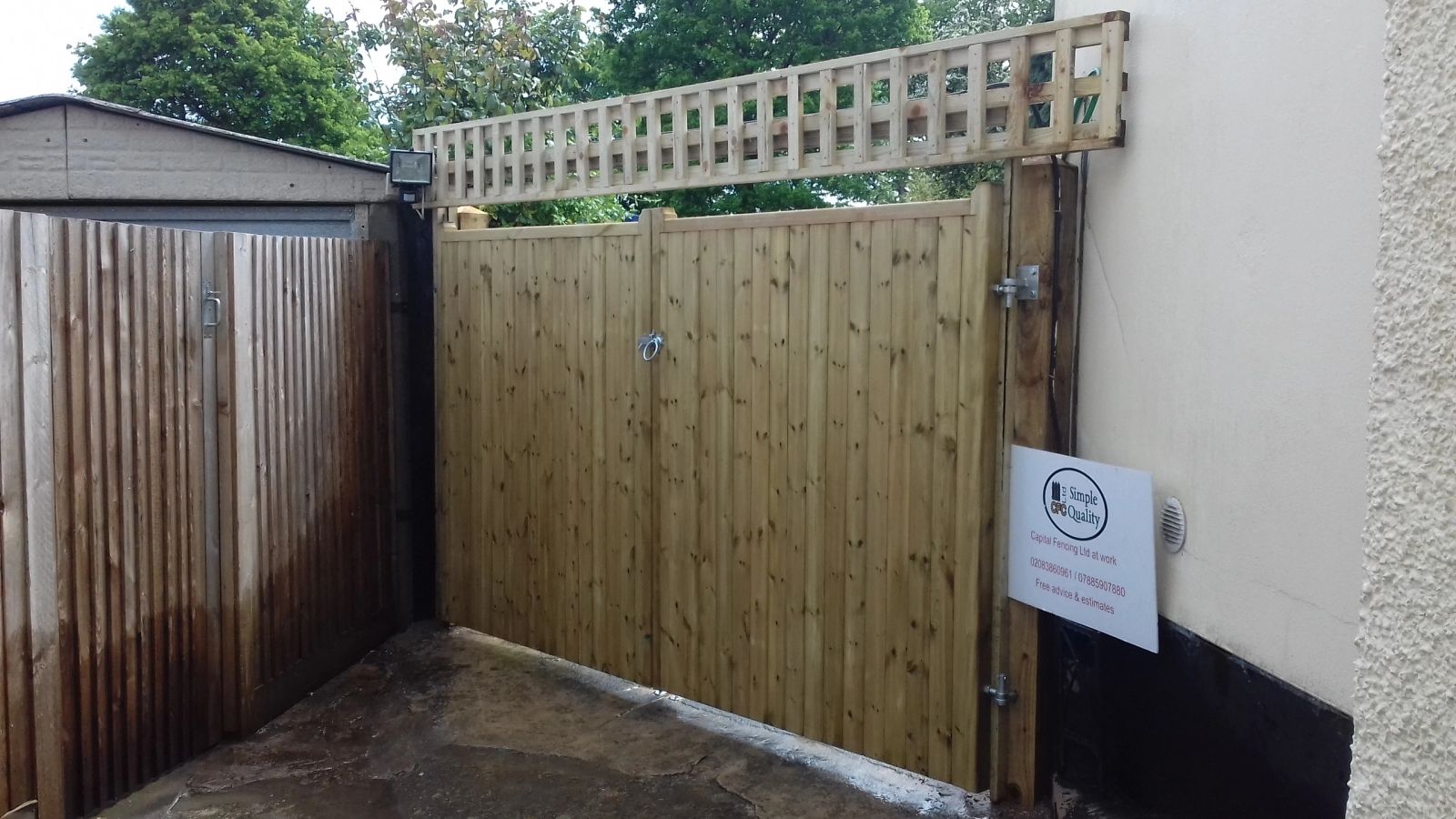
bespoke wooden gate installed by Capital Fencing in Watford (WD17)
Watford · WD17 / WD18 / WD19

Watford Wooden Gates — Specified for WD17, WD18, WD19

Timber gates are made to the opening, not trimmed to fit. We template the Watford opening, allow for the fall of the path, and build the frame with a diagonal brace working in compression so the leaf cannot drop. Wooden Gates in Watford isn't a bolt-on for us — it's a day-in, day-out install. We cover WD17 / WD18 / WD19 and the streets running toward A411 / A4008, and we know before we arrive that tree-root heave is common near cassiobury and whippendell wood, so concrete-set posts are non-negotiable. That's the first thing that shapes the spec, not the last. Recent work on Bushey Mill Lane and Hempstead Road. We orient jobs off Whippendell Wood.

Timber gates are made to the opening, not trimmed to fit. We template the Watford opening, allow for the fall of the path, and build the frame with a diagonal brace working in compression so the leaf cannot drop. Wooden Gates in Watford isn't a bolt-on for us — it's a day-in, day-out install. We cover WD17 / WD18 / WD19 and the streets running toward A411 / A4008, and we know before we arrive that tree-root heave is common near cassiobury and whippendell wood, so concrete-set posts are non-negotiable. That's the first thing that shapes the spec, not the last. Recent work on Bushey Mill Lane and Hempstead Road. We orient jobs off Whippendell Wood.

Typical spec

How we build wooden gates in Watford

Iroko hardwood, oak or planed softwood on hot-dip galvanised ironmongery. Standard build: 44mm framed, tongue-and-groove infill, adjustable ball-race hinges, drop bolt to slabs. On Watford jobs we adjust for tree-root heave is common near cassiobury and whippendell wood, so concrete-set posts are non-negotiable.

Property mix locally: Victorian terraces around the centre, 1930s semis in Oxhey, and large detached homes in Cassiobury. Typical gardens: mixed — tight back-to-backs near the town centre, generous plots toward Cassiobury Park. Postcodes we regularly service: WD17, WD18, WD19.

Common Watford briefs

  • driveway double gates — softwood or hardwood, manual or automated
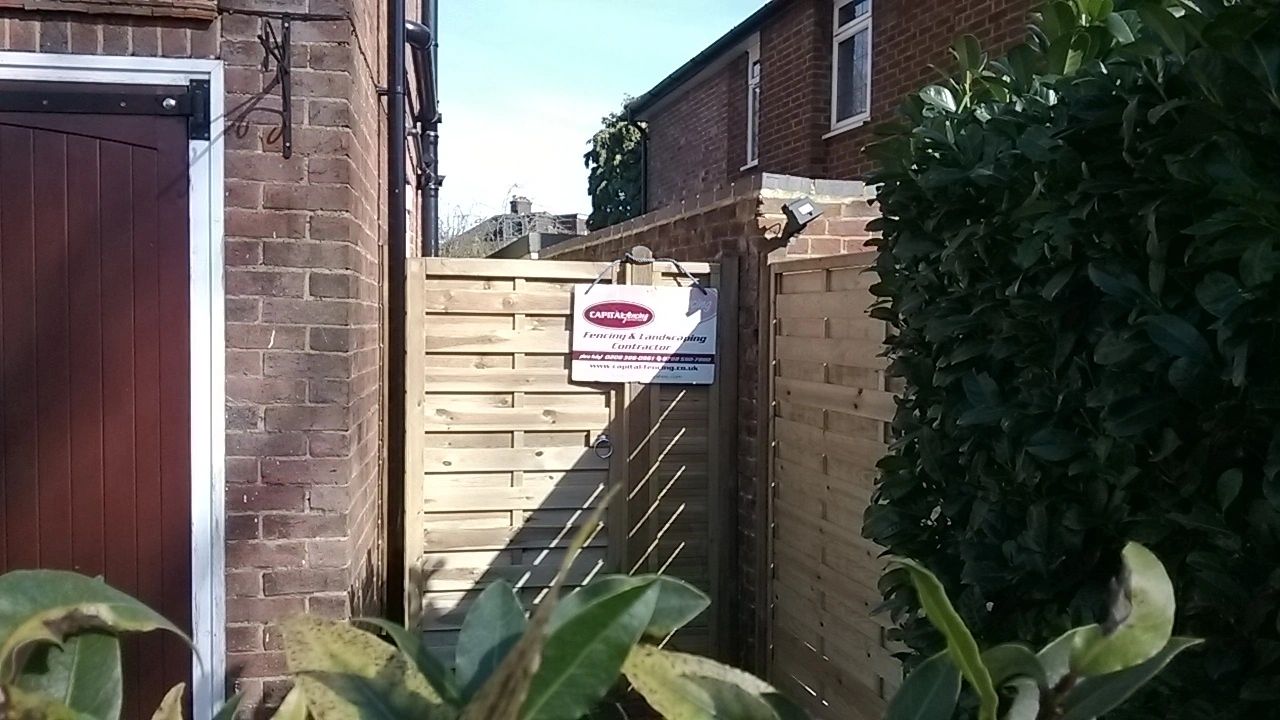
  • side gates matching a closeboard or panel boundary
Honest trade-offs

Where wooden gates isn't the right answer

  • softwood side gates need re-treating annually to avoid black spot
  • hardwood costs significantly more up-front than treated softwood

We'll say so on the site visit — a wasted quote helps nobody.

Why wooden gates works here

  • warm, matches most period and modern properties without looking industrial
  • easily re-sanded and re-oiled to refresh the finish every few years
  • hardwood options like iroko regularly outlast the ironmongery

Wooden Gates FAQs — Watford

Can wooden gates be automated?

Leaf weight drives the post size — an undersized post is the most common reason a Watford gate stops closing. For victorian terraces around the centre in WD17, that is where the cost sits. In short: warm, matches most period and modern properties without looking industrial, though timber moves seasonally — expect small alignment adjustments in year one.

Do you build gates to match an existing fence?

End grain gets sealed before hanging, because a gate bottom rail in Watford sits in splash-back all winter. We allow for mixed — tight back-to-backs near the town centre when setting out in Watford. In short: warm, matches most period and modern properties without looking industrial, though timber moves seasonally — expect small alignment adjustments in year one.

How wide can a single wooden gate span before it needs a brace or wheel?

Leaf weight drives the post size — an undersized post is the most common reason a Watford gate stops closing. Survey slots across WD17 are usually inside a week. Practically, that means easily re-sanded and re-oiled to refresh the finish every few years — and we're upfront that softwood side gates need re-treating annually to avoid black spot.

What ironmongery do you fit as standard?

Adjustable hinges mean the gate can be re-trued in ten minutes years later, without touching the frame. We work this patch weekly, from Watford Business Park out toward bushey. Practically, that means easily re-sanded and re-oiled to refresh the finish every few years — and we're upfront that softwood side gates need re-treating annually to avoid black spot.

How do you finish wooden gates to resist rot?

End grain gets sealed before hanging, because a gate bottom rail in Watford sits in splash-back all winter. For victorian terraces around the centre in WD17, that is where the cost sits. Practically, that means easily re-sanded and re-oiled to refresh the finish every few years — and we're upfront that softwood side gates need re-treating annually to avoid black spot.

Recent wooden gates work
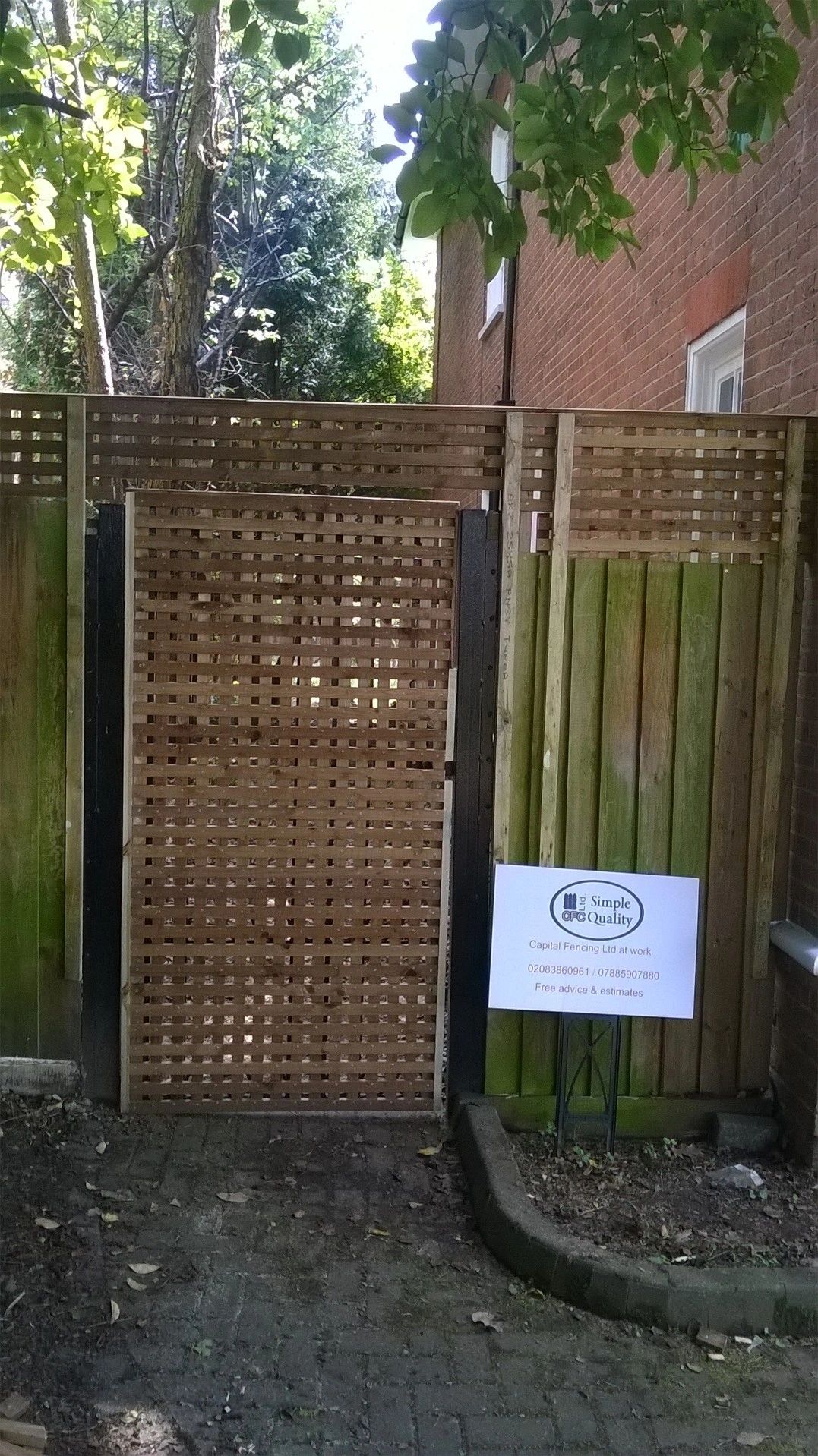
bespoke wooden gate installed by Capital Fencing in Watford (WD17)double driveway gates installed by Capital Fencing in Watford (WD17)hardwood side gate installed by Capital Fencing in Watford (WD17)metal entrance gate installed by Capital Fencing in Watford (WD17)

Local considerations across Watford and bushey

Visibility splays for vehicle gates onto a road

A driveway gate opening directly onto a road needs to be positioned or set back so that a driver waiting to exit can see approaching traffic clearly, and a solid gate that opens outward across the pavement can obstruct pedestrians as well as sightlines if not set back far enough.

This is a site layout consideration that needs addressing at the design stage, since it's much harder to correct once posts are concreted in a fixed position.

Simple maintenance that prevents gate failure

Checking hinge screws are still tight and that the gate still closes flush against the frame once or twice a year catches the early stages of sag before it becomes a full repair job.

A gate that's starting to catch on the ground is far cheaper to fix at that stage than after the frame has racked further out of square.

Segregating timber and concrete waste

Treated timber, plain untreated offcuts and broken concrete are usually classed and processed differently at a waste facility, so keeping them in separate piles or skip compartments on site can reduce disposal cost and avoid a mixed load being rejected.

Old concrete post bases and gravel boards are inert waste and can sometimes be crushed and reused as hardcore rather than sent to landfill, which is worth checking with the waste carrier before assuming it all goes in one load.

Metal fittings — old hinges, bolts, wire ties — pulled out during a strip-down are usually worth separating too, since scrap metal is handled through a different route to general construction waste.

Sheltered courtyard microclimates and reduced wear

A small enclosed courtyard garden surrounded by walls or buildings on most sides creates a sheltered microclimate with reduced wind and often reduced direct rain exposure, which can extend the practical life of a timber finish well beyond the general guideline interval.

The trade-off is often reduced airflow and higher humidity in the enclosed space, which can favour algae or mould growth even though the timber itself isn't taking direct weather.

Recommending a maintenance interval based on general exposure alone can be too cautious for a sheltered courtyard or too relaxed for a damp, poorly-ventilated one, so it's worth judging each enclosed garden on its own conditions.

Checking a frame is square before re-hanging

A frame that's been repaired or partially rebuilt is checked for square by measuring both diagonals rather than by eye, since a frame can look straight from the front while still being out of square enough to bind against its post.

Only once the diagonals match is the gate face re-hung onto the corrected frame.

Building decking over an existing patio or hardstanding

Decking built directly over a sound existing patio saves the cost and disruption of breaking out the old surface, provided the substructure can be securely fixed to it and a fall is built in for drainage rather than trapping water underneath.

A patio with a slope toward the house, rather than away from it, needs correcting in the decking substructure rather than simply built over as-is, since a deck can't fix a drainage problem it's built directly on top of.

Ventilation gaps around the edge of a deck built over solid paving matter just as much as one built over soil, since trapped moisture and poor airflow cause the same rot risk to the substructure timber either way.

Seasonal ground heave

Ground heave is the upward or lateral movement of soil as it absorbs water and expands, most pronounced in clay-rich ground after a wet autumn following a dry summer.

A post that was plumb in August can be measurably out of true by the following spring purely from this cycle, without any external damage to the fence.

Where heave is a known issue on a plot, deeper posts and a looser granular surround give the soil room to move without directly loading the post, rather than locking post and ground rigidly together.

Acoustic fencing near busy roads or railways

Taller acoustic fencing intended to reduce traffic or railway noise is still subject to the same general permitted development height limits as any other boundary structure, unless it forms part of a formally consented scheme.

Some acoustic fencing along significant infrastructure is installed by the highway or rail authority itself under separate statutory powers, which is different from a homeowner adding their own noise barrier.

A homeowner wanting extra height for noise reasons alone would generally still need to apply for planning permission above the normal limit, the same as for any other reason.

Keeping treated timber offcuts away from food-growing areas

Offcuts of pressure-treated fencing timber shouldn't be left lying in or used to edge a vegetable bed or fruit cage, since preservative can leach out of cut ends into adjacent soil over time.

Keeping offcuts on a hard surface or sheeting rather than directly on a border during the works avoids this becoming an issue even temporarily while the job is ongoing.

Where a client specifically wants to reuse leftover timber for raised beds, it's worth flagging that treated fencing stock isn't the right material for that purpose regardless of how convenient the offcuts seem.

Boundary treatments for flats and maisonettes

Shared amenity gardens attached to flats or maisonettes usually have boundary decisions made collectively through a management company or freeholder rather than by an individual leaseholder, which changes who needs to sign off a fence or gate change.

Lease terms sometimes specify who's responsible for maintaining which boundary, and altering a shared boundary without checking the lease is a common source of dispute between leaseholders.

Where several flats share a single rear garden, dividing it with new fencing usually needs agreement from all affected leaseholders, not just the person requesting the work.

Drop bolt materials and corrosion resistance

A drop bolt is typically dropped into a socket set in the ground or a hard surface to secure the closed leaf of a double gate, and that socket is one of the most exposed fittings on a gate to standing water and debris.

Galvanised or stainless drop bolts resist the corrosion that a plain steel bolt develops from sitting in a damp, dirt-filled socket, which can otherwise seize the bolt in place within a season or two.

Regularly clearing debris from the ground socket does more for a drop bolt's long-term function than the bolt's material alone, since even a corrosion-resistant bolt can jam against compacted grit and soil.

Spoil volume and removal

Digging a full run of post holes generates more spoil than most clients expect, particularly on clay where the dug material swells in volume compared with its compacted state in the ground.

Spoil that can't be spread thinly elsewhere on the plot without smothering lawn or borders usually needs skip or licensed grab-lorry removal, which should be agreed and costed before the dig starts rather than after a pile has built up on the lawn.

Heavy clay spoil left on grass for more than a day or two will usually kill it, so covering or removing arisings promptly matters if the lawn is staying.

Boundary structures on Green Belt land

Land designated as Green Belt carries additional planning restrictions aimed at preventing inappropriate development, which can extend to boundary treatments beyond the usual permitted development framework in some cases.

Most domestic garden fencing on an existing residential plot within the Green Belt is unaffected, but larger boundary structures or those on paddock and agricultural land nearby can be treated differently.

Checking with the local planning authority is the reliable way to confirm what applies to a specific Green Belt property before committing to a boundary project.

Boundary fences and neighbouring solar panel shading

There's no dedicated 'right to sunlight' for solar panels under general property law, so a compliant boundary fence generally isn't unlawful purely because it casts some shade on a neighbour's panels.

Some newer local planning policies do encourage considering solar shading when reviewing extension or outbuilding applications, though this is less commonly applied to ordinary garden fencing.

Where a fence height decision could noticeably affect a neighbour's solar generation, discussing options informally tends to avoid resentment even without a strict legal duty to do so.

Side gates, double gates and driveway pairs all get the same treatment — hot-dip galvanised ironmongery, adjustable hinges, and a drop bolt into a slab where it is needed. Wooden Gates across WD17, WD18, WD19 is one of our regular runs. We'll quote honestly, tell you if wooden gates isn't the right answer for your garden, and book the job in within a week or two of a signed quote. Recent work on Cassio Road and Nascot Wood Road. We orient jobs off Watford Junction.

Get In Touch

Get My Free Quote — 24h Response

No callout fee · Free site visit · Friendly local team covering London & Hertfordshire.

Call us
07885907880
or 02036484746
Email
capital_fencing@yahoo.com
WhatsApp
Message us anytime
Area
London & Hertfordshire
Payment
Card payments accepted

Pay by debit or credit card, bank transfer or cash once the work and price are agreed. No deposit taken online.

Request a Free Quote

We'll get back to you within 24 hours.

Free Site Visit No Callout Fee
Call WhatsAppQuote