In Waltham Cross (EN8), under Broxbourne Borough Council, you'll mostly find victorian and edwardian terraces near the town centre, with newer estates toward theobalds, with gardens usually small to medium gardens; many older properties share boundary fences with both neighbours. Most site visits in this patch come back to one thing: shared boundaries plus a high turnover of rental properties means landlord-friendly specs matter. Working hours restrictions set by councils: Most councils set standard permitted working hours for construction noise, commonly something like 8am to 6pm on weekdays and a shorter window on Saturdays, with no noisy work at all on Sundays and bank holidays, though the exact hours vary by borough. These restrictions apply regardless of whether formal planning permission was needed for the work itself, and are usually enforced under separate environmental health powers rather than the planning system. Building control interaction with retaining walls: A retaining wall over 1m in height, or one supporting a structure or the stability of a neighbouring building, generally falls within the scope of the Building Regulations even though a simple garden fence of the same height wouldn't, because failure carries a structural safety risk beyond the immediate boundary.
Talk through your Waltham Cross brief
We know Broxbourne's planning rules and this patch's ground conditions — call and we'll talk it through.
Property: Victorian and Edwardian terraces near the town centre, with newer estates toward Theobalds
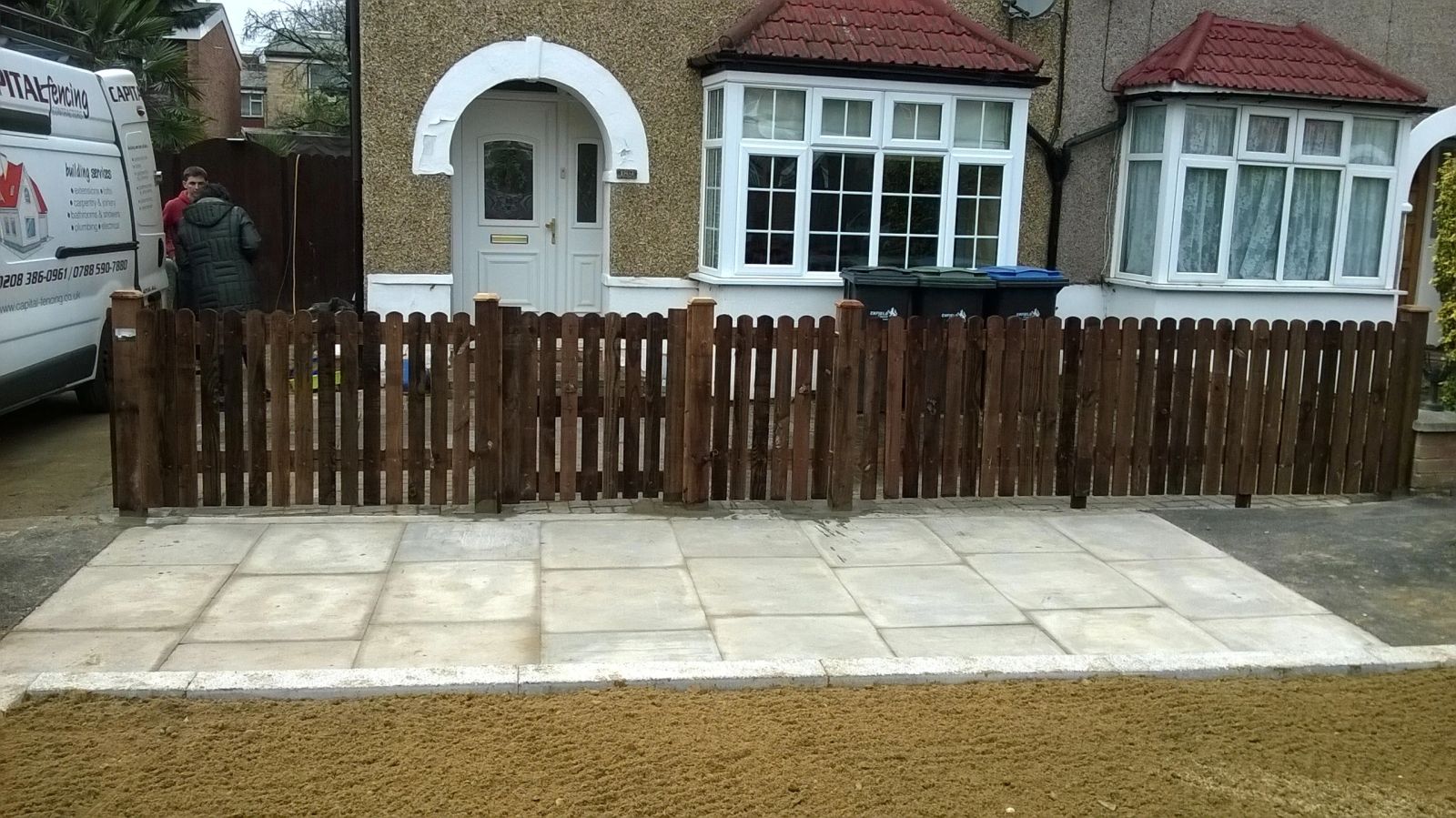
Gardens: small to medium gardens; many older properties share boundary fences with both neighbours
shared boundaries plus a high turnover of rental properties means landlord-friendly specs matter
Under Broxbourne Borough Council, covering EN8. Nearest arterial: A121 / A10, M25 J25. Served from Waltham Cross (Greater Anglia). Local commercial anchors: Eleanor Cross Road retail, Park Lane industrial area.
Streets we regularly work on: Trinity Lane, Theobalds Lane, High Street, Eleanor Cross Road. Local anchors: Lee Valley White Water Centre, Waltham Cross station, Eleanor Cross monument.
Waltham Cross sits at the junction of the M25 and A10, historically a coaching-road crossing point marked by the medieval Eleanor Cross monument. The Lee Valley White Water Centre, built for the 2012 Olympics, lies within the borough. Theobalds Park, on the town's edge, includes land with heritage designations affecting nearby boundary treatments.
Practical points for boundary work in Waltham Cross
Working hours restrictions set by councils
Most councils set standard permitted working hours for construction noise, commonly something like 8am to 6pm on weekdays and a shorter window on Saturdays, with no noisy work at all on Sundays and bank holidays, though the exact hours vary by borough.
These restrictions apply regardless of whether formal planning permission was needed for the work itself, and are usually enforced under separate environmental health powers rather than the planning system.
On a site with a specific planning condition attached, hours can be tighter still, so it's worth checking any condition notice as well as the general council policy before committing to a start time.
Building control interaction with retaining walls
A retaining wall over 1m in height, or one supporting a structure or the stability of a neighbouring building, generally falls within the scope of the Building Regulations even though a simple garden fence of the same height wouldn't, because failure carries a structural safety risk beyond the immediate boundary.
Building control involvement typically means the wall's design needs to demonstrate adequate drainage behind it and sufficient strength to resist the retained ground, often requiring a structural engineer's calculations rather than a standard trade specification.
Retaining structures built without the necessary building control sign-off can create problems on sale of the property, since a buyer's solicitor will often ask for a completion certificate that doesn't exist.
Decking fixings visible versus hidden
Face-fixed decking is screwed directly down through the board top, which is simple, cheap and easy to replace a single board on, but leaves visible screw heads that can work slightly proud over time as the timber moves.
Hidden fixing clip systems fit into the board's grooved edge and screw down into the joist from the side, giving an unbroken top surface, but they generally cost more per board and make it harder to lift a single damaged board without disturbing its neighbours.
Composite boards are more often specified with hidden clip systems since the clean, screw-free look is part of the appeal that justifies the material's higher cost.
Properties with no registered title at all
A small proportion of properties in England and Wales, usually those that haven't changed hands or been mortgaged for a very long time, still aren't registered with HM Land Registry at all.
In these cases, boundary questions rely entirely on the original paper deeds held by the owner, which can be less detailed or harder to interpret than a modern registered title plan.
First registration can be triggered voluntarily or by certain transactions, and often brings helpful clarity to boundary questions that were previously only defined by older paper deeds.
Scribing a gravel board to uneven ground
Ground level rarely runs perfectly straight between two posts, so a gravel board cut square often leaves a gap under one end and digs into the ground at the other unless it's scribed to follow the actual contour.
Scribing means holding the board in position, marking the ground profile onto its face, and cutting along that line so the board's bottom edge follows the undulation rather than an assumed flat datum.
On concrete gravel boards this isn't possible after casting, so uneven ground either needs the board bedded on a shaped mortar bed or a timber board used instead where the ground profile is particularly irregular.
Hedge disputes and the high hedge complaint route
A hedge over 2m tall made up mainly of evergreen or semi-evergreen species can be the subject of a formal 'high hedge' complaint to the local council under the Anti-social Behaviour Act 2003, but only after direct attempts to resolve it with the neighbour have failed and a fee is paid.
The council can then issue a remedial notice requiring the hedge to be reduced to a specified height, enforceable in the same way as a planning enforcement notice, though it typically won't require complete removal.
This process is separate from ordinary fence or boundary work and doesn't apply to deciduous hedges or single ornamental trees, which fall under general nuisance and tree law instead.
What should I know about properties with no registered title at all in Waltham Cross?
First registration can be triggered voluntarily or by certain transactions, and often brings helpful clarity to boundary questions that were previously only defined by older paper deeds. A small proportion of properties in England and Wales, usually those that haven't changed hands or been mortgaged for a very long time, still aren't registered with HM Land Registry at all. In these cases, boundary questions rely entirely on the original paper deeds held by the owner, which can be less detailed or harder to interpret than a modern registered title plan.
Is scribing a gravel board to uneven ground something you plan for in Waltham Cross?
On concrete gravel boards this isn't possible after casting, so uneven ground either needs the board bedded on a shaped mortar bed or a timber board used instead where the ground profile is particularly irregular. Ground level rarely runs perfectly straight between two posts, so a gravel board cut square often leaves a gap under one end and digs into the ground at the other unless it's scribed to follow the actual contour. Scribing means holding the board in position, marking the ground profile onto its face, and cutting along that line so the board's bottom edge follows the undulation rather than an assumed flat datum.
What's the typical garden like in Waltham Cross?
Small to medium gardens; many older properties share boundary fences with both neighbours is typical, alongside victorian and edwardian terraces near the town centre, with newer estates toward theobalds.
Decking fixings visible versus hidden — what does that mean for a job in Waltham Cross?
Composite boards are more often specified with hidden clip systems since the clean, screw-free look is part of the appeal that justifies the material's higher cost. Face-fixed decking is screwed directly down through the board top, which is simple, cheap and easy to replace a single board on, but leaves visible screw heads that can work slightly proud over time as the timber moves. Hidden fixing clip systems fit into the board's grooved edge and screw down into the joist from the side, giving an unbroken top surface, but they generally cost more per board and make it harder to lift a single damaged board without disturbing its neighbours.
How does "hedge disputes and the high hedge complaint route" affect fencing or decking work in Waltham Cross?
A hedge over 2m tall made up mainly of evergreen or semi-evergreen species can be the subject of a formal 'high hedge' complaint to the local council under the Anti-social Behaviour Act 2003, but only after direct attempts to resolve it with the neighbour have failed and a fee is paid. The council can then issue a remedial notice requiring the hedge to be reduced to a specified height, enforceable in the same way as a planning enforcement notice, though it typically won't require complete removal. This process is separate from ordinary fence or boundary work and doesn't apply to deciduous hedges or single ornamental trees, which fall under general nuisance and tree law instead.
Do you cover neighbourhoods near Waltham Cross?
Yes — see our full coverage map for neighbourhoods near Waltham Cross.
We work this patch off A121 / A10, close to M25 J25, via Waltham Cross (Greater Anglia). Decking fixings visible versus hidden: Face-fixed decking is screwed directly down through the board top, which is simple, cheap and easy to replace a single board on, but leaves visible screw heads that can work slightly proud over time as the timber moves. Hidden fixing clip systems fit into the board's grooved edge and screw down into the joist from the side, giving an unbroken top surface, but they generally cost more per board and make it harder to lift a single damaged board without disturbing its neighbours. Properties with no registered title at all: A small proportion of properties in England and Wales, usually those that haven't changed hands or been mortgaged for a very long time, still aren't registered with HM Land Registry at all.
Get In Touch
Get My Free Quote — 24h Response
No callout fee · Free site visit · Friendly local team covering London & Hertfordshire.