Specification driven by an insurer's boundary requirements
Some commercial and high-value premises have boundary security requirements set by an insurance policy — a minimum fence height, mesh type or lock standard — that the fencing spec has to meet regardless of what would otherwise be chosen.
Where a specific requirement applies, it's worth getting it in writing from the policy documents before quoting, since fitting to a general standard when a stricter one is required can leave a gap the client didn't expect.
Pedestrian gate self-closing devices
A hydraulic or spring-loaded self-closing hinge brings a pedestrian gate back to a closed and latched position automatically, which is useful where a gate needs to stay shut for security or to keep a garden secure for children or pets.
These devices need occasional tension adjustment as they wear, and a gate that no longer closes fully is often a closer needing adjustment rather than a hinge fault.
Pergola and screen timbers
Pergola posts generally need a larger section than a fence post of the same height, since they carry a horizontal beam and roof structure rather than just resisting wind on a flat panel, and undersized posts show up as noticeable sway at the top rather than immediate failure.
Softwood pergolas are almost always pressure-treated given the exposure, while a hardwood pergola can be left to weather untreated in the same way an oak gate can, at a higher initial material cost.
Screening timbers fixed to or beside a pergola structure follow the same gap and profile logic as free-standing slatted fencing, so the same trade-offs between privacy, light and wind loading apply.
Dealing with a post hole that keeps collapsing in loose or sandy soil
Loose or sandy soil can slump back into a freshly dug post hole before concrete goes in, which is more of a problem on a repair — where the hole is often reopening ground already disturbed by the original failure — than on undisturbed ground.
A sleeve, shuttering, or a wider hole packed with a drier mix that doesn't rely on firm hole walls to hold its shape can get a repair post set securely even where the surrounding soil won't hold a clean-sided hole.
Suspending a parking bay for a delivery
Where a residential street has marked parking bays, a resident or contractor may need to apply to the council to formally suspend a bay for the duration of a delivery or a working van.
Suspensions are usually charged per bay per day and typically need a few working days' notice, so they're worth arranging well ahead of a fencing or decking job rather than on the morning of delivery.
Parking in a suspended bay without paying the fee, or using a bay that hasn't been suspended at all, can result in a parking charge notice regardless of the reason for being there.
Arched top gates and curved rail jointing
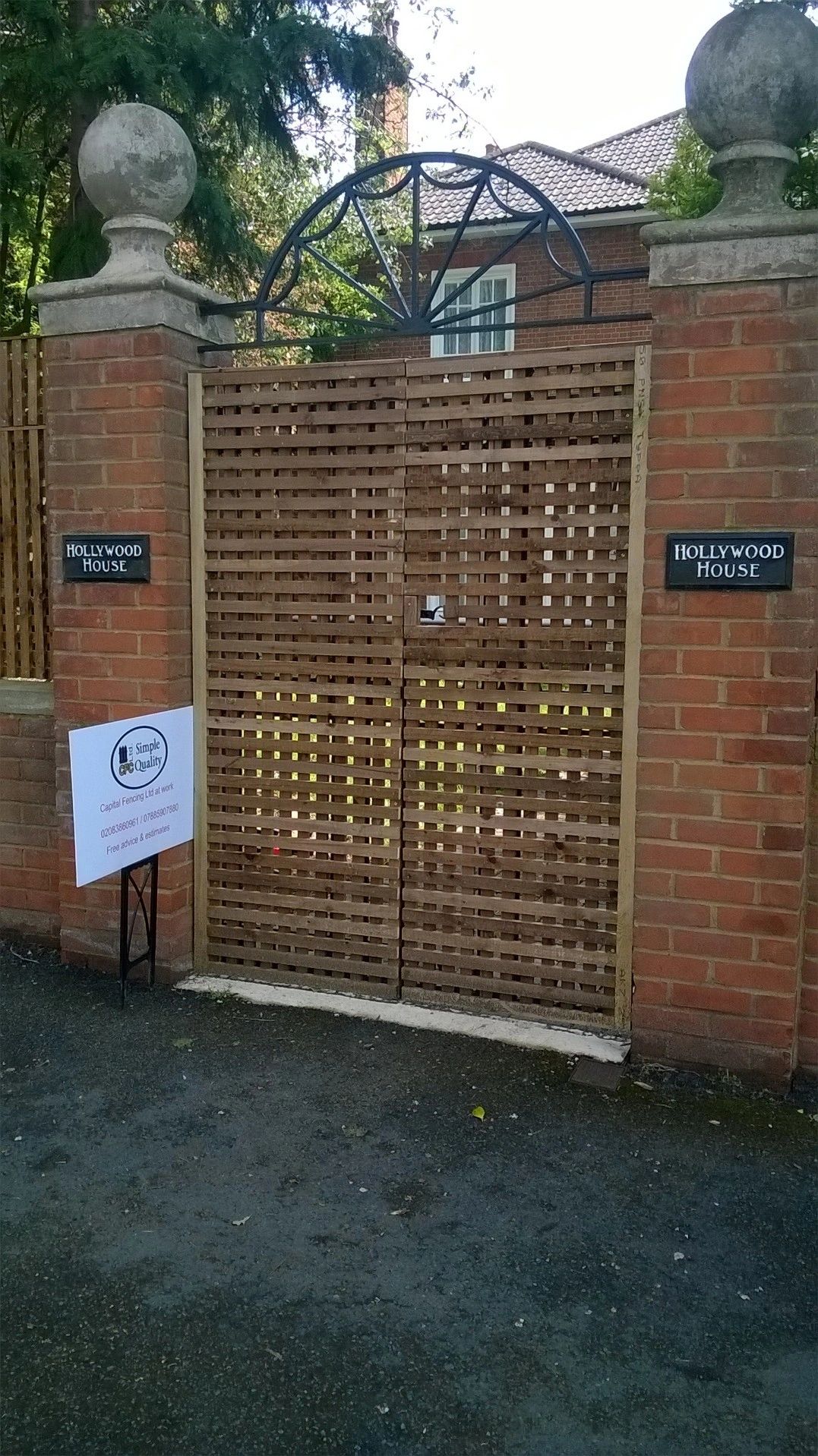
An arched top gate needs a curved top rail jointed into straight stiles, and that curved rail is usually built up from several shaped sections rather than cut from a single curved timber, since a single piece cut across the grain to follow the curve would be structurally weak.
Repairs to a cracked arched rail need to identify which built-up section has failed rather than treating the whole curve as one component.
Signage and lawful notices on a security boundary
Signage warning of CCTV, guard dogs or electric fencing has to be truthful and visible from the approach it's warning about — a sign for a feature that doesn't exist, or one hidden from view, offers no legal protection and can mislead.
Where a boundary carries a genuine hazard such as an electrified topping, specific warning signage at defined intervals is generally a legal requirement, not an optional extra.
Checking fall along the base of a fence line for drainage
Where a fence runs along the low side of a garden or parallel to a slight natural fall, water can collect and run along the fence line itself rather than away from it, sitting against gravel boards and post bases for longer than on flatter ground.
A shallow channel or a slightly raised base at the lowest points along the run helps water continue past rather than pool against the timber.
This is worth checking during a wet spell before finalising post positions, since a dry-weather site visit can miss a drainage pattern that only shows up after sustained rain.
Douglas fir for structural fencing timber
Douglas fir is a stronger, stiffer softwood than typical whitewood or redwood, with a pronounced grain pattern and moderate natural durability in its heartwood, making it a common choice for structural posts and gate framing rather than boarding.
Its resin content is generally lower than pine, which reduces the risk of resin bleed showing through a painted or stained finish.
Because of its strength-to-weight ratio it's often specified for longer unsupported spans, such as wide gate frames, where a lighter section still needs to resist twisting under its own weight.
Matching stain colour on a repaired section against a faded run
A freshly stained repair section will look noticeably darker or more saturated than the rest of a run that's faded over several seasons of UV exposure, even using the exact same product and shade.
Some clients prefer to accept this and let the new section weather in naturally over a season, while others ask for the whole run to be recoated at the same time for a more even finish immediately after the repair.
Capping rail replacement
A capping rail along the top of a panel run sheds rainwater off the panel faces and its own fixings are exposed to the most weathering on the whole fence, so it often needs replacing before the panels beneath show any damage.
Refitting capping with a slight overhang and a drip groove reduces water tracking back onto the panel face compared with a flush-fitted replacement.
Boundaries against a watercourse and riparian basics
A property boundary running along a stream, brook or ditch usually carries riparian responsibilities regardless of who technically owns the fence, including keeping the watercourse clear of obstruction and not doing anything that would worsen flood risk downstream.
Fence posts set close to a watercourse bank should avoid undermining or destabilising the bank itself, and in many cases installing anything within a set distance of the top of the bank needs consent from the relevant flood or drainage authority.
Ground immediately alongside a watercourse is also more likely to be periodically saturated or subject to erosion, which should factor into post depth and material choice on that section.
Powered auger versus hand-digging post holes
A petrol or hydraulic auger speeds up digging significantly on open, obstruction-free ground, but is the wrong tool near known services, tree roots or previous hardstanding, where it can't tell the difference between soil and something it shouldn't hit.
Access also decides the method — an auger needs room to manoeuvre and, for larger machines, a route wide enough to bring it onto site, which isn't always available on a narrow rear plot.
Hand-digging costs more in labour time but gives far more control in tight, obstructed or sensitive ground, which is why most quotes specify the method appropriate to the actual site rather than assuming the fastest option by default.
Siberian larch as a fencing timber
Siberian larch grows slowly in a cold climate, which produces a dense, tight-grained timber with better natural durability than most fast-grown European softwoods, without needing pressure treatment in many applications.
It's noticeably harder to nail and screw without pre-drilling than typical treated pine, and a nail driven in at the wrong angle is more likely to split the board than sink cleanly.
Left unfinished it weathers to a silvery grey similar to cedar, though its higher density means it holds up somewhat better to knocks and general handling on site.
Combining a low concrete plinth wall with fencing above
A low block or concrete plinth wall under a fence panel raises the effective height, resists dig-under and impact better than a timber gravel board, and gives a clean, level starting line on sloped or uneven ground.
The plinth needs its own foundation independent of the fence posts above it, since settling of one shouldn't be allowed to drag the other out of line.
Brush application versus spray for treatment
Brush application works the treatment into the grain and end grain more thoroughly, which matters most at cut ends and joints where untreated timber is exposed and most vulnerable to moisture uptake.
Spray application covers a large run far faster and gives a more even surface finish on smooth-planed boards, but relies on good weather and overspray control, and can leave the coating sitting on the surface rather than penetrating as deeply.
A practical approach on a full boundary is spraying the open panel faces for speed and finish, then finishing post tops, end grain and capping joints by hand with a brush.
Drainage consents affecting boundary works
Altering ground levels, hardstanding or drainage patterns near a boundary can affect surface water flow onto a neighbour's land, and in some cases needs consent from the local authority or, for work near a watercourse, from the relevant drainage authority or the Environment Agency.
Diverting water so that it discharges onto next door's garden rather than soaking away on the original plot is a common and avoidable source of neighbour disputes, separate from any formal consent requirement.
Where boundary work is combined with a change in levels or new hard surfacing, it's worth checking whether the combined works trigger a drainage consent even if the fence itself wouldn't on its own.
Working safely on a tall or elevated fence repair
A repair on a taller run, or one set on a retaining wall or raised bank, sometimes needs a working platform or trestles rather than simply working from a stepladder against the fence itself.
Where a repair is above head height along its full length, planning safe access before starting reduces both the time on site and the risk of further damage to the fence being used as a support.
Diagnosing squeaks and creaks in gate hardware
A squeak or creak from a gate is almost always dry friction at a hinge pin, pivot or roller rather than a structural fault, and it's worth locating the exact source by working the gate slowly through its swing rather than assuming which hinge is responsible.
Cleaning out old, dirt-laden grease before applying fresh lubricant gives a longer-lasting fix than simply oiling over grit that's already worked into the bearing surface.
Clay ground heave affecting gate posts
Clay soil expands when wet and shrinks when dry, and a gate post set into clay without sufficient depth or a suitable concrete base can be pushed out of plumb by this seasonal heave even where the post and gate themselves are in good condition.
A post moving on clay typically shows as a gradual seasonal cycle of binding and freeing up, rather than the sudden failure associated with a rotted or snapped post.
Slat gap ratios in screening fences
Horizontal slatted or louvre fencing is usually specified by a gap-to-board ratio, such as a 20mm gap between 100mm boards, which balances privacy against wind resistance.
A tighter ratio gives more privacy and blocks more wind, which in turn increases the load transferred to posts and foundations during storms, so a very solid-looking slatted screen needs the same foundation attention as a close-boarded panel.
Wider gaps let more wind through and reduce that structural load, while still breaking sightlines enough for most privacy purposes, which is why many slatted designs favour a wider gap than the boards suggest at first glance.
Noise from works and considerate constructor practice
Percussive work like post-driving, cutting concrete gravel boards or using a breaker on old foundations generates noise that can exceed what's reasonable outside the agreed working hours, even where the overall job is short.
A simple courtesy notice to immediate neighbours ahead of noisy days, giving a rough time window, reduces the chance of a complaint escalating to environmental health, which has statutory powers to serve an abatement notice on persistent nuisance noise.
Sequencing the noisiest tasks earlier in the working day and away from very early morning or evening, even within the permitted hours, is standard considerate practice on jobs close to occupied houses.