Working on a gate with restricted access
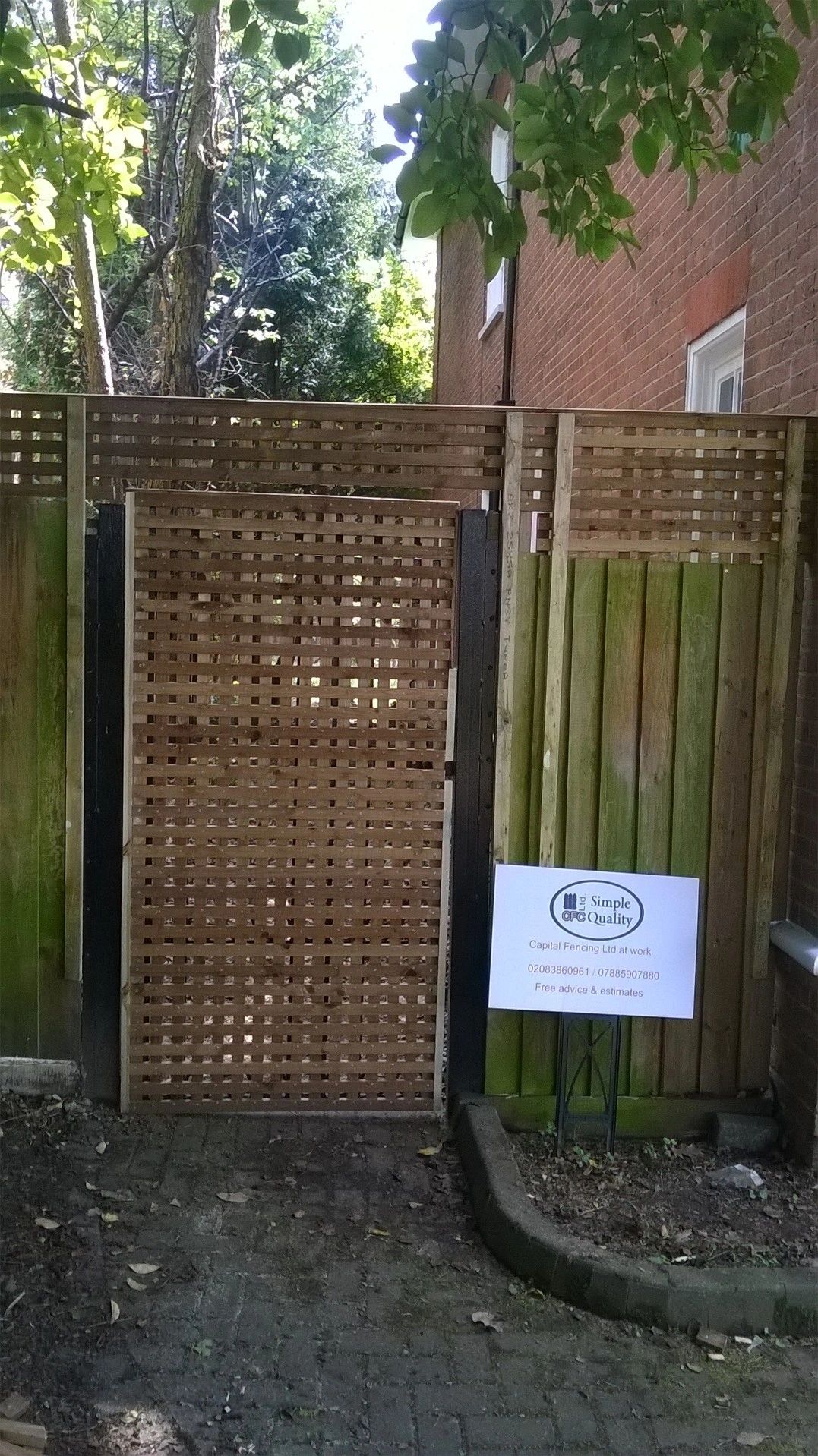
A side gate in a narrow return often has to be worked on from one side only, which changes how a hinge repair or frame rebuild is approached compared with a driveway gate that can be accessed from both sides.
We plan tool and material access before starting so a repair in a tight space doesn't take longer than it needs to.
Wet rot versus dry rot fungi in fence timber
Wet rot fungi need sustained high moisture content to establish and spread, and are the more common cause of decay in buried or ground-contact fence posts that stay consistently damp.
Dry rot, despite the name, also needs moisture to establish initially but can then spread through drier surrounding material via root-like strands, making it more of a concern in enclosed, poorly ventilated timber structures than open-air fencing.
In practice, most fence post decay encountered on typical garden and boundary fencing is wet rot rather than dry rot, given the open, ventilated conditions most fencing timber sits in.
Out-of-hours security considerations for a GP surgery boundary
A GP surgery boundary needs to accommodate a high daytime footfall of patients and visitors alongside stronger overnight security around bin stores, plant rooms and any area holding clinical waste, which often means combining an open, welcoming frontage with a more solid, higher-security rear compound.
Access for ambulance and emergency vehicles is checked against gate width and turning space before a security gate is specified, since a locked or narrow rear gate can delay emergency access if not planned around actual vehicle routes.
Comparative shrinkage rates across species
Different timber species shrink by noticeably different amounts for the same change in moisture content, with some tropical hardwoods moving comparatively little and some softwoods, particularly in the tangential direction, moving considerably more.
This matters when mixing species within the same structure, such as a hardwood gate frame with softwood infill boards, since the two materials can move at different rates and open gaps or induce stress at their junctions.
Manufacturers' technical data sheets for structural and decorative timber usually list expected shrinkage percentages, which is the more reliable way to anticipate this than relying on general species reputation alone.
Boundaries against a railway embankment
A boundary running along a railway embankment is very often owned and maintained by the railway infrastructure operator rather than the adjoining householder, and any work close to the operator's land, including digging near its toe or crest, usually needs prior notice or permission.
Embankment ground can also be made up of variable historic fill rather than natural strata, since many were built up from spoil during original construction, which affects both digging and the stability assumptions for post bases near the base of the slope.
Access for materials and machinery along these boundaries is frequently restricted, so confirming land ownership and any operator consent needed is a necessary step before quoting the work.
Composite wood-polymer ratios
Wood-plastic composite fencing boards are made from a blend of wood fibre and polymer, and the ratio between the two materially affects the finished product's stiffness, weight and how closely it resembles real timber grain.
A higher wood-fibre content generally gives a more timber-like appearance and feel but can also make the board more absorbent and slightly more prone to swelling at cut edges than a polymer-dominant mix.
Composite boards from different manufacturers aren't interchangeable even when nominally similar in size, since differing ratios change how the board expands with temperature and how it should be fixed and spaced.
House numbering and signage fixed to gates
A house number, nameplate or intercom panel is sometimes fixed directly to a gate rather than a post or wall, and this needs planning into the gate's design so the fixing doesn't interfere with the frame's structural members or the gate's swing clearance.
Retrofitting signage to an existing gate should avoid fixing through a stile or rail in a way that weakens it, favouring surface-mounted brackets instead where possible.
Choosing post hole diameter for the post size
A hole cut too close to the post's own width leaves no room for concrete to fully surround it, which weakens the base and gives water a direct channel down alongside the timber rather than a solid seal.
A generally quoted rule is a hole roughly three times the post's width, so a 100mm post wants in the region of a 300mm diameter hole, adjusted upward on poor ground or for taller, more heavily loaded posts such as gate posts.
Oversized holes aren't free either — they use more concrete and take longer to backfill and haunch neatly, so the aim is the right diameter for the post and ground rather than simply digging as wide as convenient.
A spec checklist for comparing quotes
Two quotes at very different prices for what looks like the same fence often differ in the parts that aren't obvious from a headline description — post type and spacing, gravel board material, rail count, use class of treatment, and whether waste removal is included.
Worth confirming explicitly: post material and size, number of arris rails for the height quoted, gravel board type, treatment use class of ground-contact timber, fixing corrosion class, and whether post caps and capping rail are included as standard.
A written spec covering those points, rather than just a total price and a photo of a similar job, is the practical way to compare quotes on equal terms rather than discovering the difference once the fence is already up.
Adverse possession and long-standing boundary drift
Where a fence has sat in the same slightly-wrong position for many years without objection, the land enclosed on the wrong side can sometimes be claimed through adverse possession, though registered land now has a stricter process than the old twelve-year rule for unregistered land.
A successful claim generally needs factual possession (using the land as an owner would, such as fencing it in and maintaining it) plus an intention to possess, sustained over the qualifying period, and the registered owner gets a chance to object once an application is made.
Replacing an old fence exactly on its existing (rather than legally correct) line can inadvertently continue a possession claim, so where a genuine discrepancy is known it's worth raising it with the neighbour rather than quietly perpetuating it.
London Clay shrink-swell behaviour
London Clay is one of the most shrinkable soils in the country, expanding when saturated over winter and pulling away from anything set in it during a dry summer, sometimes opening a visible gap around a post base.
That cycle is what loosens posts that were adequately firm when first concreted in, rather than any fault in the original installation.
Depth and a granular key at the base do more to resist this movement long-term than simply increasing the volume of concrete around a shallow post.
Delivery access and material drop-off
Fencing materials are heavy and awkward rather than especially bulky individually, but a full job's worth of posts, panels and gravel boards still needs a genuine drop-off point close to the work area rather than a kerbside stack carried the full plot length.
On restricted streets, agreeing a specific delivery slot with the supplier avoids a lorry blocking a road during school run or peak hours, which is often the point neighbours complain about a job rather than the noise of the work itself.
Where a driveway can take a small vehicle, checking headroom and turning space in advance saves a delivery being refused on the day and materials having to be hand-carried instead.
Threading a fence run past a rainwater downpipe
A downpipe discharging near the boundary means the fence has to either step around it with a short jog in the line, or leave a gap in the panel run rather than fixing directly over the pipe and its gulley.
Fixing a post immediately behind a downpipe risks trapping water splashing off it against the post base, so a small offset gives both the pipe and the post room without altering the overall run length much.
Where the downpipe discharges to a gulley set into a path or patio, the gravel board also needs enough clearance to avoid sitting in standing water every time it rains.
Slamming post and gate stops
The slamming post on the latch side takes a repeated impact load every time the gate closes, and a stop fitted to it prevents the gate over-swinging past its closed position and straining the hinges on the return.
A missing or worn stop is a common, low-cost cause of a gate that gradually racks out of square from repeated over-travel.
Checking existing boundary alignment before a like-for-like rebuild
Rebuilding a fence on the line of an existing one assumes that existing line was accurate, which isn't always the case — old fences can have drifted from the true boundary over successive repairs and replacements.
A quick check against any available reference, such as a boundary marker, an adjoining wall, or a neighbour's fence that's known to be accurate, is worth doing before assuming the old line should simply be copied.
Where a discrepancy is found, it's a conversation for the client and neighbour to have before rebuilding, since quietly correcting or quietly perpetuating a boundary error both carry consequences beyond the fencing job itself.
Fencing around front-garden parking
Converting part of a front garden to off-street parking usually needs a dropped kerb from the highway authority, and any remaining boundary fencing needs to respect the same visibility and access rules as the parking itself.
A low wall or open railing at the front, rather than a solid fence, is common on parking conversions so the parked vehicle doesn't look boxed in and sightlines for reversing onto the road stay clear.
Permeable paving is often a planning condition on larger front-garden parking areas to manage surface water run-off, which can indirectly affect where a boundary fence's own drainage needs to go.
Sheeting plants and borders during fencing works
Established shrubs and borders close to a fence line are easily damaged by dropped tools, spoil heaps or simply being walked over repeatedly during a multi-day job, so temporary boards or breathable sheeting laid over beds reduces incidental damage.
Concrete dust and cement splash can scorch foliage if it settles on leaves and isn't rinsed off promptly, which is worth flagging before mixing starts next to a prized border.
Where a plant genuinely sits in the way of a post position, agreeing with the client in advance whether it's moved, worked around, or the post offset avoids an awkward decision made on the spot mid-dig.
Conservation area consent for boundary works
Conservation area status doesn't ban fence or wall replacement outright, but it does mean the council can ask for materials and detailing that match the street's traditional character, and demolition of an existing wall over a certain height can itself need consent.
Removing or lowering a historic brick boundary wall is the case most likely to need permission, since unlike a simple fence swap it counts as demolition of a structure that contributes to the area's appearance.
The safest route on any period property is a short pre-application check with the conservation officer, since 'like for like' replacement is treated differently to a change of material or height.
Orientation of expanded metal mesh in a security panel
Expanded metal mesh is formed by slitting and stretching a sheet of steel, leaving diamond-shaped apertures with a slightly raised strand pattern that gives it a rougher, harder-to-grip surface than a flat welded mesh.
The direction the diamonds run relative to the ground affects both appearance and rigidity, and panels are usually oriented with the long diamond axis vertical for a taller security screen to maximise stiffness against horizontal loading.
Culverted watercourses running beneath a boundary
Some older boundaries have a small watercourse culverted — enclosed in a pipe — beneath them, often unnoticed until groundworks reveal it or a drainage problem develops.
Ordinary watercourses, even culverted ones, can carry maintenance obligations and sometimes require consent from the local authority or Environment Agency before altering anything above or around them.
Where an old map or local knowledge suggests a watercourse might run beneath a boundary, checking with the council's land drainage team before digging is a sensible precaution.
Seasonal ground conditions affecting installation
Clay ground shrinks and cracks in a dry summer and swells again over winter, which can loosen a post fixed during one season and tightened again by movement in another — installation timing is factored into how deep and how set a post needs to be.
A frozen or waterlogged base isn't workable for concreting, so winter installations sometimes need a delayed pour or a temporary prop until ground conditions allow the footing to cure properly.
Being mindful of working hours and noise on a repair in a residential setting
Cutting timber, breaking out old concrete and driving fixings all generate noise that's more noticeable on a short repair visit in a quiet residential street than it might be on a larger, more expected construction project nearby.
Keeping to reasonable working hours and giving immediate neighbours brief notice ahead of a repair that involves breaking out concrete is a simple courtesy that avoids unnecessary complaints on an otherwise routine job.