Self-closing and self-latching gates near water
A gate giving access to a garden pool or a boundary near open water benefits from a self-closing and self-latching mechanism that doesn't rely on a person remembering to shut and lock it every time, since a single unlatched instance is enough for an incident.
Combining a self-closing spring with a latch mounted high enough to be out of easy reach of a small child adds a second layer of protection beyond the closing action alone.
Sizing a hinge post to the gate's actual weight
A hinge post needs to be sized to the specific gate it will carry, since a heavy solid timber or metal gate loads its post far more than a lightweight picket gate of the same height, and an undersized post will lean over time even if correctly concreted.
This sizing decision is best made before the post goes in, since upsizing a post after a lean has developed generally means digging it out and starting again.
Diagnosing stiffness that eases through the day
A gate that's noticeably stiffer first thing in the morning and frees up as the day goes on is often responding to overnight condensation or dew on the hinge pins and latch mechanism rather than a structural fault.
This pattern is worth distinguishing from a fault that's present all day regardless of temperature, since the two point to very different causes and fixes.
Questions to ask any fencing contractor
Worth asking directly: who owns the boundary being worked on, what happens if buried obstructions are found, and whether waste removal and disposal are included in the price rather than charged separately afterwards.
It's also reasonable to ask what post-setting method will be used for the specific ground conditions on site, since a contractor who hasn't looked at soil type before quoting depth and concrete volume is guessing rather than specifying.
Asking how a contractor handles a shared boundary with a neighbour who hasn't been consulted is a good test of whether they've thought through the ownership question at all, rather than just the fence itself.
Working carefully around artificial lawn during fencing installation
Artificial turf doesn't recover from scuffing, dropped tools or concrete splash the way real grass can regrow, so any damage to it during a fencing job is effectively permanent rather than something that fades over a season.
Digging post holes at the very edge of an artificial lawn needs particular care to avoid disturbing the turf's edge trim or the compacted base beneath it, since that base is engineered to stay firm and level rather than simply being soil.
Boards or sheeting laid over artificial turf during material handling protect it from scuffing in the same way they would a patio, and are worth using as standard rather than only when asked.
Sequencing a multi-bay repair
On a repair spanning several bays, work generally runs from the soundest end toward the most damaged, so the newly fixed sections provide a stable reference line for the rest of the work rather than starting from the worst-affected point.
Where a repair is linked to an insurance claim, documentation is completed at each stage rather than only at the end.
Matching materials for a repair within a conservation area
A conservation area doesn't automatically restrict fence repairs, but where a specific material or style was originally required as a planning condition, a repair should match that condition rather than defaulting to a cheaper or more convenient modern alternative.
Checking any existing planning history for the property before sourcing repair materials avoids fitting something compliant with general fencing rules but not with a condition specific to that site.
Parking and material handling on site
Fencing, gates and decking all involve moving bulky, heavy material — concrete posts, gravel boards, decking joists — from a van to the working area, and how far that has to be carried has a real effect on labour time.
On streets with permit parking, no off-street loading bay, or restricted delivery hours, we plan the drop-off around those restrictions rather than assuming a van can sit outside all day.
Where a plot has a driveway or side gate wide enough for a barrow run, that alone can shave a meaningful amount of time off a job compared with hand-carrying everything round the front.
Balustrades and handrails on raised decking
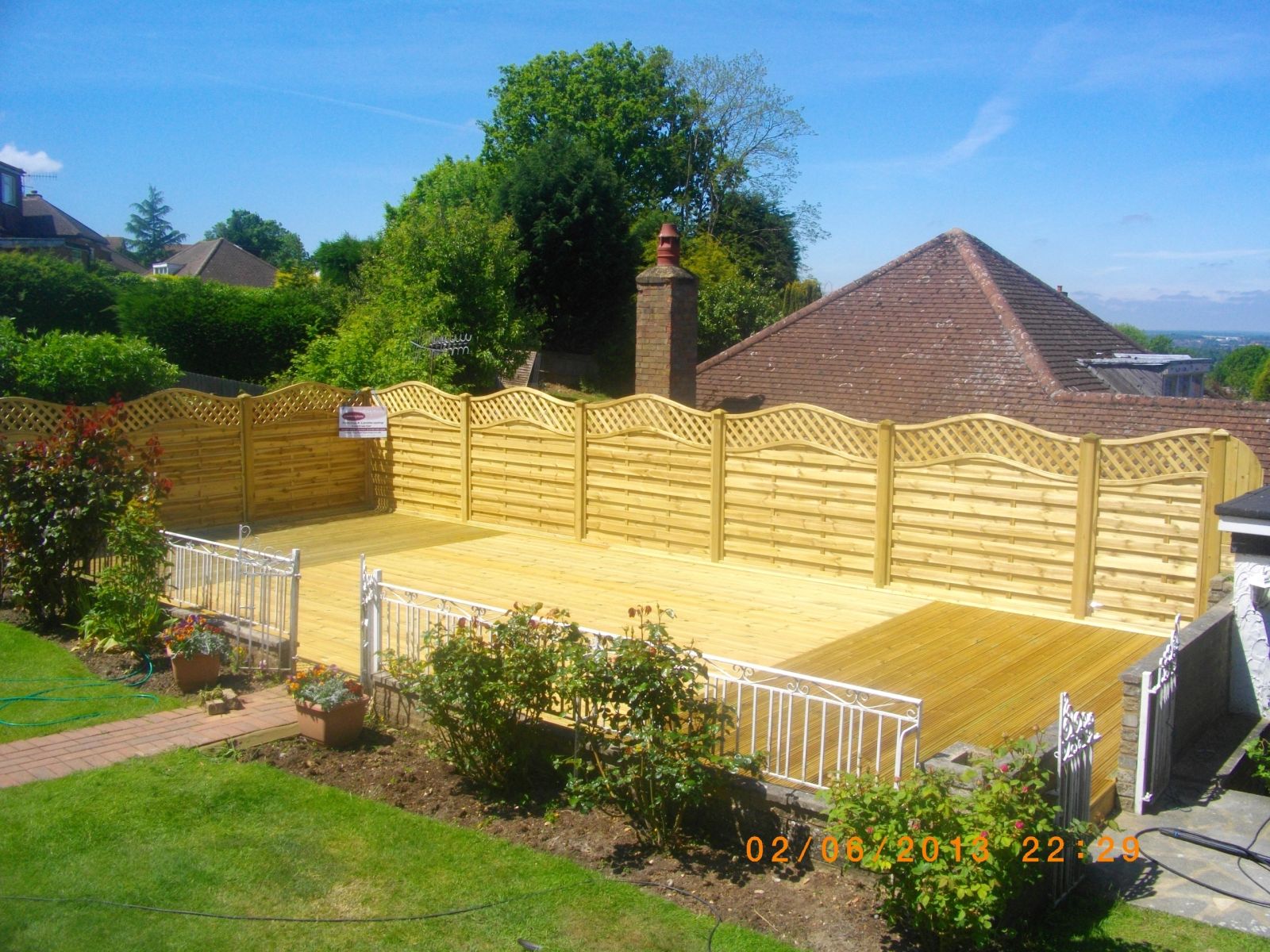
Decking raised more than around 600mm above the ground typically needs a balustrade under Building Regulations Part K, with baluster gaps narrow enough that a 100mm sphere can't pass through, to stop a child slipping between rails.
Handrail height and the strength of the newel post fixings both matter more on a raised structure than a ground-level deck, since the loads involved in someone leaning on a rail are higher than most people assume.
Steps down from a raised deck need their own handrail treatment where the rise is significant, and non-slip tread nosing is worth specifying for anywhere used year-round.
Scrap value theft targeting fence fittings
Cast aluminium or brass post caps and decorative finials have occasionally been targeted for scrap value on isolated boundaries, in the same way capping rails have, so lower-value steel or composite alternatives are sometimes specified deliberately on an exposed run for that reason alone.
Where a decorative metal fitting is wanted for appearance, fixing it with concealed or one-way screws reduces how quickly it can be removed compared with an exposed standard fixing.
Checking mesh tension across seasonal temperature changes
Steel mesh infill expands and contracts slightly with temperature across the year, and a mesh tensioned tight in cold winter conditions can develop a visible sag by the height of summer if the original tensioning didn't allow for that movement.
A seasonal tension check, particularly after the first full year following installation, catches this early and allows a simple re-tensioning before a sagging mesh starts to create a usable foothold or gap at the base.
Limits of assessing a repair from photos alone before a site visit
A photo can show an obviously snapped post or a collapsed panel clearly enough to plan materials in advance, but it rarely shows ground conditions, the state of neighbouring posts, or hidden rot just below soil level that only a physical probe test reveals.
Treating a photo assessment as a starting point rather than a final scope avoids arriving on site to find the repair is larger, or smaller, than the photos suggested.
Sound versus security trade-offs in fence design
A solid acoustic-style fence blocks noise well but also blocks the sightline that lets you see who's approaching the boundary, whereas an open mesh or railing gives good visibility but no noise reduction at all.
Where both matter, a part-solid, part-open design — solid to head height with an open topping, for instance — is a workable compromise rather than defaulting fully to one or the other.
Composite thermal expansion
Wood-plastic composite boards expand and contract with temperature considerably more than solid timber, since the polymer content responds more to heat than wood fibre does on its own.
Manufacturers specify a mandatory expansion gap at both board ends and between boards laid end to end, and skipping that gap during installation is one of the most common causes of composite decking or fencing buckling in hot weather.
Dark-coloured composite absorbs more solar heat than lighter shades and expands correspondingly more, so the expansion allowance recommended for a dark board is often greater than for a pale one of the same profile.
Gravel board rot and replacement
The gravel board takes the most ground contact and splashback of any timber component on the fence, so it's usually the first piece to need replacing regardless of how sound the panels or posts above it are.
Swapping a rotten timber gravel board for a concrete one at repair time removes that recurring failure point without needing to touch the panel above it.
Rotating spike toppings as a climb deterrent
A rotating spike topping uses a free-spinning tube studded with blunt spikes along the top of a wall or fence, so that a hand or foot pressing down on it spins rather than gripping, which defeats a climbing attempt without the injury risk of a fixed razor product.
It's most often fitted to a boundary wall in a residential or light-commercial setting where a coil topping would look too industrial, and it needs periodic checking that the rotating mechanism hasn't seized with paint overspray or corrosion.
Post spacing on a run that doesn't divide evenly
Standard panels are usually 1.83m (6ft) wide, but very few boundary runs measure out as an exact multiple of that, so the layout has to absorb the remainder somewhere rather than pretend it isn't there.
The common approach is to split the shortfall across the two end bays so both are cut slightly narrower and roughly matched, rather than leaving one full-width bay and one very narrow offcut at a single end.
Where a fixed feature — a gate opening, a manhole, an existing post that must stay — sits partway along the run, setting out works outward from that fixed point in both directions rather than from one end only.
Removing an old panel without damaging sound posts
Panels are usually fixed to posts with clips, brackets or nails through the frame, and levering a panel out with a bar without first locating and releasing those fixings risks splitting a post that would otherwise have been reusable.
Cutting through corroded nails with a reciprocating saw, rather than forcing the panel free, is often quicker and safer for the post than sustained levering.
Where only one panel in a run has failed, working carefully to free just that panel's fixings keeps the neighbouring panels and their posts undisturbed rather than loosening more of the run than necessary.
Fixing new fencing to existing walls and piers
Bolting a new fence panel or post bracket to an existing wall or brick pier depends on the wall's own condition — a soft or unstable pier can't safely take the lateral load a fence puts on a fixing point.
Where a wall is sound, resin-fixed bolts into brick or masonry give a secure end point without a new post footing; where it isn't, a freestanding post just inside the wall line is the safer option.
Repairing a post snapped clean at the ground line
A post that's sheared off flush at the ground line has usually lost most of its strength to rot just below the surface before the final break, which is often triggered by wind load or someone leaning a ladder against the panel.
The stub left in the ground is dug out or broken free of the old concrete rather than built around, since leaving it in place gives the new post nothing solid to bear against and the repair fails again within a season.
Guide wheel and channel wear on sliding gates
A sliding gate runs along a bottom track or overhead guide rather than swinging on hinges, and wear in these components shows up as the gate binding, jumping the track, or leaning as it travels rather than dropping at a hinge corner.
Debris in the track is one of the most common causes of a sliding gate sticking, and clearing it is worth checking before assuming a wheel or motor fault.
When a Party Wall Act notice might apply
The Party Wall etc. Act 1996 mainly concerns shared walls between buildings and excavations near a neighbour's structure, and doesn't generally apply to an ordinary timber garden fence.
It can become relevant where work involves a masonry party fence wall genuinely astride the boundary, or excavation for posts close enough to a neighbour's foundations to fall within the Act's distance rules.
Where there's doubt about whether notice is needed, a party wall surveyor or solicitor can confirm this far more reliably than guessing on site.