Fencing a retail service yard
A retail service yard behind a shop or unit typically holds delivery access, waste storage and sometimes gas or refrigeration plant, so its fencing needs to allow regular vehicle and trolley movement while still closing off the yard from the public shopping area.
A sliding gate is often preferred here over a swing gate because it doesn't intrude into a tight yard footprint shared with delivery vehicles manoeuvring at close quarters.
Rotating spike toppings as a climb deterrent
A rotating spike topping uses a free-spinning tube studded with blunt spikes along the top of a wall or fence, so that a hand or foot pressing down on it spins rather than gripping, which defeats a climbing attempt without the injury risk of a fixed razor product.
It's most often fitted to a boundary wall in a residential or light-commercial setting where a coil topping would look too industrial, and it needs periodic checking that the rotating mechanism hasn't seized with paint overspray or corrosion.
Boundaries against a watercourse and riparian basics
A property boundary running along a stream, brook or ditch usually carries riparian responsibilities regardless of who technically owns the fence, including keeping the watercourse clear of obstruction and not doing anything that would worsen flood risk downstream.
Fence posts set close to a watercourse bank should avoid undermining or destabilising the bank itself, and in many cases installing anything within a set distance of the top of the bank needs consent from the relevant flood or drainage authority.
Ground immediately alongside a watercourse is also more likely to be periodically saturated or subject to erosion, which should factor into post depth and material choice on that section.
Touching up galvanising after on-site cutting
Cutting a galvanised post or rail to length on site removes the zinc coating from the cut edge, leaving bare steel exposed exactly where water is most likely to sit if the cut faces upward.
A cold galvanising paint or zinc-rich primer applied to the cut edge immediately after cutting restores meaningful protection, and skipping this step on a security run is a common reason a fence corrodes first at bay joints rather than along the main rail length.
Ironmongery grades for gates
Gate hinges, latches and drop bolts are graded broadly by size and load rating rather than sold as one universal fitting, and undersized ironmongery on a heavy hardwood gate is a common cause of early sagging even when the frame itself is well built.
Externally, ironmongery needs a corrosion-resistant finish suited to constant weather exposure — galvanised, stainless or a specifically outdoor-rated coated finish — rather than internal-grade fittings that will rust and seize within a season or two.
A self-closing hinge or a matching pair of hinges rated for the gate's actual weight is worth specifying explicitly on a quote, since 'a pair of hinges' without a load rating leaves the actual spec to whatever's in stock.
Raised beds built directly against a fence
A raised planting bed built with its back edge against a fence line keeps damp soil and mulch in permanent contact with the lowest boards or gravel board, which accelerates rot at exactly the point most vulnerable to moisture.
Lining the inside face of the bed against the fence with a damp-proof membrane, rather than backfilling soil directly onto the timber, reduces this contact without changing the visible design.
This detail is easy to miss at the planning stage since the bed and the fence are often specified and built by different trades without either flagging the interaction.
Fixed versus crimped capping rail junctions
A capping rail bolted or screwed to the top of a panel run gives a fixing point that can be removed for maintenance but is also the fixing most often targeted for theft or vandalism where the rail carries scrap value.
A crimped or one-way rivet fixing is harder to remove without specialist tools, trading off easy future maintenance access against a meaningfully harder target for casual interference with the capping line.
Digging a post hole beside a mature root plate
Close to a mature tree, the first spade or auger pass often meets structural roots rather than clear soil, and cutting a root over roughly 25mm diameter can affect the tree's stability as well as its health.
Hand-digging with a spade and fork lets roots be worked around and exposed gradually, which an auger or mechanical borer can't do since it cuts through whatever's in its path without warning.
Where a root genuinely blocks the only sensible post position, moving the post sideways along the line by a short distance is almost always preferable to severing a major root to keep to the original spacing.
Storm damage to a boundary fence and insurance
Standard buildings insurance policies frequently exclude fences from cover for storm damage, or cover them only up to a modest specified limit, which surprises many homeowners after a bad storm.
Where a fence is shared or ownership is unclear, storm damage can also raise the question of whose policy, if either, is expected to respond.
Checking a policy's specific wording on fences and gates before relying on it for storm repair avoids finding out about exclusions only after a claim is made.
Temporary propping and making safe
Where a full repair can't happen immediately, a leaning panel or post can be temporarily propped or strapped to stop it falling further, which reduces risk without committing to the final repair method on the spot.
Temporary propping is treated as exactly that — a stopgap — since a prop left in place over a wet season can itself start to sink or shift in soft ground.
Off-street parking and dropped kerbs
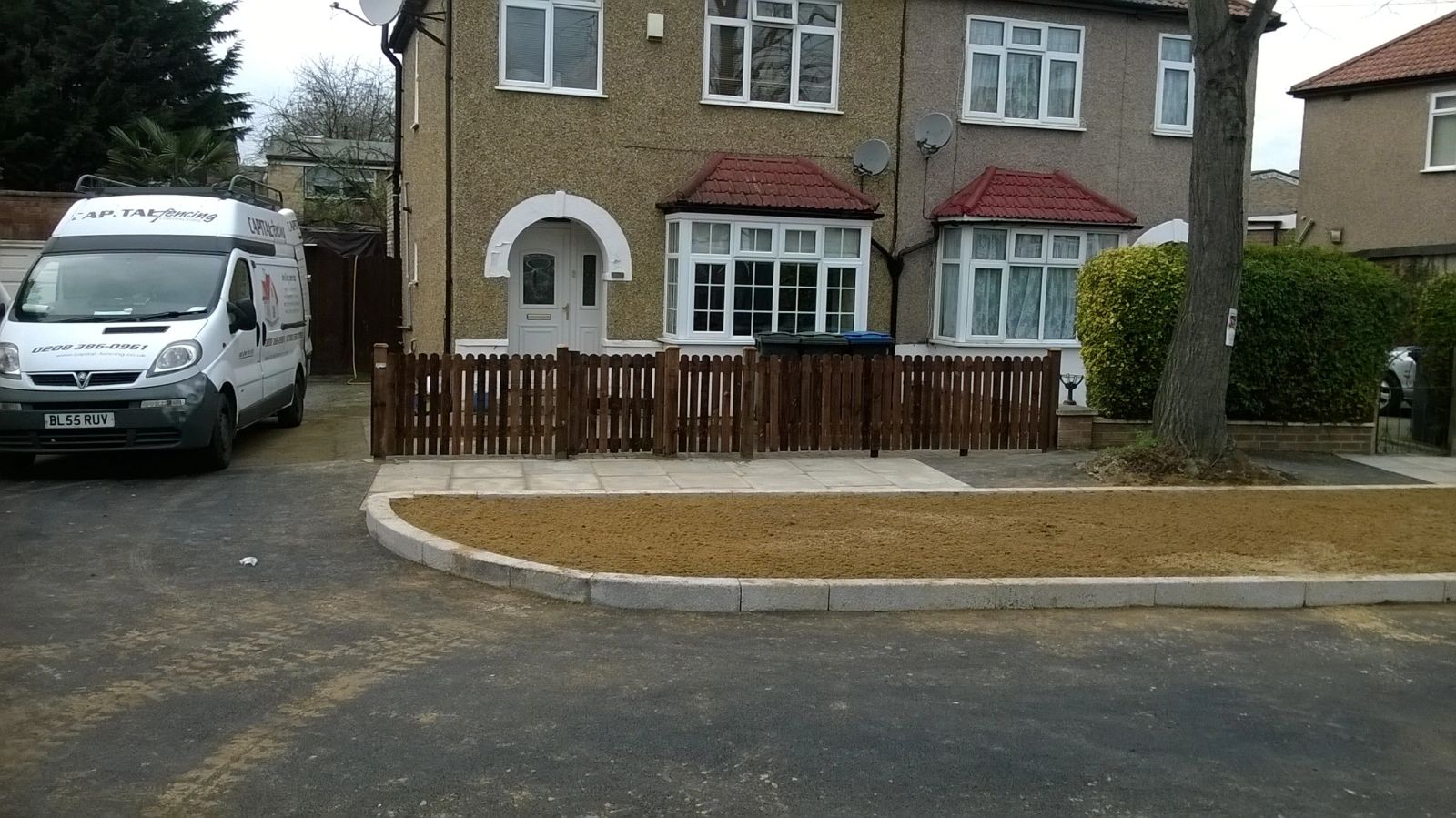
Converting a front garden to off-street parking usually requires a dropped kerb permit from the highway authority, and a boundary fence or gate across that new access has to be positioned clear of the visibility splay the dropped kerb creates.
Where a low front boundary already exists specifically to preserve sightlines onto the new parking, replacing it with a taller or solid fence can undo the safety benefit the dropped kerb approval was granted on.
It's worth checking whether the dropped kerb approval included any conditions on boundary treatment before ordering a new front fence or gate.
Nursery outdoor play area boundary detailing
An outdoor play boundary at a nursery needs a barrier young children genuinely can't climb or squeeze through, which usually rules out wide-aperture mesh and low horizontal rails in favour of vertical bar infill or tight-weave mesh with no climbable rung.
Gate latches are set at adult height and out of a small child's reach, and self-closing hardware is specified with enough force to shut the gate reliably without slamming hard enough to catch fingers.
Lap panels versus closeboard durability
Overlap (lap) panels are factory-assembled from thin horizontal slats stapled to a light timber frame, which makes them cheap and quick to fit but noticeably shorter-lived than boarded fencing.
The thin slats and lightweight frame flex in wind and the staples pull through over a handful of seasons, especially on an exposed run, whereas closeboard's thicker feather-edge boards and nailed arris rails tolerate the same movement without failing.
Lap panels suit a budget-driven job with modest exposure; anywhere wind-loaded or expected to last well past a decade is better specified as closeboard from the outset.
Noise from works and considerate constructor practice
Percussive work like post-driving, cutting concrete gravel boards or using a breaker on old foundations generates noise that can exceed what's reasonable outside the agreed working hours, even where the overall job is short.
A simple courtesy notice to immediate neighbours ahead of noisy days, giving a rough time window, reduces the chance of a complaint escalating to environmental health, which has statutory powers to serve an abatement notice on persistent nuisance noise.
Sequencing the noisiest tasks earlier in the working day and away from very early morning or evening, even within the permitted hours, is standard considerate practice on jobs close to occupied houses.
Japanese knotweed and invasive plants on a boundary
Japanese knotweed and other invasive non-native plants listed under the Wildlife and Countryside Act don't have to be removed by law, but it's an offence to allow them to spread into the wild or onto neighbouring land, and their green waste can't simply go into a normal garden waste bin.
Knotweed growing along or across a boundary is a common source of dispute and even litigation between neighbours, since an untreated infestation on one side can spread roots several metres and undermine fence posts or hard surfaces.
Any excavation near known knotweed needs specialist handling and disposal at a licensed site, since disturbing the rhizome without proper containment is one of the most effective ways to spread it further.
Headroom and ground clearance on a rising site
A gate hung across ground that rises from one side to the other needs enough clearance built into its swing to clear the highest point of that rise without the bottom rail dragging as it opens.
We measure ground level across the full arc of swing, not just at the gate posts, before setting hinge height on a sloping or uneven site.
Composite versus timber
Composite decking and fencing boards trade a higher upfront cost for lower ongoing maintenance — no annual staining or oiling, and better resistance to rot in permanently damp or shaded spots where timber struggles.
The trade-off is that composite doesn't weather the way timber does; it stays close to its original colour rather than silvering or taking on the character some clients want, and off-cuts and end sections need cutting and capping carefully to stop moisture getting into the core.
For a boundary fence that's mostly out of sight, timber with a reapplied treatment every few years is often the more economical long-term choice; for a heavily-used deck, composite's lower maintenance burden usually wins out.
Aligning mortices for arris rails between posts
Concrete posts with pre-formed mortice slots fix the height of each arris rail at manufacture, so the posts themselves have to be set at consistent heights and spacing for the rails to run in level without twisting.
Timber posts morticed on site give more flexibility to adjust rail height locally, but the mortice needs cutting square and to a consistent depth so the rail seats fully rather than sitting proud and under strain.
A rail forced into a mortice that's slightly too shallow or misaligned puts ongoing stress on the joint, which is a common cause of a joint splitting within the first year even though the timber itself is sound.
Being mindful of working hours and noise on a repair in a residential setting
Cutting timber, breaking out old concrete and driving fixings all generate noise that's more noticeable on a short repair visit in a quiet residential street than it might be on a larger, more expected construction project nearby.
Keeping to reasonable working hours and giving immediate neighbours brief notice ahead of a repair that involves breaking out concrete is a simple courtesy that avoids unnecessary complaints on an otherwise routine job.
Tuning an adjustable bolt-on hinge
An adjustable hinge allows small changes to a gate's height and lean after fitting via a cam or slotted fixing, without unbolting the hinge from the post, which is useful for correcting seasonal timber movement without a full repair visit.
These adjustments have a limited range, though, and a gate that's moved beyond what the hinge can correct needs the underlying cause addressed rather than the hinge wound to its limit.
Pergola and screen timbers
Pergola posts generally need a larger section than a fence post of the same height, since they carry a horizontal beam and roof structure rather than just resisting wind on a flat panel, and undersized posts show up as noticeable sway at the top rather than immediate failure.
Softwood pergolas are almost always pressure-treated given the exposure, while a hardwood pergola can be left to weather untreated in the same way an oak gate can, at a higher initial material cost.
Screening timbers fixed to or beside a pergola structure follow the same gap and profile logic as free-standing slatted fencing, so the same trade-offs between privacy, light and wind loading apply.
Tree Preservation Orders and a post line
A Tree Preservation Order protects specified trees from work that would damage them, and that protection extends below ground to root systems, not just the visible trunk and canopy.
Digging post holes within a protected tree's root protection area can count as damage even without touching the trunk, so it's worth checking the local TPO register before finalising a post line near a mature tree.
Where a TPO applies, the local authority can require an application before any groundworks proceed, and unauthorised damage carries meaningful penalties.