How a security survey is carried out
A security survey walks the whole perimeter, not just the section that prompted the enquiry — low runs, blind corners and gate junctions elsewhere on the boundary are usually the actual weak point, even when the call came in about one obviously damaged section.
We note sightlines from the street and from within the property, because a fence that blocks a view outward can work against security as easily as a low fence works against it from the other side.
Ironmongery corrosion and galvanising
Hinges, latches and bolts left in an ungalvanised or poorly coated finish corrode faster than the timber they're fixed to, particularly on a gate exposed to rain and wind on all sides, and a corroded hinge pin can seize or shear well before the frame itself fails.
Specifying hot-dip galvanised or stainless ironmongery at repair time is usually a small extra cost against a considerably longer service life.
Tamper-proof fixings and shear-nut bolts
Standard hex-head bolts can be undone with a spanner from outside a compound, so security runs use shear-nut or one-way bolts that snap the head off once torqued, leaving nothing for a tool to grip.
These are fitted at pale-to-rail junctions and on any panel that could otherwise be unbolted from outside the line, and they cost little more than standard fixings for a meaningful gain in tamper resistance.
Accessible gate access and reasonable adjustment
A security gate on a route used by the public or by staff and visitors needs to accommodate wheelchair users and people with limited grip strength, which affects latch height, opening force and whether a keypad or fob system is reachable from a seated position.
Retrofitting accessible hardware to an existing gate is usually straightforward, but it's cheaper and simpler to specify it correctly at the point of ordering than to identify the gap only after a complaint or an access audit.
Gate design on exposed, high-wind sites
A gate on an exposed hilltop or coastal-facing plot experiences far higher wind loading than an equivalent gate in a sheltered urban garden, and a solid-boarded gate in particular acts like a sail under those conditions, putting extra strain on hinges and latch.
Specifying heavier-duty hinges, a lower solid-to-open ratio in the infill, or additional bracing are all ways to address this on a site known to be exposed.
Pedestrian gate self-closing devices
A hydraulic or spring-loaded self-closing hinge brings a pedestrian gate back to a closed and latched position automatically, which is useful where a gate needs to stay shut for security or to keep a garden secure for children or pets.
These devices need occasional tension adjustment as they wear, and a gate that no longer closes fully is often a closer needing adjustment rather than a hinge fault.
Repairing an end post fixed against a house or garage wall
An end post bolted to masonry rather than set in its own footing fails differently — usually at the wall fixings rather than at ground level — and repair means checking whether the wall fixing itself has corroded or worked loose in the masonry.
Where the original fixing type has degraded, refitting with a heavier-duty or better-protected fixing is generally worth the small extra effort over simply replacing like-for-like into the same drilled holes.
Vertical picket infill on top of a mesh security panel
Adding a row of vertical steel pickets above a mesh panel gives extra height without the wind loading of a full-height solid mesh extension, and the picket spacing is kept tight enough that it doesn't create a new set of usable footholds.
This detail is common where a boundary needs to reach a taller overall height for a later phase of a site's security review without replacing the mesh panels already installed at the lower level.
Checking joist bearing sits level across uneven support pads
Deck support posts or pads set at even so-slightly different heights throw the whole joist run out of level, which shows on the finished deck as a barely perceptible but persistent lean across its width.
Checking each support with a long level laid across several posts at once, rather than checking each post in isolation, catches a gradual drift in height across the run that individual checks would miss.
Packing shims under a joist to correct a low support point is an acceptable fix for a small discrepancy, but it isn't a substitute for getting the support posts themselves right in the first place on a new build.
Choosing between razor wire and barbed tape toppings
Barbed tape has a flat steel strip with stamped barbed edges wound into a coil, giving a denser and more visually aggressive deterrent than traditional twisted barbed wire, which is now used less often on new commercial work.
Both carry a real injury risk and are generally reserved for boundaries without public pedestrian access, since a topping that could injure a passer-by on a footpath side raises liability concerns a lower-risk topping avoids.
Strainer posts and wire tensioning loads
A strainer, or straining post, anchors the end of a tensioned wire or mesh run and needs to resist a sustained pulling load along the line of the fence, which is a materially different stress to the mostly lateral wind load an intermediate post experiences.
Strainer posts are typically set deeper, in a larger concrete footing, or braced with a diagonal strut back to a second post, specifically to resist this sustained pull rather than an occasional gust.
Under-specifying a strainer post relative to the wire tension applied is a common cause of an entire fence run gradually leaning inward from one end, since the strainer post itself moves rather than the wire actually loosening.
Gas and water service positions near boundaries
Gas and water services typically run from the property boundary to the meter position in the shortest practical line, which on many plots means they cross close to or directly under a side boundary fence.
Utility companies can usually supply a service plan on request, though older properties sometimes have connections that predate accurate record-keeping and were never mapped precisely.
Where a plan shows a service crossing the fence line, hand-digging that section and setting the post either side of the marked route avoids the need to relocate a damaged supply.
Stumps in the fence line
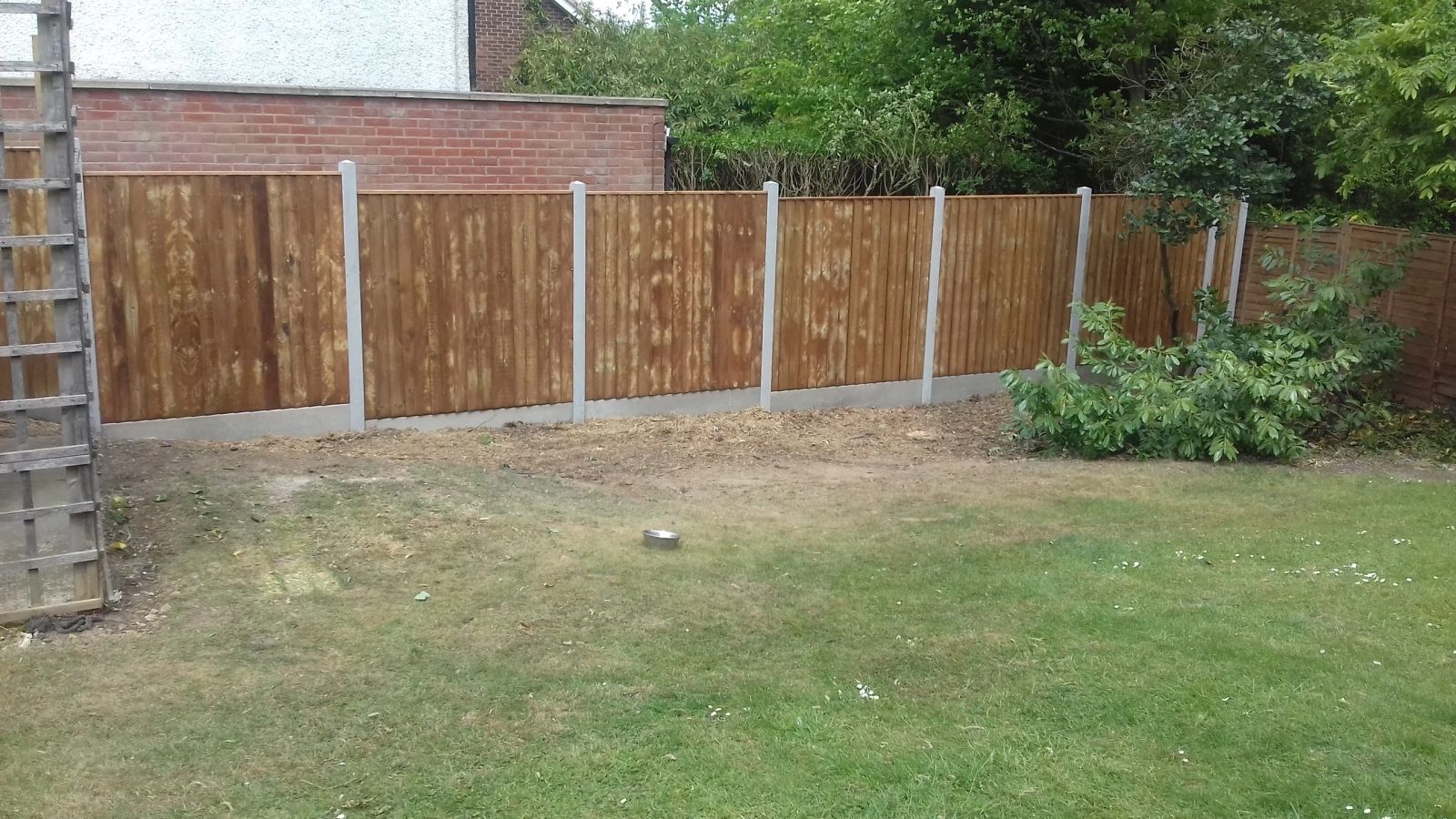
An old hedge or tree stump sitting directly on the new fence line needs grinding or digging out before a post can go in, since a post set against or on top of decaying root wood will eventually settle as that timber breaks down.
Stump grinding leaves a mix of wood chip and soil that compacts poorly, so backfilling a post hole in that material generally needs a wider excavation and imported hardcore rather than reusing the arisings.
Where a stump is close to but not on the line, it's often quicker to shift the post position slightly than to fully remove a large root system.
Aftercare guidance for the first season
Newly set posts need their first winter to fully settle, and a slight tightening of gate hinges or latch alignment after the first few months of seasonal movement is normal rather than a sign of poor work.
Untreated or lightly treated timber benefits from an owner-applied preservative or stain within the first year, particularly on end grain and cut edges exposed during installation, since factory treatment doesn't reach every surface once a panel's been cut to fit.
Clearing leaves and debris from the base of gravel boards each autumn, where they trap moisture against the timber, is a simple habit that measurably extends the life of a fence beyond what the initial installation alone determines.
Hardwood options for gates
Gates take more racking stress than a fixed fence panel, opening and closing on a single edge, which is why hardwoods such as oak or iroko are often specified for gates even where the adjoining fence is softwood.
Oak's natural durability means it can be left untreated and will weather to silver-grey, but it also moves seasonally and can stain surrounding masonry with tannin run-off in wet weather, which is worth flagging before it's fitted next to a pale render or paving.
Hardwood gate frames are usually built with mortice-and-tenon joints rather than the simple nailed or bracketed joints acceptable on a softwood panel, since the joint has to resist years of racking without loosening.
Capping rails and rail theft
Timber capping rails and metal top rails both protect the fence line beneath them from weather, but an unsecured metal capping on a low-value run has occasionally been targeted for scrap, which is worth factoring in on an isolated boundary.
Fixing capping with concealed or tamper-resistant screws rather than exposed standard screws reduces how easily a section can be lifted off without cutting into the maintenance schedule.
Boundary fencing for HMOs and multi-occupancy buildings
Houses in multiple occupation often have higher footfall through shared external areas than a single-family home, which points toward more durable gate hardware and fencing specified for frequent use rather than the lighter fittings suited to a quiet family garden.
Bin and cycle storage for several households sharing one plot needs more space and more robust screening than a single-household equivalent, and is worth planning at the same time as any boundary work.
Landlords managing several such properties often prefer a single consistent spec across their portfolio, both for cost predictability and so that future repairs use readily available standard parts.
Boundary work near underpinning or subsidence repairs
A property that's had underpinning or subsidence repair work sometimes has ground disturbance extending into the garden near the boundary, which can affect where a new fence line can safely be dug without disturbing settled ground.
Where underpinning is recent, it's worth checking with whoever carried out the structural work before digging post holes nearby, since the settlement process can continue for some time after the visible repair is finished.
Cracking in an existing boundary wall running close to a subsidence-affected building is sometimes an early symptom worth reporting rather than just repairing cosmetically.
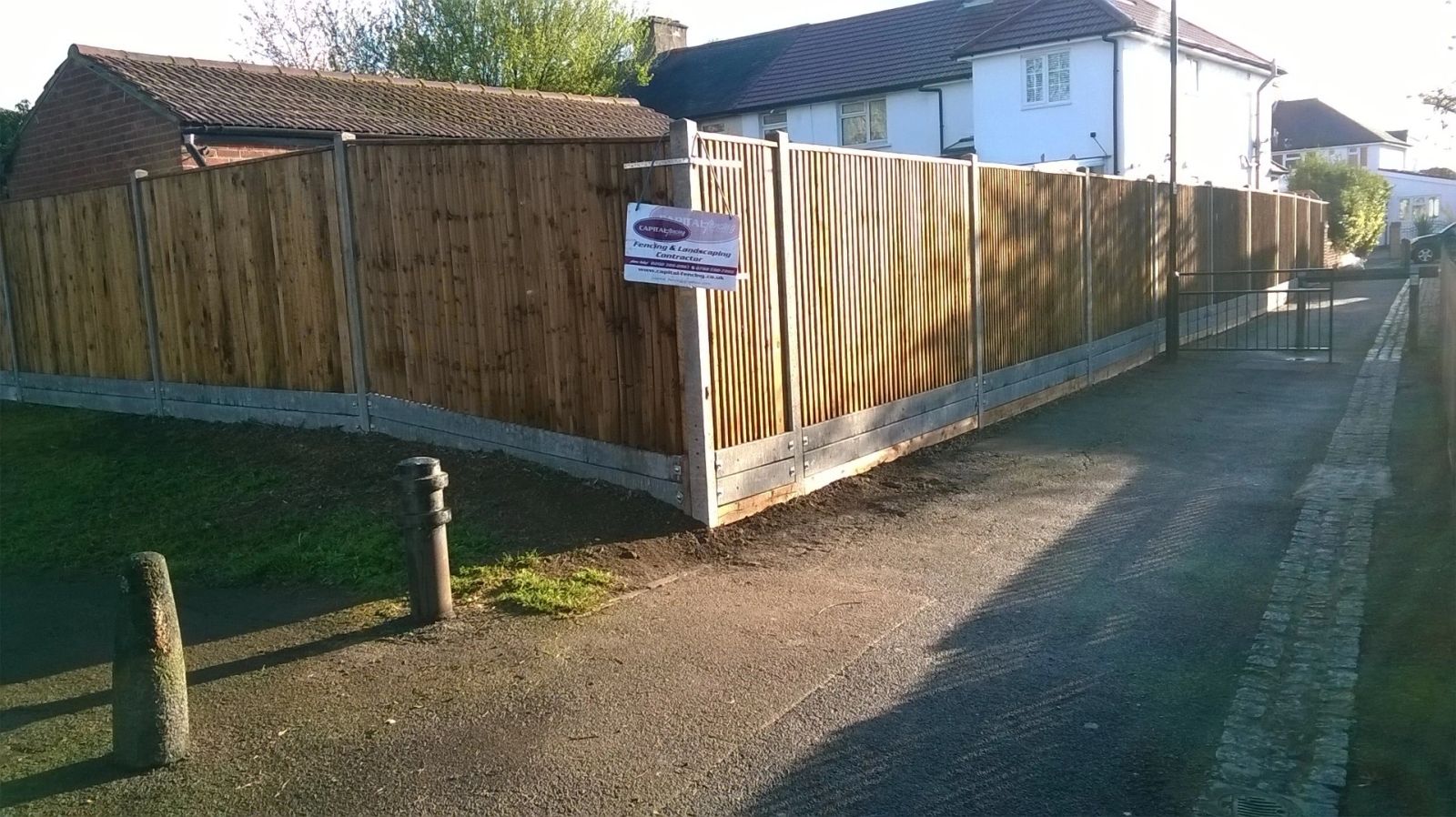
Fencing alongside a shared access driveway
A driveway shared by two or more properties usually carries a right of way that limits how close a new fence can come to the actual running surface, regardless of who legally owns the land beneath it.
Width needs checking against the widest vehicle that regularly uses the shared drive, not just a car, since delivery vans and refuse vehicles are a common reason an otherwise reasonable-looking fence line turns out too tight.
Gates across a shared driveway need agreement from all parties with a right of way over it, and usually a means of access — a code, a key, or simply leaving it unlocked — for everyone who needs to use the route.
Green belt and stock-proof boundaries
Plots backing onto green belt land, paddocks or working farmland often need a genuinely stock-proof boundary rather than a decorative garden fence, particularly where livestock graze the adjoining field.
Post-and-rail with stock netting, or a taller close-boarded run where privacy also matters, both do the job, but a standard panel fence with gaps at the base is routinely pushed through or under by sheep and larger dogs.
Any new boundary on green belt land should also be checked against local planning policy, since green belt designation adds another layer of restriction on top of the usual permitted development rules.
Sports clubs
Sports club boundaries need to withstand impact from balls and players far more than an ornamental garden fence, which usually means heavier-gauge mesh or rebound-rated panel rather than standard closeboard along pitch-facing runs.
Ball-stop netting on posts set back from the fence line is a common addition where a pitch runs close to a public path or road, and post spacing for that netting is tighter than for a standard fence line.
Clubhouse car parks and pitch perimeters are also often used for match-day parking, so access for fencing work needs scheduling around the fixture calendar rather than assumed to be free every weekend.
Dog-proofing details at ground level and gaps
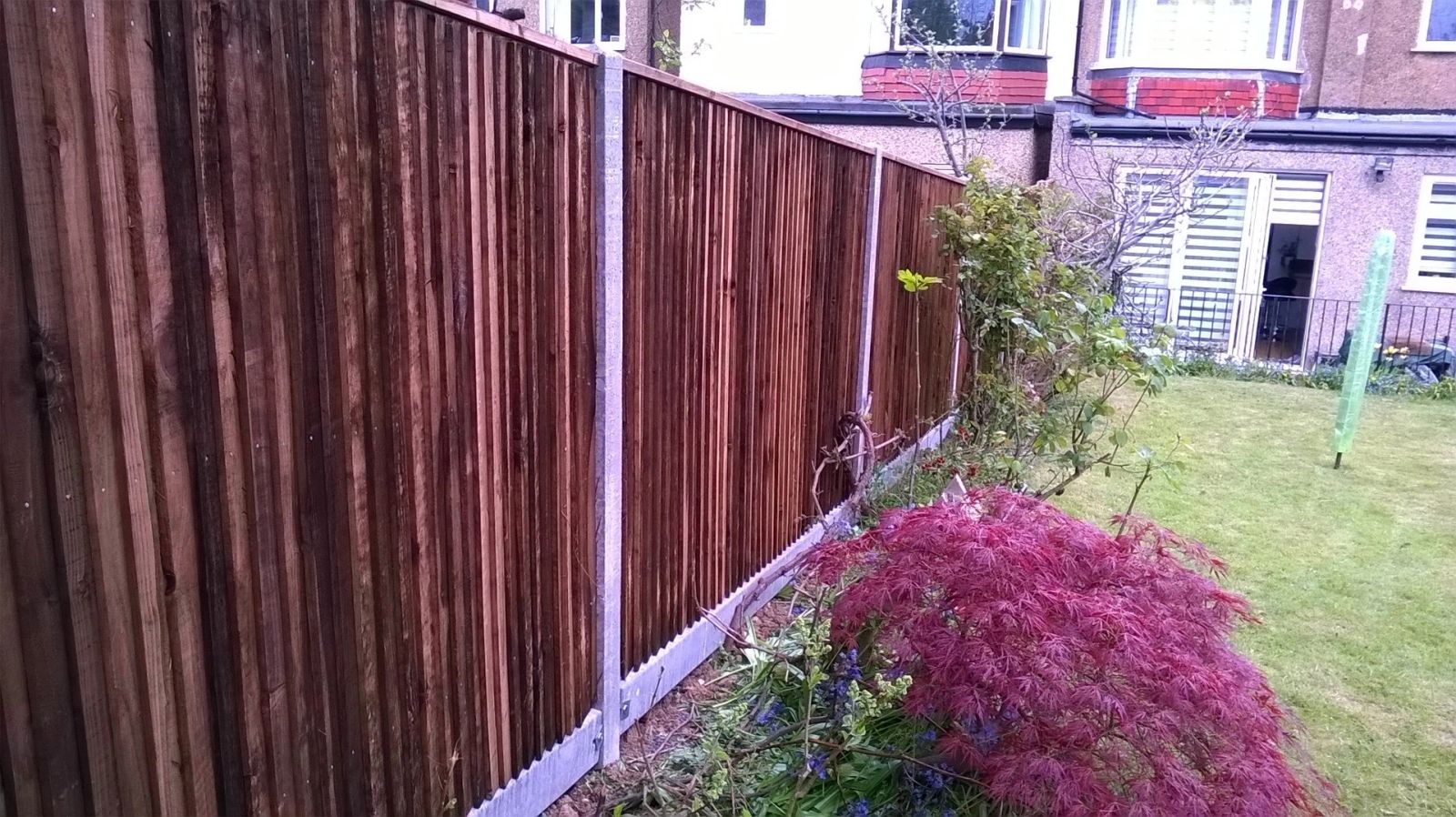
Dogs test a fence at ground level far more than at height, so gaps under gravel boards, worn hollows on sloping ground, or wide overlaps between adjacent panels are the points most likely to let a determined dog through or under.
A close-fitting concrete gravel board set with minimal gap to the ground, rather than a timber board that can warp and lift, closes off the most common escape route without changing the overall fence design.
For persistent diggers, a buried mesh apron or paving strip just inside the fence line at ground level stops excavation without needing to alter the visible fence at all.