Drainage fixes as part of a repair
Where poor drainage caused or contributed to the original failure, a repair that doesn't also address the drainage — regrading a low spot, adding a small soakaway, or fitting a concrete gravel board — risks the same failure recurring.
Addressing drainage at repair time is usually more cost-effective than repeating the same panel or post repair every few years.
Fencing around front-garden parking
Converting part of a front garden to off-street parking usually needs a dropped kerb from the highway authority, and any remaining boundary fencing needs to respect the same visibility and access rules as the parking itself.
A low wall or open railing at the front, rather than a solid fence, is common on parking conversions so the parked vehicle doesn't look boxed in and sightlines for reversing onto the road stay clear.
Permeable paving is often a planning condition on larger front-garden parking areas to manage surface water run-off, which can indirectly affect where a boundary fence's own drainage needs to go.
Wet rot versus dry rot fungi in fence timber
Wet rot fungi need sustained high moisture content to establish and spread, and are the more common cause of decay in buried or ground-contact fence posts that stay consistently damp.
Dry rot, despite the name, also needs moisture to establish initially but can then spread through drier surrounding material via root-like strands, making it more of a concern in enclosed, poorly ventilated timber structures than open-air fencing.
In practice, most fence post decay encountered on typical garden and boundary fencing is wet rot rather than dry rot, given the open, ventilated conditions most fencing timber sits in.
Weld mesh panel bracket fixings
Rigid mesh panel systems are typically clamped to posts using bolt-through brackets rather than welded directly on site, allowing individual panels to be removed and replaced without disturbing the whole run.
The bracket material and coating need to match, or be galvanically compatible with, both the panel mesh and the post to avoid the same dissimilar-metal corrosion issue seen elsewhere in mixed-material fencing systems.
Bracket bolts torqued too tightly against a coated panel edge can crack a powder-coated finish at the clamp point, giving corrosion an entry point at exactly the spot under the most mechanical stress.
Tree proximity and root-safe post positions
Digging a post hole through a tree's root protection area can damage roots enough to destabilise the tree or trigger a preservation order breach, so post positions are offset or moved to hand-dug, narrower holes where a root is found.
A boundary running close to a protected tree is checked against its root spread before any layout is finalised, rather than adjusted only once digging hits a problem.
Splash-back staining from adjacent paving
A fence running alongside a patio, path or driveway picks up rain splash-back off the hard surface, which carries fine grit and, on older paving, residual cement dust that leaves a pale tide-mark along the lowest boards.
This band of discolouration is separate from general weathering and won't fade with the rest of the timber, since it is a surface deposit rather than UV bleaching.
A gravel strip or planting border between paving and fence line reduces the splash distance, and a periodic wash-down of just the lower boards keeps the tide-mark from building up permanently.
Matching paint or stain colour to an existing scheme
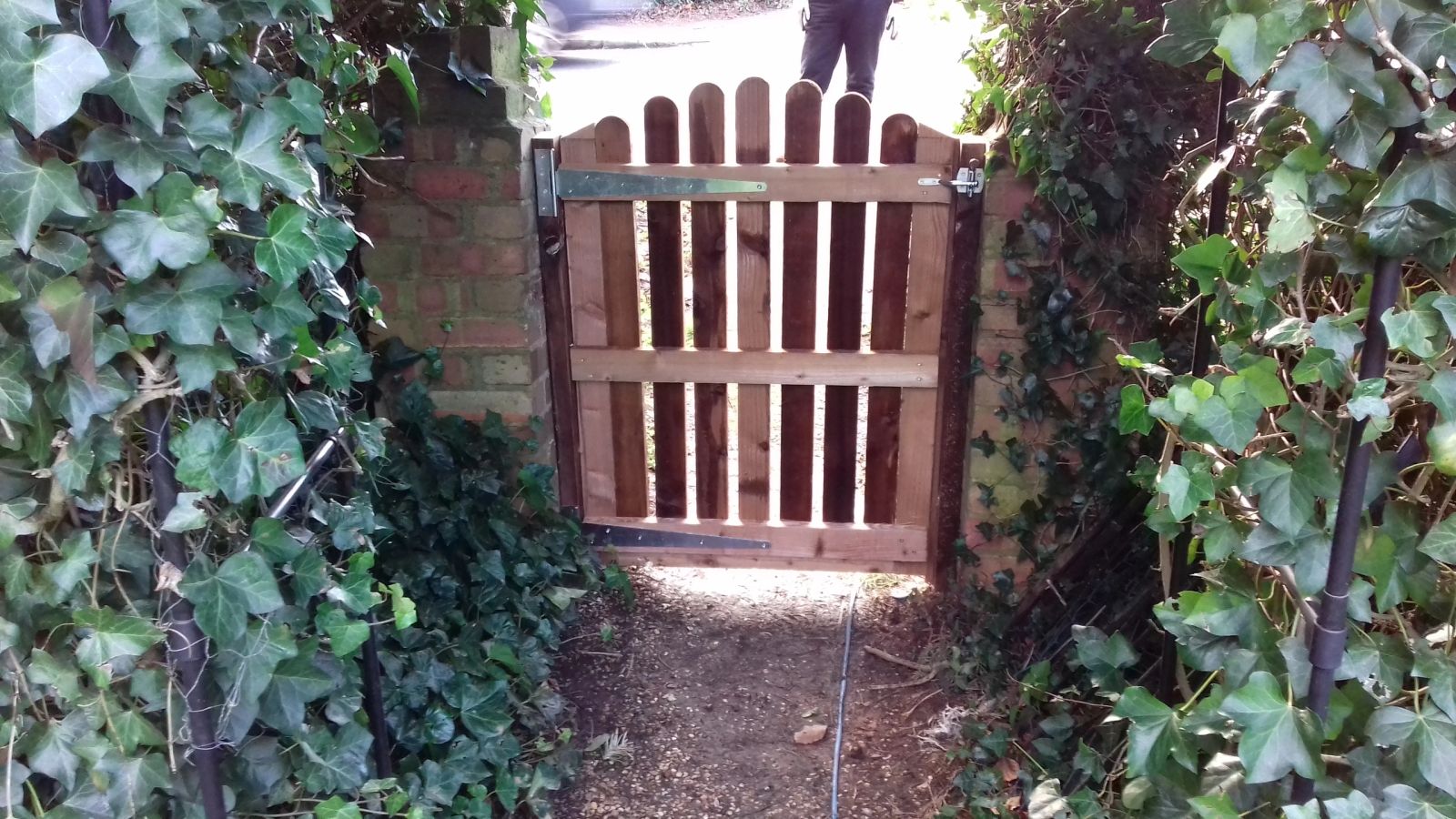
Replacing or refinishing a single gate on a property with an established fence or gate colour scheme needs the new finish matched as closely as possible, since a slightly different tone stands out far more on a single gate than it would across a whole run of fencing.
Weathering of the existing scheme also needs accounting for, since a colour matched to a faded existing finish can look mismatched again once the new work weathers at a different rate.
Repair-versus-replace where the original installation was poor
A fence that's failed early because of shallow footings, undersized posts or poor timber grading in the original build is a weaker candidate for like-for-like repair, since fixing the immediate damage doesn't address why it failed in the first place.
In that situation it's worth being upfront that a repair matching the original spec may fail again on a similar timescale, and that a modest upgrade in post size or footing depth at repair time is often better value than repeating the original approach.
Securing a rear alley boundary behind terraced housing
A rear alley boundary sees different pressure to a front garden fence, because it's typically unwatched, runs the full length of several properties, and is the route used to approach a back door or shed unseen from the street.
Consistent height and topping along the whole alley matters more here than on an individual plot, since a single weaker section among several stronger ones simply redirects the attempt rather than stopping it.
Boundary agreements where more than one property is affected
Corner plots and properties on an L-shaped or irregular boundary sometimes have more than one neighbouring owner whose land touches a single fence run, each with potentially different views on style or cost sharing.
Getting agreement from all affected neighbours before work starts, even where only one side has requested the fence, avoids a situation where one owner later objects to a fence built partly on a boundary they share.
Keeping a simple written record of who agreed to what, particularly on more complex multi-boundary plots, is worth the small extra effort.
Galvanic corrosion between dissimilar metals
Galvanic corrosion occurs when two dissimilar metals are in direct contact in the presence of moisture, with the less noble metal corroding preferentially as electrons flow between the two through the electrolyte formed by the damp.
Aluminium fixed directly to steel, or stainless steel fixings used with certain aluminium alloys, are a commonly cited combination worth checking, since the galvanic reaction can accelerate corrosion of the aluminium component well beyond what it would experience alone.
Isolating dissimilar metals with a plastic washer, sleeve or compatible coating breaks the direct contact and largely prevents the reaction, which is a standard detail on aluminium gate fittings using steel fixings.
North-facing boundaries and slower drying
A north-facing boundary receives little or no direct sun through autumn and winter, so rainfall sits on the timber and in the surrounding ground noticeably longer than on a south-facing equivalent.
This affects concrete curing time as well as timber drying — a post base poured on a north-facing run in cold weather takes longer to reach working strength and shouldn't be loaded or backfilled early just because a south-facing base nearby has already set.
Over the life of the fence, the practical effect is usually a shorter repaint or restain interval on the shaded side than the rest of the same boundary.
Communal gate access arrangements for allotment sites
An allotment site's perimeter fence is usually a lower-cost stock or mesh fence given the modest value at risk, but the communal access gate often gets a disproportionately stronger lock and hinge set, since it's the single point every plot holder and any opportunist intruder both have to pass through.
A keypad or coded padlock at the shared gate avoids the administrative burden of cutting and distributing individual keys to a changing list of plot holders over time.
Lifetime comparison of hedging and fencing as a boundary
A well-established hedge can outlast several generations of timber fencing with no post replacement or re-treatment cycle, but it needs regular cutting to stay within bounds and takes several years to reach an effective screening height from new planting.
A fence gives an immediate, defined boundary and predictable height but carries an ongoing maintenance and eventual replacement cost that a mature hedge doesn't.
Many gardens end up with a mixed solution — a fence for the immediate boundary definition with hedging planted alongside it to soften the appearance and eventually take over some of the screening role.
Capping profile and how it sheds versus holds water
A flat-topped capping board holds a thin film of water after rain for longer than a capping profile with a rounded or angled top designed specifically to shed water to one side.
This difference seems minor but compounds over years, since the flat profile spends far more cumulative hours saturated, accelerating both rot and the lichen and algae growth that thrive on damp horizontal surfaces.
Choosing a weathered or torus capping profile over a plain flat board is a small upfront cost that measurably extends the component's realistic service life.
Post cap design and end-grain water shedding
The cut top of a fence post exposes end grain, which absorbs water far faster than the sealed or treated face of the post, making it one of the most vulnerable points on an otherwise sound post if left uncapped.
A pyramid or weathered-top post cap sheds water away from that end grain rather than letting it pool on a flat cut surface, extending the practical life of the post noticeably for a small extra cost.
Where posts are cut to length on site rather than supplied pre-capped, re-treating the freshly cut end before fitting a cap matters just as much as the cap itself, since paint or preservative rarely penetrates deep enough at the mill to protect a subsequent site cut.
Fencing a boundary alongside a watercourse
A boundary running alongside a stream, ditch or river usually needs consent from the relevant authority before fencing work close to the watercourse, since works within a defined distance of the bank can affect flood flow or maintenance access.
Posts are kept clear of the bank edge itself where erosion risk is present, and a fence design that could trap floating debris during high flow is generally avoided in favour of an open rail or wire design on that specific stretch.
Snagging and sign-off walk-round
A finished fence should be walked end to end with the client before sign-off, checking posts are plumb, panels are level and gates open and close cleanly through their full swing without binding on the ground.
Gaps under gravel boards, exposed fixings, and any concrete splashed onto adjoining paving or planting during the install are the kind of small snags worth catching at walk-round rather than left for the client to notice weeks later.
Where any item is flagged, agreeing a specific date for it to be resolved — rather than a vague 'we'll come back' — is what actually gets snagging closed out.
Balustrades and handrails on raised decking
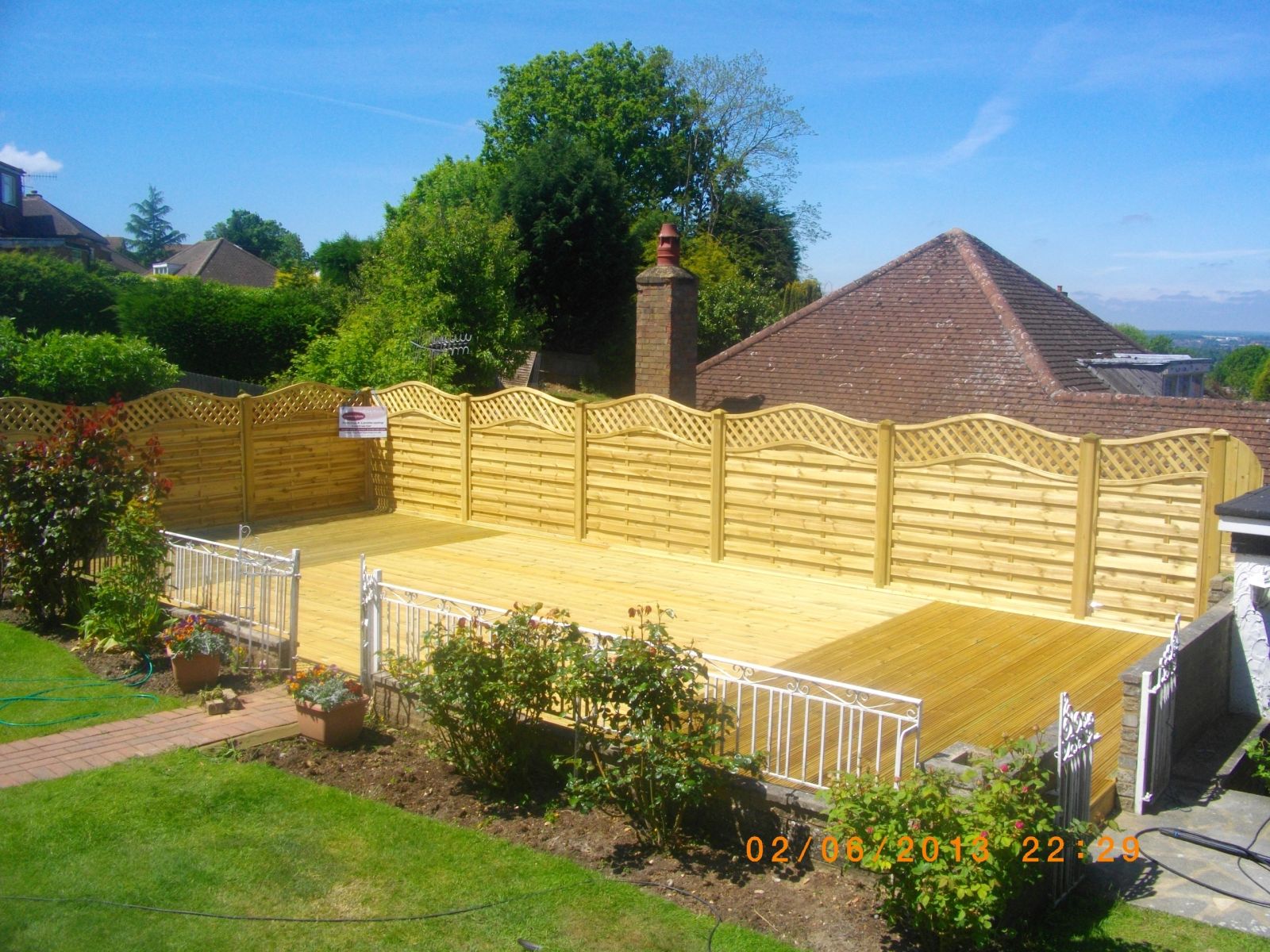
Decking raised more than around 600mm above the ground typically needs a balustrade under Building Regulations Part K, with baluster gaps narrow enough that a 100mm sphere can't pass through, to stop a child slipping between rails.
Handrail height and the strength of the newel post fixings both matter more on a raised structure than a ground-level deck, since the loads involved in someone leaning on a rail are higher than most people assume.
Steps down from a raised deck need their own handrail treatment where the rise is significant, and non-slip tread nosing is worth specifying for anywhere used year-round.
Copper-based timber preservatives
Modern timber preservatives commonly use copper compounds as the primary biocide, since copper is effective against fungal decay and is less toxicologically hazardous than the older chromated copper arsenate formulations largely phased out for domestic use.
Copper-treated timber can accelerate corrosion in fixings made from certain metals, particularly plain steel and some aluminium alloys, in a similar way to oak's tannic acid reaction, which is why treated timber often specifies compatible fixing types.
Hot-dip galvanised and stainless steel fixings both perform acceptably with copper-treated timber, whereas untreated mild steel or some aluminium fixings can corrode noticeably faster in direct, damp contact with it.
Checking older painted timber for lead content before sanding during repair
Fences and gates painted before the phase-out of lead-based paints can still carry old lead paint layers beneath more recent coats, and sanding that back during a repair without checking risks creating lead-contaminated dust.
Where a fence's paint history is unknown and it's old enough to plausibly include lead paint, it's safer to test before mechanically sanding, and to use wet sanding or careful hand scraping with contained waste disposal if lead is present.
Gate widths for cycle access
A side gate wide enough for a wheelbarrow isn't automatically wide enough for a cargo bike or a bike with panniers, which is worth checking against the actual bikes a household owns rather than a generic standard width.
Cycle storage tucked behind a side gate also needs a gate that can be propped open safely while wheeling a bike through, rather than one that swings shut under its own weight mid-manoeuvre.
Where cycle access is a genuine daily-use requirement, a slightly wider opening at quote stage is a cheap addition compared with widening an existing narrow gate later.