Emergency vehicle sirens
A siren is engineered to be audible over background noise at considerable distance and across a wide frequency range, which makes it one of the noise sources least affected by a domestic acoustic barrier of any practical height.
This is set out clearly to anyone near a main road or hospital route so that occasional siren noise isn't mistaken for a sign the barrier isn't working — it's simply outside what boundary fencing is designed to address.
Schedules of condition before nearby works
A schedule of condition is a dated record, often with photographs, of a boundary structure's state before nearby building work begins, used to settle any later dispute about damage caused during that work.
Where a neighbour is undertaking significant building work close to a shared boundary, requesting this kind of record beforehand is reasonable and protects both parties.
This is distinct from a full party wall agreement but is often produced as part of the wider party wall process where one applies.
Recording an informal boundary agreement properly
Where neighbours agree a boundary line that differs slightly from, or clarifies, what the deeds show, that agreement carries far more weight if it's put in writing and signed by both parties rather than left as a verbal understanding.
A formal boundary agreement can, in some cases, be registered with HM Land Registry against both titles, which protects the arrangement for future owners of either property.
Even a simple written note with an agreed sketch, dated and signed by both neighbours, is worth far more later than relying on memory of a conversation years afterwards.
Acoustic fence compared with an earth bund
An earth bund achieves noise reduction through mass and height in the same way as a fence, but needs far more land and isn't practical on most residential plots, whereas a fence achieves a similar line-of-sight break in a fraction of the footprint.
Where a bund already exists on a site, a fence on top of it can add further height without the land take a taller bund alone would need.
Spur repair material choice
A concrete or timber spur bolted alongside a rotted post base lets the sound upper section of the post be retained while replacing only the failed section near ground level, avoiding a full post replacement.
A concrete spur resists the ground moisture that caused the original rot far better than a timber spur repeating the same material in the same failure-prone zone, though it's heavier and less forgiving to align precisely.
The repair is only as good as the connection between spur and post, and coach bolts through both members, rather than screws alone, are needed to transfer wind load reliably across the joint.
Gaps at ground level and cill boards
A gap under the fence at ground level lets sound through even when the rest of the face is well sealed, since low-frequency noise in particular can travel along the ground rather than only through the air above it.
A close-fitting gravel board or cill board run along the base closes this gap and also protects the lowest edge of the timber from ground moisture.
Detailing a security fence junction at a brick pier
Where a fence run meets an existing brick pier, the panel or rail end needs a scribed or bracketed closer rather than a square-cut gap, since an ill-fitting junction at a pier is one of the more common weak points found during a security survey.
The pier's own condition is checked before any bracket is fixed into it, because a soft or spalling pier face won't hold a resin anchor reliably even where the fence design otherwise calls for one.
Basketball hoop and ball-bounce noise
The repeated impact noise of a ball bouncing on a hard driveway surface, or striking a hoop backboard, is an impulsive sound rather than a continuous one, and impulsive noise tends to be judged as more intrusive than steady noise of a similar average level.
A barrier reduces the airborne carry of that impact noise into a neighbouring garden, though the underlying activity and its timing remain outside what any fence can control.
Tuning an adjustable bolt-on hinge
An adjustable hinge allows small changes to a gate's height and lean after fitting via a cam or slotted fixing, without unbolting the hinge from the post, which is useful for correcting seasonal timber movement without a full repair visit.
These adjustments have a limited range, though, and a gate that's moved beyond what the hinge can correct needs the underlying cause addressed rather than the hinge wound to its limit.
Garden doors set into a masonry wall
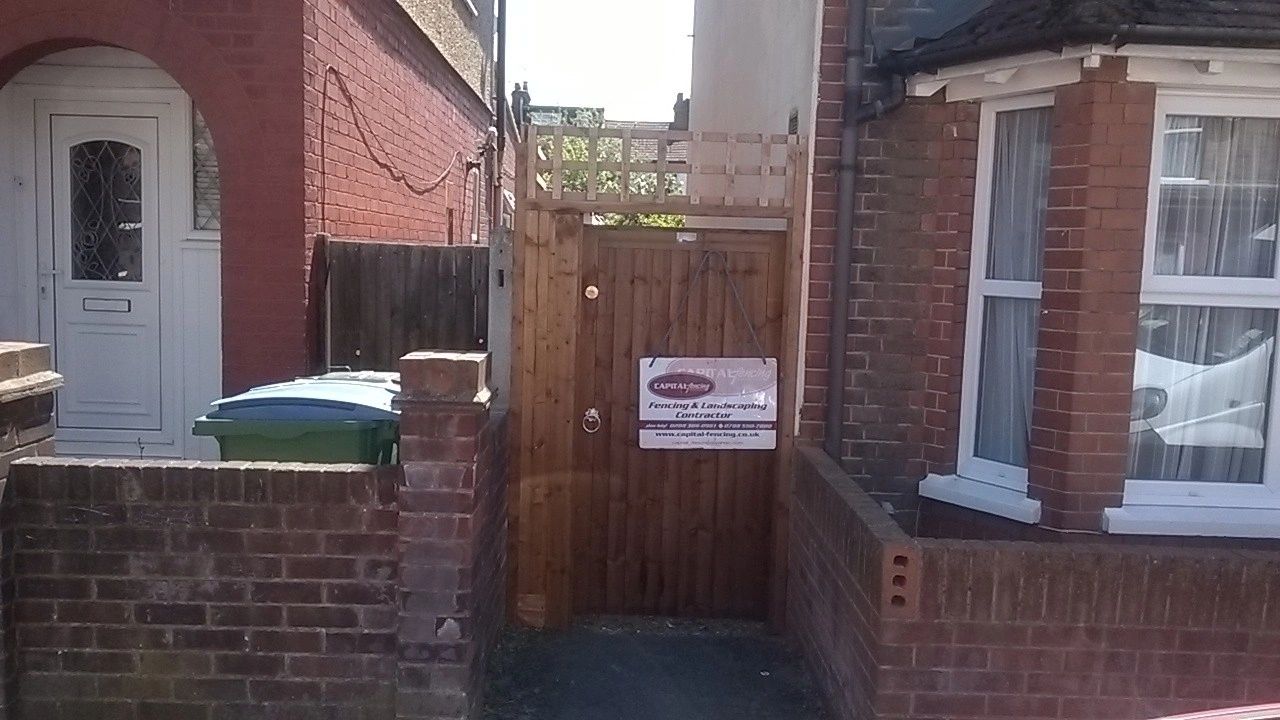
A garden door hung within a brick or block opening behaves differently to a gate hung between timber posts, since the fixings go into masonry rather than a post that can be dug out and replaced.
Frame fixings into old or soft mortar joints are a common failure point, and repairs often involve re-fixing into sound brick rather than simply tightening the same holes.
Insurance paperwork after storm damage
Most household policies distinguish between storm damage to a fence, which is often covered subject to policy wording and excess, and general wear or rot, which typically isn't, so insurers commonly ask for photographs of the damage and sometimes of the fence's prior condition.
A dated photo of the boundary from before the storm, even an incidental one, can materially help a claim where the insurer disputes whether failure was storm-related or simply due to age.
This is a general description of how these claims are typically assessed rather than a statement about any specific insurer's policy, and terms, excesses and definitions of 'storm' vary between providers and should be checked in the policy document.