London & Hertfordshire Free Site Visit
closeboard fence run installed by Capital Fencing in Letchworth Garden City (SG6)
Letchworth Garden City · SG6

New-Build Garden Fencing in Letchworth Garden City (SG6)

New-build boundary fencing in Letchworth Garden City is one of our regular briefs — buyers on modern estates upgrading the developer's minimum-spec boundary after handover. On the world's first garden city — arts and crafts cottages with generous, the failure mode we see most often is the one we design out first. Roads such as Norton Way South and Icknield Way are typical of the local layout. Howard Park is a useful local reference point. Letchworth Garden City was the first garden city, and its layout and architecture are protected through covenants overseen by the Letchworth Garden City Heritage Foundation.

New-build boundary fencing in Letchworth Garden City is one of our regular briefs — buyers on modern estates upgrading the developer's minimum-spec boundary after handover. On the world's first garden city — arts and crafts cottages with generous, the failure mode we see most often is the one we design out first. Roads such as Norton Way South and Icknield Way are typical of the local layout. Howard Park is a useful local reference point. Letchworth Garden City was the first garden city, and its layout and architecture are protected through covenants overseen by the Letchworth Garden City Heritage Foundation.

What goes wrong

Common failure modes on new-build boundary fencing

  • putting new closeboard on the existing developer posts — those are the part that failed first, not the panels
  • raising a shared boundary without agreeing with the neighbour, then discovering they've taken it down
Default spec

How we build new-build boundary fencing in Letchworth Garden City

6ft closeboard on concrete posts, 150mm gravel boards, mid-rail capped — a genuine 15-year replacement for the developer's 4-year panel. On Letchworth Garden City jobs we adjust for letchworth heritage foundation design rules dictate fence styles, heights and finishes on most streets.

Property mix locally: the world's first garden city — Arts and Crafts cottages, planned terraces and consistent street trees. Typical gardens: generous, leafy plots — many gardens contain protected trees with TPOs. Postcodes we regularly service: SG6.

Why this spec, for buyers on modern estates upgrading the developer's minimum-spec boundary after handover

  • no more callouts every winter — the standard developer spec fails inside four years and we know exactly what fails
  • we work around plot-boundary pegs and drainage runs that new-build gardens hide badly
  • quotes broken down so you can see exactly where the money over the developer spec goes

Typical new-build boundary fencing briefs in Letchworth Garden City

  • raising a shared boundary height with neighbour agreement, keeping to permitted development
  • replacing developer 4ft overlap panels with 6ft closeboard on concrete posts

New-Build Garden Fencing FAQs — Letchworth Garden City

Do I need permission to raise a new-build boundary?

On new-build boundary fencing jobs in Letchworth Garden City (SG6), our default answer is: 6ft closeboard on concrete posts, 150mm gravel boards, mid-rail capped — a genuine 15-year replacement for the developer's 4-year panel. The honest trade-off is putting new closeboard on the existing developer posts — those are the part that failed first, not the panels — which is exactly what our default spec designs out.

What's the maximum height without planning on a new build?

Across Letchworth Garden City we spec around letchworth heritage foundation design rules dictate fence styles, heights and finishes on most streets, so on new-build boundary fencing that usually means 6ft closeboard on concrete posts. The honest trade-off is putting new closeboard on the existing developer posts — those are the part that failed first, not the panels — which is exactly what our default spec designs out.

Can new panels be fitted to existing developer posts?

North Hertfordshire District coverage means we can survey most SG6 addresses inside a week — buyers on modern estates upgrading the developer's minimum-spec boundary after handover. The honest trade-off is putting new closeboard on the existing developer posts — those are the part that failed first, not the panels — which is exactly what our default spec designs out.

Can you match my neighbour's post colour and spacing?

Practically: replacing developer 4ft overlap panels with 6ft closeboard on concrete posts. That's the Letchworth Garden City version of this job, not a generic one. We'll walk you through no more callouts every winter — the standard developer spec fails inside four years and we know exactly what fails on the site visit before you commit.

Can I replace the developer's fence in the first two years?

On new-build boundary fencing jobs in Letchworth Garden City (SG6), our default answer is: 6ft closeboard on concrete posts, 150mm gravel boards, mid-rail capped — a genuine 15-year replacement for the developer's 4-year panel. The honest trade-off is putting new closeboard on the existing developer posts — those are the part that failed first, not the panels — which is exactly what our default spec designs out.

Recent new-build garden fencing work
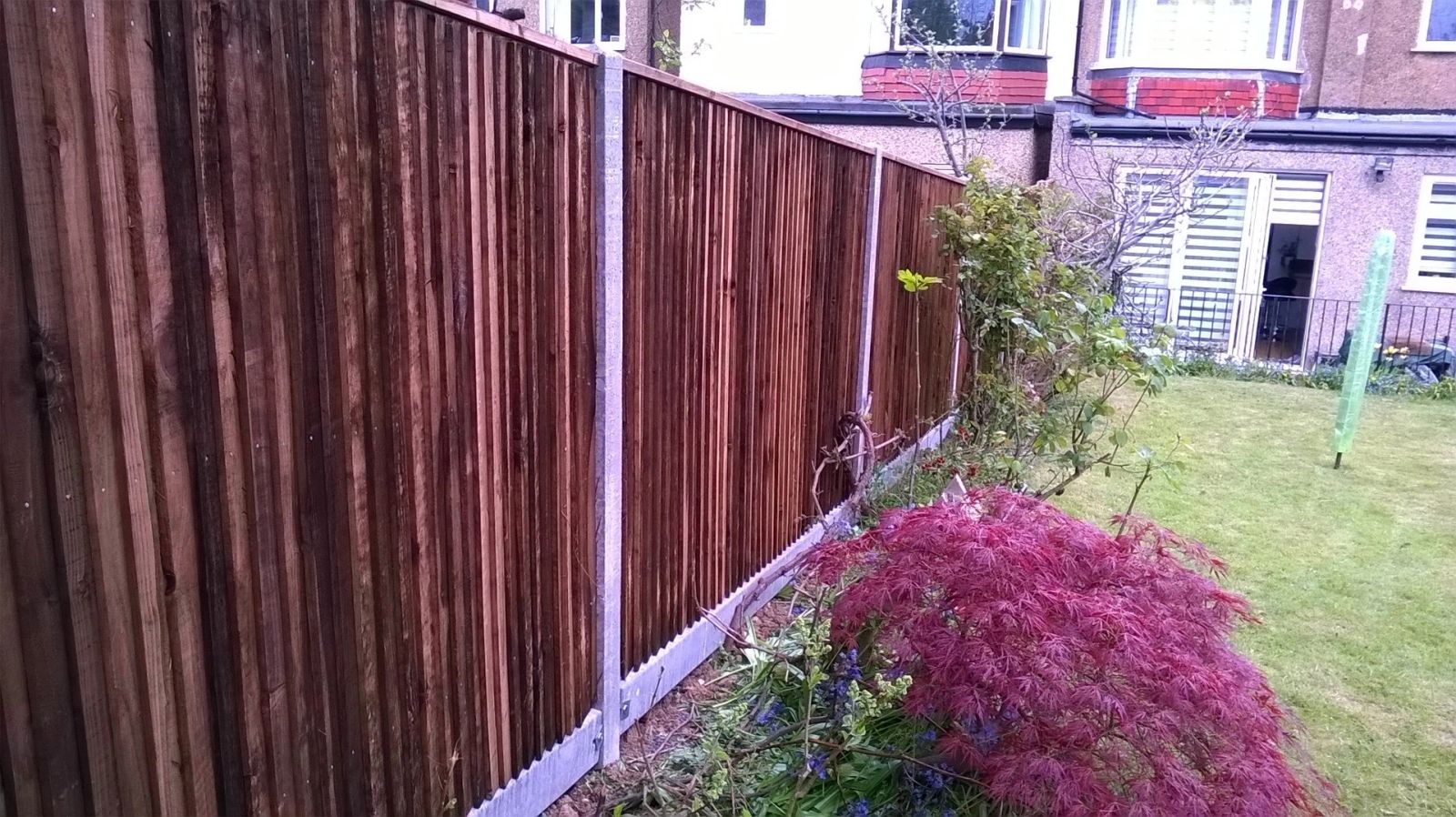
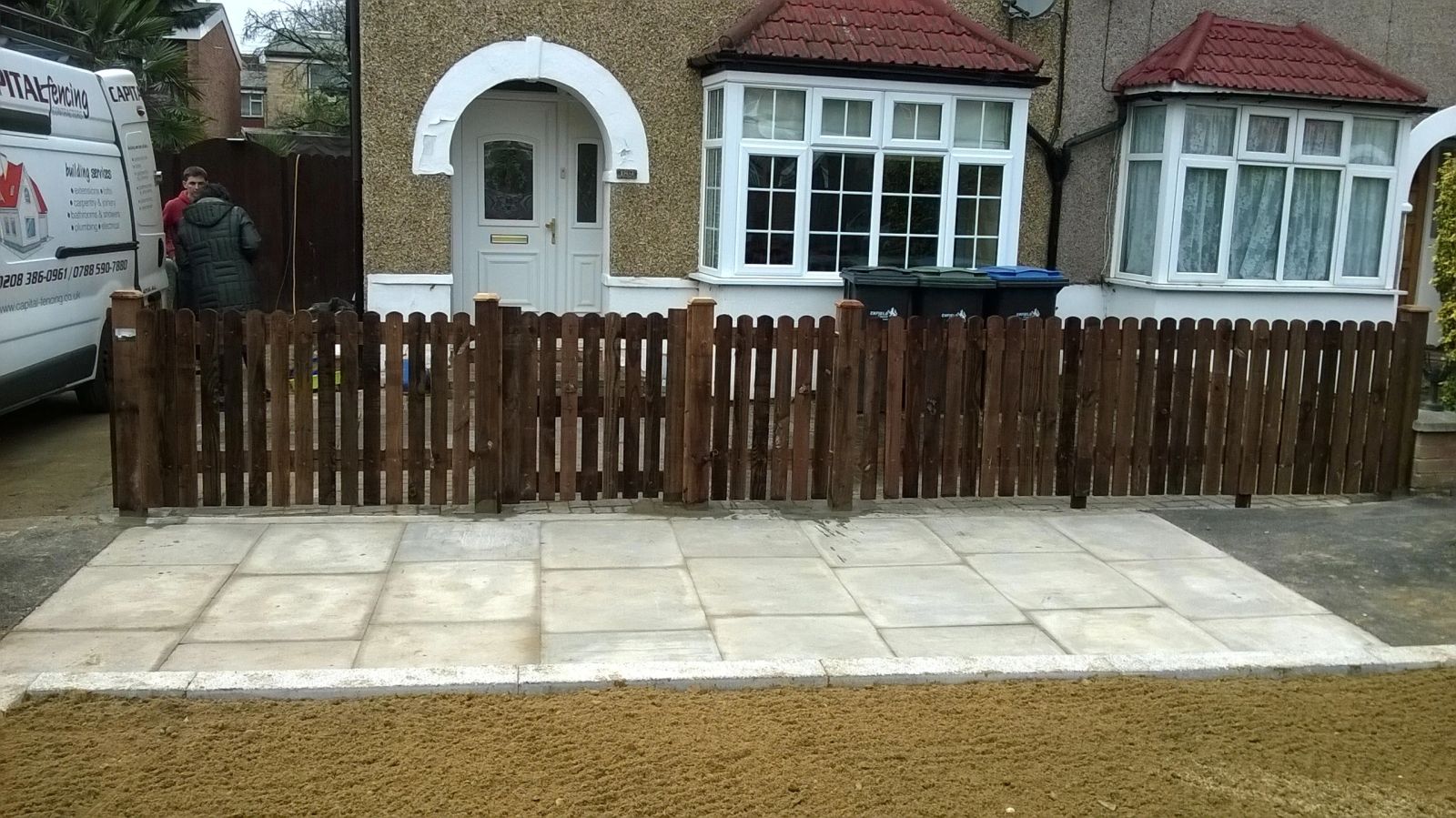
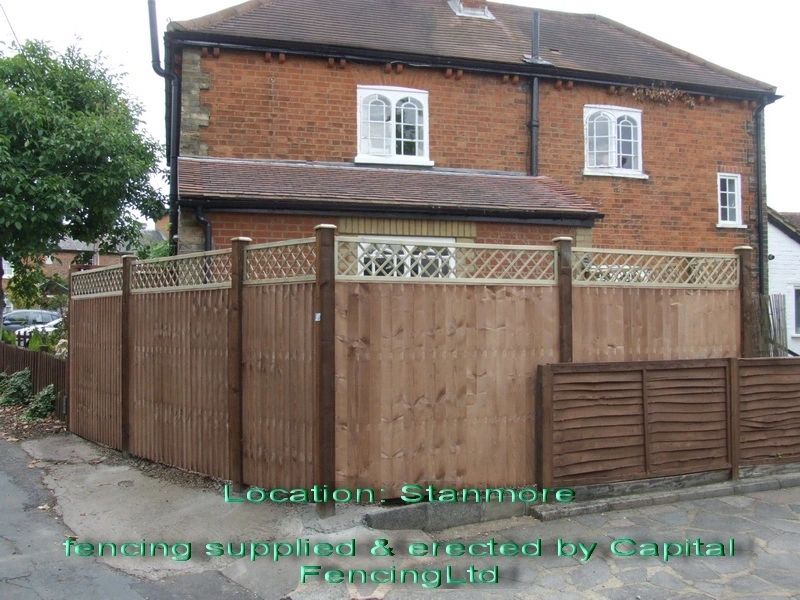
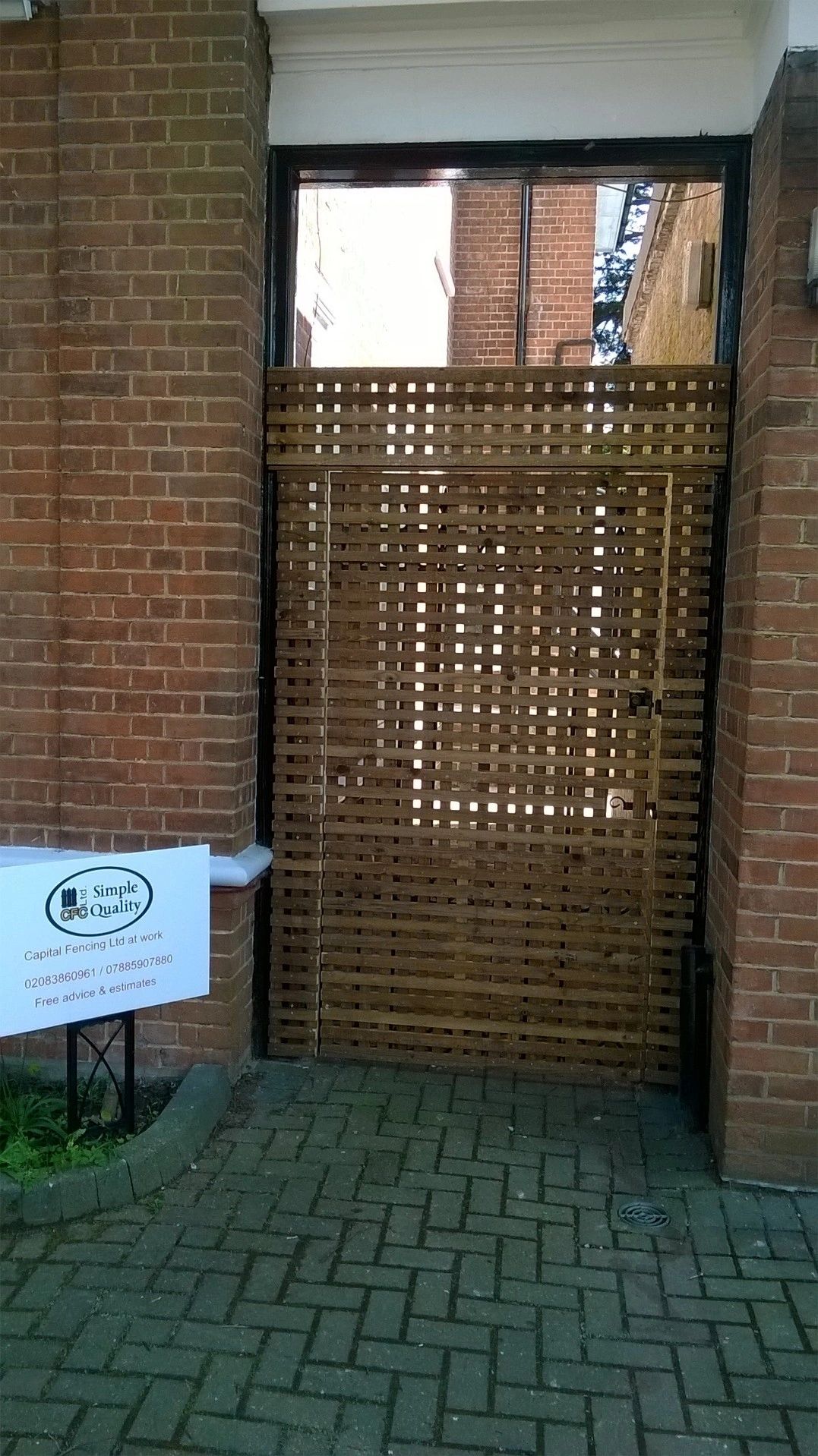
closeboard fence run installed by Capital Fencing in Letchworth Garden City (SG6)panel fence install installed by Capital Fencing in Letchworth Garden City (SG6)trellis-topped fence installed by Capital Fencing in Letchworth Garden City (SG6)bespoke decorative fence installed by Capital Fencing in Letchworth Garden City (SG6)

How we approach new-build garden fencing on Letchworth Garden City properties

BS 1722 and palisade fencing specification

BS 1722 covers dimensions, materials and fixing details for various fence types including steel palisade, and specifying to a named part of the standard gives a common reference point between client, contractor and any approving body rather than relying on informal descriptions of height and gauge.

Referencing the standard doesn't remove the need for site-specific judgement on threat level, but it does establish a baseline for pale gauge, post spacing and fixing that a site-specific spec can then be built up from.

Minimum clear width for pedestrian gate access

A pedestrian gate needs enough clear width once open to comfortably pass through with hands full, a pushchair or a wheeled bin, and a gate that technically opens but leaves very little usable width against an adjacent wall or post is a common design oversight on tight side returns.

Checking the actual clear opening, not just the gate leaf's nominal width, avoids this problem before a gate is ordered.

Making a storm-damaged fence temporarily safe before full repair

Where a fence has failed suddenly — a fallen tree, a collapsed panel — and a full repair can't happen immediately, propping the affected section and taping off the area reduces the immediate risk to people or pets before proper repair work starts.

A temporary make-safe isn't a substitute for the repair itself, and a client should understand it's a stop-gap measure rather than something that resolves the underlying failure.

Galvanic corrosion between dissimilar metals

Galvanic corrosion occurs when two dissimilar metals are in direct contact in the presence of moisture, with the less noble metal corroding preferentially as electrons flow between the two through the electrolyte formed by the damp.

Aluminium fixed directly to steel, or stainless steel fixings used with certain aluminium alloys, are a commonly cited combination worth checking, since the galvanic reaction can accelerate corrosion of the aluminium component well beyond what it would experience alone.

Isolating dissimilar metals with a plastic washer, sleeve or compatible coating breaks the direct contact and largely prevents the reaction, which is a standard detail on aluminium gate fittings using steel fixings.

Capped versus uncapped composite boards

Capped composite boards have a thin outer polymer shell bonded over the wood-polymer core, giving better resistance to moisture ingress, staining and UV fade than an uncapped board with the core material exposed directly to weather.

Uncapped composite is generally cheaper and machines more like traditional timber, since the surface can be cut, drilled or profiled without exposing a different material underneath, but it's more prone to surface fading and moisture absorption over time.

A capped board's protective shell is only on the finished faces, so a cut end on site exposes the uncapped core underneath, which some manufacturers address with an end-cap trim while others leave it exposed.

Hedgehog gaps and protected species awareness

A small gap at the base of a fence panel, often around 13cm square, lets hedgehogs and other small wildlife move between gardens, which is increasingly encouraged as gardens become more enclosed.

Separately, some sites may have protected species such as bats, nesting birds or great crested newts present, and disturbing them during certain works can be a legal matter regardless of boundary ownership.

Where there's any reason to suspect protected species on a site, checking with an ecologist or the local authority before groundworks is the sensible route rather than assuming it won't apply.

Composite fencing construction and expansion gaps

Composite fencing boards are a wood-fibre and polymer blend, usually clipped or screwed onto an aluminium or timber sub-frame rather than nailed directly, which avoids splitting the board and allows for its different movement characteristics.

Composite expands and contracts with temperature more than timber does, so boards are fitted with a small expansion gap at each end and between courses rather than butted tight, and a run installed without those gaps can bow or buckle in hot weather.

The sub-frame itself is usually still timber or aluminium posts rather than composite throughout, since composite isn't generally used as a structural post material.

A gate that swings and closes itself on a slope

A gate hung on ground that falls away from the latch post can swing open or shut under its own weight rather than staying where it's left, which is a nuisance rather than a fault in the hardware itself.

Fitting a hydraulic closer, a gravity latch set to hold at the correct point, or re-hanging with a slight counter-lean can correct the tendency without rebuilding the gate.

Tongue-and-groove privacy panels

Tongue-and-groove boards interlock edge to edge with no overlap, giving a genuinely solid, gap-free face that's the most private board profile available in timber fencing.

Because the boards key into each other rather than overlapping, the panel needs to be built with a small allowance for seasonal swelling, or the interlocking edges can bind and cup as the timber moves.

It's a heavier, stiffer panel than lap or slatted profiles, so it's usually paired with more substantial posts, and it's a common choice for pool or hot-tub screening where sightlines matter more than airflow.

Mediation as a step before a formal boundary dispute

Community and property mediation services exist specifically to help neighbours resolve disagreements, including boundary and fencing disputes, without going straight to solicitors or court.

Mediation is generally faster and considerably cheaper than formal legal action, and can preserve a working relationship between neighbours who will, after all, remain neighbours.

Where a boundary disagreement is becoming entrenched, raising the idea of mediation early is often more productive than escalating straight to legal correspondence.

Compression versus tension fixing of infill panels

Some panel systems clip into a compression-fit channel between posts, relying on the panel being cut to a precise size to stay in place under load; others are bolted under tension to the post face, which tolerates more variation in panel size but adds visible fixing points.

Compression-fit systems look cleaner but are harder to make tamper-resistant, since a panel that can be removed without tools for maintenance can usually also be removed without tools by someone else.

End-grain sealing on cut timber

End grain is far more absorbent than a timber's long faces because it exposes the open ends of the wood's vascular cells, so a post or rail cut to length on site can soak up moisture many times faster at the cut end than elsewhere.

Leaving a fresh cut untreated is one of the more common ways a pressure-treated timber ends up rotting from the middle outwards, since the factory treatment doesn't extend to a cut made after the fact.

A brush-applied end-grain preservative or sealant on every site-cut post base and rail end restores some of that lost protection, and takes only a few minutes per cut relative to the risk it avoids.

Right to light and a tall boundary fence

There's no general legal 'right to a view' or automatic entitlement to sunlight in a garden, so a taller boundary fence built within the applicable height limits usually isn't unlawful purely because it shades a neighbour's garden.

Right to light law in England mainly concerns windows in buildings that have enjoyed light for a long period, rather than open garden space, and even then applies in fairly narrow circumstances.

Where a taller fence is likely to significantly affect a neighbour's garden, discussing it before building tends to prevent ill feeling even where there's no strict legal obstacle.

Housing association permissions for boundary work

Housing association and council tenants typically need written permission before altering a garden boundary, even for straightforward like-for-like fence replacement, under the terms of their tenancy agreement.

Some landlords have a specific alterations request process and approved list of acceptable fence types or heights, which can differ from what a private neighbour might choose.

Tenants planning boundary work are usually best placed to check with their housing officer first, since unauthorised alterations can occasionally need to be reversed at the tenant's cost.

Party wall notices and communication

The Party Wall etc. Act 1996 covers work to a shared wall or excavation near a neighbour's foundations, and while an ordinary timber fence on a boundary line usually falls outside it, a new masonry boundary wall built astride the line, or deep post holes close to a neighbour's foundations, can bring it into play.

Where the Act applies, formal written notice is required before work starts, giving the neighbour a defined period to consent or dissent, and proceeding without notice risks an injunction even on otherwise straightforward work.

Even where the Act doesn't strictly apply, a simple letter or conversation confirming line, height and access before work starts avoids most of the disputes that end up needing formal resolution.

Safety standards for automated gates

Automated gates fall under machinery safety regulations, which means a force-limiting device or safety edge to stop the gate on contact with an obstruction, and photocells or other sensors to detect someone in the gate's path, aren't optional extras.

A risk assessment covering the specific installation — proximity to a public footpath, likely pedestrian use, manual override in a power cut — should be part of any automation job, not an afterthought once the gate's already built.

Annual servicing of the motor, safety sensors and mechanical stops keeps an automated gate compliant and catches wear before it becomes a safety issue rather than just an inconvenience.

How fence height is measured against ground level

Height is measured from the ground level immediately adjacent to the fence, which matters on a sloping or stepped site because the same fence can appear to comply on one side and exceed a limit on the other if ground level either side differs.

Where a fence sits on a raised bank or retaining structure, some planning assessments measure from the lower ground level rather than the top of the bank, so it's worth checking the specific basis being applied before finalising a height that's close to a limit.

Gate stops and end buffers

An end stop or buffer at the fully open and fully closed positions of a sliding gate prevents the leaf running off the end of its track or slamming into a post, and a missing or worn buffer is a common cause of impact damage over time.

Checking and replacing worn buffers is a low-cost part of a sliding gate service that prevents more expensive frame damage.

Timber grades and treatment

Pressure-treated softwood is graded by the treatment's intended service life — timber rated for ground contact (Use Class 4) should always be used for posts, while a lighter Use Class 3 treatment is normally sufficient for panels and boards that don't touch soil.

Tanalised or vacuum-pressure-treated stock takes preservative deeper into the timber than a surface-dipped batch, which matters most at cut ends, where the untreated core is exposed and should always be re-treated on site.

Hardwoods like oak or iroko don't need chemical preservative to the same degree but cost more upfront and behave differently as they season, so the choice is really about budget and maintenance appetite rather than one being simply 'better'.

Questions to ask any fencing contractor

Worth asking directly: who owns the boundary being worked on, what happens if buried obstructions are found, and whether waste removal and disposal are included in the price rather than charged separately afterwards.

It's also reasonable to ask what post-setting method will be used for the specific ground conditions on site, since a contractor who hasn't looked at soil type before quoting depth and concrete volume is guessing rather than specifying.

Asking how a contractor handles a shared boundary with a neighbour who hasn't been consulted is a good test of whether they've thought through the ownership question at all, rather than just the fence itself.

Ground clearance for airflow

Leaving a consistent gap, typically 50-75mm, between the underside of a fence panel or gate and the ground lets air circulate around the bottom rail, which is usually the first part of a timber fence to rot.

That clearance also stops the panel wicking moisture directly from wet grass or standing puddles after rain, something ground contact makes almost unavoidable over time.

On sites with soft or uneven ground, a gravel board fitted below the panel achieves the same protection while keeping the panel itself off the soil entirely.

Using a post hole auger effectively

A petrol or manual auger clears loose, stone-free ground far faster than hand-digging, but it works by shearing soil rather than levering it, so it struggles the moment it meets a root, a buried stone or compacted rubble.

Lifting the auger clear and clearing spoil from the flutes every 150-200mm of depth keeps it cutting efficiently; forcing it deeper without clearing spoil just packs the hole and stalls the motor.

On heavy clay an auger can also polish and seal the hole's sides, which reduces drainage around the base — a quick scoring of the sides with a spade before concreting helps break that glazed surface.

Whether the brief is replacing developer 4ft overlap panels with 6ft closeboard on concrete posts or raising a shared boundary height with neighbour agreement, keeping to permitted development, we quote it from a site visit, not a photo. Letchworth Garden City is inside our core working patch and most jobs are booked in inside a fortnight. Roads such as Nevells Road and Hillshott are typical of the local layout. Broadway Cinema is a useful local reference point. Icknield Way follows the route of the ancient Icknield Way trackway, and chalk geology sits close to the surface along much of its length.

Get In Touch

Get My Free Quote — 24h Response

No callout fee · Free site visit · Friendly local team covering London & Hertfordshire.

Call us
07885907880
or 02036484746
Email
capital_fencing@yahoo.com
WhatsApp
Message us anytime
Area
London & Hertfordshire
Payment
Card payments accepted

Pay by debit or credit card, bank transfer or cash once the work and price are agreed. No deposit taken online.

Request a Free Quote

We'll get back to you within 24 hours.

Free Site Visit No Callout Fee
Call WhatsAppQuote