Storm damage triage
After a storm, triage prioritises anything posing an immediate hazard — a fence leaning over a path, a snapped post near a driveway — ahead of cosmetic damage further along the same run.
A wider survey of the whole boundary is worth doing at the same visit, since storm stress often weakens bays that haven't visibly failed yet but are more likely to fail in the next event.
Boundary rules in National Parks and AONBs
Properties within a National Park or an Area of Outstanding Natural Beauty can have reduced permitted development rights for boundary structures, reflecting the additional planning protection these areas carry.
Material and colour choices are often more tightly guided in these areas too, even where the height itself would otherwise be permitted.
The relevant National Park authority or council planning department is the right first point of contact for confirming what applies before ordering materials.
Tall fences, shading and neighbour relations
A tall boundary fence can significantly shade a neighbouring garden depending on orientation, and while there's no general legal right to a set amount of sunlight in a garden, an unusually tall or dark structure close to a shared boundary is a common source of neighbour friction.
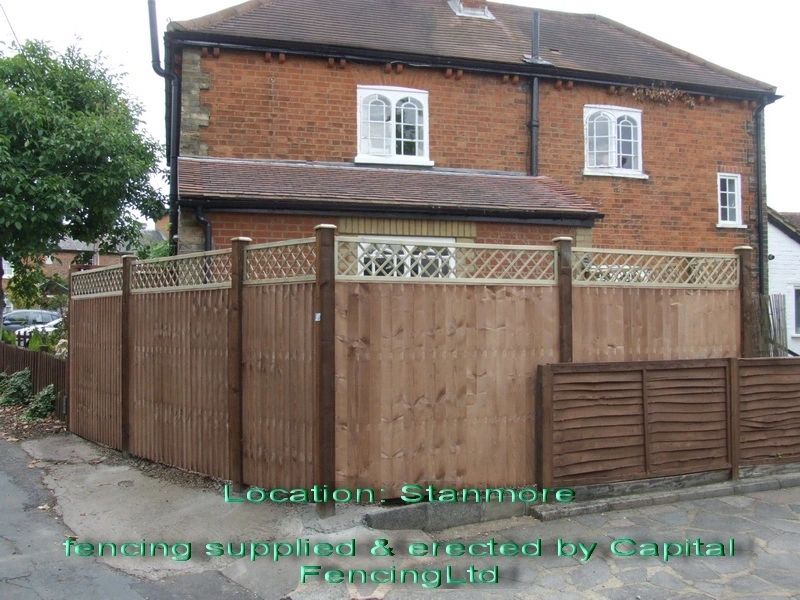
Slatted, louvred or partially open designs let some light and air through while still giving privacy, which is often a reasonable middle ground where a fully solid fence would cause a shading complaint.
Discussing height and design with an affected neighbour before building, even where there's no legal requirement to, tends to avoid a dispute that a technically-compliant fence wouldn't otherwise resolve.
Slat gap ratios in screening fences
Horizontal slatted or louvre fencing is usually specified by a gap-to-board ratio, such as a 20mm gap between 100mm boards, which balances privacy against wind resistance.
A tighter ratio gives more privacy and blocks more wind, which in turn increases the load transferred to posts and foundations during storms, so a very solid-looking slatted screen needs the same foundation attention as a close-boarded panel.
Wider gaps let more wind through and reduce that structural load, while still breaking sightlines enough for most privacy purposes, which is why many slatted designs favour a wider gap than the boards suggest at first glance.
Picket fence styles and spacing
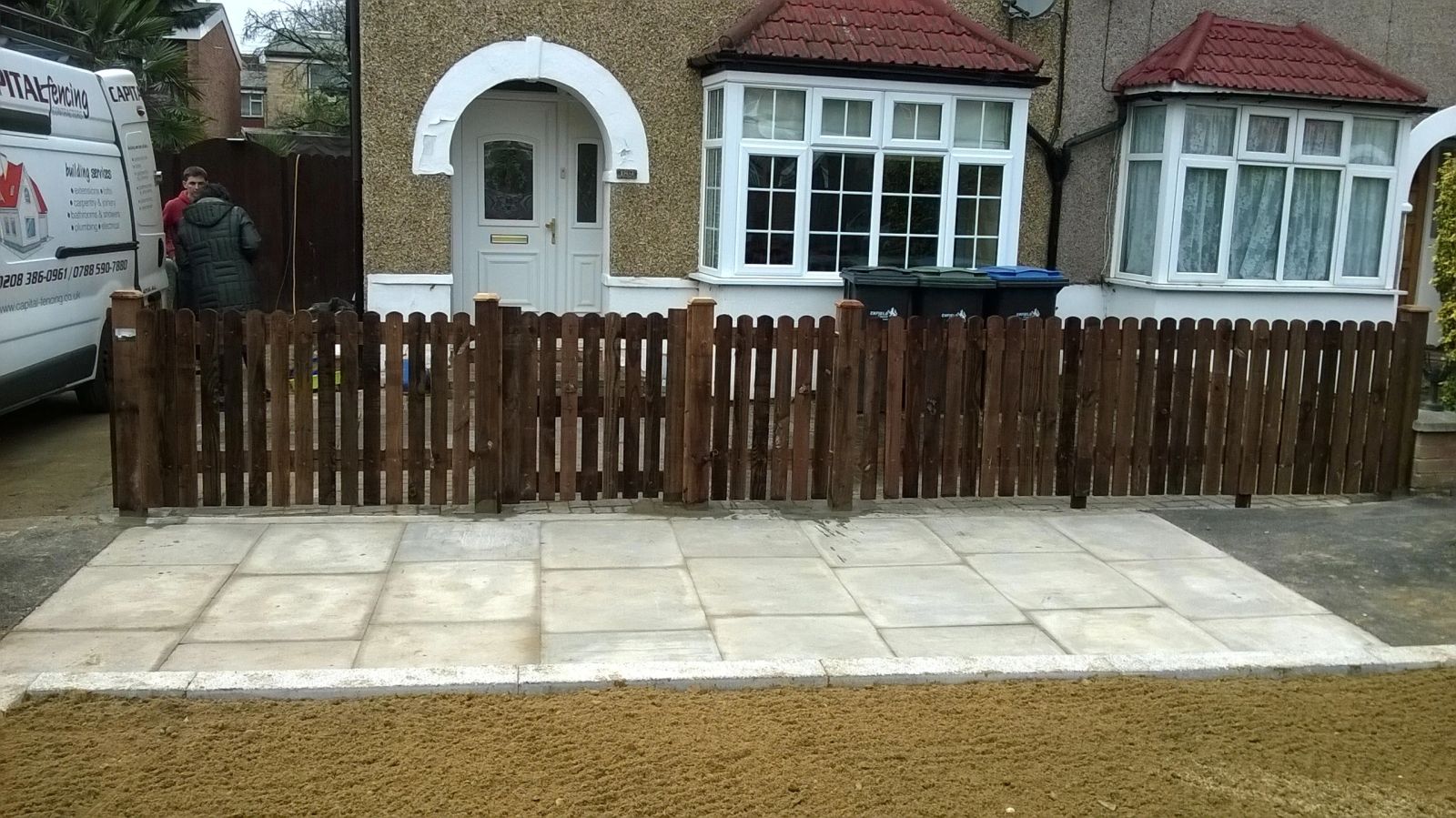
Picket fencing trades privacy for a lower, more open boundary, which suits front gardens where sightlines to the street and a welcoming appearance matter more than screening.
Picket spacing is a genuine design choice — narrower gaps look more traditional and offer a bit more containment for small pets, while wider spacing uses less timber and lets more light and air through a planted border behind it.
Because picket fencing is low, it rarely needs the same post depth as a taller closeboard run, though corner and gate posts still need proper concrete footings regardless of the fence's height.
Boundaries adjoining registered common land
Land registered as common land under the Commons Registration Act carries specific legal protections, and fencing along a boundary with it can require consent from the Planning Inspectorate under separate legislation.
This is a different and more specialist process than an ordinary planning application, reflecting the protected status of common land itself.
Anyone with a boundary adjoining registered common land should check its status carefully before assuming a straightforward fence replacement is all that's needed.
Visibility splays on corner plots and driveways
Corner plots and driveways onto a road often have a highway visibility splay — a triangular zone near the junction — where boundary height is restricted so drivers and pedestrians can see each other clearly.
These restrictions are usually lower than the standard 1m front-boundary limit and are enforced by the highway authority rather than just general planning policy, so it's worth checking with the council for any plot near a junction or driveway crossing a footway.
Open railings or low planting within a visibility splay are common solutions where some boundary definition is still wanted without blocking sightlines.
Mediation as a step before a formal boundary dispute
Community and property mediation services exist specifically to help neighbours resolve disagreements, including boundary and fencing disputes, without going straight to solicitors or court.
Mediation is generally faster and considerably cheaper than formal legal action, and can preserve a working relationship between neighbours who will, after all, remain neighbours.
Where a boundary disagreement is becoming entrenched, raising the idea of mediation early is often more productive than escalating straight to legal correspondence.
Setting out a straight run with string lines
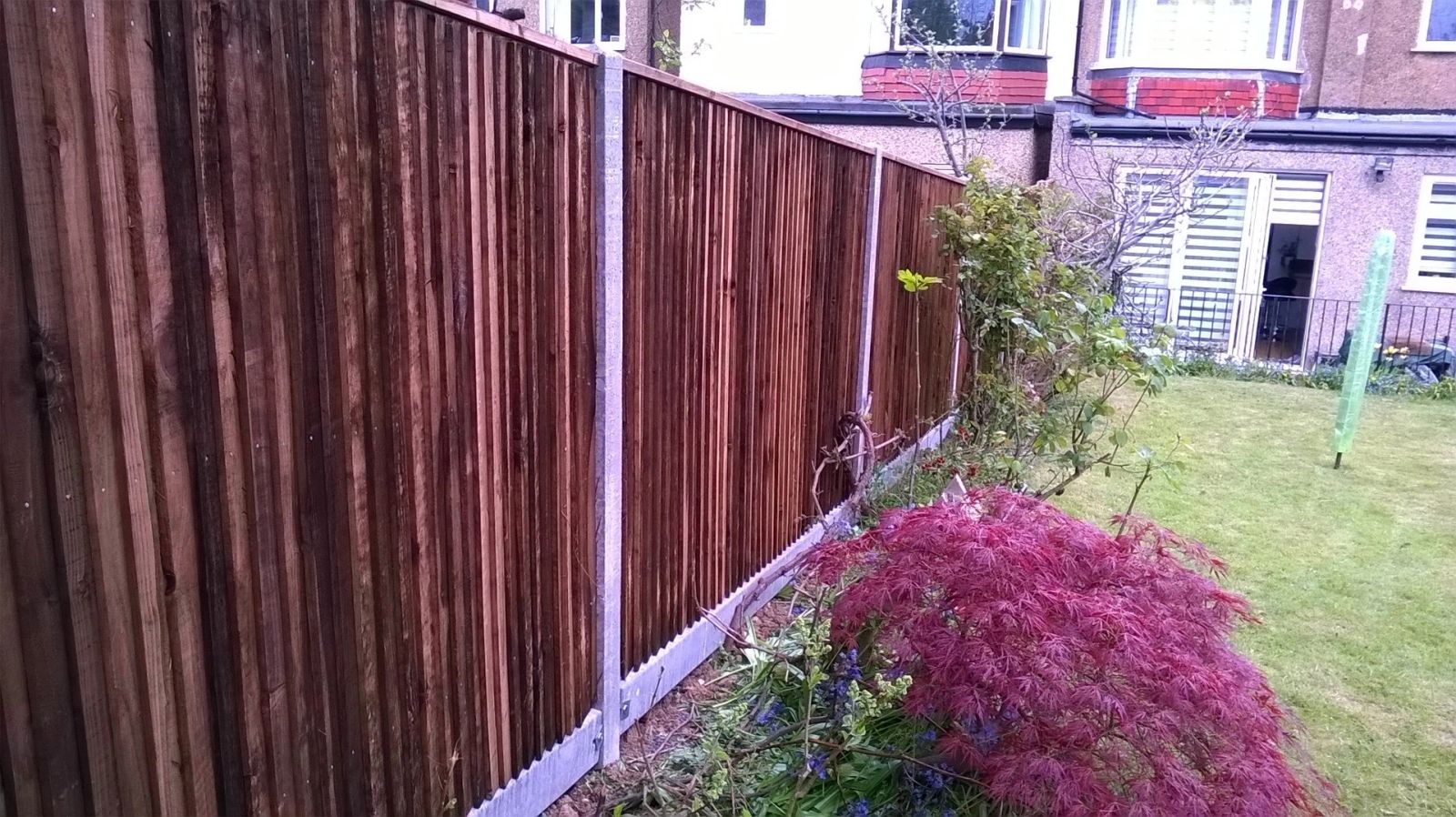
A straight fence line starts with two fixed end points and a string line pulled taut between them, usually run just above where the posts will sit rather than at ground level where it snags on grass or debris.
On a long run the string sags under its own weight, so an intermediate profile or peg is needed every few bays to keep the sight line true rather than trusting a single span.
Any post that's set even 10-15mm off that line becomes visible once panels go in, because the eye picks up a wander in a boundary far more readily than a small step in level.
Small claims court as a route for fencing disputes
Straightforward disputes over the cost or condition of a shared boundary fence can, in principle, be pursued through the small claims track of the county court, which is designed to be accessible without needing a solicitor.
This route is generally reserved for lower-value, relatively clear-cut disagreements rather than complex boundary line disputes, which usually need more specialist legal input.
It's worth exhausting direct discussion and mediation options first, since even a successful small claim can be a slower and more stressful route than reaching agreement directly.
Post depth rules of thumb by height
A common trade rule of thumb is burying roughly a third of the total post length below ground, so a 2.4m fence post typically needs around 600-750mm set depth in reasonable ground.
That ratio needs adjusting upward on wind-exposed sites, in poor bearing ground, or on taller runs above around 1.8m, where the extra leverage on the post multiplies the load on the buried section.
On very firm chalk or dense gravel, slightly shallower depths can be adequate, but as a rule it's easier to justify going deeper than to explain a leaning post two winters later.
Re-plumbing posts after ground movement
Seasonal clay movement can tilt a post a few degrees without breaking the footing outright, and re-plumbing involves breaking out enough of the old concrete to reset the post vertical rather than packing the gap and leaving the tilt.
Where movement is ongoing rather than a one-off event, re-plumbing without addressing drainage or ground preparation risks the same tilt recurring within a season or two.
Downpipe discharge points near a fence base
A downpipe discharging directly onto open ground near a fence line, rather than into a proper drain or soakaway, concentrates a large volume of roof water at one specific point along the boundary during heavy rain.
Over time this creates a permanently saturated patch that behaves like a high water table locally, even though the rest of the garden drains normally.
Redirecting the discharge with a short length of pipe or a small soakaway a metre or two from the fence line resolves the issue far more effectively than trying to compensate with a more resistant post base.
Sleeper edging and planters
Softwood landscape sleepers are pressure-treated to a ground-contact use class and are generally cheaper and more consistent in size than reclaimed hardwood railway sleepers, which vary in condition and may carry historic residues such as creosote unsuitable for areas near planting or seating.
Sleepers used for raised beds or low retaining edges are usually stacked and pinned with long timber screws or steel rebar driven through pre-drilled holes rather than simply stacked loose, since an unpinned stack can shift as the ground behind it settles.
Where a sleeper structure is also expected to retain a meaningful depth of soil rather than just edge a bed, it moves into proper retaining-wall territory with its own drainage and structural considerations.
Outbuildings close to a boundary and separate rules
Garden rooms, sheds and other outbuildings have their own distinct permitted development rules on height and proximity to a boundary, which are different from the rules governing fences, walls and gates.
It's a common mix-up to apply fence height limits to an outbuilding, or vice versa, when checking what's allowed near a boundary line.
Where a fence and a new outbuilding are being planned together near the same boundary, it's worth checking each against its own specific permitted development category.
Lubrication scheduling for security gate hinges
A heavy security gate hinge under constant use benefits from a scheduled lubrication check rather than waiting until it starts to squeak or bind, since a dry hinge accelerates wear on the pin and bush faster than the load alone would cause.
A grease appropriate to outdoor exposure is used rather than a light household oil, which washes out quickly in wet weather and leaves the hinge running dry again within a short period.
Cladding fixing pattern and thermal movement
Timber cladding boards are usually fixed with a single row of fixings near one edge rather than through the centre, allowing the board to expand and contract slightly around that fixed edge without the fixing itself resisting the movement.
Fixing through both edges of a wide board effectively locks it in place, which forces any subsequent expansion or shrinkage to manifest as cupping, splitting or fixing failure rather than free movement.
This detail becomes more important as board width increases, since a narrow board moves relatively little in absolute terms while a wide board can move several millimetres across its face between a dry and a humid spell.
Boundary questions in conveyancing enquiries
When a property is sold, standard conveyancing enquiries (the TA6 form) ask the seller to confirm boundary ownership and disclose any known disputes, including informal agreements about fence lines that were never registered.
An unrecorded verbal agreement about who maintains which boundary can cause problems at sale stage if it isn't consistent with the T-marks or general boundary on the title plan, since the buyer's solicitor will flag the discrepancy.
Keeping a simple written note or email trail of any boundary agreement reached with a neighbour, even an informal one, makes a later sale considerably smoother than relying on memory years afterwards.
Ironmongery grades for gates
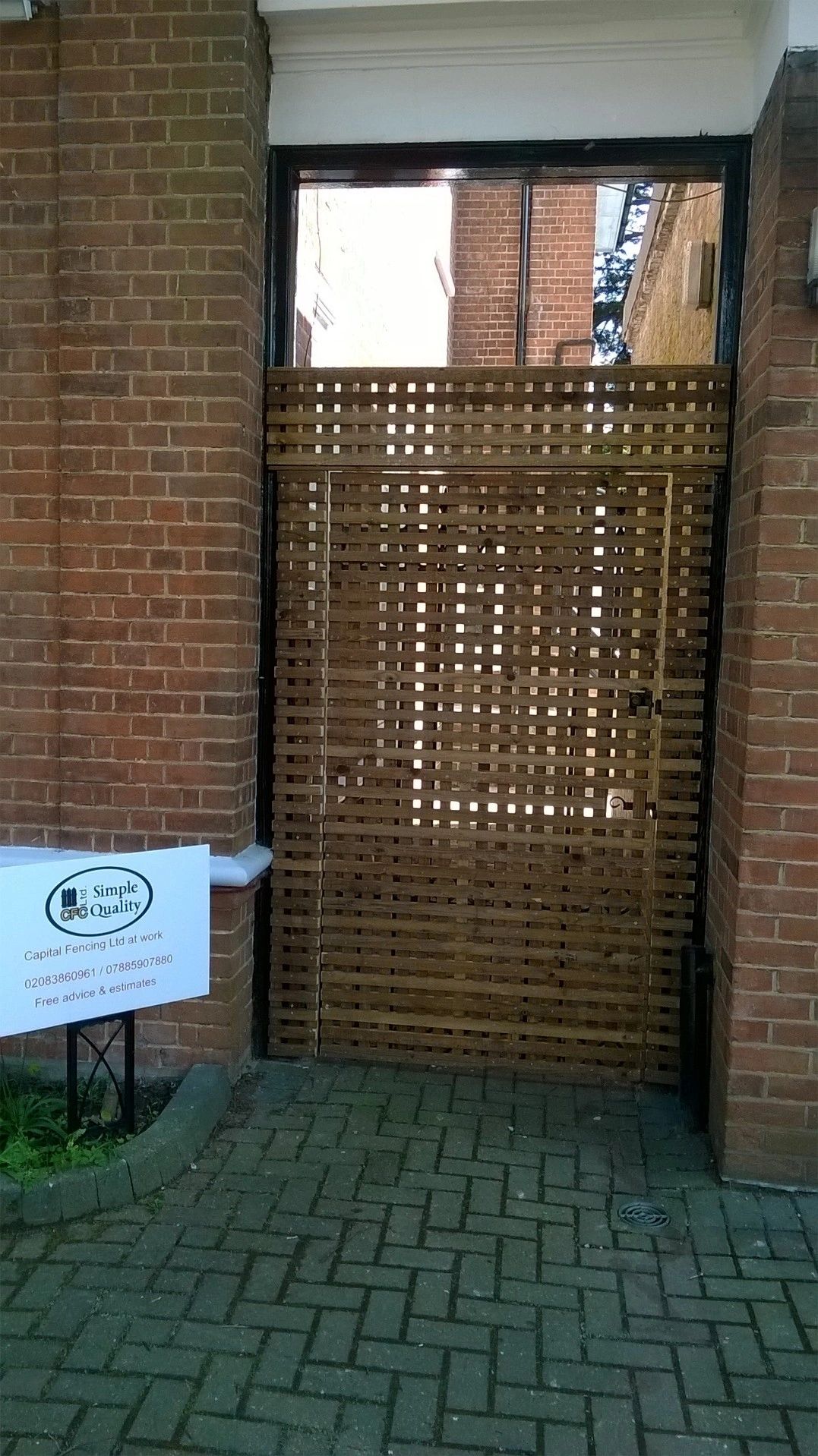
Gate hinges, latches and drop bolts are graded broadly by size and load rating rather than sold as one universal fitting, and undersized ironmongery on a heavy hardwood gate is a common cause of early sagging even when the frame itself is well built.
Externally, ironmongery needs a corrosion-resistant finish suited to constant weather exposure — galvanised, stainless or a specifically outdoor-rated coated finish — rather than internal-grade fittings that will rust and seize within a season or two.
A self-closing hinge or a matching pair of hinges rated for the gate's actual weight is worth specifying explicitly on a quote, since 'a pair of hinges' without a load rating leaves the actual spec to whatever's in stock.
Repairing a damaged section of welded mesh panel
A localised dent or cut in a weld mesh panel can sometimes be patched by welding in a replacement section rather than replacing the whole panel, provided the damage doesn't extend to the panel's frame or fixing points.
Where damage is at a corner or fixing point rather than mid-panel, a full panel swap is usually more reliable than a patch repair, since a repaired fixing point is a more likely future failure than a repaired mesh field.
Boundary questions following inheritance or probate
Properties passing through inheritance sometimes bring boundary questions to light for the first time, particularly where an elderly relative had an informal understanding with neighbours that was never documented.
Executors and new owners are generally well advised to check the title plan and deeds carefully during this process rather than simply continuing an inherited informal arrangement without confirming it.
Where a boundary genuinely wasn't clear to the previous owner, this is a reasonable moment to check with the neighbour and consider formalising a written agreement.
Repositioning a post slightly off its original line
Where an original post position has proven to be a recurring failure point — sitting in a wet hollow, or close to a tree root that keeps disturbing it — repositioning it a short distance along the run can solve a problem that repeated resets in the same spot haven't.
This needs agreement on the boundary line first if the shift is more than a token amount, since moving a post changes where the fence physically sits relative to the boundary rather than just repairing it in place.