Defensive planting alongside a security fence
Dense, thorny planting such as hawthorn or berberis along the inside or outside of a lower fence adds a deterrent layer without extra height, and is sometimes used where planning limits the fence itself.
Planting needs a maintained gap from the fence line so roots don't undermine posts and growth doesn't hide someone approaching the boundary — the deterrent only works if it's kept low enough to see over and dense enough not to push through.
Extending or matching an existing secure line
Where a security upgrade only covers part of a boundary, the new section is matched to the existing line's height and topping detail so the boundary reads as one continuous deterrent rather than a strong section next to an obviously weaker one.
On a shared commercial perimeter this often means checking a neighbouring occupier's existing spec before finalising the new section.
Aligning capping rail over a stepped run
Capping rail fitted along the top of a level fence run is a straightforward continuous fix, but on a stepped run each panel sits at its own level, so the capping has to be cut and joined at each step rather than run through in one length.
A clean joint at the step usually means mitring or scarfing the capping ends rather than butting them square, since a square joint leaves an open gap where the two levels meet.
Where the steps are shallow, some fitters run the capping level in short horizontal sections with a visible small drop at each post, which is faster to fit but reads as more obviously stepped than a mitred joint.
Corrosion at ground line on steel posts
The point where a post meets the ground or concrete collar is where corrosion concentrates, because moisture sits there longest and any coating is most easily scuffed during installation.
A sacrificial sleeve, extra coating thickness, or a slight fall on the concrete collar to shed water all reduce this, and it's worth checking on any steel post that's been in the ground more than a few years.
Sleeper thresholds beneath field and driveway gates
A timber or concrete sleeper set into the ground beneath a wide field or driveway gate gives the gate's bottom edge a firm, level reference to close against, preventing the bottom rail from dropping into soft or rutted ground over time.
This detail is particularly useful on unsurfaced openings where the ground either side of the gate sees regular vehicle or livestock traffic and would otherwise rut unevenly.
Balancing ground clearance against security
A larger gap under a gate makes it less likely to bind as the ground moves seasonally, but too large a gap gives an easy route underneath for a determined intruder, a dog, or floodwater debris, so the clearance has to be judged against what the gate is actually being asked to keep out or in.
This trade-off is worth discussing explicitly rather than defaulting to either a very tight or very generous gap regardless of the site's purpose.
Data protection basics for boundary CCTV
Domestic CCTV covering only a homeowner's own property is generally exempt from full UK GDPR obligations, but that exemption narrows considerably once cameras capture a neighbour's garden, shared paths, or public areas.
Where wider coverage is genuinely needed, clear signage and being able to explain why footage is captured helps if a neighbour raises a concern with the Information Commissioner's Office.
Positioning cameras to focus tightly on a homeowner's own boundary and property, rather than sweeping across a neighbour's space, is the simplest way to avoid this becoming an issue.
Capped versus uncapped composite boards
Capped composite boards have a thin outer polymer shell bonded over the wood-polymer core, giving better resistance to moisture ingress, staining and UV fade than an uncapped board with the core material exposed directly to weather.
Uncapped composite is generally cheaper and machines more like traditional timber, since the surface can be cut, drilled or profiled without exposing a different material underneath, but it's more prone to surface fading and moisture absorption over time.
A capped board's protective shell is only on the finished faces, so a cut end on site exposes the uncapped core underneath, which some manufacturers address with an end-cap trim while others leave it exposed.
Gravel terraces of the Lea and Colne valleys
The river terraces along the Lea and Colne valleys are largely sand and gravel over clay, ground that drains quickly and digs easily compared with the heavier clays further from the rivers.
Free-draining gravel is generally kinder to timber posts since water doesn't pool against the base, but loose gravel can also slump back into an open hole faster than clay, making a wider working hole necessary to get concrete properly around the post.
Where the gravel sits directly over a clay band, augers can hit a hard, sticky transition partway down that slows digging without warning.
Driveway gate sizing and swing arc
A driveway gate needs its swing arc checked against the car actually parked behind it, not just the opening width, since a gate that clears a small hatchback can still clash with a larger estate or a roof box.
Outward-opening gates onto a public footway are generally avoided because they can obstruct pedestrians and pushchairs, which is why most residential driveway gates are hung to open inward onto the drive itself.
Sliding gates are a practical alternative on a short or sloping driveway where there isn't room for a swing arc, though they need a level track run and enough side clearance to slide fully open.
Weather windows for concrete and timber work
Concrete shouldn't be mixed or poured in a hard frost, since freezing water in the mix before it cures weakens the finished base permanently rather than just delaying the cure.
Heavy or prolonged rain during digging can turn a clean-sided post hole into a collapsing, waterlogged trench within an hour on clay or silty ground, which is why digging is often timed around a forecast dry spell rather than started regardless.
Staining or oiling timber needs a dry surface and typically a minimum air temperature to cure properly, so that stage of a job is usually scheduled separately from the wetter groundwork rather than done back-to-back on the same visit.
Meeting stiles on double gates
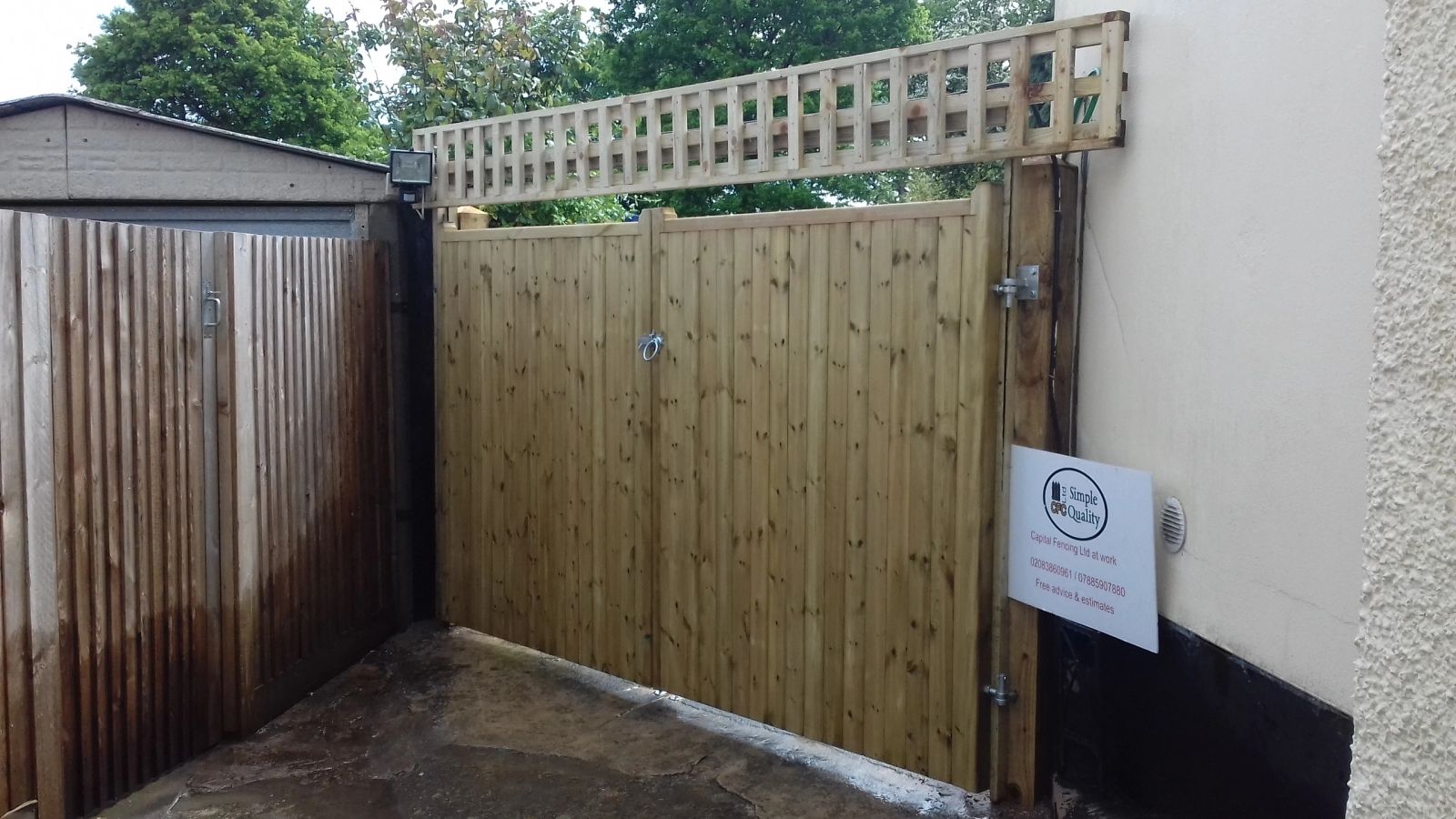
Where two leaves of a double gate meet in the middle, the meeting stiles need to stay flush and aligned with each other for the latch or bolt arrangement to work, and seasonal movement or a dropped hinge on either leaf throws this alignment off first.
We check both leaves together rather than adjusting one side in isolation, since a fix on one leaf alone can leave the meeting point mismatched.
Sapwood versus heartwood durability
Heartwood is the older, inner part of a tree trunk that's stopped conducting sap and often contains natural extractives that resist fungal decay, while sapwood is the outer, still-active layer with little inherent durability.
Species like oak and western red cedar owe much of their reputation for longevity to heartwood content, but any board can include a strip of pale sapwood at the edge that will rot faster than the rest of the same piece.
Because sawn fencing timber is rarely graded strictly by heartwood content, some sapwood is inevitable in most runs, which is exactly why preservative treatment matters even on naturally durable species.
Temporary Heras fencing during works
Heras-style temporary panels on concrete feet secure a site while permanent fencing is being installed, and are the standard interim measure on a commercial job where the boundary can't be left open overnight.
Panels need linking clamps and enough ballast or feet weight to resist wind, and a site with public footfall nearby usually needs anti-climb or block-tied panels rather than freestanding ones.
Selvedge detailing on chain-link mesh
The selvedge is the twisted or knuckled edge finish at the top and bottom of a chain-link roll, and a twisted (barbed) selvedge gives a rougher, harder-to-grip edge than a knuckled one, which is a small but relevant detail on a security-rated chain-link run.
A knuckled selvedge is safer where the fence is near public access because it removes the sharp twisted ends, so the choice between the two trades off deterrent value against injury risk in the same way as toppings do.
Touching up galvanising after on-site cutting
Cutting a galvanised post or rail to length on site removes the zinc coating from the cut edge, leaving bare steel exposed exactly where water is most likely to sit if the cut faces upward.
A cold galvanising paint or zinc-rich primer applied to the cut edge immediately after cutting restores meaningful protection, and skipping this step on a security run is a common reason a fence corrodes first at bay joints rather than along the main rail length.
Choosing ironmongery for a repaired gate
Galvanised heavy-duty hinges and latches cost little more than the light-duty fittings often supplied as standard, and they last considerably longer under repeated use, which makes an ironmongery upgrade one of the better-value additions at repair time.
Where a gate has electric automation, we handle the timber or metal gate itself and refer motor, control-board or sensor faults to a specialist automation engineer.
Keep wear from repeated latch impact
A keep takes the direct impact of the latch bar every time the gate closes, and over years of use the keep's opening can wear wider than the bar, letting the latch rattle loose even when the latch mechanism itself is fine.
Replacing a worn keep is usually far cheaper than replacing the latch it serves, so it's worth checking the keep first on an older gate with a loose-feeling latch.
LOLER-adjacent inspection duties on powered gates
Automated or powered gates fall under machinery safety regulations rather than lifting equipment rules directly, but the same discipline of scheduled inspection applies — force limiting, safety edges and photocell alignment on a powered gate need periodic checking, not a one-off commissioning test.
Where a fencing contractor supplies the mechanical gate leaf but not the automation, responsibility for these checks is usually split contractually, and it's worth confirming who's covering what before the gate goes live.
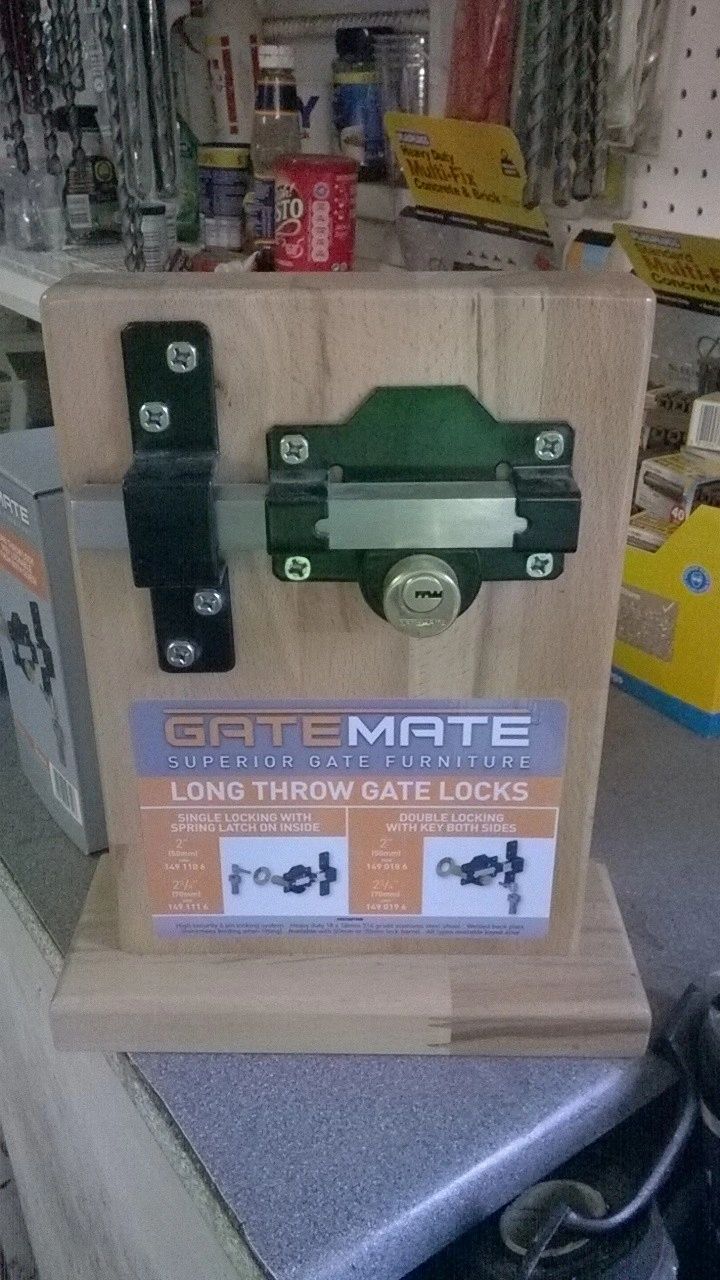
Deadlocks fitted to timber gate doors
A deadlock fitted to a solid timber gate door needs a keep let into a post or frame that's substantial enough to resist forcing, since a deadlock is only as strong as the timber and keep it engages with.
Outdoor use also means the lock case and keep need weather protection or a corrosion-resistant finish that an equivalent internal door lock wouldn't require.
Continuous strip footing compared with individual post holes
A continuous concrete strip footing running the full length of a fence line gives even support and a clean base for a plinth wall or kickboard, and is generally chosen where the boundary also needs a level base to close gaps under the fence.
Individual post holes are quicker and cheaper on a long straight run over consistent ground, but they leave open ground between posts that needs a separate gravel board or infill strip if a continuous barrier at ground level is also required.
Block management and communal consultation
Managing agents for blocks of flats are usually required to consult leaseholders on works above a set cost threshold under a Section 20 process, which applies to significant boundary or fencing works charged through the service charge.
That consultation period adds real time to a project timeline compared with a private garden job, so it's worth building the notice period into the schedule rather than assuming work can start once a quote is accepted.
Communal boundary decisions also tend to involve balancing several flats' differing views on privacy, light and appearance, which a single homeowner job never has to negotiate.