Bin store gates and repeated daily wear
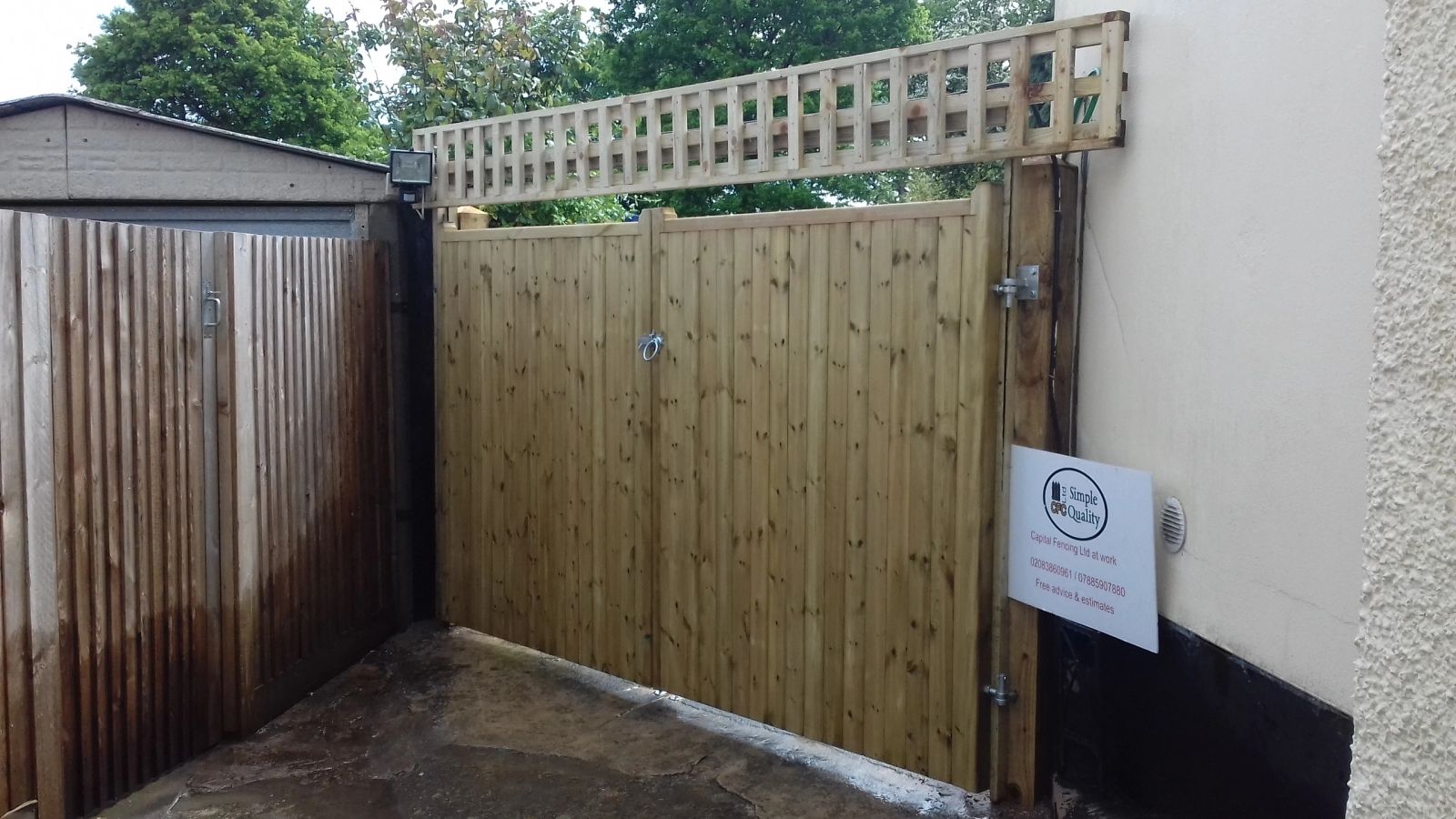
A gate fitted to a bin store gets opened and closed far more often than a garden gate used a few times a week, which accelerates hinge and latch wear well beyond what the timber or hardware size would normally suggest.
Specifying hardware rated for frequent use, rather than standard light-duty fittings, reduces how often these gates need attention once installed.
Access and material handling on site
Concrete, posts and panels are heavy, and a site with only a narrow side return or no vehicle access changes how a job is priced and sequenced — materials sometimes have to be carried through rather than dropped at the boundary.
On a commercial yard the opposite problem applies: keeping a working site operational around a delivery of steel palisade or mesh panels needs a delivery and storage plan agreed before the first post goes in.
Capping rails and finials
A capping rail along the top of a fence run does more than tidy the appearance — it sheds rainwater off the end grain of vertical boards, which is otherwise the fastest point for water to soak in and start rot.
Decorative finials on posts are largely an aesthetic choice, but a domed or sloped post cap still serves the same water-shedding purpose as a capping rail along a panel top.
Skipping a capping rail to save cost on a budget job is one of the more common reasons a fence's boards fail from the top down within a few years, even when the rest of the construction is sound.
Checking for secondary damage after a fence has fallen flat
Once a section of fence has actually fallen rather than just leaning, it's worth checking what it fell onto or against — a shed, a parked car, planting — since secondary damage from the fall is sometimes the more significant repair cost.
The fallen section itself also needs assessing for whether any timber is still reusable, since a fall can snap fixings without necessarily destroying the panel or boards, which affects how much of the repair is replacement versus refitting.
Diagnosing squeaks and creaks in gate hardware
A squeak or creak from a gate is almost always dry friction at a hinge pin, pivot or roller rather than a structural fault, and it's worth locating the exact source by working the gate slowly through its swing rather than assuming which hinge is responsible.
Cleaning out old, dirt-laden grease before applying fresh lubricant gives a longer-lasting fix than simply oiling over grit that's already worked into the bearing surface.
Japanese knotweed and invasive plants on a boundary
Japanese knotweed and other invasive non-native plants listed under the Wildlife and Countryside Act don't have to be removed by law, but it's an offence to allow them to spread into the wild or onto neighbouring land, and their green waste can't simply go into a normal garden waste bin.
Knotweed growing along or across a boundary is a common source of dispute and even litigation between neighbours, since an untreated infestation on one side can spread roots several metres and undermine fence posts or hard surfaces.
Any excavation near known knotweed needs specialist handling and disposal at a licensed site, since disturbing the rhizome without proper containment is one of the most effective ways to spread it further.
Boundary questions raised during a property sale
Conveyancing on a property sale routinely asks the seller to confirm boundary ownership and flag any known disputes, which can bring long-dormant boundary questions to the surface.
A fence built or replaced without proper regard to the true boundary line can complicate or delay a sale if it comes up during these enquiries.
Keeping any boundary agreements, planning permissions or correspondence about a garden fence on file makes answering these standard conveyancing questions considerably easier when the time comes.
Corrosion at ground line on steel posts
The point where a post meets the ground or concrete collar is where corrosion concentrates, because moisture sits there longest and any coating is most easily scuffed during installation.
A sacrificial sleeve, extra coating thickness, or a slight fall on the concrete collar to shed water all reduce this, and it's worth checking on any steel post that's been in the ground more than a few years.
Out-of-hours security considerations for a GP surgery boundary
A GP surgery boundary needs to accommodate a high daytime footfall of patients and visitors alongside stronger overnight security around bin stores, plant rooms and any area holding clinical waste, which often means combining an open, welcoming frontage with a more solid, higher-security rear compound.
Access for ambulance and emergency vehicles is checked against gate width and turning space before a security gate is specified, since a locked or narrow rear gate can delay emergency access if not planned around actual vehicle routes.
Chain link wire coating options
Chain link fencing wire is available galvanised, or galvanised with an additional PVC coating bonded over the zinc, which adds a further weatherproof barrier and is available in a range of colours rather than plain galvanised silver.
The PVC coating also cushions the wire slightly, reducing the risk of the sharp cut ends common on plain galvanised chain link snagging clothing or skin.
Where the PVC coating is damaged or cut through, for example at a repair splice, the exposed galvanised wire beneath is still protected by the zinc, though it will weather to a different appearance than the surrounding coated wire.
Setting gate posts before the rest of a fence run
Gate posts carry more load and need tighter tolerances on spacing and plumb than intermediate fence posts, so they're normally set and checked first, with the rest of the run measured out relative to the confirmed gate opening rather than the other way round.
Where a gate is ordered to a bespoke size, its exact opening width has to be locked in before that section of the run is built, since a fence panel either side can absorb small adjustments far more easily than a made-to-measure gate can.
A gate post is also usually set with extra depth or a wider concrete base than a standard fence post, given the additional leverage a swinging gate applies, so it needs its own dig rather than being treated the same as its neighbours.
Orientation of expanded metal mesh in a security panel
Expanded metal mesh is formed by slitting and stretching a sheet of steel, leaving diamond-shaped apertures with a slightly raised strand pattern that gives it a rougher, harder-to-grip surface than a flat welded mesh.
The direction the diamonds run relative to the ground affects both appearance and rigidity, and panels are usually oriented with the long diamond axis vertical for a taller security screen to maximise stiffness against horizontal loading.
Removing or working around hedges
A mature hedge along a boundary line often needs partial removal or heavy cutting back before a new fence can go in behind or in place of it, and stump and root removal is usually a bigger job than the hedge above ground suggests.
Where a hedge is being kept and a fence added behind it, root disturbance during digging needs the same care as any other established planting — cutting a major root to fit a post line can visibly stress or kill the hedge over the following season.
Some hedgerows, particularly older boundary hedgerows in a rural or semi-rural setting, are protected under separate hedgerow regulations, so it's worth checking before removing one entirely rather than just cutting it back.
Corner visibility splays affecting fence height specifically
Some corner plots have a specific visibility splay condition attached to their planning history that limits fence, hedge or wall height at the junction to well below the normal 1m road-facing limit.
This is separate from the general permitted development height rule and takes precedence where it applies, since it's usually tied to road safety at a specific junction.
Checking the property's planning history for this kind of condition before fencing a corner plot boundary avoids building something that later needs cutting back.
Threading a fence run past a rainwater downpipe
A downpipe discharging near the boundary means the fence has to either step around it with a short jog in the line, or leave a gap in the panel run rather than fixing directly over the pipe and its gulley.
Fixing a post immediately behind a downpipe risks trapping water splashing off it against the post base, so a small offset gives both the pipe and the post room without altering the overall run length much.
Where the downpipe discharges to a gulley set into a path or patio, the gravel board also needs enough clearance to avoid sitting in standing water every time it rains.
Historic boundary stones and markers
Older rural and some urban boundaries occasionally retain historic boundary stones, iron markers or other physical features predating modern title plans, sometimes referenced directly in old deeds.
These features can carry real evidential weight in establishing a long-accepted boundary line, particularly where later documents are vague or contradictory.
Where such a marker exists, it's worth photographing and noting its position before any fencing work potentially disturbs or removes it.
Boundary near a railway or utility corridor
A boundary next to a railway or utility corridor may be governed by the operator's own standards as well as normal planning rules, and access for their maintenance staff sometimes has to be preserved even where the land is privately owned.
Any work close to a railway boundary generally needs the operator notified in advance, and specific fence types or heights may be mandated rather than left to the landowner's choice.
Hedge disputes and the high hedge complaint route
A hedge over 2m tall made up mainly of evergreen or semi-evergreen species can be the subject of a formal 'high hedge' complaint to the local council under the Anti-social Behaviour Act 2003, but only after direct attempts to resolve it with the neighbour have failed and a fee is paid.
The council can then issue a remedial notice requiring the hedge to be reduced to a specified height, enforceable in the same way as a planning enforcement notice, though it typically won't require complete removal.
This process is separate from ordinary fence or boundary work and doesn't apply to deciduous hedges or single ornamental trees, which fall under general nuisance and tree law instead.
Small gaps for garden wildlife
A small gap, roughly 13cm square, cut into the base of a fence panel lets hedgehogs and other small wildlife move between connected gardens without needing to climb or dig, which matters where fencing has fragmented a previously open row of gardens.
This kind of gap doesn't meaningfully weaken a fence's structure or security when it's cut cleanly and positioned away from a post, and can be added to an existing fence as well as specified on a new one.
Where a client has an interest in garden wildlife, it's a low-cost addition worth mentioning at quote stage rather than something usually offered unprompted.
Straightening a leaning run
A run that's leaning uniformly along several bays usually points to a common cause — waterlogged ground, wind loading from one direction, or an original footing depth that was too shallow — rather than a fault with any single post.
Straightening involves resetting posts along the affected bays rather than pulling the fence back into line at the top, since forcing the panels straight without addressing the post bases just reintroduces the lean.
Ground-line collars on timber posts
A plastic or metal collar fitted around a timber post at the point where it enters the ground creates a physical break between the post and the surrounding soil, reducing direct abrasion and moisture wicking at that specific zone.
Ground level is where oxygen, moisture and soil organisms are all present together in the right combination for decay fungi to thrive, which is why this narrow band is disproportionately where post failure originates compared with either the fully buried or fully exposed sections.
A collar doesn't replace preservative treatment but adds a secondary physical barrier specifically targeted at this highest-risk zone, similar in principle to the extra retention already specified for ground-contact use-class timber.
How post hole diameter relates to load capacity
A wider post hole gives the concrete footing more surface area to resist overturning, which matters most on a taller or more exposed security run where wind and impact loading are higher than on a standard garden fence.
Increasing hole depth without also increasing diameter has a smaller effect on lateral resistance than is often assumed, since it's the concrete's bearing area against the surrounding soil that resists the post trying to rotate, not depth alone.