Drainage fixes as part of a repair
Where poor drainage caused or contributed to the original failure, a repair that doesn't also address the drainage — regrading a low spot, adding a small soakaway, or fitting a concrete gravel board — risks the same failure recurring.
Addressing drainage at repair time is usually more cost-effective than repeating the same panel or post repair every few years.
Repairing posts in waterlogged ground after heavy rain
A footing dug in waterlogged ground doesn't compact or bond as reliably as one dug in drier conditions, and standing water in the hole can dilute a concrete mix before it's had a chance to set properly.
Where a repair can't wait for drier ground, options include a free-draining aggregate base in the hole and a quick-set mix suited to damp conditions, but the underlying decision is often whether the repair should be delayed a few days rather than pushed through in poor conditions.
Splicing a new post section onto a sound base
Splicing joins a new length of post timber onto the sound lower section of an existing post using a scarfed or halved joint reinforced with bolts or a metal splice plate, used where the base and footing are solid but the post has failed higher up.
It suits posts damaged by impact or by a snapped rail rather than posts failed by rot, since a spliced joint relies on both pieces being genuinely sound timber to hold load reliably.
Sizing a driveway gate
A single driveway gate needs enough swing clearance to open fully without catching a kerb, a parked car, or a slope in the drive itself, which is worth checking with a tape measure rather than assuming a standard width will fit.
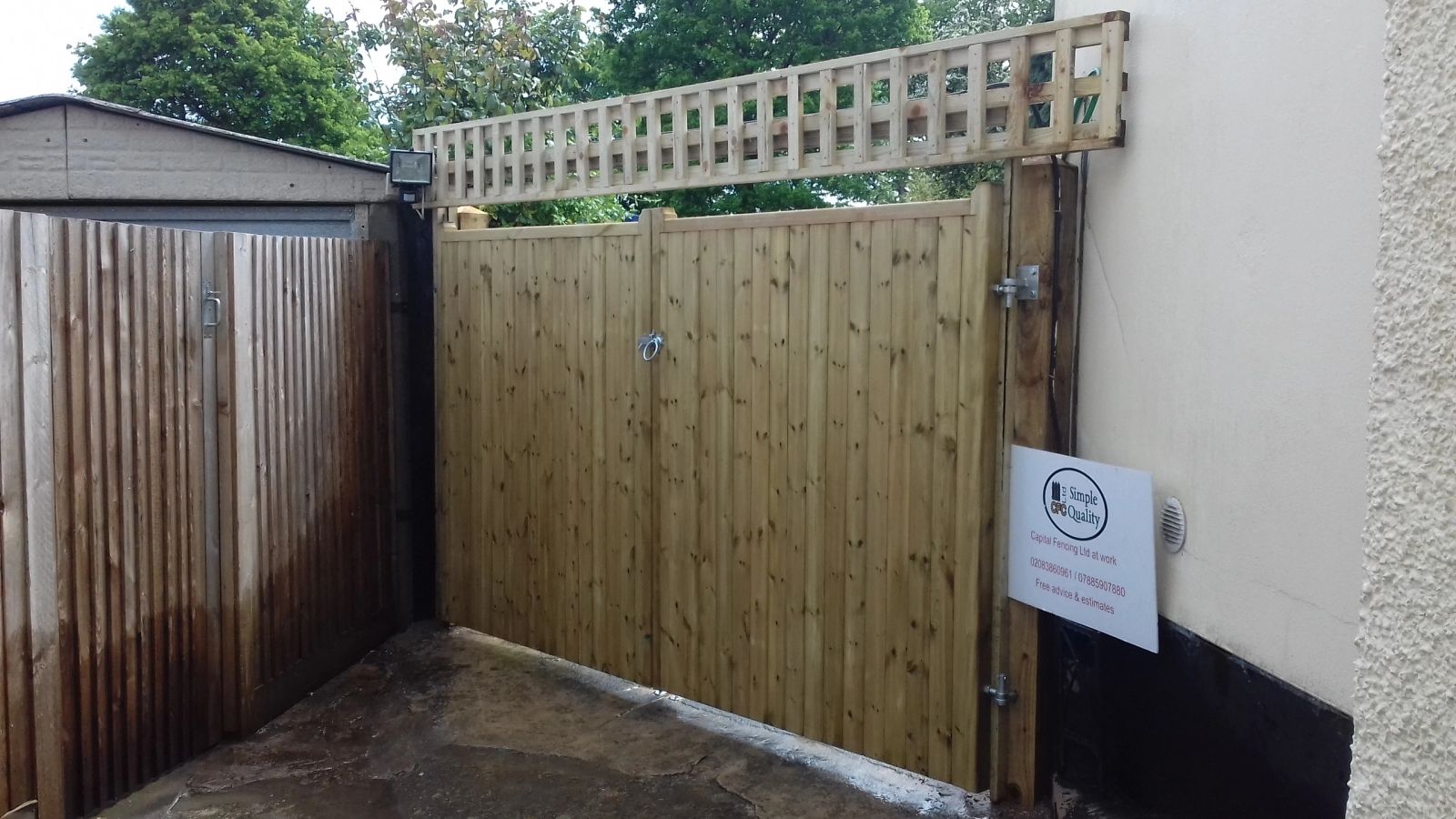
Double gates spread the load and swing arc across two leaves, which suits wider openings and reduces the strain on any one hinge post, but need a solid centre stop or drop bolt so the leaves meet cleanly and don't rack under wind load.
Automation, if it's wanted, changes the gate's structural requirements too — motorised gates need a rigid, properly braced frame and adequate foundations for the motor mounts, which is worth specifying before the gate is built rather than retrofitting later.
Capping and end-grain protection
End grain absorbs moisture far faster than the face of a timber board, so an uncapped top rail or exposed post top takes in water long before the rest of the gate shows any sign of decay.
Fitting a capping strip or weathered top cut sheds water away from that end grain and noticeably extends the life of an otherwise sound gate.
Detached plots with a paddock or field edge
Detached properties backing onto a paddock, field or grazing land need a boundary that does two jobs at once — keeping the garden private and, if livestock use the adjoining land, keeping animals off the garden side.
A standard close-boarded fence isn't stock-proof on its own; where horses or cattle are present on the other side, a stock fence or post-and-rail set slightly inside the garden fence is the usual belt-and-braces approach.
Field boundaries also see more vegetation growth and root pressure from hedgerows than a typical suburban fence line, so posts often need resetting or straightening more often than an equivalent garden boundary.
Coordinating fencing work with other trades on a shared site
On a job where fencing follows landscaping, paving or groundworks by another trade, confirming final levels and boundary positions with that other trade before digging starts avoids fence posts being set to a level that then changes once the remaining groundwork is finished.
Where fencing is scheduled before paving, agreeing which side of the post line the paving will finish against prevents a post ending up embedded in what should have been a clear paving joint.
Simple sequencing conversations at the outset, rather than each trade working to its own assumptions, avoid the more expensive alternative of one trade's finished work being disturbed by the next.
Fencing near listed buildings
Listed building consent applies to works that affect the character of a listed building, and that can extend to boundary treatments within its curtilage even where the fence itself isn't old or notable.
In practice this usually means sticking to traditional materials and profiles — timber rather than metal panel systems, painted rather than stained finishes matching existing joinery — and checking with the conservation officer before ordering rather than after installation.
Unauthorised alterations near a listed building can require reversal at the owner's cost, so a five-minute enquiry call is cheap insurance against a much more expensive mistake.
Right to light and boundary structures
A right to light is a legal easement that can be acquired after twenty years of uninterrupted light through a defined window, and it protects a level of illumination to that window rather than an open view or unobstructed garden outlook.
An ordinary garden fence or low wall almost never generates a right to light issue, but a tall close-boarded fence, high wall or dense screening structure built close to a window that has enjoyed light for decades in principle could, particularly in dense urban plots.
In practice this rarely affects standard fencing height, but it's a different legal question from planning permission and worth being aware of on unusually tall or solid boundary structures near windows.
Strainer posts and wire tensioning loads
A strainer, or straining post, anchors the end of a tensioned wire or mesh run and needs to resist a sustained pulling load along the line of the fence, which is a materially different stress to the mostly lateral wind load an intermediate post experiences.
Strainer posts are typically set deeper, in a larger concrete footing, or braced with a diagonal strut back to a second post, specifically to resist this sustained pull rather than an occasional gust.
Under-specifying a strainer post relative to the wire tension applied is a common cause of an entire fence run gradually leaning inward from one end, since the strainer post itself moves rather than the wire actually loosening.
Checking battery backup on an automated security gate
An automated gate reliant on mains power for its motor and control panel usually has a battery backup to allow a limited number of open-close cycles during a power cut, and this backup is worth testing periodically rather than trusting it will work when actually needed.
A gate left stuck open or shut during a power outage because an untested backup battery had already failed defeats the purpose of automation entirely, so a manual release mechanism is also checked as part of the same inspection.
Gaps at party walls and stepped brickwork
Where a fence meets a party wall or a stepped brick boundary, an ill-fitting junction leaves a gap that undoes the security of the whole run, so infill panels or a scribed timber closer are cut to follow the step rather than left square.
On an older terrace the brickwork step is rarely uniform along its length, so each junction is measured on site instead of assuming a standard offset.
Getting pre-application planning advice for boundary work
Most local planning authorities offer a paid pre-application advice service, which can give a reasonably reliable steer on whether a specific boundary proposal needs formal permission before committing to it.
This is particularly useful for larger, taller, or unusually positioned boundary structures where the answer isn't obviously covered by the standard permitted development rules.
While it isn't free, the cost is generally modest compared with building something that later needs to be altered or removed following enforcement action.
Why corner posts fail more often and need stronger repair specification
A corner post carries the combined load of two fence runs meeting at an angle rather than a single run passing through, so it's under more sustained stress than an intermediate post and often fails first on an ageing boundary.
Repairing a corner post is worth specifying to a slightly higher standard than a mid-run post — larger section, deeper footing, sometimes additional bracing — given the extra load it carries permanently rather than only occasionally.
Skip permits on a public highway
A skip placed on a public road or pavement, rather than entirely on private land such as a driveway, generally needs a permit from the local council's highways department beforehand.
Permits usually specify how the skip must be lit and marked, particularly overnight, and there are often restrictions near junctions or on narrower streets.
Placing a skip on the highway without the required permit can result in a fine, so it's worth checking with the skip hire company or council directly rather than assuming it's not needed.
Digging in summer-baked clay ground
Clay that's dried and cracked over a hot summer can be almost as hard as digging through soft rock in the top few hundred millimetres, even though the same ground would be workable a season later once it's rehydrated.
An auger struggles on baked clay in the same way it struggles on rubble, tending to bounce and judder rather than cut cleanly, so a pilot hole broken up with a bar first can make the auger's job easier.
Watering the dig point lightly the day before, where practical, softens the very top layer enough to ease the first stage of digging without turning the hole into a mud pit.
Sound versus security trade-offs in fence design
A solid acoustic-style fence blocks noise well but also blocks the sightline that lets you see who's approaching the boundary, whereas an open mesh or railing gives good visibility but no noise reduction at all.
Where both matter, a part-solid, part-open design — solid to head height with an open topping, for instance — is a workable compromise rather than defaulting fully to one or the other.
Diagnosing sag, frame rack or post lean
A gate that no longer closes properly can be dropping at the hinge corner, racking as a whole rectangle out of square, or simply following a hinge post that's leaning in the ground — each has a different fix and they're easy to mix up from the ground.
We check the post for plumb first, then check the frame diagonals against each other, and only then look at the hinges themselves, since treating a leaning post as a hinge fault wastes a repair visit.
Strimmer damage at the fence-to-lawn edge
Repeated strimming right up against the base of gravel boards or post bases scars the timber surface and removes any protective coating exactly at the point most exposed to ground moisture.
A mowing strip of paving or gravel along the base of the fence line removes the need to strim that close, protecting both the timber finish and the lawn edge itself.
This is a small design addition worth suggesting on new installs, since the damage it prevents is otherwise mistaken for premature timber failure rather than a maintenance habit.
Cleat fixing at pale-to-rail junctions
Pales are commonly bolted to rails through a cleat rather than welded, because a bolted cleat can be replaced individually if a pale is damaged, whereas a welded joint means cutting into the rail to make a repair.
Cleats are punched to match the pale profile so the fixing sits flush rather than proud, and a mismatched cleat left loose is one of the more common defects found on an older palisade run at survey stage.
Using a post hole auger effectively
A petrol or manual auger clears loose, stone-free ground far faster than hand-digging, but it works by shearing soil rather than levering it, so it struggles the moment it meets a root, a buried stone or compacted rubble.
Lifting the auger clear and clearing spoil from the flutes every 150-200mm of depth keeps it cutting efficiently; forcing it deeper without clearing spoil just packs the hole and stalls the motor.
On heavy clay an auger can also polish and seal the hole's sides, which reduces drainage around the base — a quick scoring of the sides with a spade before concreting helps break that glazed surface.
Reading a T-mark on a title plan
A 'T' mark on the inside of a boundary line on a Land Registry title plan is a conventional (though not conclusive) indication of who owns and is responsible for that particular boundary feature.
Where two T marks meet to form an 'H', that usually points to a shared responsibility, such as a party fence wall between two gardens.
The mark is only ever a starting point for a conversation, not a legal guarantee, so we'd always suggest checking the actual title register wording or asking a solicitor if ownership genuinely matters for a job.