Child-safe latch heights
Positioning a latch or lock out of easy reach of a young child is common general practice on a garden gate, particularly one near water, a driveway or a road, though the appropriate height depends on the specific site and use.
This is a design choice worth discussing at repair or replacement stage rather than simply refitting a latch at its original height by default.
Ground anchors on hardstanding
Where a post can't be dug into soil — a concrete yard, a roof terrace, or a surface that can't be broken — a mechanical or resin ground anchor bolted through a base plate provides the fixing instead.
Anchor capacity has to match the loading of the fence height and any expected impact, and manufacturer pull-out figures are checked against the specific slab thickness before anchors are relied on for a taller run.
Safety considerations on a storm-damage repair
A fallen panel or leaning post next to a road, a shared path or a play area is treated as a priority repair on safety grounds, and the damaged section is made safe on the first visit even if the full repair follows later.
Where a repair is next to a boundary with public access, work is fenced off or scheduled to avoid the busiest times of day.
Key-alike cylinders across multiple gates
A key-alike cylinder set lets several gates on one property, such as a side gate and a bin store gate, be opened with a single key rather than a separate key for each, which is a common request on properties with multiple access points.
Specifying key-alike hardware needs to happen at the point of ordering the cylinders, since matching an existing single cylinder to a new one after installation isn't generally possible without replacing both.
Trellis toppers failing under wind load separately from the fence
A trellis topper adds height and surface area above a solid panel, which increases the wind load the whole assembly has to resist even though the panel below might be perfectly sound, and toppers are a common point of failure in gusty conditions.
Where a topper has failed repeatedly on an exposed boundary, a lower-solidity design or additional bracing to the topper's own fixings is worth considering rather than replacing the same topper style each time it fails.
Breaking out old concrete footings
An old post base often left in the ground after a previous fence comes out will usually be a lump of concrete far bigger than the post it once held, and it rarely sits exactly where a new post needs to go.
Breaking it out with a hand tool or breaker takes real time compared with digging clean ground, and on a long run of old fencing there can be one buried lump per post rather than just an occasional obstruction.
Where a footing can't be fully removed without excessive disruption, offsetting the new post's position by a short distance is usually more practical than fighting the old base to keep exact spacing.
Prevailing wind direction and driven rain exposure
In much of southern England the prevailing wind and driven rain come predominantly from the south-west, so a south-west-facing fence face typically weathers, silvers and needs re-coating faster than the opposite face of the same run.
This uneven exposure is worth explaining to clients who are puzzled that one side of a boundary looks noticeably more weathered than the other despite being installed on the same day from the same materials.
Where a client wants a more even appearance over time, orienting board overlap so the leading edge faces the prevailing weather sheds rain more effectively than the reverse arrangement.
Stabilising a pergola post that has started to rock
A pergola post rocks where its footing has cracked or where the post itself has begun rotting at the base, and because pergola posts often carry a roof structure rather than just a fence line, a rocking post carries more consequence if ignored.
Repair generally means breaking out and repouring the footing with the post braced upright and level while the concrete cures, and checking the beam fixings at the top of the post at the same time, since a post reset out of plumb strains the joinery above it.
Key-alike locking across multiple gates
Where a property has several gates, key-alike cylinders let one key operate all of them instead of carrying a separate key for each, which is a straightforward upgrade at the point locks are being replaced anyway.
This needs cylinders sourced as a matched set from the outset rather than retrofitted individually afterwards.
Corner plots with two effective road frontages
A corner plot bounded by two separate roads can be treated as having two frontages for permitted development purposes, meaning the lower 1m height limit potentially applies on both sides rather than just one.
This is a common point of confusion, since the 'front' of the house and the road-facing boundary aren't always the same thing on an L-shaped or wraparound plot.
Checking with the local planning authority which boundaries count as fronting a highway is worthwhile before fencing any corner plot to the maximum height.
Diagnosing rot at the ground line versus mid-post
Ground-line rot sits just below and just above soil level, where moisture cycles wet and dry fastest and fungal decay does most of its damage; a probe test at that band catches most failures before they're visible above ground.
Rot higher up the post, mid-height under a rail bracket or where a panel clip traps water, is a different failure mode caused by standing moisture rather than soil contact, and needs the fixing checked as well as the timber.
Spirit level versus laser level for checking a run
A spirit level checks a single post is plumb and a single panel is level, but confirming that an entire run stays level or follows a consistent fall over 20 or 30 metres is far quicker and more reliable with a rotating laser level set at a fixed height.
On a stepped run, a laser also makes it straightforward to confirm each step drops by the same consistent amount rather than checking each post in isolation and hoping the cumulative effect looks even.
A basic spirit level remains the more practical tool for quick checks during a single post's installation, since setting up a laser for every individual post would slow the job without adding useful accuracy at that scale.
Wheelbarrow routes and lawn protection
Moving concrete, gravel boards and spoil across a lawn on a wet day can leave rutting that lasts the rest of the season, particularly on clay soils that compact easily underfoot.
Boards or trackway laid along the barrow route spread the load and are a cheap precaution compared with reinstating a churned-up lawn afterwards.
Planning the route to cross the lawn at its narrowest point, or using a hard surface where one exists, reduces the area affected without slowing the job down.
Block management and communal consultation
Managing agents for blocks of flats are usually required to consult leaseholders on works above a set cost threshold under a Section 20 process, which applies to significant boundary or fencing works charged through the service charge.
That consultation period adds real time to a project timeline compared with a private garden job, so it's worth building the notice period into the schedule rather than assuming work can start once a quote is accepted.
Communal boundary decisions also tend to involve balancing several flats' differing views on privacy, light and appearance, which a single homeowner job never has to negotiate.
Timber decking board profiles
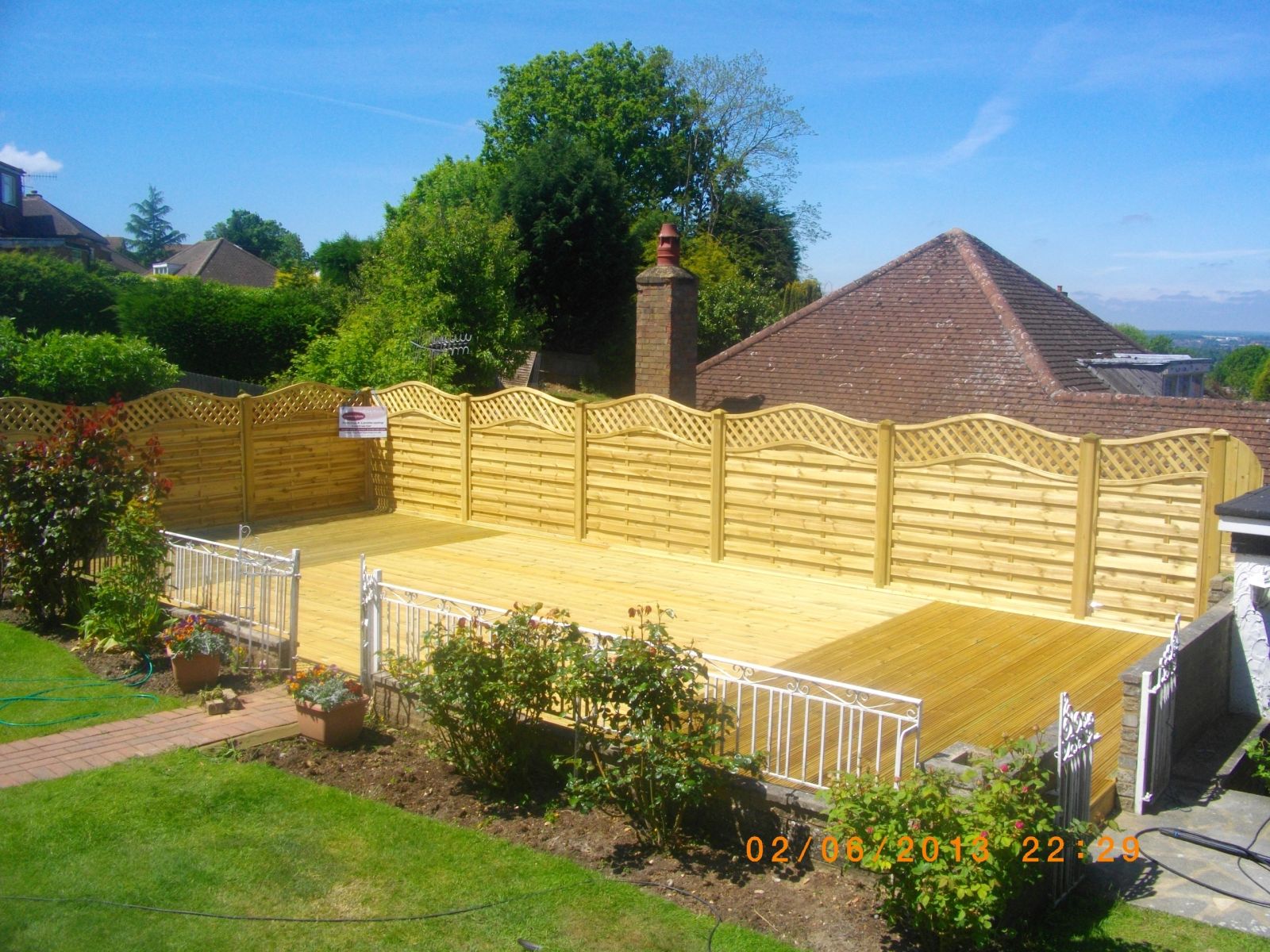
Grooved decking boards have a reeded or ribbed surface intended to improve underfoot grip, particularly when wet, compared with a smooth-planed board of the same species and treatment.
The grooves can also trap moisture, algae and debris more readily than a smooth board, meaning a grooved deck often needs more regular cleaning to keep the grip benefit from being offset by a slippery algal film.
Reversible boards with a smooth face on one side and grooved on the other let the fitted orientation be chosen, or later reversed once the first face weathers, extending the usable life of the same boards.
Repair-versus-replace where the original fence style is discontinued
Where a damaged section uses a panel style, board profile or post section that's no longer manufactured, a close match might be achievable for a small repair, but a larger area of damage can tip the balance toward replacing the whole run in a current style rather than chasing an increasingly poor match.
This is a judgement client conversation as much as a technical one, since some clients prioritise keeping the existing look even with a visible join, while others would rather have a uniform new run.
Long-run line setting with laser and string
A straight security run over a long distance is set out with a string line or laser level between end posts before any intermediate post is positioned, since a small error compounded over many bays leaves a visibly crooked line.
On an undulating site, a laser also confirms consistent post height above ground even where the ground itself rises and falls, keeping the top line level rather than following every dip.
Conservation covenants affecting boundary land
A relatively newer legal tool, the conservation covenant, allows landowners to agree binding restrictions on land use for conservation purposes, which can in principle extend to boundary treatments on affected plots.
These are still uncommon on ordinary residential properties but more likely on larger plots, smallholdings, or land near protected habitats.
Checking the title register for any registered covenant of this kind is worth doing on larger or more unusual plots before assuming standard rules apply.
Ironmongery checks during a fence repair
A repair visit is a natural point to check any gate ironmongery on the same boundary, since hinges and latches wear on a similar timescale to the timber around them and a worn hinge left unaddressed puts extra strain on a newly repaired gate post.
We flag any ironmongery that's due for replacement rather than only fixing the panel or post that prompted the call-out.
Algae growth on north-facing panels
A boundary that faces north, or sits in the permanent shade of a tall building or dense hedge, stays damp for far longer after rain than a south-facing run, which is exactly the condition green algae needs to establish.
Algae on timber is mostly cosmetic in the early stages but makes the surface noticeably slippery, which matters where a fence line doubles as an informal foothold near steps or a sloped path.
A dilute biocidal wash applied before restaining is more effective long-term than staining directly over algae, which simply seals damp organic growth beneath the new coating.
Temporary bracing while concrete cures
A freshly-concreted post has no strength to resist knocks or wind until the concrete has gone off, so it needs temporary raking struts or timber braces fixed to hold it plumb and in line while curing.
Braces are best left in place for at least the manufacturer's stated initial cure time, and longer in cold weather, rather than removed as soon as the concrete looks solid on the surface.
A post nudged out of true during this window is much harder to correct afterwards than one checked and adjusted while the mix is still workable, so the check-and-brace step is worth the extra few minutes per post.
Checking older painted timber for lead content before sanding during repair
Fences and gates painted before the phase-out of lead-based paints can still carry old lead paint layers beneath more recent coats, and sanding that back during a repair without checking risks creating lead-contaminated dust.
Where a fence's paint history is unknown and it's old enough to plausibly include lead paint, it's safer to test before mechanically sanding, and to use wet sanding or careful hand scraping with contained waste disposal if lead is present.